What Oil for a VW Transporter? Full Guide by Model, Engine & Generation
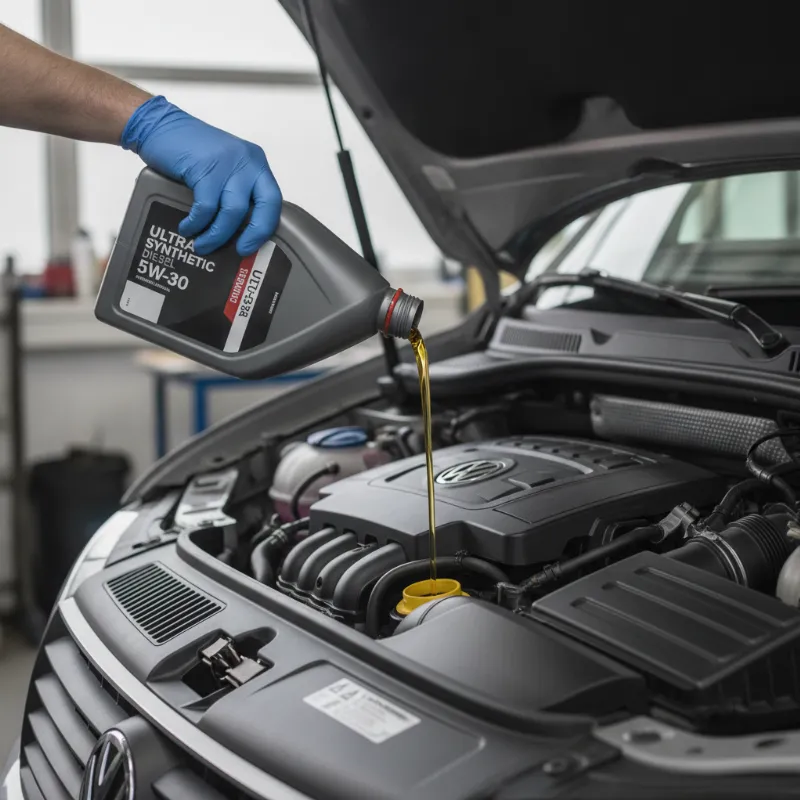
What Oil Does a VW Transporter Take? Quick Answer
Most modern VW Transporters use a low-SAPS (Sulphated Ash, Phosphorus and Sulphur) fully synthetic engine oil that meets Volkswagen's own approval standards — typically a 5W-30 grade for common rail diesel engines. The exact viscosity and VW specification (such as VW 507.00 for diesels with a particulate filter, or VW 508.00 / 509.00 for the newest long-life engines) depends on the generation, engine variant and whether the van is fitted with a DPF.
As a rule of thumb: T5 and T6 diesels generally take a 5W-30 oil to VW 507.00, older T5 2.5 TDI engines can use 5W-30 or 5W-40 to VW 505.01, and the latest T6.1 and T7 engines have moved to lower-viscosity long-life oils. Always cross-check with your owner's handbook or the sticker under the bonnet before topping up.
Recommended Oil Specifications by VW Transporter Generation
The Transporter has been through several major generations in the UK, and each has its own oil requirements based on the engine family fitted. Getting the specification right matters more than the brand — VW-approved oils are formulated to protect specific engine components such as injectors, turbochargers and diesel particulate filters.
VW Transporter T5 (2003–2015) Oil Specs
The T5 came with a wide range of diesel engines, from the early 1.9 TDI and 2.5 TDI PD (Pumpe Düse) units through to the later 2.0 TDI common rail engines introduced from 2009. Early PD engines require an oil meeting VW 505.01, most commonly a 5W-40 fully synthetic. The later 2.0 TDI CR engines with a DPF need a low-SAPS oil to VW 507.00, typically 5W-30.
If your T5 is a facelift model (T5.1, 2010 onwards) with the 2.0 TDI, stick to 5W-30 VW 507.00. Using the wrong oil on a DPF-equipped engine can clog the filter and lead to expensive regeneration or replacement.
What Oil for VW Transporter T5 2.5 TDI
The 2.5 TDI five-cylinder engine fitted to many T5s between 2003 and 2009 is a PD (Pumpe Düse) unit and needs an oil meeting VW 505.01 as a minimum. A 5W-40 fully synthetic to VW 505.01 is the safest, most widely available choice. Some 2.5 TDI variants with a DPF also accept VW 507.00 — check your service book, as the specification changed partway through production.
The 2.5 TDI is known for being oil-hungry when worked hard, so keep a spare litre in the van and check the dipstick regularly, especially before long motorway runs or when towing.
VW Transporter T6 Oil Specs
The T6 (2015–2019) and the facelifted T6.1 (2019–2024) are almost exclusively powered by 2.0 TDI common rail engines in 84, 102, 150 and 199 PS outputs, plus a 2.0 TSI petrol on some Kombi and Caravelle models. All the diesel engines run a DPF, so they need a low-SAPS 5W-30 oil to VW 507.00. The 2.0 TSI petrol takes a 5W-30 oil to VW 504.00.
Genuine VW-branded oil, Castrol Edge Professional LongLife III, Shell Helix Ultra Professional AV-L and Mobil 1 ESP are all commonly used and meet the required specifications.
VW T6 Camper and VW T6 Kombi Oil Considerations
A T6 Camper or T6 Kombi runs the same engine as the panel van, so the oil specification is identical — 5W-30 to VW 507.00 for diesels. However, campers and Kombis often carry more weight (fitted furniture, water tanks, batteries, passengers) and spend more time idling on hook-up sites or crawling in traffic on holiday routes. That extra load and low-speed running can accelerate oil degradation.
If you use your T6 Kombi as a daily driver plus weekend camper, consider a fixed 12-month or 10,000-mile service interval rather than VW's variable LongLife regime, as short trips and heavy loads shorten oil life significantly.
VW T7 / VW Transporter T7 Oil Specs (New VW Transporter T7)
The new VW Transporter T7, launched in 2024 and built in partnership with Ford, shares its underpinnings with the Ford Transit Custom. The 2.0 TDI diesel engines fitted to the T7 use a low-viscosity 0W-20 oil meeting Ford's WSS-M2C950-A specification, which differs from previous Transporters. There is also a plug-in hybrid variant and a fully electric T7 in the range.
Because the T7 is a mechanical departure from the T6.1, do not assume old T5/T6 oil grades will apply. Always follow the handbook, and be aware that servicing a T7 may fall under a slightly different parts and lubricant supply chain than earlier Transporters.
Engine Oil for 4x4 VW Transporter (4MOTION) Models
4MOTION Transporters use exactly the same engine oil as their two-wheel-drive equivalents — the drivetrain doesn't change the engine's lubrication requirement. What does change is that a 4MOTION van also has a Haldex coupling and, on some models, a rear differential that need their own fluid changes.
The Haldex fluid should be changed roughly every 40,000 miles, and the rear diff oil (typically a 75W-90 GL-5 gear oil) at intervals set out in the service schedule. Skipping these on a 4MOTION van is a common cause of Haldex pump failure and shuddering under load.
Electric VW Transporter: Fluids You Still Need to Check
The eTransporter (based on the T6.1) and the fully electric T7 don't take engine oil, but they aren't fluid-free. You'll still need to check and periodically replace brake fluid, coolant for the battery thermal management system, reduction gearbox oil, screenwash and, where fitted, air-conditioning refrigerant.
The reduction gearbox on an electric Transporter is usually filled for life, but it's worth having the fluid level checked at every service. Battery coolant, in particular, is safety-critical and must be the correct VW-specified type — never mix coolant grades.
Oil Requirements for Converted and Specialist Transporters
Converted Transporters — campers, welfare vans, tippers, dropsides and Kombi conversions — share the mechanical package of the base van, so the engine oil specification doesn't change. What can change is how the van is used, and that has a big impact on how quickly the oil needs replacing.
How to Convert a VW Transporter into a Camper — Servicing Impact
Turning a panel van into a camper generally involves adding insulation, ply lining, furniture, a leisure battery system, a pop-top roof and often a swivel seat base. None of that touches the engine, but the finished vehicle is heavier and often driven in a very different pattern from a working van — long touring trips, mountain passes, then weeks parked up.
After conversion, it's sensible to move to a fixed-interval service schedule and use a fully synthetic oil to the correct VW spec (507.00 for most modern TDI engines). Fresh oil before a long summer trip is cheap insurance.
How to Convert VW T5 Van to Camper — Oil and Service Notes
The T5 is the classic camper conversion base in the UK. If you're converting an older T5, take the opportunity to bring the service history up to date before you start fitting furniture, because access to the oil filter and dipstick can become tighter once battery boxes and under-seat storage are installed.
For a T5 2.0 TDI CR, use 5W-30 VW 507.00. For a T5 2.5 TDI PD, use 5W-40 VW 505.01. Change the oil and filter every 10,000 miles or annually — whichever comes first — once the van is doing camper duty.
VW Transporter Kombi, VW Transporter Kombi Lease and VW Transporter Kombi Sportline
Whether you own outright, run a VW Transporter Kombi on a lease, or have the range-topping Kombi Sportline, the engine oil specification follows the mechanical variant, not the trim. All UK Kombi diesels since the T6 use 5W-30 VW 507.00.
Lease vehicles will normally be tied to VW's official service schedule as a condition of the contract, so always use VW-approved oils and get servicing carried out at a franchised dealer or a garage that stamps the digital service history correctly — this protects both warranty and end-of-contract condition reports.
VW Transporter Sportline, VW Transporter Sportline For Sale and VW Transporter Sportline Kombi For Sale
The Sportline is based on the highest-output 2.0 TDI (typically the 199 PS biturbo unit) with DSG and 4MOTION on many examples. Oil specification is 5W-30 VW 507.00, but because the Sportline is a performance-oriented variant often driven harder and used for towing, we'd strongly recommend sticking to the shorter fixed service interval rather than LongLife.
If you're browsing a Sportline or Sportline Kombi for sale, ask to see a full service history with genuine VW-approved oil used throughout — the biturbo engine is sensitive to poor oil quality, and neglected examples can suffer turbo and injector problems.
VW Transporter Dropside Servicing Notes
Dropside Transporters are working vehicles, usually carrying weight close to their gross limit and often idling on site. Use the same 5W-30 VW 507.00 oil as the panel van equivalent, but treat the service intervals as maximums, not targets. Annual oil and filter changes are strongly recommended regardless of mileage, and check the dipstick weekly if the van is doing daily site work.
How Much Oil Does a VW Transporter Need? Capacity by Engine
Oil capacity varies by engine, but as a general guide for a full service (with filter change):
- 1.9 TDI (T5): approximately 4.3 litres
- 2.0 TDI CR (T5.1, T6, T6.1): approximately 5.7 litres
- 2.5 TDI PD (T5): approximately 6.5 litres
- 2.0 TSI petrol (T6/T6.1 Kombi & Caravelle): approximately 5.7 litres
- 2.0 TDI biturbo 199 PS (T6.1 Sportline): approximately 5.7 litres
Always fill in stages — add most of the capacity, run the engine briefly, let it settle for a few minutes, then top up to the upper mark on the dipstick. Overfilling a modern diesel can damage the DPF and turbo.
How to Check and Top Up Oil on a VW Transporter
Park on level ground with the engine warm but switched off, and wait two to three minutes for the oil to drain back to the sump. Pull the dipstick, wipe it clean, reinsert it fully, then withdraw and read the level. It should sit between the minimum and maximum marks — the gap between them is typically about one litre.
Top up through the filler cap on the cam cover, adding no more than half a litre at a time and rechecking. Use the correct VW-specification oil — mixing grades is not ideal but is far better than running low. On newer T6.1 and T7 models, the oil level is also displayed digitally through the instrument cluster menu, which can be more accurate than the dipstick on level ground.
Service Intervals and Common Oil-Related Issues
VW offers two service regimes: Fixed (every 12 months or 10,000 miles) and LongLife (variable, up to 24 months or 20,000 miles based on driving conditions). For working vans, campers, tow vehicles and anything doing lots of short journeys, Fixed is the right choice. LongLife is better suited to steady, high-mileage motorway use.
Common oil-related issues on Transporters include DPF blockage from using non-low-SAPS oil, timing chain wear on early 2.0 TDI engines from extended service intervals, and oil dilution from short-run diesel use where fuel from failed DPF regenerations contaminates the sump. If your dipstick reads above the maximum mark or smells strongly of diesel, get the oil changed straight away.
Buying a VW Transporter? Browse Our Stock
Whether you're after a panel van for work, a Kombi for the family, a Sportline for weekend use or a base van to convert into a camper, we hold a wide range of VW Transporters in stock across T5, T6, T6.1 and the new T7. Every van we sell comes with a service history check and a fresh oil and filter change where needed, using the correct VW-approved specification for the engine. Get in touch or call in to see the current stock.
FAQs
What engine oil does a VW Transporter take, by generation and engine variant?
For most modern VW Transporters (T5.1, T6 and T6.1 with 2.0 TDI common rail diesels) the correct oil is a fully synthetic 5W-30 meeting VW specification 507.00. Older T5 2.5 TDI and 1.9 TDI PD engines take 5W-40 to VW 505.01. The 2.0 TSI petrol in Kombi and Caravelle models uses 5W-30 to VW 504.00. The new T7, which shares its platform with the Ford Transit Custom, uses a lower-viscosity 0W-20 oil to Ford WSS-M2C950-A. Always confirm against the handbook or under-bonnet sticker.
Can I use 5W-40 instead of 5W-30 in my VW Transporter?
On older PD diesels that were originally specified for 5W-40 VW 505.01, yes — that's the correct grade. On modern common rail TDI engines with a DPF (2.0 TDI in T5.1, T6 and T6.1), you should stick to 5W-30 VW 507.00. Using a 5W-40 that isn't a low-SAPS oil in a DPF engine can clog the particulate filter and lead to expensive repairs.
How often should I change the oil in a VW Transporter?
On a Fixed service regime, every 12 months or 10,000 miles, whichever comes first. On LongLife, up to 24 months or 20,000 miles depending on driving conditions. For working vans, campers, tow vehicles and anything doing lots of short trips, Fixed is strongly recommended — LongLife only really suits steady, long-distance motorway use.
How much oil does a VW Transporter 2.0 TDI need for a service?
A 2.0 TDI common rail engine (fitted to T5.1, T6 and T6.1) typically needs around 5.7 litres for a full oil and filter change. Add most of it, run the engine briefly, let it settle for a few minutes, then top up to the upper dipstick mark rather than pouring it all in at once.
Does an electric VW Transporter need oil?
No engine oil is needed on the eTransporter or electric T7, but the reduction gearbox, brake fluid, battery cooling system, screenwash and air-conditioning refrigerant all still need periodic checks. The battery coolant in particular must be the exact VW-specified type and should only be topped up or changed by a technician familiar with high-voltage systems.