How Much Does a VW Transporter Weigh? Kerb Weight, GVW & Payload by Model
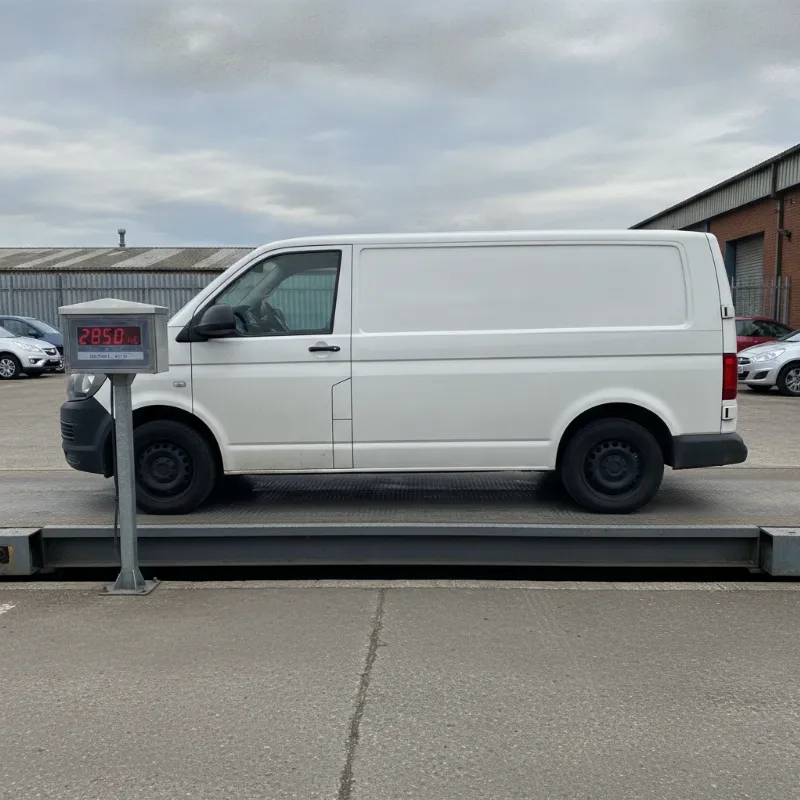
How much does a VW Transporter weigh? Quick answer
As a general rule, a Volkswagen Transporter panel van weighs somewhere between 1,900kg and 2,400kg unladen, with a gross vehicle weight (GVW) of around 2,600kg to 3,200kg depending on the model. The exact figure varies significantly based on generation (T5, T6, T6.1 or the new T7), body style, wheelbase, engine, trim level and whether it's a two-wheel drive or 4Motion variant. See the full weight breakdown by generation.
For a quick reference, a standard short-wheelbase T6.1 panel van typically has a kerb weight of around 1,950kg to 2,050kg, while a fully loaded Kombi with high-spec trim or the Sportline package can push closer to 2,200kg unladen. Camper conversions and 4Motion versions add more still. Read on for a full breakdown by generation, body style and drivetrain.
VW Transporter kerb weight and gross vehicle weight (GVW) explained
Before comparing figures, it helps to understand what the different weight terms actually mean. Van manufacturers, including Volkswagen, publish several weight ratings on the VIN plate, and each tells you something different about how the van can be used on the road legally and safely.
Kerb weight vs payload vs GVW
Kerb weight (also called unladen weight or mass in running order) is the weight of the van with a full tank of fuel, all fluids topped up and a nominal driver weight (usually 75kg) included. It's essentially how much the van weighs before you put anything in it.
Gross vehicle weight (GVW), also known as maximum authorised mass (MAM), is the maximum the van is legally allowed to weigh when fully loaded – vehicle, driver, passengers, fuel and cargo combined. For most Transporters this sits between 2,600kg and 3,200kg, which keeps it inside the standard car licence (Category B) limit of 3,500kg.
Payload is simply the difference between the kerb weight and the GVW – in other words, how much you can actually carry. This is the number that matters most if you're loading tools, stock or camper conversion equipment. Exceeding GVW is an offence and can invalidate your insurance, so knowing your payload margin is essential.
VW Transporter weight by generation
Each generation of the Transporter has crept up in weight as safety equipment, sound deadening and technology have been added. Here's how the recent generations compare.
VW Transporter T6 weight
The T6 (2015–2019) and facelifted T6.1 (2019–2024) panel vans have kerb weights that generally start at around 1,904kg for a basic short-wheelbase 2.0 TDI, rising to around 2,100kg for long-wheelbase, high-roof or higher-output variants. GVW ratings typically sit at 2,800kg, 3,000kg or 3,200kg depending on how the van was specified, giving payloads of roughly 800kg to 1,300kg.
VW T6 Kombi weight
The Kombi is heavier than the panel van because of its extra rear seats, side glazing, second sliding door glazing and additional trim. A T6 Kombi typically weighs between 2,050kg and 2,200kg unladen. GVW is usually the same 2,800kg or 3,000kg as the equivalent panel van, so payload drops to around 700kg to 950kg once you've factored in the seats and passengers.
VW T6 Camper weight
Once a T6 has been converted into a camper – whether an official California, a professional conversion or a home build – kerb weight climbs sharply. A T6 California Ocean weighs around 2,415kg unladen, and third-party conversions with a pop-top roof, kitchen pod, rock-and-roll bed, leisure battery and water tanks typically add 250kg to 400kg to the base panel van. Many camper conversions end up in the 2,300kg to 2,600kg range before you've even packed for a trip.
VW Transporter T7 weight (new VW Transporter T7)
The new T7 Transporter, launched in 2024 and developed alongside the Ford Transit Custom, is a larger and heavier vehicle than the outgoing T6.1. Kerb weights start at around 2,100kg for the entry-level diesel panel van and climb to over 2,400kg for high-spec long-wheelbase and plug-in hybrid models. GVW ratings run from 2,800kg up to 3,200kg, keeping the van within the standard car licence bracket.
VW T7 Transporter weight vs T6
Compared with an equivalent T6.1, the T7 is roughly 150kg to 250kg heavier in like-for-like specifications. That's partly down to a bigger body – the T7 is longer, wider and taller than the T6 – and partly because of extra crash structure, driver assistance systems and, on hybrid models, the battery pack. Load volume and payload are generally up too, but if you're moving from a T6 to a T7 it's worth double-checking your operational weight assumptions.
Weight by body style and trim
Body style and trim make a noticeable difference to how much a Transporter weighs. A basic Startline panel van is significantly lighter than a top-spec Sportline Kombi with alloys, leatherette and body styling.
VW Transporter Kombi weight
A standard T6.1 Kombi typically weighs between 2,050kg and 2,180kg depending on wheelbase and engine. The extra weight over a panel van comes from the second and third row of seats, additional glazing, extra trim panels and often heavier soundproofing.
VW Transporter Kombi Sportline weight
A Kombi Sportline adds the Sportline body styling kit, larger alloy wheels (usually 18-inch or 20-inch), sports seats, and often uprated infotainment. Expect a kerb weight of around 2,150kg to 2,250kg, with payload correspondingly reduced. Buyers who plan to carry a full set of passengers and luggage should check the GVW carefully.
VW Transporter Sportline weight (Sportline for sale considerations)
The panel van Sportline is lighter than the Kombi Sportline because it doesn't carry the rear seats and glazing, typically weighing 2,050kg to 2,150kg. If you're browsing a Sportline for sale, remember that many have been retrofitted with side windows, ply-lining, roof racks or camper elements – all of which add weight and eat into payload. Always check the VIN plate and any modifications against the original specification.
VW Transporter Sportline Kombi weight
The Sportline Kombi combines the extra seats and glazing of a Kombi with the styling, wheels and interior upgrades of the Sportline. It's one of the heaviest factory Transporter specifications, typically weighing between 2,180kg and 2,280kg unladen. On a 3,000kg GVW model, that leaves around 720kg to 820kg of payload for people and cargo combined.
VW Transporter Dropside weight
Dropside conversions – whether single or double cab – replace the rear bodywork with a flat load bed and drop-down sides. A single cab T6.1 dropside typically has a kerb weight of around 1,950kg to 2,050kg, while a double cab (crew cab) dropside is around 2,050kg to 2,150kg. Because dropsides are usually specified on a 3,200kg chassis, payloads of well over 1,000kg are common, which is why they remain popular with builders and landscapers.
How drivetrain and powertrain affect weight
Engine choice, gearbox and driven wheels all influence how much a Transporter weighs and, just as importantly, how much it can carry.
4x4 VW Transporter weight (4Motion models)
4Motion models add a Haldex-based all-wheel-drive system, an additional propshaft, rear differential and heavier front driveline components. Typically this adds around 80kg to 120kg over the equivalent two-wheel-drive Transporter, so a 4Motion panel van sits at around 2,050kg to 2,150kg kerb, while a 4Motion Kombi can be closer to 2,250kg. Payload drops accordingly, which is important to remember if you're planning to tow or carry heavy loads off-road.
Electric VW Transporter weight
The ABT e-Transporter 6.1 – an electric conversion of the T6.1 panel van – has a kerb weight of around 2,700kg, roughly 700kg more than a diesel equivalent, because of the battery pack under the load floor. GVW is uprated to 3,500kg, but even so payload is limited to around 1,000kg. The new all-electric T7-based ID. Buzz Cargo and the forthcoming electric T7 Transporter follow a similar pattern: heavier kerb weights, but uprated GVWs to preserve usable payload.
Camper conversion weight considerations
Converting a Transporter to a camper is one of the most common uses for the platform, but weight management is critical if you want to stay legal and within the standard car driving licence limit.
How to convert a VW Transporter into a camper without exceeding GVW
Start with the VIN plate to confirm the exact GVW of your van – on later T6.1 and T7 models this is often 3,000kg or 3,200kg, which gives you more headroom than an older 2,800kg example. Before any conversion, weigh the vehicle at a public weighbridge so you know the true starting kerb weight, then plan your build with lightweight materials: poplar ply instead of birch, lithium leisure batteries instead of lead-acid, compact water tanks and a pop-top rather than a fixed high-top wherever possible. Keep a running tally of every component you fit, and re-weigh the van once the conversion is complete. If you're close to the limit, some Transporters can be re-plated to a higher GVW by an approved specialist, giving you extra legal payload without changing the vehicle mechanically.
How to convert a VW T5 van to camper and stay within weight limits
The older T5 (2003–2015) generally has a lower base kerb weight than the T6, often around 1,850kg to 1,950kg, which gives you a useful head start. However, many T5s were specified with a lower GVW of 2,600kg or 2,800kg, so the payload margin isn't always as generous as it appears. Prioritise a pop-top over a fixed roof, choose a simple two-hob gas or diesel cooker, fit a modest 60–90 litre fresh water tank rather than 150 litres, and avoid heavy solid-wood furniture. Weigh axle-by-axle as well as overall, because rear-heavy layouts (with the kitchen and battery over the back wheels) can exceed the rear axle limit even when the total is fine.
Weight, payload and choosing the right VW Transporter
When you're comparing Transporters, don't just look at the headline kerb weight – look at the payload figure and think about how you'll actually use the van. Trades and delivery drivers usually want the highest payload, which points to a 3,200kg GVW panel van or dropside. Families and leisure buyers may prefer a Kombi or California, accepting a lower payload in exchange for seats and glazing. Camper converters should always err on the side of more payload than they think they need.
What oil for a VW Transporter T5 2.5 TDI (and how servicing affects running weight)
It might seem an odd link, but keeping a Transporter properly serviced actually affects its everyday running weight and efficiency. The T5 2.5 TDI five-cylinder engine takes a fully synthetic 5W-30 oil meeting VW specification 507 00 (for engines with a diesel particulate filter) or 506 01 for earlier variants – check your handbook to be sure. Running with the correct grade helps the engine reach operating temperature efficiently, reduces internal friction and keeps fuel consumption in check, which matters more the closer you load to GVW. The same principle applies to tyre pressures: underinflated tyres on a fully loaded van increase rolling resistance and wear, so always adjust to the laden pressures shown on the door pillar.
Find your next VW Transporter
Whether you're after a lightweight, high-payload panel van for work, a Kombi for family life, a Sportline for something with a bit more style, or a base van to convert into a camper, understanding the weight figures is the first step to buying the right Transporter. Check the VIN plate on any van you're considering, ask for the original build specification, and factor in any modifications that may have added weight since it left the factory. With the right choice, a VW Transporter will comfortably handle whatever you throw at it – within its legal limits.
FAQs
How much does a VW Transporter weigh on average?
A typical VW Transporter panel van weighs between 1,900kg and 2,100kg unladen (kerb weight), with a gross vehicle weight (GVW) of 2,800kg to 3,200kg. Kombis, Sportlines, 4Motion models and camper conversions weigh more, often between 2,150kg and 2,500kg unladen.
Can I drive a VW Transporter on a normal car licence?
Yes. All standard VW Transporters have a GVW of 3,200kg or less, which is well within the 3,500kg limit for a UK Category B (car) licence. The only time this becomes an issue is if the van has been re-plated to a higher GVW, or if you're towing a heavy trailer that pushes the combined weight over the limit.
What is the payload of a VW Transporter?
Payload varies from around 700kg for a well-equipped Kombi to over 1,300kg for a 3,200kg GVW panel van or dropside. The payload is simply the GVW minus the kerb weight, both of which are shown on the VIN plate inside the van.
How much does a VW Transporter camper conversion add to the weight?
A typical pop-top camper conversion with a rock-and-roll bed, kitchen unit, leisure battery and water tank adds roughly 250kg to 400kg to the base panel van weight. Fixed high-top conversions with full bathrooms and larger tanks can add 500kg or more, so it's important to weigh the van after conversion to make sure you're still within GVW.
Is the new T7 Transporter heavier than the T6?
Yes. The new T7, launched in 2024, is around 150kg to 250kg heavier than an equivalent T6.1 in like-for-like specification. This is because it's a larger vehicle with more standard safety and driver assistance equipment, and hybrid versions also carry a battery pack.