Where Are Volkswagen Transporters Made? A Guide to VW Transporter Manufacturing
Where Are Volkswagen Transporters Made?
The Volkswagen Transporter has been one of Europe's most recognisable working vans for more than seven decades, and its manufacturing story is closely tied to Germany. Historically, every generation of the Transporter — from the T4 through to the T6.1 — has rolled off the production line at Volkswagen Commercial Vehicles' Hannover plant in Lower Saxony. With the arrival of the all-new T7 generation, however, production has shifted, opening a new chapter in the Transporter's long history and changing where the vans on UK forecourts today actually come from.
For buyers in the UK, understanding where your Transporter was built is more than a piece of trivia. It informs build quality expectations, parts supply, warranty logistics and even resale value. This guide walks through the plants involved, the models they build, and what the shift to the new T7 means if you're shopping for a Transporter today.
The Home of the VW Transporter: Hannover, Germany
Hannover-Stöcken has been the spiritual and physical home of the VW Transporter since 1956. The plant is the headquarters of Volkswagen Commercial Vehicles (VWCV) and, at its peak, has employed more than 14,000 people building panel vans, Kombis, chassis cabs, Caravelles and Multivans. When you see a T5, T6 or T6.1 on the road in Britain, there's a very strong chance it started life on the assembly lines here in Lower Saxony.
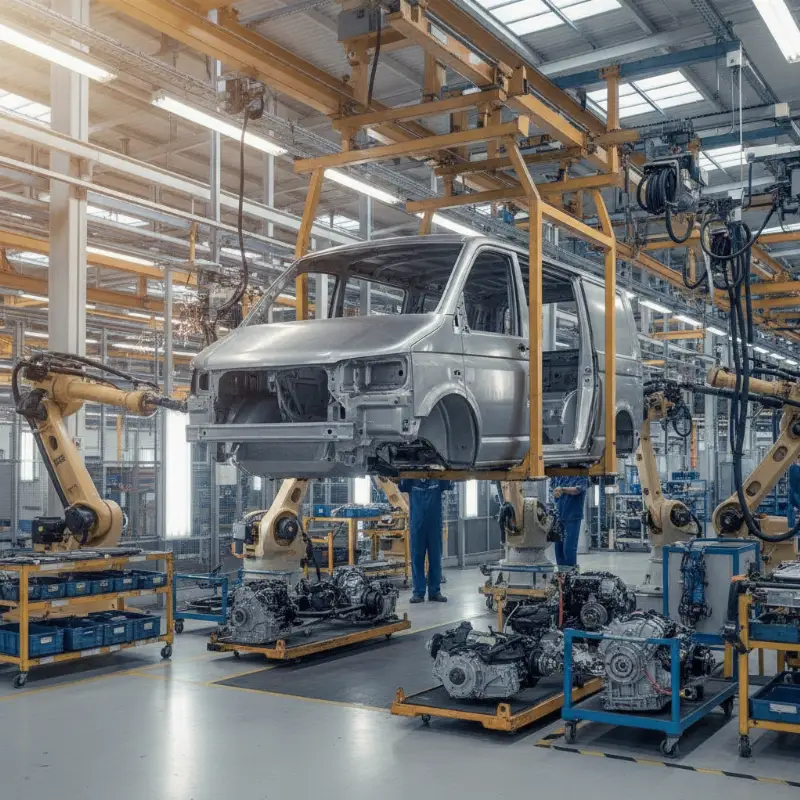
The Hannover site is enormous — a fully integrated plant that presses body panels, welds shells, paints and assembles finished vehicles under one roof. It also houses VWCV's engineering, design and prototype workshops, meaning the vans built there are effectively produced within a stone's throw of the engineers who designed them.
A Brief History of the Hannover Plant
Construction of the Hannover plant began in March 1955, and the first Type 2 (T1) Transporter — the iconic split-screen "Bulli" — rolled off the line on 8 March 1956. Since then, Hannover has produced more than eight million Transporters across every generation. The T2 introduced the bay window design in 1967, the T3 (or T25 as it's often known in the UK) followed in 1979, and the T4 in 1990 marked the shift to a front-engine, front-wheel-drive layout. The T5 arrived in 2003, the T6 in 2015, and the facelifted T6.1 in 2019 — all built at Hannover.
Today the plant continues to build the T6.1 alongside the ID. Buzz electric van, ensuring Hannover remains central to VWCV's future even as the traditional Transporter torch is passed elsewhere.
Other Global VW Transporter Production Sites
While Hannover is the headline story, VW Transporters and Transporter-badged variants have been assembled at other sites over the years. Volkswagen has historically used facilities in Mexico, South Africa and Brazil to build older Transporter generations for regional markets, and complete knock-down (CKD) kits have been shipped to assembly plants around the world. For UK and European buyers, though, the two locations that matter today are Hannover in Germany and Poznań in Poland.
Poznań, Poland — Where the New VW Transporter (T7) Is Built
The all-new seventh-generation Transporter — often referred to as the T7 — is being built at the Ford Otosan plant in Kocaeli, Turkey, with associated Volkswagen commercial activity in Poznań, Poland, forming part of the wider VWCV production network. Poland has been a growing hub for Volkswagen commercial vehicles for years, producing the Caddy and Crafter, and Polish-built VW commercials have earned a strong reputation for build consistency.
For UK buyers, the important point is that the new Transporter is no longer a Hannover-built van in the traditional sense. Instead, it emerges from a partnership plant, using shared architecture with the latest Ford Transit Custom.
New VW Transporter T7 Transporter: A Shift in Manufacturing
The T7 represents the biggest change in Transporter manufacturing since the model launched in 1950. Rather than developing an all-new platform in-house, Volkswagen partnered with Ford to co-develop the next generation of medium panel vans. As a result, the T7 shares its underpinnings, powertrains and much of its structure with the current Ford Transit Custom, and it is assembled at Ford Otosan's plant in Kocaeli, Turkey.
Volkswagen has kept the exterior styling, interior trim, seating and badging distinctly VW, so the T7 still looks and feels like a Transporter inside and out. But mechanically, it's a different beast to the outgoing T6.1 — with new engines, updated electronics, and a plug-in hybrid option that the Hannover-built Transporters never offered.
How UK Buyers Get Their VW Transporter Van
Whether your Transporter is built in Hannover or Turkey, the route to the UK is broadly the same. Finished vans are transported by rail and road to European port hubs — typically Emden in Germany — before being shipped across the North Sea to UK ports such as Sheerness, Grimsby or Immingham. From there, they're distributed to Volkswagen Van Centres and independent dealers.
Lead times can vary depending on specification, powertrain and any conversions that need to be carried out after the van arrives in Britain. Panel vans in popular colours and standard specs tend to be quickest; heavily optioned Sportlines, 4Motion models and converted campers naturally take longer.
Trim-Specific Production Notes
Not every version of the Transporter follows the exact same manufacturing path. Certain trims, drivetrains and body styles have specific production quirks worth knowing about before you buy.
4x4 VW Transporter (4Motion) Production
4Motion Transporters are built on the same lines as their front-wheel-drive counterparts, but the four-wheel-drive system — supplied historically by Haldex — is fitted during the standard assembly process. On T6 and T6.1 4Motion vans, this all happens at Hannover, meaning there's no separate factory for the 4x4 versions. Build slots can be more limited, however, as 4Motion is a lower-volume option.
Electric VW Transporter (e-Transporter) Production
The T6.1-based e-Transporter was produced at Hannover, with battery integration handled by ABT eLine, a specialist Volkswagen partner. Vans destined for electrification were built as standard shells and then converted to battery-electric drive. The T7 range introduces a fully integrated electric drivetrain from the outset, built alongside its diesel and plug-in hybrid siblings on the shared Ford-VW platform.
VW T6 Camper Origins and Base Van Manufacture
Every T6 and T6.1 camper you see on British roads started life as a standard Kombi or panel van built at Hannover. Volkswagen itself produces the California camper in Hannover as a factory conversion, complete with pop-top roof and integrated furniture. Third-party campers, meanwhile, use Hannover-built base vans that are then converted in the UK.
VW T6 Kombi and VW Transporter Kombi Build Details
The Kombi — essentially a panel van with a second row of seats and side windows — is built alongside the panel van at Hannover. Because Kombis leave the factory with removable rear seating, they've long been a favourite starting point for camper conversions in the UK, as they qualify as multi-purpose vehicles for insurance and taxation purposes.
VW Transporter Sportline and Sportline Kombi Manufacturing
Sportline models are factory-built at Hannover with their distinctive body kit, lowered suspension, larger alloys and unique interior trim installed on the line — they aren't aftermarket dress-ups. The Sportline Kombi combines the Sportline styling package with the Kombi body configuration, and both are built to order rather than for stock, which is why lead times on new Sportlines can stretch to several months.
VW Transporter Dropside Conversions and Chassis Cab Build
Volkswagen builds Transporter chassis cabs at Hannover, but the dropside body, tipper body or Luton box you see on a finished van is almost always fitted by a third-party bodybuilder — often in the UK. So while the mechanical van is German, the load-carrying bodywork could well be British-built, with each conversion tailored to the operator's needs.
VW Transporter T6 vs New VW Transporter T7
The most important manufacturing distinction on the market today is between the outgoing T6.1 (Hannover, Germany) and the new T7 (Kocaeli, Turkey, under the Ford-VW joint venture). The T6.1 remains a pure Volkswagen product, engineered and built in Germany. The T7 is a co-developed van that shares much of its DNA with the latest Ford Transit Custom.
VW T7 and VW T7 Transporter: The Ford-VW Partnership Explained
The Ford-VW commercial vehicle alliance was announced in 2019 and covers several joint projects, of which the new Transporter and Transit Custom are the most visible. Under the arrangement, Ford leads development and manufacturing of the medium van platform, while Volkswagen handles the Amarok pickup jointly developed with the Ford Ranger. The result is that T7 buyers get Ford's proven Transit architecture wrapped in VW styling, engineering calibration and trim.
VW Transporter T7 For Sale and VW T7 Availability in the UK
New T7 Transporters have been arriving at UK dealers throughout the current model year, with panel van, Kombi and Caravelle-equivalent configurations available. Availability depends on powertrain — diesel remains the volume choice, with plug-in hybrid and fully electric variants joining the range. Because production is still ramping up, some specifications carry longer lead times than others.
VW Transporter Kombi Lease Options on UK-Delivered Vans
Kombis are among the most popular Transporters for UK business leasing, thanks to their dual-purpose crew and cargo capability. Whether you opt for a Hannover-built T6.1 Kombi or a new-generation T7 Kombi, leasing packages are generally structured the same way — fixed monthly payments over two to four years with agreed mileage and maintenance options. Speak to your dealer about which build option best matches your operational cycle.
VW Transporter Sportline For Sale and Sportline Kombi For Sale
Sportline demand has always outstripped supply in the UK, and used examples hold their value strongly. Because the Sportline is a factory-built trim rather than a UK-added kit, buyers should always verify authenticity through the vehicle's build sheet — a genuine Hannover-built Sportline will be documented as such in Volkswagen's records.
VW Transporter Dropside Conversions and Chassis Cab Build
As mentioned above, dropside and tipper Transporters combine a Hannover-built chassis cab with UK-fitted bodywork. This gives fleet operators the flexibility to specify exactly the load bed they need, and it means servicing splits neatly between the VW mechanical warranty and the bodybuilder's warranty on the conversion itself.
Camper Conversions: How British Converters Add Value After Manufacture
The Transporter's popularity as a camper base is one of the reasons its manufacturing story extends beyond the factory gate. Once a Kombi or panel van arrives in the UK, a thriving cottage industry of converters — many of them small, family-run businesses in Yorkshire, Devon, the Midlands and Scotland — turn it into a bespoke camper. In effect, each converted van has two build stories: the factory one, and the British craftsman one.
How to Convert a VW Transporter Into a Camper
A typical Transporter camper conversion starts with a Kombi or long-wheelbase panel van, ideally with the highline windows already fitted. From there, the converter adds insulation, ply lining, carpet-lined side panels, a rock-and-roll bed, a side kitchen unit with sink and hob, a leisure battery system, and — for full campers — a pop-top roof to create standing room and extra sleeping space. Elevating roofs from specialists such as SCA and Reimo are among the most popular.
How to Convert VW T5 Van to Camper
The T5 (produced 2003 to 2015) remains the sweet spot for buyers wanting a proven, affordable camper base. Because T5s are now well out of warranty, they're commonly bought used and converted from scratch. The process is essentially the same as for a T6, though buyers should pay close attention to rust around the sliding door runners, tailgate and wheel arches — issues that can add cost before conversion work even begins.
What Oil for VW Transporter T5 2.5 TDI (Servicing Post-Purchase)
Post-purchase servicing is a topic that often comes up with older T5s. For the 2.5 TDI five-cylinder engine (the AXD, AXE, BNZ and BPC codes), Volkswagen specifies a fully synthetic 5W-30 oil meeting VW 507.00 standard for later variants and 505.01 for the earlier pump-duse (PD) versions. Always check your handbook or the workshop manual before topping up, as using the wrong specification can affect the DPF and injection system.
Why Manufacturing Origin Matters When Buying a VW Transporter
Where your Transporter was made affects a surprising number of practical considerations. Hannover-built T6.1s benefit from a mature production line, an extensive parts network across Europe, and a consistent quality reputation built over decades. Turkish-built T7s, meanwhile, come from a Ford-VW venture with fresh tooling and the latest quality processes — but they share more DNA with the Ford Transit Custom than any Transporter before them.
For residual values, the Hannover heritage still carries weight in the used market, especially among enthusiasts and camper buyers. For pure operational use, the T7's newer platform, updated electronics and hybrid options may be more compelling. Neither is inherently better — it depends on what you need the van to do, and how you feel about the shift from pure-German to co-developed European build.
Find Your VW Transporter With Us
Whether you're after a Hannover-built T6.1 Kombi ready for a camper conversion, a Sportline for weekend duty, a 4Motion for winter site access, or a brand-new T7 with the latest tech, we can help you find the right van. Our team knows the Transporter range inside out and can talk you through build origin, specification and delivery timescales so you buy with complete confidence. Get in touch to discuss availability, pricing and finance options tailored to your needs.
FAQs
Where are Volkswagen Transporters made?
Traditionally, every generation of the VW Transporter from the T1 through to the current T6.1 has been built at Volkswagen Commercial Vehicles' Hannover plant in Lower Saxony, Germany — the model's home since 1956. The all-new seventh-generation Transporter (T7), however, is built at the Ford Otosan plant in Kocaeli, Turkey, as part of the Ford-VW commercial vehicle alliance. So whether your Transporter is German- or Turkish-built depends on which generation you're buying.
Is the new VW Transporter the same as the Ford Transit Custom?
They share the same platform, powertrains and much of their underlying structure, as both are built at the same Ford Otosan plant in Turkey under the Ford-VW alliance. However, Volkswagen has kept the styling, interior, seating and trim distinctly VW, so the T7 still looks and drives like a Transporter — it's mechanically related to the Transit Custom rather than a rebadged copy.
Are Hannover-built VW Transporters better quality than the new T7?
Both are built to Volkswagen's quality standards, but they come from different traditions. Hannover-built T6.1s benefit from decades of refinement on a mature production line, while the T7 uses fresh tooling and the latest processes at Ford Otosan. Neither is inherently better — the T6.1 offers pure VW heritage and strong residuals, while the T7 brings a newer platform, updated electronics and hybrid options.
Does where a VW Transporter is made affect its UK warranty?
No. Volkswagen's UK warranty applies equally to Transporters regardless of which plant they came from, provided they were supplied through the official Volkswagen network. Parts, servicing and warranty claims are handled through UK Van Centres and authorised repairers, so build location doesn't affect your ownership experience from a warranty perspective.