Where Is the Fuse Box on an Iveco Daily? Locations by Year and Model
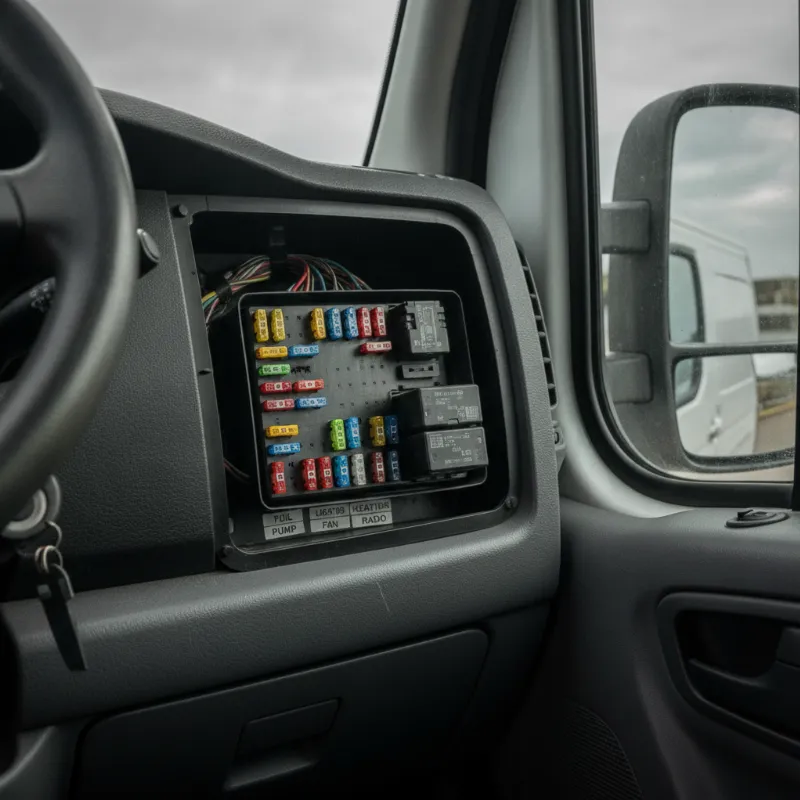
Where is the fuse box on an Iveco Daily?
The Iveco Daily actually has more than one fuse box, and knowing where each one sits will save you a lot of head-scratching when something electrical stops working. Most Daily vans have a primary fuse box tucked inside the cab on the dashboard, plus a secondary fuse and relay box under the bonnet in the engine bay. Between them, they handle everything from your interior lights and wipers to the engine management system, glow plugs and cooling fans.
The exact position varies slightly depending on which generation of Daily you're driving and whether you have a left- or right-hand drive model, but the general layout has stayed consistent for years. If you're troubleshooting a fault, it's worth checking both boxes rather than assuming everything runs through the dashboard unit.
Main dashboard fuse box location
On most Iveco Daily vans, the main fuse box lives on the dashboard, on the driver's side. In UK right-hand drive models you'll usually find it on the right-hand end of the dashboard, behind a removable plastic panel that you can pop off with your fingers or a flat tool. Open the driver's door and look at the side of the dash facing the door frame — you should see a rectangular cover, sometimes marked with a fuse symbol.
On some later Daily models, particularly those from around 2014 onwards, the dashboard fuse panel can also be accessed from below the steering column, behind a lower trim panel. Either way, once the cover is off you'll see rows of coloured mini and standard blade fuses, along with a small plastic fuse puller clipped inside the lid on most vans.
Engine bay fuse and relay box location
The engine bay fuse box on the Iveco Daily is typically mounted on the driver's side of the engine compartment, close to the bulkhead or next to the battery. It's a larger black plastic box with a clip-on lid, and it houses the higher-amperage fuses and relays that control things like the starter, alternator, glow plugs, ABS system and cooling fans.
To open it, release the clips on the sides of the lid — they usually just pop up with thumb pressure. You may find a fuse layout diagram printed on the underside of the lid, which is genuinely useful for identifying which fuse does what without needing to dig out the owner's manual.
How to access the Iveco Daily fuse box
Getting to either fuse box on the Daily is a straightforward DIY job that takes only a couple of minutes, provided you take a few basic precautions. There's no need to remove any major trim panels or use specialist tools — the covers are designed to come off by hand so drivers can swap a blown fuse at the roadside.
Tools you might need
For most jobs, you'll only need the plastic fuse puller that comes clipped inside the fuse box lid, plus a set of replacement fuses in the correct amperage ratings. It's worth keeping a small assortment in the glovebox — 5A, 10A, 15A, 20A and 30A blade fuses will cover most common circuits. A small flat-blade screwdriver can help lever off stubborn covers, and a torch is handy for reading fuse numbers in low light.
If you plan to test whether a fuse has actually blown rather than just eyeballing it, a cheap circuit tester or multimeter is a sound investment. Blown fuses aren't always obvious to the naked eye, especially the mini blade type.
Removing the fuse box cover safely
Before you start poking around, turn the ignition off and remove the key. For work in the engine bay, it's sensible to disconnect the negative battery terminal if you're going to be handling higher-amperage fuses or maxi fuses near the battery — this avoids any risk of a short circuit.
To remove the dashboard cover, get your fingers behind the notch on the edge of the panel and pull gently outwards. It should unclip cleanly. Don't force it with a metal screwdriver as you'll scratch the trim. For the engine bay box, release the side clips and lift the lid straight up. When refitting either cover, make sure the seal sits flush so water and dirt can't get in.
Iveco Daily fuse box diagram and layout
Every Iveco Daily should come with a fuse box diagram either printed inside the lid of the fuse box itself or included in the owner's handbook in the glovebox. The diagram shows each fuse position numbered, with the amperage rating and the circuit it protects. If you've bought the van second-hand and the handbook is missing, Iveco dealers can supply a replacement, or you can find generation-specific diagrams in the workshop manual.
The layout typically groups fuses by function — lighting circuits in one area, engine management in another, comfort features like the heater and radio in a third block. Relays are usually clustered together, often at one end of the box. Bear in mind that the layout does change between the 2006, 2011, 2014 and 2019 model updates, so always check the diagram that matches your specific van rather than relying on generic information.
Common fuses to check on the Iveco Daily van
Certain circuits on the Daily are more prone to blowing fuses than others, usually because they get heavy use or because they share protection with accessories that owners have added themselves. Before assuming you have a bigger electrical fault, it's always worth checking the obvious fuses first.
Interior lights, wipers and heater
If your cab light has gone dead, the wipers won't sweep, or the heater blower has stopped working, these all run through fuses in the main dashboard fuse box. The wiper fuse is a common culprit in winter, especially if the blades have been trying to shift a heavy load of snow or frozen ice. The heater blower fuse can also go if the motor is starting to fail and drawing more current than it should.
Interior lighting fuses tend to blow less often, but a short in a door switch or a damaged wire in the load area can catch one out. If a replacement fuse of the correct rating blows again immediately, don't keep swapping in new ones — that's a sign of an underlying fault that needs tracing.
Reversing lights, indicators and dashboard
Reversing light failures on the Daily are often down to the switch on the gearbox rather than the fuse, but it's still the first thing to check. Indicator faults, particularly if all indicators have stopped at once, usually point to the hazard/indicator fuse or the flasher relay. Dashboard warning light issues can be trickier — sometimes it's the instrument cluster fuse, other times it's a fault in the CAN bus network that a fuse alone won't fix.
Central locking, electric windows and mirror heaters each have their own fuses too, and these are worth checking systematically if you notice one function has died without warning.
Fuse box location differences by year and model
The Iveco Daily has been through several major redesigns since the third generation launched in 2000, and while the basic principle of a dashboard fuse box plus an engine bay unit has stayed the same, the exact positions and fuse layouts have shifted.
Older Iveco Daily vans (pre-2006)
On earlier Daily vans from the late 1990s and early 2000s, the main fuse box is generally located on the dashboard end panel, accessible with the driver's door open. The engine bay unit tends to be smaller and mounted near the battery, with fewer relays than later vans. Layouts are simpler, but replacement fuse diagrams can be harder to source, so it's worth photographing the inside of the lid before removing anything.
Newer Iveco Daily vans and 4x4 variants
From 2014 onwards, and especially on the current generation launched in 2019, the Daily's electrical system is far more complex, with additional fuse boxes for driver assistance systems, telematics and, on some models, auxiliary bodybuilder circuits. The 4x4 variants often have extra fuses for the transfer case controls and diff lock actuators. On these newer vans, if a fault isn't fixed by a straightforward fuse swap, the diagnostics really do need a plug-in scan tool to interrogate the ECU rather than more guesswork under the dash.
When to see a mechanic instead of replacing a fuse
Swapping a blown fuse is a legitimate DIY fix, but there are times when it's the wrong answer. If a fuse blows repeatedly, if you smell burning plastic anywhere near the fuse box, or if multiple circuits have failed at the same time, stop and get the van looked at by an auto electrician or an Iveco specialist. Fitting a higher-rated fuse to stop it blowing is dangerous and can cause a wiring fire — always replace like with like.
Similarly, if the fuses all check out fine but the circuit still isn't working, the problem lies further down the line, whether that's a failed relay, a broken wire, a bad earth or a component at the end of the circuit that's given up. A professional with the right diagnostic gear will find the fault far quicker than hours spent tracing wires yourself, and on a working van that downtime matters. For anything involving the ECU, ABS module or airbag circuits, it's always worth going straight to a qualified technician rather than experimenting.
FAQs
Where is the fuse box located on an Iveco Daily van, and how do I access it?
The Iveco Daily has two main fuse boxes. The primary one is on the dashboard, usually on the driver's side end panel and accessible by opening the driver's door and unclipping a plastic cover by hand. The second is in the engine bay, typically on the driver's side near the battery or bulkhead, with a clip-on lid. On some newer Dailys the dashboard fuses can also be reached from below the steering column. Turn the ignition off before removing any cover, and use the plastic fuse puller clipped inside the lid to swap fuses.
Is there a fuse box diagram inside the Iveco Daily fuse box lid?
On most Iveco Daily vans, yes — there's a diagram printed on the underside of the fuse box lid showing each fuse position, amperage rating and the circuit it protects. If yours is missing or faded, the same information is in the owner's handbook, and Iveco dealers can supply replacements. Always match the diagram to your van's specific model year, as the layout changed with the 2006, 2011, 2014 and 2019 updates.
Why does the same fuse keep blowing on my Iveco Daily?
A fuse that blows repeatedly is telling you there's a fault in the circuit it protects — usually a short to earth, a failing component drawing too much current, or a damaged wire. Never fit a higher-rated fuse to stop it blowing, as this can cause overheating and even a wiring fire. Get the circuit tested by an auto electrician or Iveco specialist to find and fix the underlying cause.
What amp fuses does the Iveco Daily use?
The Iveco Daily uses standard automotive blade fuses in a mix of amperage ratings, typically 5A, 7.5A, 10A, 15A, 20A, 25A and 30A for the dashboard box, plus larger maxi fuses (40A, 60A, 80A and above) in the engine bay for high-current circuits like the alternator, glow plugs and starter. Always replace a blown fuse with one of exactly the same rating and colour.