Who Makes Iveco Daily Vans? The Story Behind the Brand
Who Makes Iveco Daily Vans?
The Iveco Daily is manufactured by Iveco S.p.A., an Italian commercial vehicle manufacturer headquartered in Turin. Iveco itself is part of the Iveco Group N.V., a global company that spun off from CNH Industrial in 2022 to become an independent listed business focused on trucks, buses, and specialist commercial vehicles. Iveco Group also owns FPT Industrial, which supplies many of the engines fitted to the Daily range, giving the manufacturer full control over the drivetrain from block to bonnet.
Although Iveco is best known in the UK as the maker of the Daily, the brand's portfolio stretches well beyond light commercials. It builds the Eurocargo and S-Way heavy trucks, defence vehicles, and buses under the Iveco Bus banner. The Daily, however, remains the model most British operators recognise, thanks to its long-running reputation as a heavy-duty workhorse that sits somewhere between a conventional panel van and a light truck.
A Brief History of the Iveco Daily Van
The Daily has one of the longest continuous production runs of any large van on sale today. First launched in 1978, it has been in almost constant development for more than four decades, with six major generations and numerous facelifts along the way. Over that time it has evolved from a fairly basic ladder-chassis workhorse into a sophisticated modern van offering weights up to 7.2 tonnes, an eight-speed automatic gearbox, and a full suite of driver-assistance technology.
From Fiat Origins to the Iveco Brand
Iveco was formed in 1975 when Fiat merged its commercial vehicle operations with those of OM in Italy, Unic in France, and Magirus-Deutz in Germany. The name is an acronym for Industrial Vehicles Corporation. When the Daily arrived three years later, it inherited engineering DNA from several of those brands and was designed from the outset as a rugged, chassis-based light commercial rather than a scaled-up car. That truck-like foundation, with a separate ladder frame and rear-wheel drive, is one of the reasons the Daily still stands apart from monocoque rivals like the Ford Transit or Mercedes-Benz Sprinter today.
Where Iveco Daily Vans Are Built Today
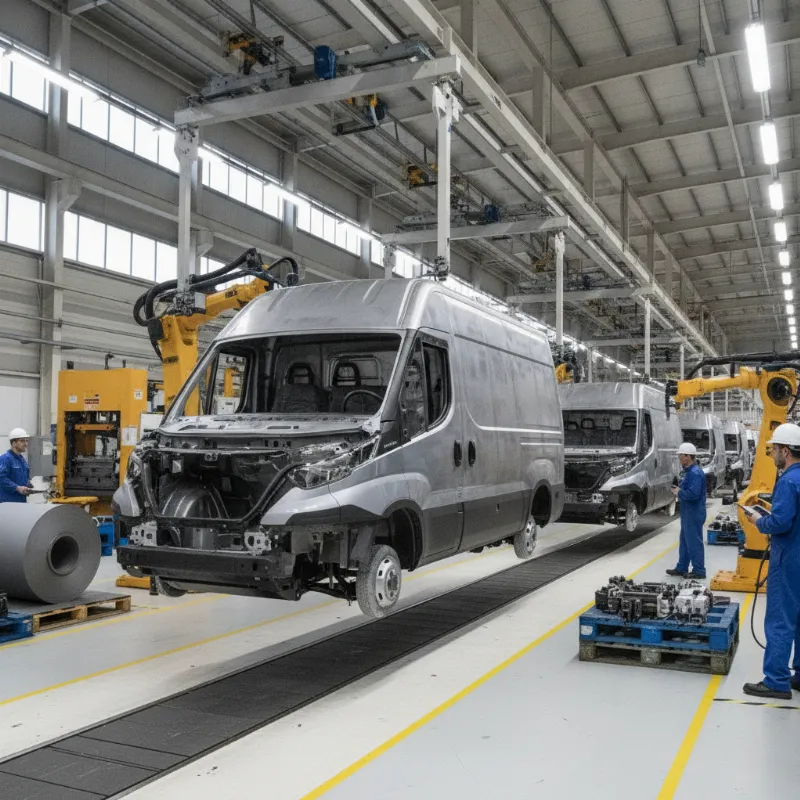
The vast majority of Iveco Daily vans sold in the UK are produced at Iveco's plant in Suzzara, in the Lombardy region of northern Italy. The Suzzara factory has been the spiritual home of the Daily for decades and handles panel vans, chassis cabs, and specialist conversions. Iveco also produces Daily variants in Valladolid, Spain, and operates additional plants across Europe and South America for other models in its range. Engines destined for UK-market Dailys are typically built by FPT Industrial at its facility in Foggia, southern Italy.
What Makes the Iveco Daily Different From Other Vans
The Daily's biggest technical difference from most of its competitors is its construction. While rivals such as the Transit, Sprinter, Renault Master and Vauxhall Movano use a unitary body-and-chassis structure, the Daily is built on a separate ladder frame with rear-wheel drive as standard and twin rear wheels on higher-payload models. This gives it a payload capacity and towing ability closer to a small truck than a large van, with gross vehicle weights available from 3.5 tonnes right up to 7.2 tonnes on chassis-cab versions.
That truck-based approach also makes the Daily particularly popular with conversion specialists. Motorhome builders, tipper bodybuilders, recovery operators and Luton box-van converters all favour the chassis for its strength and the wide range of wheelbases on offer. Inside, more recent generations have narrowed the gap on car-like refinement, with a modern infotainment system, adaptive cruise control, and Iveco's Hi-Matic eight-speed automatic gearbox available across much of the range.
The Iveco Daily 4x4 and Tipper Variants
Among the most distinctive members of the family is the Daily 4x4, a genuinely off-road-capable version with high and low-range transfer case, differential locks, and increased ground clearance. It is widely used by utility companies, forestry operators, mountain rescue teams and expedition builders, and there is very little else on the market that offers that combination of van practicality and serious off-road ability. The Daily is also one of the most popular platforms for factory-built and third-party tippers, dropsides, and Luton bodies, thanks to the strength of its chassis and the availability of single- and double-cab configurations.
Is the Iveco Daily a Good Van to Buy?
For operators who need to shift heavy loads, tow substantial trailers, or run bespoke bodywork, the Iveco Daily is one of the strongest choices on the UK market. Its heavy-duty engineering means it tends to cope better with sustained hard use than lighter monocoque vans, and higher-payload versions can legally carry loads that would put many rivals over their weight limits. The FPT engines, particularly the 3.0-litre unit, are well regarded for pulling power and are used across a wide range of Iveco commercial vehicles.
On the other hand, the Daily is a bigger, more truck-like van to drive than a Transit Custom or Vivaro, and it is not aimed at operators who simply need a small city delivery van. Running costs on the larger-engined models will be higher than on a mid-size van, and dealer networks are more specialist than for the mainstream brands. For the right kind of work, though — heavy panel-van duties, tipper and dropside work, motorhome bases, or 4x4 utility roles — few vans match it.
Find an Iveco Daily Van for Sale in the UK
Because the Daily is available in so many wheelbase, roof-height, weight and body configurations, it pays to be specific about what you need before you start shopping. Buyers should think carefully about gross vehicle weight, payload, whether they need a panel van or a chassis cab, and whether an automatic gearbox would suit their driving pattern. Service history is particularly important on higher-mileage examples given the heavy-duty roles many Dailys perform, and it is worth checking the condition of the chassis, rear axle and any bodywork fitted by a converter.
Used Iveco Daily vans are widely available across the UK through both franchised Iveco dealers and independent commercial vehicle specialists. Whether you are looking for a straightforward long-wheelbase panel van, a 7.2-tonne chassis cab for a bespoke conversion, or a rare Daily 4x4, taking the time to compare specifications and inspect vehicles properly will help you get the right van for the job.
FAQs
Who manufactures the Iveco Daily van?
The Iveco Daily is manufactured by Iveco S.p.A., an Italian commercial vehicle maker headquartered in Turin and part of the independent Iveco Group N.V. since 2022. Most UK-market Dailys are built at Iveco's Suzzara plant in Lombardy, Italy, with engines supplied by sister company FPT Industrial.
Is Iveco owned by Fiat?
Not any more. Iveco was originally formed in 1975 from Fiat's commercial vehicle operations combined with OM, Unic and Magirus-Deutz, and was part of Fiat and later CNH Industrial for many years. In 2022, Iveco Group was spun off as a separate, independently listed company, so it is no longer owned by Fiat or Stellantis.
Where are Iveco Daily vans built?
The main production facility for the Iveco Daily is in Suzzara, northern Italy, which handles panel vans and chassis cabs for the European market including the UK. Some variants are also produced in Valladolid, Spain, and engines are typically built by FPT Industrial in Foggia, Italy.
Are Iveco Daily vans reliable?
Iveco Dailys have a strong reputation for durability, particularly in heavy-duty and high-payload roles, thanks to their truck-derived ladder-frame chassis and FPT diesel engines. As with any commercial vehicle, reliability depends heavily on servicing and how hard the van has been worked, so a full service history and a thorough pre-purchase inspection are important on used examples.
What is the difference between an Iveco Daily and a Ford Transit?
The main difference is construction. The Daily uses a separate ladder chassis with rear-wheel drive and is available up to 7.2 tonnes gross weight, making it closer to a light truck. The Ford Transit uses a monocoque body-and-chassis design and tops out at 5.0 tonnes, which makes it lighter to drive but less capable when it comes to very heavy payloads, towing, or specialist bodywork conversions.