Ford or Iveco Daily Van? A Complete Guide to the Iveco Daily Range
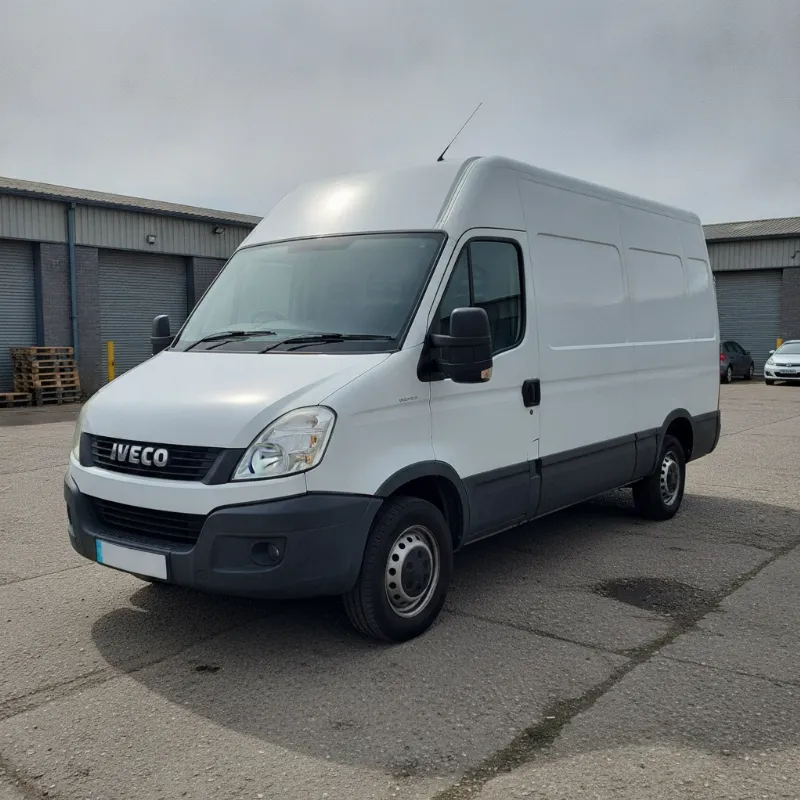
Ford vs Iveco Daily: Clearing Up the Confusion
Let's start with the short answer: there is no such thing as a "Ford Iveco Daily van". Ford and Iveco are two entirely separate manufacturers producing two entirely separate ranges of commercial vehicles. Ford builds the Transit, Transit Custom, Transit Connect and Transit Courier. Iveco builds the Daily, the eDaily and a family of larger trucks like the Eurocargo. The two brands have never produced a joint van, and the Daily has never worn a Ford badge.
The confusion is understandable, though. Both brands dominate the UK's working van and light-truck market, both produce vehicles that overlap in size and payload, and both are often shortlisted by the same buyers — tradespeople, couriers, hauliers and fleet managers looking for a workhorse that can earn its keep. If you've been searching for a "Ford Iveco Daily van", the vehicle you're most likely thinking of is the Iveco Daily itself, and this guide will walk you through the entire range.
Why Some Buyers Search for a 'Ford Iveco Daily Van'
The phrase tends to come up for a few reasons. Some buyers are cross-shopping the Ford Transit and the Iveco Daily and typing both names into the same search box. Others have heard the Daily described as being "in the Transit class" and assumed there's a link between the two. And a small number are simply looking for a large panel van or Luton and don't yet know which brand suits them best.
Whichever camp you fall into, it's worth understanding where the two ranges actually sit. The Ford Transit tops out at around 5.0 tonnes gross vehicle weight in its heaviest guise, while the Iveco Daily is built on a proper truck-derived chassis and goes all the way up to 7.2 tonnes. That difference in engineering philosophy is why the Daily is often the answer when a Transit runs out of payload, wheelbase or towing capacity.
Ford Transit vs Iveco Daily: How They Compare on Payload, Size and Price
On payload, the Transit is competitive up to around 2.0 tonnes, but the Daily comfortably clears 3.0 tonnes on the higher-GVW versions and up to around 4.5 tonnes on chassis cab variants. On load volume, the biggest Transit panel van offers roughly 15.1 cubic metres, whereas the largest Daily panel van reaches around 19.6 cubic metres — a genuine step up if you're moving bulky but light freight.
On price, the Transit is usually cheaper to buy new and has a deeper used market, which keeps monthly finance and lease costs down. The Daily typically costs more up front but offers a heavier-duty chassis, higher towing capacity (up to 3.5 tonnes braked as standard on many variants) and a longer service life for high-mileage operators. Simply put: the Transit is the better all-round tradesman's van, while the Daily is the better choice when the job is closer to light-truck work.
Iveco Daily Van Range at a Glance
The Iveco Daily is offered in an unusually wide spread of configurations. On the panel van side you can choose from 3.5-tonne, 5.0-tonne, 6.0-tonne and 7.2-tonne gross weights, with wheelbases ranging from 3,000mm up to 4,100mm and roof heights up to H3. Beyond the standard panel van, the Daily is available as a chassis cab, crew cab, tipper, dropside, Luton box, minibus and 4x4 — all sharing the same underlying platform.
Engines are almost exclusively 2.3-litre and 3.0-litre four-cylinder diesels, with power outputs from around 116hp up to 210hp. Transmission options include a six-speed manual and Iveco's eight-speed Hi-Matic torque-converter automatic, which is a standout gearbox in this class. The all-electric eDaily now sits alongside the diesel range with battery packs that can be scaled to match the daily route.
New Iveco Daily Models and Iveco Daily Lease Options
Buying a new Iveco Daily gives you the pick of the latest safety and driver-assistance kit, including lane departure warning, adaptive cruise, crosswind assist and city brake systems. Trim levels typically step up through a working base spec, a Business-oriented mid trim and a higher-spec cab with more comfort and connectivity.
For businesses that would rather protect cash flow than lay out capital, contract hire and finance lease are the two most popular routes. Contract hire fixes your monthly cost, bundles maintenance if you want it, and hands the vehicle back at the end of the term. Finance lease keeps the vehicle on your balance sheet with a lower monthly cost and a balloon payment at the end. Hire purchase is also widely available if the goal is outright ownership. Which route works best depends on your annual mileage, your VAT position and how long you want to keep the van — a fleet specialist can model the different options against your usage.
4x4 Iveco Daily for Sale: The Off-Road Workhorse
The Daily 4x4 is one of the most capable light commercials money can buy. It uses a proper part-time four-wheel-drive system with a low-range transfer box and up to three mechanical differential locks — front, centre and rear — making it more Land Rover Defender than Transit AWD. Ground clearance is significantly higher than a standard Daily, approach and departure angles are steeper, and the ladder-frame chassis gives it real off-road durability.
Typical buyers include utility companies, forestry contractors, mountain rescue teams, ski resorts and expedition builders. If your work takes you off metalled roads on a regular basis and a pickup simply isn't big enough, the 4x4 Daily is often the only vehicle that fits the brief.
Iveco 4x4 Daily for Sale: Spec, Uses and What to Look For
When you're shopping used, the 4x4 Daily comes in several body styles: single cab, crew cab, chassis cab for custom bodies, and factory panel van conversions. Gross weights typically span 3.5 to 5.5 tonnes. The 3.0-litre diesel is the most common engine, paired with either a six-speed manual or the Hi-Matic automatic.
Things to check on any used example include the condition of the diff locks (make sure all three engage properly), evidence that the transfer box has been serviced on schedule, and the state of the underbody — 4x4 Dailies often lead a hard life on farms, forests and utility sites. Bodywork rust around the sills and rear crossmember is worth a close look, and any conversion bodywork (tipper, crane, cherry picker) should come with LOLER certification if applicable.
Iveco Daily 4x4 for Sale: Buying Guide
Because 4x4 Dailies are low-volume and often bought new for specific contracts, the used market is thin and prices hold up strongly. Expect to pay a meaningful premium over an equivalent 4x2 Daily, but also expect a longer working life if the vehicle has been well maintained.
Key questions to ask the seller: what work has it done, how many hours (not just miles) are on the drivetrain, has the transfer box oil been changed, and are the service records complete? A full Iveco dealer history is ideal, but many 4x4 Dailies are serviced by specialist truck garages, which is equally acceptable provided the paperwork is there. Finally, always drive it in low range on a suitable surface before committing — the low box and diff locks are the whole reason to buy this variant, and they need to work faultlessly.
Iveco Daily 35C12 LWB Luton Van Explained
The 35C12 is one of the most common Daily variants on UK roads. The naming convention decodes as follows: "35" means 3.5 tonnes gross vehicle weight, "C" refers to the medium-duty chassis, and "12" indicates roughly 120hp from the 2.3-litre diesel. In LWB Luton form, it typically pairs a long wheelbase chassis cab with a box body and an overcab pod, giving a load volume in the region of 20 cubic metres and a payload of around 900-1,100kg depending on body weight.
The 35C12 Luton is popular with removals firms, courier subcontractors and rental fleets because it can be driven on a standard category B car licence (subject to the 3.5-tonne limit and driver age rules), while offering far more load space than any panel van. If you regularly move furniture, white goods or palletised freight, this is the Daily to look at first.
Iveco Daily Minibus: Passenger Variants and Uses
The Daily minibus is offered in a wide range of seating configurations from around 10 up to 22 seats, using either a factory Iveco body or a coachbuilt conversion by an approved partner such as Nu-Track, EVM or Mellor. Wheelchair-accessible variants with rear or side lifts are common, making the Daily a mainstay of community transport, care providers and school runs.
Comfort features vary considerably between conversions — some are stripped-back workhorses for shuttle duties, others come with individual reclining seats, forced-air ventilation and PSVAR-compliant fittings for accessible public transport contracts. If you're buying used, always check the conversion paperwork, the number of belted seats certified on the V5, and the current MOT/PSV status.
Iveco Daily Tipper: Chassis Cab and Body Options
On the chassis cab side, the Daily is a natural base for tipper and dropside conversions. Single-cab tippers are the standard choice for builders, groundworkers and landscapers, while crew-cab tippers add a second row of seats for carrying a full gang plus their tools and spoil. Bodies are usually aluminium for weight or steel for durability, with electric or hydraulic tipping gear.
Because the Daily comes in gross weights from 3.5 up to 7.2 tonnes, you can size the tipper precisely to your payload needs. A 3.5-tonne tipper stays within the car licence bracket but will only take around 1.0 tonne of payload once the body is fitted; step up to a 5.0- or 7.0-tonne variant (with a category C1 or C licence) and you can carry two to three times as much per trip. That flexibility is one of the biggest reasons operators pick the Daily over a Transit at the top end of the range.
How to Drive a 2008 Iveco Daily Automatic (Agile Gearbox Tips)
The 2008-era Daily automatic uses the Agile gearbox — an automated manual (AMT) rather than a true torque-converter automatic. Mechanically it's a manual gearbox with a computer-controlled clutch and shift actuator, which means it behaves differently to the smooth self-shifter you might be used to in a modern car.
The main tip is to lift off the throttle briefly as the box changes gear. AMTs need a moment to disengage the clutch, swap ratios and reengage, and if you keep your foot planted through the shift you'll get a noticeable lurch. A short throttle lift, timed with the change, produces a much smoother ride. When pulling away on a hill, use the handbrake to hold the van while the clutch takes up, and consider using the manual mode (tip the lever across) on steep gradients so you can pre-select the right gear. Finally, avoid resting your foot lightly on the accelerator at low speed — the box can get confused about whether you want to creep or accelerate. Once you're used to it, the Agile is perfectly serviceable, and later Dailies moved to the far superior eight-speed Hi-Matic torque-converter unit.
Common Iveco Daily Owner Questions
Two questions come up more often than any others from Daily owners and prospective buyers, so it's worth addressing them directly.
Where Is the Fuse Box on an Iveco Daily?
Most Iveco Dailies have two fuse boxes. The main interior fuse box is located in the dashboard behind a removable panel on the driver's side — usually on the right-hand end of the dash on a UK right-hand-drive van, near the door pillar. Pop the cover off and you'll find the passenger-compartment fuses and relays, with the fuse map printed on the inside of the cover.
The second fuse box is under the bonnet and handles the higher-current engine and chassis circuits — starter, glow plugs, cooling fans, ABS and so on. It's typically on the driver's side of the engine bay in a black plastic box with a clip-on lid. On later Dailies there may also be a separate battery-mounted fuse block for the pre-heater and auxiliary circuits. Always consult the specific owner's manual for your model year, because layouts changed subtly between the 2006, 2011, 2014 and 2019 facelifts.
Iveco Daily Van Dimensions at a Glance
Panel van lengths range from around 5.1 metres (S-length, short wheelbase) up to around 7.5 metres (XL, long-wheelbase extra-long). Wheelbases span 3,000mm, 3,520mm, 3,520mm-extended, 4,100mm and 4,100mm-extended. Roof heights come in H1, H2 and H3 flavours, with the H3 offering interior standing height of just over 2.1 metres.
Load lengths inside the biggest panel van reach around 5.1 metres, load widths sit at around 1.8 metres (with 1.32 metres between the wheel arches on most variants — enough for a Euro pallet loaded sideways), and cargo volume tops out at 19.6 cubic metres. Overall vehicle width including mirrors is typically 2.43 metres, so unlike a Transit the Daily benefits from checking your access routes and parking bays before you buy.
Finding the Right Iveco Daily Van for Your Business
The Daily's biggest strength is also the thing that makes buying one slightly more involved than picking a Transit: there are simply so many variants. Nail down the four key questions first — what's your maximum payload, what body style do you need, do you need a car licence or are you happy with C1, and does your route ever leave the tarmac — and the range will narrow quickly.
If you've been searching for a "Ford Iveco Daily van", the honest answer is that you're choosing between two different vehicles from two different manufacturers. The Transit is the volume champion and hard to beat below 3.5 tonnes. The Iveco Daily takes over where the Transit stops, offering truck-grade engineering, higher payloads, real off-road capability and body variants that a Transit simply doesn't offer. Speak to a Daily specialist about your weekly workload and mileage, and match the spec to the job — do that properly, and the Daily will run reliably for many hundreds of thousands of miles.
FAQs
Is there such a thing as a Ford Iveco Daily van?
No. Ford and Iveco are two separate manufacturers and have never produced a joint vehicle. Ford makes the Transit range; Iveco makes the Daily range. Buyers often search for a 'Ford Iveco Daily van' when they're cross-shopping the Ford Transit and the Iveco Daily, but the two vans are entirely unrelated in engineering, chassis and badging.
Which is better, a Ford Transit or an Iveco Daily?
It depends on the job. The Ford Transit is cheaper, lighter and better suited to typical tradesman and courier work up to around 3.5 tonnes. The Iveco Daily uses a truck-derived chassis, goes up to 7.2 tonnes gross weight, offers more load volume and tows more, so it's the better pick when the Transit runs out of payload, wheelbase or towing capacity.
Can I drive an Iveco Daily on a standard car licence?
Yes, provided the vehicle is 3.5 tonnes gross weight or below and you meet the age and licence conditions. Many Daily panel vans, Lutons and tippers are built specifically to sit at 3.5 tonnes so they stay within category B. Heavier Dailies at 5.0, 6.0 or 7.2 tonnes require a C1 or C entitlement.
How reliable is the Iveco Daily?
With proper servicing the Daily is a genuinely long-life vehicle — high-mileage examples regularly reach 300,000-500,000 miles in fleet service. The 2.3 and 3.0-litre diesels are well-proven, and the ladder-frame chassis stands up to hard use. As with any commercial vehicle, DPF, EGR and injector issues are the most common wear items, so a full service history is important when buying used.
What's the difference between the Agile and Hi-Matic gearboxes on an Iveco Daily?
The Agile, fitted to older Dailies including the 2008 model year, is an automated manual — a manual gearbox with a robotised clutch. It works but needs a light lift on the throttle during shifts to feel smooth. The Hi-Matic, introduced later, is a proper ZF eight-speed torque-converter automatic and is one of the best transmissions in the class, shifting smoothly and quickly with no driver input needed.