How Long Is the Iveco Daily 7 Tonne Chassis? Length Guide
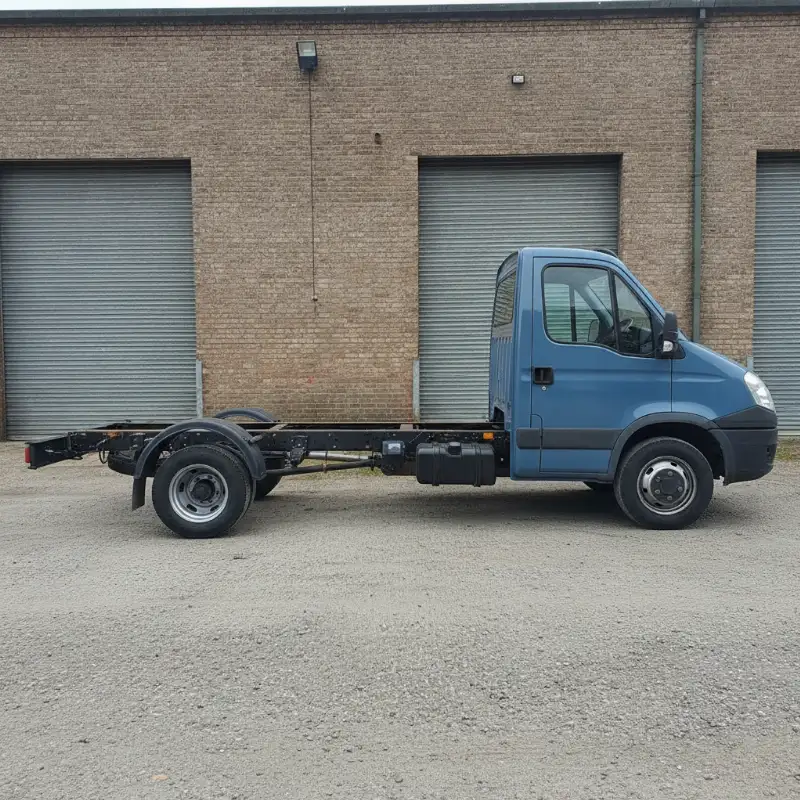
How long is the Iveco Daily 7 tonne chassis?
The Iveco Daily 7 tonne chassis-cab is offered in several length configurations, with overall vehicle lengths typically ranging from around 6.7 metres up to just over 7.5 metres depending on the wheelbase and rear overhang specified. In practical terms, that means a 7 tonne Daily can be built to carry bodies from roughly 3.75 metres long at the shorter end up to around 5.1 metres on the extra-long wheelbase chassis.
The exact length you end up with depends on three things: the wheelbase (the distance between the front and rear axles), the rear overhang (the section of chassis behind the rear axle), and the cab type fitted. All 7 tonne Daily variants use the heavy-duty single rear-wheel or twin rear-wheel chassis with the larger 3.0-litre engine and reinforced running gear, so the underlying platform is consistent — it's the wheelbase and overhang that dictate how much load space you can build on top.
Iveco Daily 7 tonne chassis cab wheelbase and length options
Iveco has traditionally offered the 7 tonne (7.0t GVW, often listed as the 70C or 72C model) Daily chassis-cab in two main wheelbase choices for the UK market, each with a choice of rear overhang. This gives bodybuilders and operators flexibility to match the chassis to the intended payload and body type without carrying unnecessary length.
Standard wheelbase measurements
The standard long wheelbase on the 7 tonne Daily is 3,750 mm (3.75 m). With a typical rear overhang, this produces an overall vehicle length of approximately 6.7 to 7.0 metres and supports a body length of around 4.1 to 4.3 metres. This configuration is the popular all-rounder for operators who need meaningful load space but still want a chassis that's manageable in urban delivery work and easy to manoeuvre on tighter yards and building sites.
Extra-long wheelbase measurements
The extra-long wheelbase measures 4,350 mm (4.35 m) and pushes the overall vehicle length out to around 7.4 to 7.5 metres, allowing for body lengths of roughly 4.8 to 5.1 metres. This is the specification most commonly chosen for large box, Luton and curtainside conversions where maximum load volume is the priority. It's still car-licence-friendly in terms of dimensions on most UK sites, but drivers will need to be mindful of overhead loading bay heights and swept turning circles.
Body length vs overall length: what to measure
When comparing Iveco Daily 7 tonne chassis, it's important to be clear about which measurement you're looking at. Overall vehicle length includes the cab, engine bay and any rear bumper or tail-lift; body length refers only to the load-carrying section fitted behind the cab. A 7.5 metre overall length doesn't equate to 7.5 metres of usable load space — you typically lose around 2.2 to 2.4 metres to the cab and front section.
Bodybuilders will also quote a "cab-to-axle" or CA measurement, which is the distance from the back of the cab to the centre of the rear axle. This figure is more useful than wheelbase alone when planning body fitment, because it tells the converter exactly how much chassis rail is available forward of the axle for the body subframe. Always confirm CA and rear overhang with your Iveco dealer or converter before committing to a body design.
Choosing the right chassis length for your bodybuild
The right length of 7 tonne Iveco Daily chassis depends heavily on what's going on the back and how the vehicle will be used day-to-day. Choosing too long a chassis can hurt manoeuvrability and increase running costs; too short and you'll be turning work away because the body can't take the pallets or plant you need to move.
Box, Luton and dropside conversions
For box van, Luton and dropside builds, the extra-long 4,350 mm wheelbase is usually the natural choice. A 5-metre box body on a 7 tonne Daily comfortably accommodates six to eight standard UK pallets depending on layout, making it a strong option for parcel, furniture and general distribution work. Dropside operators building for landscaping, builders' merchants or plant hire often prefer the standard 3,750 mm wheelbase because it keeps the vehicle nimble around sites while still offering a 4-metre-plus load bed.
Tipper and specialist conversions
Tipper conversions almost always favour the shorter standard wheelbase. A shorter body tips more cleanly, distributes weight better over the rear axle, and reduces the risk of instability when the body is raised. For specialist bodies — welfare units, workshop trucks, recovery beds or beavertail plant carriers — the wheelbase choice comes down to the exact deck length and payload distribution required, and it's worth speaking to both the converter and the dealer early in the process to make sure the chassis specification supports the intended use.
Iveco Daily 7 tonne vs lighter Daily variants
It's worth noting that the 7 tonne Daily shares its bodyshell and cab with lighter Daily models (typically 3.5t, 5.0t and 6.5t variants), so the physical wheelbase and length dimensions are broadly similar across the range. What changes at 7 tonnes is the chassis rating: heavier-duty suspension, uprated brakes, larger wheels and tyres, and a higher gross vehicle weight allowance.
That means if you've previously operated a 3.5 tonne Daily and are stepping up to 7 tonnes, the vehicle will feel familiar in terms of cab layout and driving position, but the licence category changes — a 7 tonne chassis-cab requires a C1 (7.5 tonne) licence rather than the standard category B car licence. Payload capacity roughly doubles compared with a 3.5 tonne variant, which is often the main driver for stepping up.
Buying a 7 tonne Iveco Daily in the UK
When ordering a 7 tonne Iveco Daily chassis-cab in the UK, you'll typically specify wheelbase, cab type (single or crew), engine output, transmission and any factory-fit options before the chassis heads to a bodybuilder for conversion. Lead times can be significant on a build-to-order chassis with a bespoke body, so it pays to start conversations with your dealer and converter well ahead of the date you need the vehicle on the road.
If you're buying used, always check the V5 for gross vehicle weight, measure the actual body length rather than relying on advertised figures, and confirm the wheelbase against the VIN plate. A well-specified 7 tonne Daily is a versatile workhorse — but only if the chassis length genuinely matches the job you're buying it for.
FAQs
How long is the Iveco Daily 7 tonne chassis-cab overall?
The 7 tonne Iveco Daily chassis-cab has an overall length of approximately 6.7 to 7.5 metres depending on the wheelbase and rear overhang specified. The standard 3,750 mm wheelbase gives an overall length of around 6.7 to 7.0 metres, while the extra-long 4,350 mm wheelbase extends this to roughly 7.4 to 7.5 metres.
What wheelbase options are available on the 7 tonne Iveco Daily?
The 7 tonne Daily is typically offered with two wheelbase options in the UK: a standard 3,750 mm (3.75 m) wheelbase suited to tippers, dropsides and shorter bodies, and an extra-long 4,350 mm (4.35 m) wheelbase for maximum-volume box, Luton and curtainside conversions.
What body length can I fit on a 7 tonne Iveco Daily?
Body lengths typically range from around 4.1 metres on the standard wheelbase up to approximately 5.1 metres on the extra-long wheelbase, depending on the rear overhang and body design. Always confirm the exact cab-to-axle and overhang figures with your dealer or bodybuilder before finalising the build.
Do I need a special licence to drive a 7 tonne Iveco Daily?
Yes. A 7 tonne Iveco Daily exceeds the 3.5 tonne limit of a standard category B car licence, so you'll need a category C1 licence, which covers vehicles up to 7.5 tonnes. Drivers who passed their car test before 1 January 1997 may already have C1 entitlement on their licence.
Is the 7 tonne Daily longer than the 3.5 tonne Daily?
Not necessarily. The 3.5t, 5.0t, 6.5t and 7.0t Daily variants share the same chassis platform and wheelbase options, so a 7 tonne Daily on the standard wheelbase is broadly the same length as a 3.5 tonne Daily on the equivalent wheelbase. The main differences are in payload capacity, running gear and gross vehicle weight rating rather than physical dimensions.