What Euro Version Is My Citroen Relay? A Year-by-Year Guide
Why the Euro emissions standard on your Citroen Relay matters
If you drive a Citroen Relay for work, knowing exactly which Euro emissions standard your van meets has gone from a technical footnote to a genuine business issue. The Euro rating — Euro 3, 4, 5 or 6 — dictates how much nitrogen oxide (NOx) and particulate matter your engine is allowed to emit, and increasingly it decides where you can drive without paying a daily charge. London's Ultra Low Emission Zone (ULEZ), Birmingham's Clean Air Zone (CAZ), Bristol, Bath, Bradford, Sheffield, Newcastle, Portsmouth and a growing list of other cities all use the Euro standard as their compliance benchmark.
For a working van like the Relay, that can mean the difference between rolling into a job in central London for free or paying £12.50 every single day. Over a working week, that's £62.50; over a year of five-day working, it's more than £3,000 in daily charges alone. So the question "what Euro version is my Citroen Relay?" isn't idle curiosity — it directly affects running costs, resale value and where the van is realistically usable.
How to check what Euro version your Citroen Relay is
There are three reliable ways to identify the Euro standard of a Citroen Relay, and it's worth using more than one to be sure. Cross-referencing is important because the changeover between standards didn't always happen on 1st January — manufacturers phased engines in over several months, so a van registered in early 2016, for example, could be either Euro 5 or Euro 6 depending on when it was built and which engine variant it uses.
Check the V5C logbook
The quickest place to look is your V5C registration document (the logbook). On more recent V5Cs, the Euro standard is listed directly, usually in section D.2 or in the environmental information block. Older V5Cs may not print the Euro category explicitly, but they will show the emissions data — CO2 figure, particulate mass and, crucially, the type approval number. That type approval reference contains a code that indicates the Euro standard the vehicle was certified against.
If your logbook doesn't show it clearly, don't panic. You can also enter your registration into the DVLA's free vehicle check service, and for ULEZ specifically, Transport for London's online checker will tell you outright whether your Relay is compliant.
Cross-reference the registration date and engine
The date of first registration is the next best clue. Euro standards were introduced in stages, and light commercial vehicles like the Relay generally followed the Euro schedule about a year behind passenger cars. As a rough rule of thumb, a diesel Relay registered from September 2016 onwards is very likely Euro 6, one registered from 2011 to 2015 is usually Euro 5, and anything from 2006 to 2010 will typically be Euro 4.
Combining the registration date with the engine badge — 2.0 HDi, 2.2 HDi, 2.2 BlueHDi and so on — narrows it down further. BlueHDi engines, which use AdBlue (SCR) to cut NOx, are Euro 6 by design.
Use the VIN plate under the bonnet
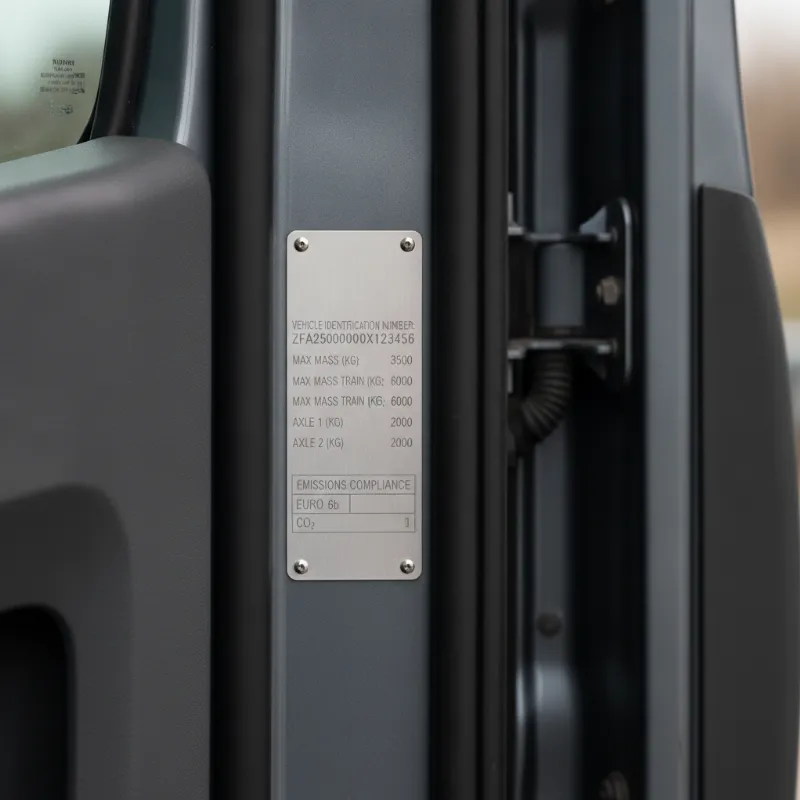
Finally, open the bonnet and find the manufacturer's VIN plate — on the Relay it's usually on the offside slam panel or the top of the bulkhead. Alongside the VIN and weight ratings, you'll often find a small code or approval number that references the Euro standard the vehicle was homologated to. Some Relays also carry a sticker in the door aperture with an emissions category printed on it. If you're buying a used Relay from a private seller, this is a very useful sanity check to make sure the van is what the advert claims.
Citroen Relay Euro standards by year and engine
Citroen has produced the current-shape Relay (X250 platform, shared with the Peugeot Boxer and Fiat Ducato) since 2006, with an earlier generation running before that. Across those years the van has passed through every modern Euro standard, so here's a year-by-year guide to help you place your own.
Euro 3 Relay (roughly 2001–2005, including 2.0 HDi and 2.2 HDi)
The pre-facelift Relay of the early 2000s, powered by the 2.0 HDi and 2.2 HDi diesel engines, was built to the Euro 3 standard. These vans don't meet any modern Clean Air Zone requirements for diesels and will attract the full daily charge in ULEZ and Class B/C/D CAZs. They're now approaching or exceeding 20 years old, so most surviving examples are used away from restricted city centres or for very local work.
Euro 4 Relay (roughly 2006–2010)
The all-new third-generation Relay launched in 2006 arrived with Euro 4 diesel engines, again in 2.2 HDi form along with the 3.0 HDi for heavier variants. Euro 4 was a substantial improvement on Euro 3, but it still falls well short of what ULEZ and most CAZs demand from a diesel today. If your Relay was registered between 2006 and around late 2010, it's almost certainly Euro 4 and will not be ULEZ-compliant.
Euro 5 Relay (roughly 2011–2015)
From around 2011, Citroen updated the Relay's engines to meet Euro 5, mainly through the addition of a diesel particulate filter (DPF) and revised injection calibration. This is the standard that catches a lot of van owners out. Euro 5 sounds recent and reasonably clean, but for the purposes of ULEZ and most Class D Clean Air Zones, Euro 5 diesels are treated the same as older vehicles — they're not compliant and will be charged.
Euro 6 Relay (2016 onwards, including BlueHDi)
Euro 6 arrived on the Relay from September 2016, badged as BlueHDi. These engines use Selective Catalytic Reduction with AdBlue to slash NOx emissions and are the first Relays that fully meet ULEZ and CAZ diesel requirements. If your V5C shows a first registration date from late 2016 onwards and the engine is a BlueHDi, you can drive into London's ULEZ, Birmingham CAZ, Bristol, Bradford and the others without paying a daily charge.
What your Euro rating means for ULEZ, CAZ and Clean Air Zones
Once you've pinned down your Relay's Euro standard, the practical question is: where can I drive it without being charged? The rules are broadly consistent across the UK's Clean Air Zones, but each city has its own scheme, hours of operation and daily fee.
Diesel Relay minimum standard (Euro 6)
For diesel light commercial vehicles up to 3.5 tonnes — which is the vast majority of Relays on the road — the minimum standard for free entry into ULEZ, Birmingham CAZ, Bristol, Bradford, Sheffield, Newcastle, Tyneside and Portsmouth is Euro 6. If your Relay is Euro 5 or older, you'll be charged every day you drive within the zone boundary, whether you're delivering, picking up materials or just passing through.
The daily charges vary. London ULEZ is £12.50 per day for vans, and it runs 24 hours a day, 365 days a year except Christmas Day. Birmingham CAZ is £8 a day for non-compliant vans, and Bristol's scheme is £9. Miss a payment and penalty charge notices can push the cost far higher.
Options if your Relay doesn't meet the standard
If your Relay is Euro 5 or older and you regularly work in charged zones, there are really three options. First, pay the daily charge and pass it on to customers where you can — practical for occasional trips, punishing if it's a daily commute. Second, look into whether any local scrappage or upgrade grant schemes are still open in your area; London and Birmingham have both offered these to sole traders and small businesses at various points. Third, upgrade to a Euro 6 Relay, which for most operators working in or near city centres becomes the most cost-effective answer within a couple of years.
Upgrading to a compliant Citroen Relay van
If the sums point towards upgrading, the good news is that Euro 6 BlueHDi Relays are now widely available across the used market, with a broad choice of body lengths, roof heights, chassis cabs, Lutons and dropside conversions. You don't have to buy new to get ULEZ-compliant — any Relay registered from around September 2016 onwards with a BlueHDi engine will qualify, and used prices on those earlier Euro 6 vans are much more accessible than they were.
When you're shopping, always ask the seller to confirm the Euro standard in writing, check the V5C in person, and run the registration through the TfL ULEZ checker before you hand any money over. That way you know for certain the van will earn its keep on every job, in every city, without a daily charge quietly eating into your margin.
FAQs
What Euro emissions standard is my Citroen Relay, and how do I check it?
The Euro standard of your Citroen Relay depends on when it was first registered and which engine it has. As a general guide: Relays from roughly 2001–2005 are Euro 3, 2006–2010 are Euro 4, 2011–2015 are Euro 5, and Relays from September 2016 onwards with the BlueHDi engine are Euro 6. To check for certain, look at your V5C logbook (the Euro category or type approval number is listed in the environmental section), inspect the VIN plate under the bonnet, or enter your registration into the TfL ULEZ checker, which will tell you whether the van is compliant.
Is my Citroen Relay ULEZ compliant?
For diesel vans, ULEZ compliance requires Euro 6. That means a Citroen Relay registered from around September 2016 onwards with a BlueHDi engine will typically be compliant and can enter the ULEZ without paying the daily £12.50 charge. Earlier Relays (Euro 3, 4 or 5) are not compliant and will be charged every day they drive in the zone. Always confirm using the official TfL vehicle checker with your number plate.
Are all BlueHDi Citroen Relays Euro 6?
Yes. The BlueHDi engine range was introduced specifically to meet Euro 6 by adding Selective Catalytic Reduction (SCR) with AdBlue to reduce NOx emissions. If your Relay is badged BlueHDi, it will be Euro 6 and compliant with ULEZ, Birmingham CAZ and other Clean Air Zones for diesel vans.
Can a Euro 5 Citroen Relay be upgraded or retrofitted to Euro 6?
In theory, retrofit SCR systems exist for some commercial vehicles, but for light vans like the Relay there is no widely approved, cost-effective retrofit that will change the vehicle's official Euro classification on the DVLA record. For most owners, the practical route to Euro 6 compliance is to trade the van in for a later BlueHDi model rather than attempt a conversion.
Does the Euro standard affect my Citroen Relay's road tax or insurance?
Van road tax (VED) for light commercial vehicles is generally a flat rate rather than emissions-based, so the Euro standard doesn't directly change your annual tax bill in the same way it does for cars. However, the Euro rating strongly affects resale value, ULEZ and CAZ charges, and can influence fleet insurance quotes and access to certain contracts, particularly for city-based delivery work where compliant vehicles are increasingly required.