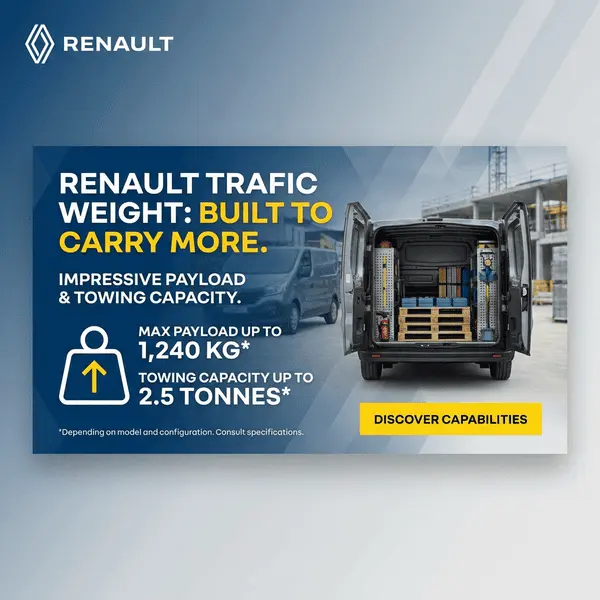
Renault Trafic Weight Guide
Renault Trafic Weight : Payload
The Renault Trafic is a popular commercial van known for its versatility and reliability. Understanding the Renault Trafic weight is crucial for businesses and individuals who rely on this vehicle for their transportation needs. From the Renault Trafic payload to its towing capacity, these factors play a significant role in Renault Vans determining the van’s suitability for various tasks and operations. Source
This guide delves into the key aspects of the Renault Trafic’s weight specifications. It explores the vehicle’s gross weight, payload capacity, and towing capabilities, providing valuable insights for potential buyers and current owners. The article also examines how the Renault Trafic Crew Cab weight in kg compares to its competitors and discusses the impact of different dimensions, such as the Renault Trafic LWB weight, on its overall performance and utility.
Understanding Gross Vehicle Weight (GVW)
What Is the Payload of a Renault Trafic?
Gross Vehicle Weight (GVW) is a crucial concept in the automotive industry, especially for commercial vehicles like the Renault Trafic Weight. GVW refers to the total weight of a vehicle, including its maximum allowable load. This encompasses the weight of the unloaded vehicle plus the weight of any cargo, passengers, and additional equipment. It’s the maximum weight that a vehicle should not exceed when in use on the road.
Importance of GVW for the Renault Trafic
Understanding the GVW is essential for Renault Trafic owners and operators for several reasons:
- Legal Compliance: The GVW determines the legal weight limit for the vehicle. Exceeding this limit can lead to penalties and safety risks.
- Performance: The GVW has an impact on the vehicle’s performance, including fuel efficiency, handling, and braking distance.
- Safety: Staying within the GVW limits ensures the vehicle operates safely, reducing the risk of accidents or mechanical failures.
- Payload Capacity: The GVW helps determine the maximum payload capacity, which is crucial for businesses relying on the Trafic for transportation.
GVW Options for Different Trafic Models
The Renault Trafic has undergone changes in its GVW options over the years:
- Pre-2019 Models:
- Two GVW options: 27 and 29 (approximately 2,700kg and 2,900kg)
- Maximum payload: 1,280kg for the LL29 variant
- Post-2019 Models (including 2022 update):
- Updated GVW options: 28 and 30 (approximately 2,800kg and 3,000kg)
- Maximum payload for UK models: 1,166kg (applicable to LL30 models in Business specification)
It’s important to note that the payload capacity varies depending on the model specifications:
- Shorter models have a lower payload capacity
- High roof models also have a reduced payload capacity
- Models with more standard equipment have lower payload ratings
For example, Sport models typically have lower payload ratings compared to entry-level Business versions due to additional features and equipment.
The Renault Trafic’s GVW options are relatively low compared to some competitors, such as the Ford Transit Custom and the latest Vauxhall Vivaro. This has an impact on its maximum payload capacity.
To provide a clearer understanding of the weight specifications for different Trafic models, here’s a table with some example data:
| Model Variant | Gross Vehicle Weight (kg) | Kerb Weight (kg) | Max Payload (kg) |
|---|---|---|---|
| Short Wheelbase | 2835 – 2860 | 1757 – 1824 | 1036 – 1078 |
| Long Wheelbase | 2955 – 2985 | 1757 – 1810 | 1170 – 1198 |
| High Roof | 2995 – 3070 | 1881 – 1947 | 1092 – 1145 |
These figures demonstrate the range of GVW, kerb weight, and payload capacities across different Trafic configurations. It’s crucial for potential buyers and current owners to consider these specifications when choosing the most suitable Trafic model for their specific needs.
Payload Capacity of Renault Trafic Definition of payload
Payload capacity, often referred to simply as “payload,” is the maximum weight a vehicle can effectively carry. For the Renault Trafic, this includes the total weight of passengers, goods, equipment, and any other objects transported within the van. It’s a crucial factor in vehicle design, operation, and maintenance, as exceeding the payload capacity can lead to safety hazards, reduced performance, and potential vehicle damage.
Factors affecting payload Renault Trafic Weight
Several factors influence the payload capacity of the Renault Trafic:
- Gross Vehicle Weight (GVW): The Trafic’s payload is limited by its GVW options. Before 2019, the GVW options were labeled 27 and 29 (roughly 2,700kg and 2,900kg). After 2019, including the 2022 update, these changed to 28 and 30 (approximately 2,800kg and 3,000kg).
- Vehicle Configuration: Shorter models and high roof variants typically have lower payload capacities compared to their longer counterparts.
- Standard Equipment: Models with more standard features, such as Sport versions, have lower payload ratings than entry-level Business models due to the additional weight of the equipment.
- Modifications: Any aftermarket or authorized-dealer installed equipment reduces the payload capacity. The weight of such modifications must be subtracted from the original payload listed on the Tire and Loading label.
- Wheelbase Length: The Trafic comes in short wheelbase (SWB) and long wheelbase (LWB) variants, which affect the payload capacity.
To calculate the available cargo capacity, one needs to subtract the curb weight from the Gross Vehicle Weight Rating (GVWR). This calculation provides the maximum weight the vehicle can safely carry in terms of passengers, cargo, and additional gear.
Maximum payload for different Trafic variants
The payload capacity of the Renault Trafic varies depending on the specific model and configuration. Here’s an overview of the maximum payload for different Trafic variants:
- Pre-2019 Models:
- Maximum payload: 1,280kg (applicable to LL29 variant)
- This maximum payload applied to all four engine options
- 2022 Facelift Models:
- Maximum payload for UK models: 1,166kg (applicable to LL30 models in Business specification)
- Variant-specific payload capacities:
| Model Variant | Gross Vehicle Weight (kg) | Kerb Weight (kg) | Max Payload (kg) |
|---|---|---|---|
| Short Wheelbase | 2835 – 2860 | 1757 – 1824 | 1036 – 1078 |
| Long Wheelbase | 2955 – 2985 | 1757 – 1810 | 1170 – 1198 |
| High Roof | 2995 – 3070 | 1881 – 1947 | 1092 – 1145 |
It’s worth noting that the Renault Trafic’s payload capacity is relatively lower compared to some of its competitors in the medium van sector. While the Trafic can carry up to 1,257kg in some configurations, the best payload ratings in this segment are now approaching 1,500kg.
The Trafic’s loading zone allows for up to 3 europallets with a maximum weight of 1,266 kg for the L2H1 version. However, it’s crucial to remember that overloading a vehicle can have serious consequences. Exceeding the payload capacity can lead to:
- Increased wear and tear on vehicle components such as the frame, brakes, tires, and gearbox
- Difficulty in controlling, stopping, and maintaining vehicle stability
- Reduced performance, including slower acceleration and increased fuel consumption
- Potential legal issues and fines
To ensure safe and legal operation, Trafic owners should always consult the vehicle’s information plate, typically found on the door frame, which provides details on the gross train weight and front and rear axle weight limits. Additionally, it’s important to consider the distribution of weight between the front and rear axles, with specific limits for each (e.g., 1,585kg for the front axle and 1,650kg for the rear axle in some models).
By understanding and adhering to these payload capacities, Renault Trafic owners can ensure optimal performance, safety, and compliance with legal requirements.
Towing Capacity of Renault Trafic
The Renault Trafic is known for its impressive towing capabilities, making it a versatile choice for businesses and individuals who need to transport heavy loads. Understanding the towing capacity of this van is crucial for safe and efficient operation.
Braked vs unbraked towing capacity
The towing capacity of the Renault Trafic is divided into two categories: braked and unbraked. Braked towing capacity refers to the maximum weight the van can tow when the trailer has its own braking system. Unbraked towing capacity, on the other hand, is the maximum weight that can be towed without a separate braking system on the trailer.
For the Renault Trafic, the maximum unbraked towing capacity is 750kg. This applies to all models and is a standard limit for vehicles without trailer brakes. The braked towing capacity, however, is significantly higher and varies depending on the specific model and year.
Maximum towing capacities for Trafic models
The braked towing capacity of the Renault Trafic has evolved over the years. Here’s an overview of the maximum braked towing capacities for different model years:
- 2024-2022: Up to 2500kg
- 2021-2019: Up to 2000kg
- 2018-2004: 2000kg
It’s important to note that these figures represent the maximum capacity, and the actual towing capacity may vary depending on the specific configuration of the van. For instance, the 2024-2022 models have a range of 1630kg to 2500kg for braked towing capacity.
For automatic transmission models (EDC), the maximum braked towing capacity is slightly lower, ranging from 1690kg to 1800kg.
Factors influencing towing capacity Renault Trafic Weight
Several factors can influence the towing capacity of the Renault Trafic:
- Vehicle configuration: Different versions of the same van model can have varying towing capacities. It’s crucial to check the specific capacity for your particular Trafic model.
- Transmission type: As mentioned earlier, automatic transmission models typically have a lower towing capacity compared to manual transmission models.
- Gross Vehicle Weight (GVW): The GVW of the van affects its towing capacity. It’s essential to consider the combined weight of the van, its load, and the trailer to ensure it doesn’t exceed the Gross Train Weight (GTW) or Gross Combination Weight (GCW).
- Legal requirements: In some regions, there are specific regulations regarding towing. For example, in New Zealand, trailers with a GVM over 2000kg must have brakes on at least one axle, while those over 2500kg GVM require cab-controlled brakes and a breakaway system.
- Safety considerations: It’s recommended that the weight of the caravan or trailer should not exceed 85% of the van’s kerb weight for safe driving.
When planning to tow with a Renault Trafic, it’s crucial to consider these factors and adhere to the manufacturer’s guidelines. Always check the VIN plate of your specific van to confirm the maximum towing capacity and ensure you’re operating within safe limits.
To maximize safety and performance when towing, consider the following:
- Ensure your Trafic is equipped with a proper tow bar and wiring harness.
- Display a spare number plate on the trailer.
- Check the plated weights inside the door frame of the van.
- Consider the van’s power and performance, especially when towing heavier loads.
- Be aware of the van’s safety features related to towing.
By understanding and respecting the towing capacity of your Renault Trafic, you can ensure safe and efficient operation while maximizing the van’s capabilities for your specific needs.
Renault Trafic Dimensions and Their Impact on Weight
Exterior dimensions
The Renault Trafic Sport comes in various configurations to suit different needs. The van is available in two wheelbases and two roof heights, offering flexibility for various business requirements. The short wheelbase (SWB) models measure 4,999mm in overall length, while the long wheelbase (LWB) versions extend to 5,399mm, providing an additional 400mm of length. This increase in length has an impact on the van’s weight and carrying capacity.
The width of the Trafic remains consistent across all variants, measuring 1,956mm without door mirrors and 2,283mm with mirrors extended. The height of the van varies depending on the roof configuration. Low roof models (H1) stand at approximately 1,971mm, while high roof variants (H2) reach up to 2,495mm in height.
It’s worth noting that the 2022 facelift brought a slight increase of 80mm to the overall length of the Trafic, enhancing its spaciousness without significantly altering its weight distribution.
Load area dimensions
The Trafic’s load area has been thoughtfully designed to maximize utility. Even the shortest version of the Trafic has enough floor space to accommodate three Euro pallets, demonstrating its practical layout. The usable floor length varies depending on the model:
- SWB models: 2,537mm
- LWB models: 2,937mm
However, these dimensions can be extended further thanks to the innovative load-through facility. This feature includes a flap in the bulkhead and a lift-up passenger seat, allowing for the transportation of longer items. With this facility, the maximum load length increases to:
- SWB models: 3,750mm
- LWB models: 4,150mm
The load area width is consistent across all variants, with a maximum width of 1,662mm, narrowing to 1,268mm between the wheel arches. The loading height (sill height) is 552mm, facilitating easy loading and unloading.
Renault has also considered vertical space, offering two roof height options:
- Low roof (H1): Usable height of 1,387mm
- High roof (H2): Usable height of 1,898mm
These variations in load area dimensions directly influence the van’s payload capacity and overall weight distribution.
How dimensions affect payload Renault Trafic Weight
The dimensions of the Renault Trafic have a significant impact on its payload capacity. Generally, longer and taller variants offer increased load volumes but may have slightly reduced payload capacities due to their increased kerb weight.
Load volumes vary between 5.2 and 8.6 cubic meters, depending on the roof height and wheelbase:
- SWB, low roof (SL): 5.2 cubic meters
- LWB, low roof (LL): 6.0 cubic meters
- SWB, high roof (SH): 7.2 cubic meters
- LWB, high roof (LH): 8.6 cubic meters
The payload capacity of the Trafic varies across different models and configurations. For instance, the maximum payload for UK models in the 2022 facelift is 1,166kg, applicable only to the LL30 models in Business specification. However, it’s important to note that shorter models and high roof variants typically have lower payload capacities.
The Gross Vehicle Weight (GVW) options for the Trafic have evolved over time. Pre-2019 models had GVW options of 27 and 29 (roughly equivalent to 2,700kg and 2,900kg), while post-2019 models, including the 2022 update, have options of 28 and 30 (approximately 2,800kg and 3,000kg). See Renault Trafic Interior
It’s crucial to consider that additional standard equipment reduces the payload capacity. For example, Sport models generally have lower payload ratings compared to entry-level Business versions due to the extra features and equipment they carry.
Comparing Trafic’s Weight Capacities to Competitors
The Renault Trafic has established itself as a reliable and versatile medium-sized van in the commercial vehicle market. To understand its position in the competitive landscape, it’s essential to compare its weight capacities with those of its rivals. This comparison will focus on payload capacity, towing capability, and overall performance against key competitors. See Renault Trafic Engine
Ford Transit Custom comparison
The Ford Transit Custom stands out as a formidable competitor to the Renault Trafic. In terms of payload capacity, the Transit Custom has a slight edge. The 340 L1 H1 manual Transit Custom model offers the highest payload in the medium van segment, surpassing the next best competitor by just one kilogram. This marginal difference showcases Ford’s attention to detail in maximizing the van’s utility.
The Transit Custom provides up to 15.1 cubic meters of load space, which is significantly more than the Trafic’s maximum of 8.6 cubic meters. However, it’s worth noting that the Trafic excels in load length, accommodating items up to 4.15m long in its extended wheelbase version. This feature makes the Trafic particularly suitable for businesses that frequently transport long items.
In terms of practicality, both vans offer versatile configurations to suit various needs. The Transit Custom has an increased payload capacity compared to its previous models and features a lower loading height, enhancing ease of use.
Vauxhall Vivaro comparison
The Vauxhall Vivaro, once closely related to the Renault Trafic, has undergone significant changes since 2019. Following Stellantis’ acquisition of Opel/Vauxhall, the Vivaro now shares more similarities with the Citroën Dispatch and Peugeot Expert than with the Trafic.
In terms of payload capacity, the Vivaro offers a maximum of 1,458kg, which is slightly higher than the Trafic’s maximum of around 1,200kg. This difference gives the Vivaro an advantage for businesses requiring higher payload capabilities.
Regarding fuel efficiency, the Vivaro claims a range of up to 47.0 mpg under WLTP conditions for its 1.5-liter Turbo D variant, while its 2.0-liter version achieves around 39.2 mpg. The Trafic’s 2.0-liter engine, by comparison, offers up to 40.9 mpg. This suggests that the Trafic is marginally more economical when comparing 2.0-liter models, but the Vivaro’s 1.5-liter option provides better fuel efficiency for those who can manage with less power.
Towing capacity is another area where the Vivaro excels. It can tow up to 2,500kg with a braked trailer, which is higher than the Trafic’s capacity. This makes the Vivaro a more suitable choice for businesses with heavy towing requirements.
Other medium van comparisons
When comparing the Renault Trafic to other medium vans in the market, several key points emerge:
- Payload Capacity: The Trafic’s maximum payload of over 1,200kg is competitive but falls short of some rivals. For instance, the Citroën, Peugeot, and Toyota equivalents offer payloads just 8kg lower than the Vauxhall Vivaro, which leads this group.
- Load Space: The Trafic’s maximum load space of 8.6 cubic meters is respectable but less than some competitors like the Ford Transit Custom.
- Load Length: The Trafic excels in this area, offering one of the longest load lengths in its class, particularly in the extended wheelbase version.
- Fuel Efficiency: The Trafic’s fuel economy is competitive, especially in its 2.0-liter variant, but some rivals offer more efficient smaller engine options.
- Reliability: The Trafic has built a strong reputation for reliability over the years, which is a significant factor for many businesses when choosing a commercial vehicle.
In conclusion, while the Renault Trafic may not lead in every category, it offers a well-rounded package that combines competitive payload capacity, excellent load length, and proven reliability. Its strengths make it particularly suitable for businesses that prioritize versatility and dependability in their commercial vehicles.
Conclusion Renault Trafic Weight
The Renault Trafic stands out as a versatile and reliable medium-sized van, offering a balance of payload capacity, towing ability, and practical dimensions. Its range of configurations, including different wheelbases and roof heights, allows businesses to tailor the van to their specific needs. While it may not lead in every category compared to its competitors, the Trafic’s strengths in load length and fuel efficiency make it a compelling choice for many operators.
To wrap up, the Trafic’s weight specifications, from its gross vehicle weight to its payload and towing capacities, play a crucial role in its performance and utility. Understanding these aspects is essential to choose the right model and operate it safely and efficiently. For businesses and individuals looking for a dependable workhorse, the Renault Trafic offers a well-rounded package that can handle a wide range of tasks with ease.
FAQs Renault Trafic Weight
1. What is the maximum towing capacity of the Renault Trafic?
The Renault Trafic is capable of towing up to 2.5 tons, thanks to its class-leading load length of 4.15 meters when utilizing the load-through bulkhead beneath the passenger seat.
2. What is the highest payload capacity available in a Renault Trafic?
The Renault Trafic’s maximum payload capacity reaches up to 1,280kg in the LL29 variant, which was available before 2019. This capacity is consistent across all four engine types, offering flexibility in choosing a model that isn’t necessarily the most powerful or expensive.
3. How much can a 2011 Renault Trafic carry?
The 2011 Renault Trafic panel vans are designed to carry a minimum of 1,000kg. The crew van versions typically carry about 100kg less. The SL models provide the highest payload, up to 1,248kg, whereas the LL, SH, and LH models have a slightly reduced capacity due to their heavier bodywork.
4. What was the towing capacity of the 2008 Renault Trafic?
The 2008 Renault Trafic has a towing capacity of up to 2000kg with brakes. Without trailer brakes, the maximum load it can tow is 750kg, provided it is rated for such towing capabilities.