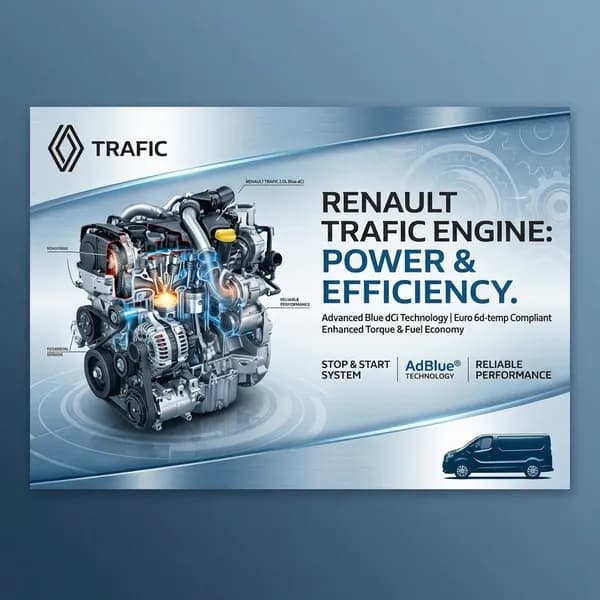
Renault Trafic Engine
Renault Trafic Engine : Performance
The Renault Trafic engine stands as the heart of one of Europe’s most popular commercial vans. This powerplant has evolved significantly since its debut, shaping the vehicle’s performance, efficiency, and reliability. Understanding the intricacies of the Renault Trafic engine is crucial for owners, fleet managers, and mechanics alike, as it has an impact on operational costs, maintenance schedules, and overall vehicle longevity. Source
This guide delves into the world of Renault Trafic engines, covering their evolution, current options, and key characteristics. It explores performance metrics, fuel efficiency, and emissions standards that these engines meet. The article also examines common maintenance requirements, including oil types, timing chain intervals, and potential issues like DPF clogging or turbo failures. By the end, readers will have a comprehensive understanding of what makes the Renault Trafic engine tick and how to keep it running smoothly. See Renault Trafic Minibus Leasing
Evolution of Renault Trafic Engines
The Renault Trafic, a light commercial vehicle, has been a staple in the automotive industry since its introduction in 1980. Over the years, this popular van has undergone significant changes, particularly in its engine technology. Let’s explore the evolution of Renault Trafic engines through its three generations.
First Generation (1980-2001)
The original Renault Trafic made its debut in 1980, featuring a variety of engine options to suit different needs. Initially, the van came with a 1397 cc motor, which fit behind a flat grille. For those requiring more power, Renault offered larger engines, including a 2.1-liter diesel and a 1647 cc petrol engine. These larger powerplants necessitated an extended plastic grille and a deeper bumper.
In the mid-1980s, Renault introduced a 1721 cc OHC engine to replace the 1647 cc OHV unit. This new engine fit under the shorter grille but required a small lump in the bonnet. The diesel and 2.2-liter petrol engines continued with the extended grille design.
A significant milestone came at the end of 1984 with the introduction of a four-wheel drive version. This part-time system was coupled with the diesel engine and a five-speed manual transmission. It operated as a front-wheel drive until the rear wheels were engaged using a dog clutch, similar to the system used in the Renault R18 4×4.
The first-generation Trafic underwent two major facelifts. In May 1989, it received a rounder front end with a plastic bumper and a new longer body shape accommodating all engine varieties. The final facelift came in 1995, introducing a new grille, tail lights, large double rear-view mirrors, and a modernized interior with an updated dashboard and multi-adjustable seats.
Second Generation (2001-2014)
The second-generation Renault Trafic marked a new era of collaboration in the automotive industry. It was the result of a joint venture between Renault, Opel (a German automaker), and Nissan (a Japanese manufacturer). This collaboration led to the Trafic being sold under different brands, including Opel/Vauxhall Vivaro and Nissan Primastar.
Designed by Renault’s corporate design department at the Technocentre near Paris, the new Trafic was developed by the engineering team of Renault’s light commercial vehicle unit in Villiers-Saint-Frédéric. Interestingly, this generation of the Trafic became the first Renault vehicle to be built in the United Kingdom in over thirty years, manufactured at GM Manufacturing Luton’s plant alongside the Primastar and Vivaro.
Third Generation (2014-Present)
Renault introduced the third-generation Trafic in September 2014, continuing its collaboration with other manufacturers. This new model was again rebadged and sold as the Opel Vivaro in Europe and Vauxhall Vivaro in the UK.
The third-generation Trafic brought significant advancements in engine technology. In 2019, Renault introduced a new range of 2.0-liter BluedCi diesel engines, replacing the previous units. These new powerplants offer improved performance and efficiency while meeting stringent Euro 6D-Full emissions regulations.
The current engine lineup includes four variants of the 2.0-liter diesel:
| Engine Model | Power Output |
|---|---|
| dCi 110 | 110 hp |
| dCi 130 | 130 hp |
| dCi 150 | 150 hp |
| dCi 170 | 170 hp |
All these engines come with stop-start functionality, contributing to improved fuel efficiency. The dCi 110 and dCi 130 are available with a six-speed manual gearbox, while the more powerful dCi 150 and dCi 170 offer an optional six-speed EDC automatic transmission.
These new engines provide more power and torque compared to their predecessors, with increases of up to 25 hp and 40 Nm respectively. Despite the performance boost, they maintain excellent fuel efficiency, with the dCi 110, dCi 130, and dCi 150 all achieving official WLTP figures of up to 40.9 mpg.
Current Renault Trafic Engine Options
The Renault Trafic now boasts an impressive lineup of four powerful and efficient 2.0-liter BluedCi diesel engines. These engines, introduced in 2019, have been designed to meet the stringent Euro 6D-Full emissions standards while offering improved performance and fuel efficiency. Each engine in the range comes equipped with Renault’s innovative Stop & Start technology, which helps to reduce fuel consumption and emissions.
Blue dCi 110 Renault Trafic Engine
The Blue dCi 110 serves as the entry-level option in the Renault Trafic engine range. This 2.0-liter turbocharged engine delivers 110 horsepower and 300 Nm of torque, providing a balance between efficiency and performance. It comes paired with a 6-speed manual transmission, allowing for precise control and optimal fuel economy. The Blue dCi 110 is an ideal choice for those who prioritize fuel efficiency and don’t regularly transport heavy loads.
Blue dCi 130
Stepping up in power, the Blue dCi 130 offers 130 horsepower and an impressive 330 Nm of torque. This engine replaces the previous dCi 120 model, providing a noticeable boost in performance. Like its less powerful sibling, it comes with a 6-speed manual gearbox. The Blue dCi 130 strikes a balance between fuel efficiency and driving pleasure, making it a versatile option for various Trafic applications.
Blue dCi 150
The Blue dCi 150 engine takes performance up a notch with 150 horsepower and 350 Nm of torque. This powerplant offers a significant increase in responsiveness and driving comfort compared to its predecessors. It’s available with either a 6-speed manual transmission or a 6-speed EDC (Electronic Diesel Control) dual-clutch automatic gearbox. The latter option combines the advantages of both manual and automatic transmissions, providing smooth shifts and enhanced driving pleasure.
Blue dCi 170
At the top of the range sits the Blue dCi 170, the most powerful engine option for the Renault Trafic. With 170 horsepower and a robust 380 Nm of torque, this engine delivers exceptional performance and responsiveness in all driving situations. Like the Blue dCi 150, it’s available with either a 6-speed manual or a 6-speed EDC automatic transmission. The Blue dCi 170 is particularly well-suited for those who frequently transport heavy loads or require maximum pulling power.
All four engine options in the current Renault Trafic range incorporate AdBlue® technology, which helps to reduce harmful emissions without compromising on performance. This system works in conjunction with the engines to minimize NOx emissions, ensuring compliance with the latest environmental regulations.
To provide a clear comparison of the engine options, here’s a table summarizing their key specifications:
| Engine Model | Power Output | Torque | Transmission Options |
|---|---|---|---|
| Blue dCi 110 | 110 hp | 300 Nm | 6-speed manual |
| Blue dCi 130 | 130 hp | 330 Nm | 6-speed manual |
| Blue dCi 150 | 150 hp | 350 Nm | 6-speed manual or EDC automatic |
| Blue dCi 170 | 170 hp | 380 Nm | 6-speed manual or EDC automatic |
These engines offer impressive fuel efficiency, with the Blue dCi 110, 130, and 150 models achieving up to 40.9 mpg combined according to WLTP figures. The Blue dCi 170, despite its higher power output, still maintains excellent efficiency while providing enhanced performance.
The current Renault Trafic engine lineup caters to a wide range of needs, from urban delivery services to long-distance hauling. With the integration of advanced technologies like Stop & Start and AdBlue®, these engines strike an optimal balance between power, efficiency, and environmental responsibility.
Performance Characteristics Renault Trafic Engine
The Renault Trafic engine performance characteristics showcase its versatility and capability as a commercial vehicle. With a range of powerful engines and impressive capabilities, the Trafic is designed to meet the diverse needs of businesses and individuals alike.
Horsepower and Torque Renault Trafic Engine
The Renault Trafic engine offers a lineup of 2.0-liter turbocharged diesel engines, each providing a balance of power and efficiency. The range includes:
- Blue dCi 110: This entry-level engine delivers 110 horsepower and 300 Nm of torque.
- Blue dCi 130: With 130 horsepower and 330 Nm of torque, this engine offers increased responsiveness.
- Blue dCi 150: Producing 150 horsepower and 350 Nm of torque, this option provides enhanced driving pleasure.
- Blue dCi 170: The top-tier engine boasts 170 horsepower and an impressive 380 Nm of torque.