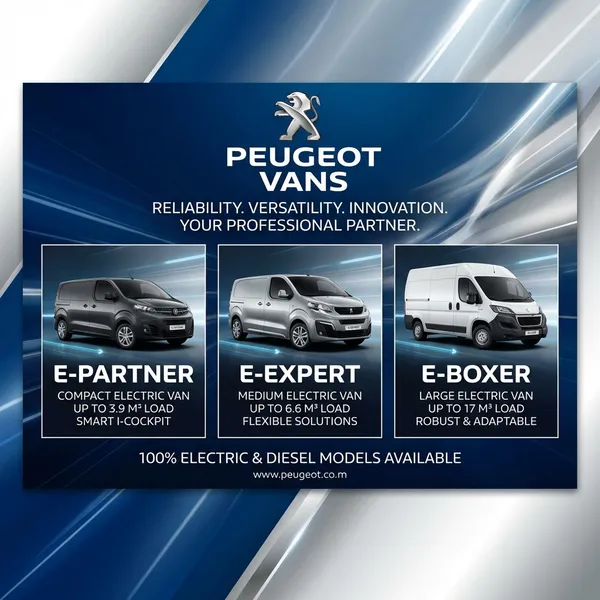
Peugeot Vans Models – Complete Commercial Van Line-Up
Peugeot Partner – Compact Van Model
Peugeot vans models have become a staple in the commercial vehicle market, offering a range of options to suit various business needs. From small peugeot vans to large peugeot vans, the lineup includes the versatile Peugeot Partner van, the practical Peugeot Expert van, and the spacious Peugeot Boxer van. These vehicles have made a name for themselves as reliable workhorses, combining efficiency with functionality to meet the demands of modern businesses.
In this article, we’ll take a closer look at the key differences between the Peugeot Expert, Partner, and Boxer models. We’ll compare their sizes and capacities, examine their performance and efficiency, explore the features and technology they offer, and weigh their price and value propositions. By the end, readers will have a clear understanding of how these peugeot vans commercial vehicles stack up against each other and which model might best suit their specific requirements.
Overview of Peugeot’s Van Range
Peugeot offers a comprehensive range of vans to cater to various business needs. The lineup includes three main models: the Partner, the Expert, and the Boxer. Each model has its unique features and capabilities, making them suitable for different types of commercial applications.
The Partner
The Peugeot Partner has established itself as a leader in the small van segment. It has claimed the Parkers Small Van of the Year Award in both 2020 and 2021, a testament to its exceptional value and performance. The Partner delivers a delightful driving experience, surprising technological features, and impressive payload capacity.
One of the Partner’s standout features is its comfortable and stylish interior. It incorporates Peugeot’s i-Cockpit dashboard layout, which includes a compact steering wheel and high-set dials. The van offers ample storage space, including a large shelf above the seats, a box on the dashboard, door bins, and cupholders.
The Partner comes in two body lengths: standard and long. The long version has a slightly longer wheelbase and can carry much longer items inside. It provides a load volume of up to 4.4m3 and a payload capacity of up to 987 kg. The van also offers a towable load of up to 1200 kg (braked).
For those looking to go green, the Partner is available in a fully electric version called the e-Partner. This electric variant offers unrestricted access to low-emission zones, savings on fuel and maintenance costs, and qualifies for government incentives like the Plug-in Van Grant.
The Expert
The Peugeot Expert, which underwent a complete overhaul in 2016, is a middleweight van that combines practicality with car-like driving dynamics. It uses the PSA Group’s EMP2 platform, which is also used in passenger cars, resulting in a more refined driving experience compared to many rival vans.
The Expert is available in three body lengths: Compact, Standard, and Long. The Compact version bridges the gap between the smaller Partner and the rest of the Expert range, with an overall length of 4,600mm. The Standard van is 4,950mm long, while the Expert Long measures 5,300mm. All versions can fit two Euro pallets inside.
Peugeot offers the Expert with a range of diesel engines, including the BlueHDi 100, BlueHDi 120, and BlueHDi 180 models. These engines meet Euro 6 emissions standards and offer some of the best economy and emissions figures in the mid-sized van sector. For those seeking an eco-friendly option, the electric e-Expert was introduced in 2020, offering a range of up to 211 miles with the larger 75kWh battery option.
The Boxer
The Peugeot Boxer is the largest panel van in the company’s lineup. Despite being around for a while, updates in 2014, 2016, and 2019 have kept it competitive in its class. The most recent update added Euro 6 compliant engines, improving its environmental credentials.
The Boxer offers a wide range of options to suit various needs. It’s available in four lengths and three heights, providing payload capacities ranging from 1,125kg to 1,570kg. Load volumes extend from 8 cubic meters in the L1 H1 (short wheelbase, low roof) model to 17 cubic meters in the L4 H3 (extra long wheelbase, high roof) version.
One of the Boxer’s strengths is its relatively lightweight construction, making it popular with converters for its flexibility when it comes to putting a body on the back and adding equipment inside. Peugeot also offers a dedicated range of off-the-shelf Boxer vans, including curtain-sided, drop-sided, Luton, and tipper versions.
Size and Capacity Comparison
Peugeot’s van range offers a variety of sizes and capacities to suit different business needs. The Partner, Expert, and Boxer models each have their own unique dimensions and capabilities, making them suitable for various commercial applications.
Dimensions
The Peugeot Partner, the smallest in the range, comes in two body lengths: Standard and Long. The Standard version has a wheelbase of 2,785mm, while the Long version extends to 2,975mm. This translates to load lengths of 1,817mm and 2,167mm, respectively, when measured along the cargo floor. The overall length of the Partner ranges from 4,403mm for the Standard model to 4,753mm for the Long version.
Moving up in size, the Peugeot Expert offers three body lengths: Compact, Standard, and Long. The Standard Expert measures 4,959mm in length, while the Long version extends to 5,309mm. Both variants share a wheelbase of 3,275mm. The Expert’s height varies slightly between models, with the Short version standing at 1,940mm and the Long version at 1,948mm.
The Boxer, being the largest in the lineup, provides even more spacious options. It’s available in four lengths and three heights, offering a wide range of configurations to meet diverse business requirements.
Payload
Payload capacity is a crucial factor for many businesses, and Peugeot’s van range doesn’t disappoint in this aspect. The Partner offers impressive payload options, with some models capable of carrying up to 1,000kg. The payload rating varies depending on the specific model, engine, and trim level, ranging from 650kg to 1,000kg.
The Expert, being a medium-sized van, offers competitive payload capacities. While specific figures vary across models, some Expert variants can carry payloads of up to 1,170kg, making it a strong contender in its class.
The Boxer, as the largest van in the range, provides the highest payload capacities. Depending on the specific configuration, the Boxer can handle payloads ranging from 1,125kg to 1,570kg, catering to businesses with heavy-duty transport needs.
Cargo Volume
In terms of cargo volume, each model in Peugeot’s van range offers different capacities to suit various business requirements. The Partner, despite its compact size, provides impressive cargo space. The Standard length offers a load volume of 3.3 cubic meters, while the Long version increases this to 3.8 cubic meters. With the optional Multi-Flex under-seat storage system, these volumes can be expanded to 3.9 and 4.4 cubic meters, respectively.
The Expert, as a medium-sized van, naturally offers larger cargo volumes. While specific figures weren’t provided in the key points, its dimensions suggest it can accommodate significant loads. The Expert can fit two Euro pallets in its load area, and with three body lengths available, it provides flexibility for various cargo needs.
The Boxer, being the largest in the range, offers the most substantial cargo volumes. Load volumes in the Boxer extend from 8 cubic meters in the shortest, lowest roof model (L1 H1) to an impressive 17 cubic meters in the extra-long wheelbase, high roof version (L4 H3).
Each model in Peugeot’s van range has its strengths in terms of size and capacity. The Partner excels in maneuverability and efficiency for smaller loads, the Expert strikes a balance between capacity and drivability, while the Boxer offers maximum space and payload for heavy-duty requirements. This diverse range ensures that businesses can find a Peugeot van that fits their specific needs.
Performance and Efficiency
Engine Options
Peugeot offers a range of engine options across its van lineup to cater to various performance needs. The Expert van, for instance, comes with BlueHDi diesel engines in 120PS, 140PS, and 180PS variants. These engines meet Euro 6 emissions standards, showcasing Peugeot’s commitment to environmental responsibility.
The BlueHDi 100 features a 1.5-liter engine producing 99bhp, while the BlueHDi 120 and BlueHDi 180 models utilize a larger 2.0-liter engine, delivering 119bhp and 178bhp respectively. Torque figures range from 210Nm to 370Nm, providing ample pulling power for diverse load requirements.
Transmission options vary depending on the engine choice. The 99bhp and 119bhp engines come standard with a six-speed manual gearbox, while the 178bhp version is equipped with an eight-speed automatic transmission featuring steering wheel paddle-shifters.
The Boxer, Peugeot’s largest van, offers diesel engine options including BlueHDi 140 and 180 hp variants, providing robust performance for heavy-duty applications.
Fuel Economy
Fuel efficiency has become a crucial factor for van operators, and Peugeot’s van range has made significant strides in this area. The Expert van, in particular, has shown impressive fuel economy figures. The BlueHDi 100 engine leads the pack with a combined cycle rating of 44.2 mpg under the WLTP testing protocol, accompanied by CO2 emissions of 176 g/km.
The 2.0-liter BlueHDi 120 engine achieves 40.5 mpg with CO2 emissions of 190 g/km, while the BlueHDi 180 with the eight-speed automatic transmission manages 39.4 mpg and 204 g/km of CO2 emissions.
For the larger Boxer van, fuel consumption is rated at 35.3 mpg, with CO2 emissions of 216 g/km. It’s worth noting that these figures may vary depending on factors such as driving conditions, vehicle load, and use of equipment like air conditioning or heating.
Peugeot’s commitment to lightweight construction has contributed to these impressive efficiency figures. Engineers estimate that the Expert van is between 100kg and 150kg lighter than its predecessor and up to 300kg lighter than some competitors, resulting in fuel economy improvements of around 5 mpg in real-world conditions.
Electric Variants
Recognizing the growing demand for eco-friendly transport solutions, Peugeot has introduced electric variants to its van lineup. The e-Expert, launched in 2020, represents Peugeot’s foray into the electric van market. It features a 100 kW (136 hp) electric motor with a maximum torque of 260 Nm, offering smooth and quiet operation.
The e-Expert provides two battery capacity options: 50 kWh and 75 kWh. The 50 kWh battery offers a range of up to 143 miles (230 km) according to the WLTP protocol, while the 75 kWh battery extends this to an impressive 205 miles (330 km).
Charging flexibility has been a key focus for Peugeot. The e-Expert comes with a standard 7.4 kW single-phase on-board charger, with an optional 11 kW three-phase charger available. Using a 100 kW public fast-charging station, the e-Expert can reach 80% charge in just 45 minutes.
The e-Boxer, Peugeot’s largest electric van, boasts an even more impressive range of up to 263 miles WLTP. It offers rapid charging capabilities, reaching 80% charge in 55 minutes using a 150 kW public charging station. With power outputs of up to 200 kW (270 hp), the e-Boxer demonstrates that electric vans can deliver both performance and efficiency.
Both electric models produce zero CO2 emissions during operation, making them ideal choices for businesses operating in low-emission zones or those aiming to reduce their carbon footprint.
Features and Technology
Safety Systems
Peugeot vans are equipped with advanced safety features to ensure driver and passenger protection. The PEUGEOT Connect SOS system stands out as a crucial safety measure. This technology utilizes an integrated SIM card to automatically alert emergency services in case of an accident, providing location details for swift assistance. Drivers can also manually activate this feature by pressing a button, connecting them directly to emergency services.
For non-emergency situations, the PEUGEOT Connect Assistance button connects drivers to a control center. This service offers remote troubleshooting or dispatches roadside assistance when needed. These features demonstrate Peugeot’s commitment to driver safety and vehicle reliability.
The Active Safety Brake system enhances road safety by automatically engaging the brakes if the driver fails to respond to warnings. This technology helps prevent collisions or reduce their severity by decreasing the vehicle’s speed. Additionally, the Lane Departure Warning system uses a camera to detect unintentional lane crossings, alerting the driver through visual and acoustic signals. Its active system can even make slight trajectory corrections to keep the vehicle in its lane.
Infotainment
Peugeot vans boast state-of-the-art infotainment systems designed to enhance the driving experience. The centerpiece of this system is a 10-inch HD touchscreen, standard in models like the E-PARTNER and E-EXPERT. This screen controls various functions, including the audio system and TOM TOM 3D connected navigation.
The infotainment system is further enhanced by the OK PEUGEOT voice assistant, allowing drivers to control main functions using natural language commands. This feature proves particularly useful for professionals who frequently enter and exit their vehicles.
Connectivity has been given special attention in Peugeot vans. The system supports wireless connections to Apple CarPlay and Android Auto, enabling drivers to access smartphone content on the central screen without the need for cables. A wireless smartphone charger, conveniently located on the center console, adds to the practicality of the system.
For larger models like the E-BOXER, the infotainment system includes a 7-inch all-digital instrument cluster. This customizable display can show various information, including a 3D map of the navigation system, providing drivers with clear and concise data at a glance.
Driver Assistance
Peugeot vans come equipped with an impressive array of driver assistance technologies. The Adaptive Cruise Control with Stop and Go function, coupled with Lane Centering Assistance and Traffic Jam Assistant, significantly reduces driver fatigue during long journeys.
The Blind Spot Monitoring system enhances safety by alerting drivers to vehicles in adjacent lanes through indicator lights in the relevant mirror. This system works in conjunction with an active alert mechanism for added safety.
Parking assistance has been given special attention in Peugeot vans. The Visio Park system provides a 180° video camera view, while some models feature an additional camera in the radiator grille for improved visibility. The Park Assist function uses ultrasonic sensors to analyze parking space size and control steering during parking maneuvers.
Other notable driver assistance features include Traffic Sign Recognition, which detects and displays speed limit signs on the instrument panel, and Hill Start Assist, which facilitates starting and maneuvering on slopes by briefly holding the vehicle stationary.
These advanced features and technologies in Peugeot vans not only enhance safety and convenience but also demonstrate the brand’s commitment to innovation in commercial vehicles. By integrating these systems, Peugeot has created a range of vans that cater to the diverse needs of modern businesses while prioritizing driver comfort and safety.
Price and Value Proposition
Starting Prices
Peugeot offers a range of vans to suit different business needs and budgets. The Expert van, a popular choice in the lineup, has a starting price of £39,340.43 plus on-road costs for the Pro Long Auto variant. This model features a 2.0-liter four-cylinder turbo-diesel engine and automatic transmission. It’s worth noting that this price point is higher than some competitors, such as the long-wheelbase HiAce auto equivalent, which is priced at £36,736.06.
For those requiring a larger vehicle, the Boxer 160 is available with a 2.0-liter turbo-diesel engine and six-speed manual transmission. Customers can choose between a 4035mm long wheelbase or a 3450mm standard wheelbase. The standard wheelbase model has a list price of £37,309.57.
Total Cost of Ownership
When considering the purchase of a Peugeot van, it’s essential to look beyond the initial price tag and consider the total cost of ownership. Peugeot has taken steps to make their vans more economical to run over time.
One significant factor in the total cost of ownership is fuel efficiency. Peugeot’s commitment to lightweight construction has resulted in fuel economy improvements. For instance, the Expert van is estimated to be between 100kg and 150kg lighter than its predecessor and up to 300kg lighter than some competitors. This weight reduction translates to fuel economy improvements of around 5 mpg in real-world conditions, which can lead to substantial savings over the vehicle’s lifetime.
Maintenance costs also play a crucial role in the total cost of ownership. Peugeot offers capped-price servicing for the first five scheduled services, helping owners budget for ongoing maintenance expenses. For example, the Expert has a total capped-price servicing cost of £238.839 over five years, averaging £479.08 per year. The Boxer’s capped-price servicing for the first five scheduled services totals £270.265.
Warranty
Peugeot provides comprehensive warranty coverage for its van range, offering peace of mind to business owners. The Expert and Boxer models are covered by a five-year/200,000km warranty, which is competitive in the commercial vehicle market.
This warranty covers manufacturing defects, paintwork issues, and perforation (corrosion of the bodywork from the inside to the outside). It includes the repair or free replacement of defective parts, excluding those subject to normal wear and tear, such as brake pads. For paintwork defects, Peugeot offers partial or total respraying or re-lacquering to rectify the issue.
Peugeot’s warranty coverage extends across the entire European Union and 15 other countries or regions. All warranty work is carried out free of charge by professionals in the Peugeot network, ensuring quality service and maintenance.
For electric and hybrid vehicles in the Peugeot range, there’s an additional 8-year warranty specifically for the traction battery. This extended coverage demonstrates Peugeot’s confidence in their electric vehicle technology and provides added value for businesses considering the switch to electric vans.
The combination of competitive pricing, efficient fuel economy, capped-price servicing, and comprehensive warranty coverage contributes to a compelling value proposition for Peugeot vans. While the initial purchase price may be higher than some competitors, the potential long-term savings in fuel and maintenance costs, coupled with the peace of mind provided by the warranty, make Peugeot vans an attractive option for businesses looking for reliable and cost-effective commercial vehicles.
Conclusion
Peugeot’s van lineup offers a comprehensive range of options to meet diverse business needs. From the compact Partner to the spacious Boxer, each model brings its own strengths to the table. The Expert stands out as a versatile middle ground, combining practicality with car-like driving dynamics. These vans have an influence on the commercial vehicle market with their blend of efficiency, technology, and functionality.
To wrap up, Peugeot’s commitment to innovation is clear in their van range. The inclusion of advanced safety features, modern infotainment systems, and electric variants shows their focus on meeting current and future market demands. While the initial cost might be higher for some models, the potential long-term savings in fuel and maintenance, coupled with comprehensive warranty coverage, make Peugeot vans a solid choice to consider for businesses looking for reliable and cost-effective commercial vehicles.
FAQs
1. Which Peugeot van is larger, the Partner or the Expert?
The Peugeot Expert is larger than the Partner. The Expert Compact, which is a smaller version within the Expert range, has a wheelbase of 2,925mm and an overall length of 4,600mm, allowing it to accommodate two pallets. The standard Expert measures 4,950mm in length, and the Expert Long extends to 5,300mm.
2. What vans are comparable to the Peugeot Boxer?
The Peugeot Boxer is similar to the Citroen Relay and the Vauxhall Movano. These vans are essentially the same but feature different branding. The range offers a variety of options to meet diverse needs.
3. Are there any vans similar to the Peugeot Expert?
The Peugeot Expert shares its design with several other vans including the Vauxhall Vivaro, Citroën Dispatch, Fiat Scudo, and Toyota Proace. These vans are not only similar in design but are also manufactured in the same factory, primarily the Vauxhall factory in Luton.
4. How does the Peugeot Boxer perform?
The Peugeot Boxer is known for its satisfactory performance, featuring light and well-positioned controls, along with excellent front visibility from one of the highest driving positions available in the current van market.