LDV Maxus Van Won't Start When Cold? Causes & Fixes
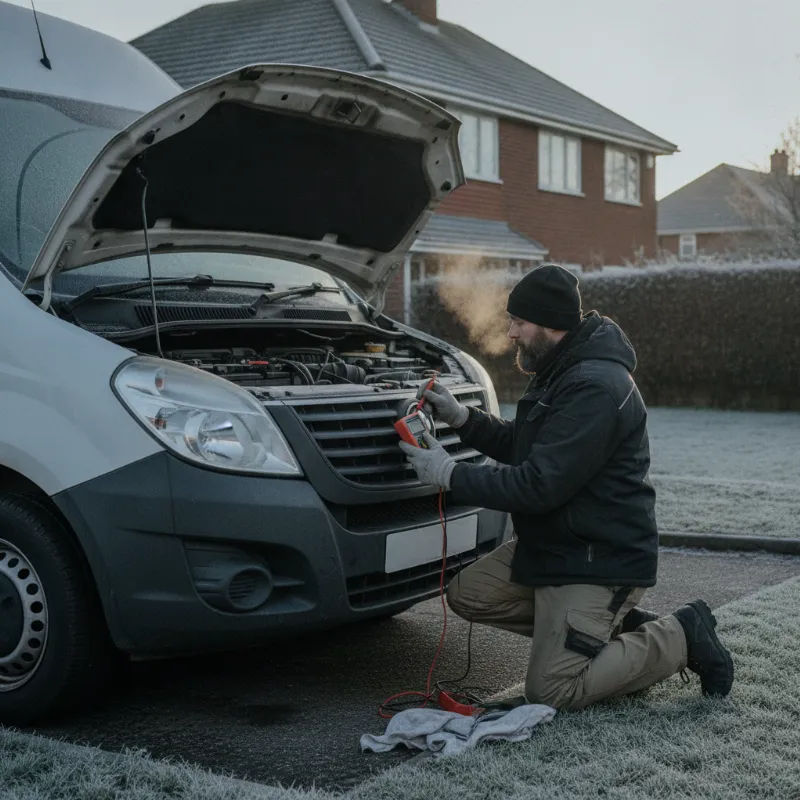
Why your LDV Maxus van won't start when cold: the quick answer
If your LDV Maxus refuses to fire up on a cold morning, nine times out of ten the culprit is one of a small handful of components: a tired battery that can't deliver enough cranking amps, glow plugs that aren't preheating the combustion chambers properly, or a fuel system that's struggling with cold, waxy diesel. Less commonly, you might be looking at a worn starter motor, a corroded earth strap, or — on the electric e-Deliver models — a high-voltage battery that's simply too cold to discharge at its normal rate.
The good news is that most of these issues are diagnosable at home with a multimeter and a bit of patience, and many are inexpensive to put right. Below, we walk through the most common cold-start problems on the LDV Maxus range, what to check before you pay for a call-out, and how to stop the same thing happening next winter.
Common cold-start problems on Maxus vans
The LDV Maxus — including the older V80, the newer Deliver 9, and the electric e-Deliver 3 and e-Deliver 9 — is a hard-working commercial vehicle, but like any van it has a few weak spots that show up when the temperature drops below freezing. Here are the issues we see most often.
Weak or failing battery in cold weather
Cold weather is brutal on batteries. At 0°C a battery can lose around a third of its cranking power, and at -18°C that figure climbs to nearly half. If your Maxus battery is more than four or five years old, or if it's been sitting through a spell of short journeys where it never fully recharges, a cold snap is often the tipping point. You'll typically hear the starter turn over slowly, the dash lights dim as you crank, or you'll get nothing but a click from the solenoid.
A quick test with a multimeter should show around 12.6 volts at rest and no less than 9.6 volts while cranking. Anything significantly lower and the battery is on its way out. It's also worth checking the terminals for the telltale white or greenish crust of corrosion, which can throttle the current even on a healthy battery.
Glow plug faults on diesel Maxus vans
Diesel engines rely on compression to ignite the fuel, and when it's cold the cylinders lose heat too quickly for that to happen reliably. Glow plugs solve this by preheating the combustion chamber for a few seconds before you crank. If one or more glow plugs has failed — or if the glow plug relay has packed in — you'll get long cranking times, white smoke on start-up, a rough idle for the first minute, and often an amber warning light on the dash.
On the Maxus 2.5 and 2.0 diesel engines, glow plugs typically last around 60,000 to 100,000 miles. Testing them is straightforward with a multimeter — a healthy plug reads under 2 ohms of resistance. Replacement is a job most competent DIYers can tackle, though seized plugs in an aluminium head are a known headache and are sometimes worth handing to a specialist.
Fuel system issues (diesel waxing, filter, injectors)
Diesel fuel contains paraffin wax, and when the temperature drops below about -7°C that wax can start to crystallise, clogging the fuel filter and starving the engine. UK forecourts switch to a winter blend from mid-November, but if you've been running on summer diesel that's been sitting in the tank, or you fill up abroad, you can still get caught out. A blocked fuel filter is another common culprit — if yours hasn't been changed in the last 20,000 to 30,000 miles, it's overdue.
Worn or leaking injectors can also cause cold-start problems, since they don't atomise the fuel finely enough to ignite in a cold cylinder. Signs include a strong diesel smell, black smoke once it does start, and a noticeable knock at idle.
Starter motor and earth strap problems
If the battery tests fine but you're still getting a slow crank or a repetitive clicking, the starter motor itself may be tired. Brushes wear down over time and cold thickens the grease inside the motor, so a starter that's been borderline all summer will often give up on the first frosty morning. Equally common — and much cheaper to fix — is a corroded earth strap between the engine and chassis. A poor earth connection acts like a partial short, robbing the starter of the current it needs. Give the strap a visual once-over and clean up any rust or paint at the contact points.
EV Maxus e-Deliver models: cold-weather battery behaviour
The electric e-Deliver 3 and e-Deliver 9 don't have glow plugs or fuel to worry about, but they have their own cold-weather quirks. Lithium-ion batteries deliver noticeably less power and charge more slowly when they're cold-soaked overnight. You may see a reduced range estimate, slower acceleration in the first few miles, and — in extreme cold — the van refusing to power up until the battery management system has warmed the pack enough.
Preconditioning the battery while it's still plugged in is the single most effective fix. Most e-Deliver owners get into the habit of scheduling a departure time via the app so the battery is warmed and ready when they climb in. If your 12V auxiliary battery has failed (yes, EVs still have one), the high-voltage system won't wake up at all — worth checking with a multimeter before assuming the worst.
Step-by-step: what to check before calling a mechanic
Before you spend money on a call-out, work through this quick checklist. It only takes ten minutes and often turns up the culprit.
First, turn the key to position II (ignition on, but don't crank) and watch the dashboard. Do all the warning lights come on brightly, or are they dim? Dim lights point to a battery or charging problem. Next, listen for the fuel pump priming — a two-second whirr from the back of the van. Silence there suggests a pump or relay fault.
Now cycle the ignition on and off two or three times before cranking. This gives the glow plugs a full preheat cycle and often gets a stubborn diesel to fire. If it still won't start, check the battery voltage with a multimeter — anything under 12.4 volts at rest suggests it needs a charge or a replacement. Have a look at the battery terminals and the earth strap for corrosion, and check under the bonnet for any obvious loose connectors, chewed wiring, or fuel leaks.
Finally, if the engine cranks strongly but simply won't catch, try a small shot of a diesel cold-start spray into the air intake (used sparingly — it's not a long-term fix). If that gets it running, you're almost certainly looking at glow plugs or fuel system trouble that needs diagnosing properly.
How to prevent cold-start issues on your Maxus van
Prevention is much cheaper than a recovery truck at 6am. If your Maxus lives outside, a solar trickle charger or an overnight mains charger will keep the battery topped up, which massively extends its life and guarantees a strong crank on cold mornings. Aim to replace the battery every four to five years as a matter of course, rather than waiting for it to fail.
For diesel models, use a fuel system additive through the winter months — it lowers the wax point and keeps injectors clean. Change the fuel filter on schedule, and keep the tank at least a quarter full to reduce condensation. If you're due a service, ask your garage to test the glow plugs and check the starter draw at the same time; both take minutes with the right kit.
e-Deliver owners should get into the habit of leaving the van plugged in overnight whenever possible, even at a low state of charge, and use scheduled departure or preconditioning through the LDV app. Park nose-in to a wall or building to shelter the front of the van from the worst of the wind chill.
When it's time to consider replacing your LDV Maxus
Cold-start problems on their own aren't usually a reason to replace a van — a battery, glow plugs, and a fuel filter together will rarely top £500 and buy you years more service. But if your Maxus is starting to rack up faults across the board — the starter this winter, an injector last summer, a turbo before that — the maths starts to shift. Once annual repair bills climb past what you'd pay in finance on a newer van, and once downtime starts costing you jobs, it's worth doing a proper cost comparison.
Older V80s in particular are getting harder to keep on the road as parts availability tightens, and if yours is approaching 150,000 miles with a tired engine, a move up to a Deliver 9 or a switch to an e-Deliver may make more sense than another round of repairs. Get a part-exchange valuation on your current van and see where you stand — you may be pleasantly surprised at what a well-kept Maxus is still worth.
FAQs: LDV Maxus cold-start problems
Below are answers to the questions Maxus owners ask us most often when the temperature drops.
FAQs
Why won't my LDV Maxus van start when it's cold, and how do I fix it?
The three most common causes are a weak battery that can't deliver enough cranking amps in the cold, failed or failing glow plugs that aren't preheating the cylinders, and fuel system problems such as a clogged filter or waxed diesel. Start by checking the battery voltage — it should read 12.6V at rest and stay above 9.6V during cranking. Cycle the ignition two or three times to give the glow plugs a full preheat, and check the earth strap and battery terminals for corrosion. If cranking is strong but the engine won't catch, glow plugs or the fuel system are the most likely suspects and are worth having tested properly.
How much does it cost to replace glow plugs on an LDV Maxus?
Glow plugs themselves are typically £15 to £30 each, and a diesel Maxus has one per cylinder — so parts for a four-cylinder engine come to under £120. Labour varies: if the plugs come out cleanly it's usually an hour or two of work, so you're looking at £150 to £300 all in at an independent garage. If a plug is seized in the head, the job can take considerably longer and it's worth going to a specialist to avoid snapping one off.
Can I jump-start an LDV Maxus if the battery is flat in cold weather?
Yes, a diesel Maxus can be jump-started in the normal way — connect the positive leads first, then the negative jump lead to a bare metal earth point on the flat van rather than directly to the battery negative. Let the donor vehicle run for a few minutes before cranking. On the electric e-Deliver models you can jump-start the 12V auxiliary battery to wake the van up, but you cannot jump-start the high-voltage traction battery — that needs charging in the usual way.
Does my LDV Maxus need a special winter diesel?
UK forecourts automatically switch to a winter-grade diesel blend from around mid-November to mid-March, which resists waxing down to about -15°C. You don't need to buy anything special, but if your van sits for long periods, you fill up abroad, or you operate in exposed rural areas, a winter fuel additive is cheap insurance. Keeping the tank at least a quarter full also reduces condensation and helps prevent water in the fuel system, which is a common hidden cause of cold-start trouble.
How long should the battery last on an LDV Maxus?
A standard starter battery on a diesel Maxus typically lasts four to five years in regular use, and slightly less if the van does lots of short journeys or sits unused for weeks at a time. If yours is over four years old and you're heading into winter, it's worth having it load-tested at a garage or a factors — most will do it free of charge. Replacing a battery proactively is far cheaper than a recovery call-out and a missed day's work.