LDV G10 9 Seater Review: Is It the Right People Carrier Van for You?
LDV G10 9 Seater at a glance
The LDV G10 9 Seater sits in a fairly niche corner of the UK van market: a full-size people carrier that blends the practicality of a panel van with the passenger capacity of a minibus. Built by SAIC, the same Chinese automotive giant behind MG, the G10 has been quietly picking up buyers who need to move a lot of people without stepping up to a full PSV-classed minibus or paying premium money for a Volkswagen Caravelle or Mercedes V-Class.
On paper, the appeal is obvious. You get nine full-size seats, a proper sliding side door, a decent-sized rear tailgate and the sort of squared-off body that makes loading kit or luggage far easier than in most MPVs. Prices, both new and used, tend to undercut European rivals by a significant margin, and equipment levels are generous — air conditioning, cruise control, parking sensors and a touchscreen infotainment system are all standard rather than options that inflate the invoice.
It's not without compromises, which we'll get into below, but for community groups, larger families, private hire operators and businesses that need to shuttle staff between sites, the G10 makes a compelling case on cost-per-seat alone.
Interior, van seats and cabin practicality
Step inside the G10 and the first impression is one of space. The cabin is genuinely wide, the ceiling is high, and there's a real sense of airiness that you don't get in a converted panel van. Materials are functional rather than plush — expect hard-wearing plastics and durable cloth upholstery rather than soft-touch dashboards — but everything feels solidly screwed together and easy to wipe clean, which matters when you're regularly ferrying passengers.
The driver gets a car-like driving position with a height-adjustable seat, reach and rake adjustable steering, and clear analogue dials. The centre console houses a touchscreen with Bluetooth and reversing camera display, and there are enough cup holders, cubbies and USB points to keep passengers happy on longer trips.
Seating layout and passenger space
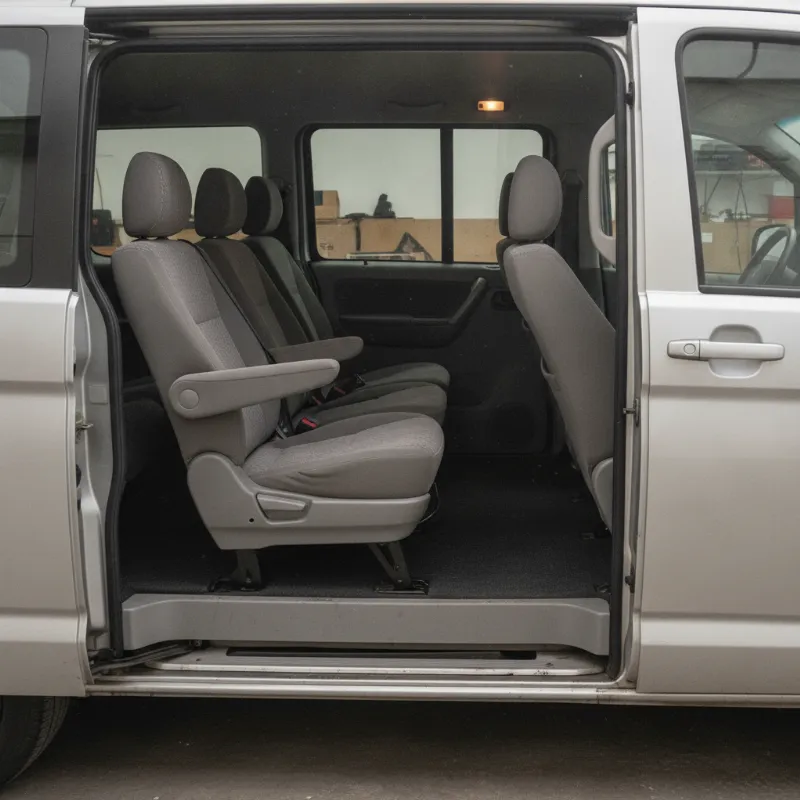
The nine-seat layout is arranged as two front seats, a three-seat middle row and a four-seat rear bench. All nine positions are full-size adult seats with three-point belts and proper headrests — this isn't a case of squeezing kids into token jump seats. Middle and rear passengers benefit from the sliding side door and a low step-in height, so getting in and out is easy even for older or less mobile passengers.
Legroom is generous throughout, and the middle row can be slid fore and aft to balance space between rows depending on who's sitting where. Headroom is excellent thanks to the tall roofline, and large side windows make the cabin feel bright and welcoming rather than van-like.
Boot capacity with all seats in use
This is where the G10 pulls ahead of most nine-seat MPVs. Even with all nine seats occupied, there's a usable luggage area behind the rear bench — enough for a weekly shop, several soft holdalls or a couple of medium suitcases stacked upright. It won't swallow nine full-size suitcases with the rear row in place, but few vehicles at this price point will.
Remove or fold the rearmost row and the load area expands dramatically, giving you a genuinely van-like cargo bay while still keeping seven passenger seats in play. This flexibility is one of the G10's strongest selling points and makes it a viable choice for operators who alternate between people-carrying and load-carrying duties.
Engine, driving experience and running costs
UK-market G10 9 Seaters have typically been offered with a 1.9-litre turbo diesel producing around 141bhp, paired with a six-speed manual or a six-speed automatic gearbox depending on trim and model year. It's not a quick vehicle — 0-60mph takes a leisurely amount of time and motorway overtakes need forward planning — but the engine has plenty of low-down torque for pulling a full load of passengers up hills without labouring.
On the road, the G10 drives more like a van than an MPV. The steering is light, the ride is soft and slightly bouncy when unladen, and body roll in corners is noticeable. Loaded up with passengers, however, it settles down nicely and feels stable and composed at motorway speeds. Refinement is acceptable rather than class-leading — expect a bit of engine noise under acceleration and some wind rustle around the door mirrors at 70mph.
Running costs are one of the G10's strongest suits. Fuel economy sits in the low-to-mid 30s mpg in mixed driving, servicing is competitively priced through the LDV dealer network, and insurance groupings tend to be reasonable for a vehicle of this size. Parts availability has improved considerably as the UK network has grown.
How it compares to other multi-seat vans
The G10 doesn't have many direct rivals — most manufacturers either offer smaller seven-seat MPVs or full minibuses. That in-between position is exactly where the G10 makes its case, but it's worth understanding how it stacks up against the closest alternatives.
LDV G10 9 seater vs 7 seat crew cab van options
A seven-seat crew cab van — think Ford Transit Custom Kombi, Vauxhall Vivaro Crew Van or Volkswagen Transporter Kombi — gives you a bulkhead-separated load bay behind the second row, which is ideal if you're primarily moving tools and occasionally moving people. The G10, by contrast, is designed people-first: you get two extra seats, better all-round passenger comfort, and a proper tailgate rather than barn doors.
If your typical week involves five or six passengers plus a big load of kit, a crew cab van is probably the better fit. If you regularly need to move seven, eight or nine people and treat the load area as a bonus, the G10 wins comfortably — and usually undercuts a well-specced European crew cab on price.
Alternatives if you only need a 3 or 4 seater
If nine seats is more than you'll ever realistically use, it's worth looking down the range. A standard three-seat panel van gives you the biggest possible load bay for the money, while a four or five-seat double cab pickup or crew van offers a compromise between passenger and cargo capacity. Buying more seats than you need means paying for weight you'll be dragging around empty, which hurts fuel economy and, over time, your total cost of ownership.
Be honest about your peak requirement rather than your occasional one. If you only need nine seats twice a year, hiring a minibus for those trips and running a smaller van day-to-day often works out cheaper overall.
Verdict: who should buy the LDV G10 9 Seater?
The LDV G10 9 Seater is a genuinely good buy for a specific type of user. If you're a large family, a community transport group, a care provider, a hotel or airport shuttle operator, or a business that regularly moves teams of staff between sites, the combination of nine full-size seats, flexible luggage space and keen pricing is hard to argue with. It's not the last word in refinement or badge appeal, but it does the core job well and costs noticeably less to buy than the established European competition.
It's less well suited to buyers who need proper load-lugging ability most of the time, or those who prioritise driving dynamics and cabin polish over practicality and value. For everyone else, the G10 deserves a serious look and a test drive before you commit to a pricier alternative — you may well find that the extra badge on the nose of a Caravelle or V-Class doesn't justify the extra thousands on the invoice.
FAQs
Is the LDV G10 9 Seater a good van to buy?
For buyers who genuinely need nine seats, yes — it offers a rare combination of full-size passenger capacity, useful boot space with all seats in use, and pricing that undercuts European rivals like the VW Caravelle and Mercedes V-Class. It's less refined than those alternatives and drives more like a van than an MPV, but the value proposition is strong for families, community groups and businesses that regularly move larger groups of people.
How many seats does the LDV G10 have and are they all full-size?
The G10 9 Seater has nine full-size adult seats arranged as two in the front, three in the middle row and four in the rear bench. All positions have three-point seatbelts and proper headrests, so it's suitable for adult passengers rather than being a seven-seater with two token jump seats added on.
What engine does the LDV G10 9 Seater use and what's the fuel economy like?
UK G10 9 Seaters are typically powered by a 1.9-litre turbo diesel producing around 141bhp, paired with a six-speed manual or automatic gearbox. Real-world fuel economy sits in the low-to-mid 30s mpg in mixed driving, which is competitive for a vehicle of this size and weight, especially when carrying a full load of passengers.
Is there any boot space left with all 9 seats in use?
Yes — unlike many nine-seat MPVs where the last row sits right up against the tailgate, the G10 retains a usable luggage area behind the rear bench. It'll take a weekly shop, several soft bags or a couple of upright suitcases. Folding or removing the rear row transforms it into a large, van-like load bay while still keeping seven seats in place.
How does the LDV G10 compare to a Ford Transit Custom Kombi or VW Transporter Kombi?
The Transit Custom Kombi and VW Transporter Kombi are primarily vans with an added second row — usually six or seven seats and a bulkheaded load bay behind. The G10 is designed people-first, offering nine seats, a tailgate rather than barn doors, and better passenger comfort. If you mostly carry tools and occasionally people, a crew van wins; if you mostly carry people and occasionally kit, the G10 is the better fit.