Dimensions of a Volkswagen Transporter Van: Complete UK Size Guide
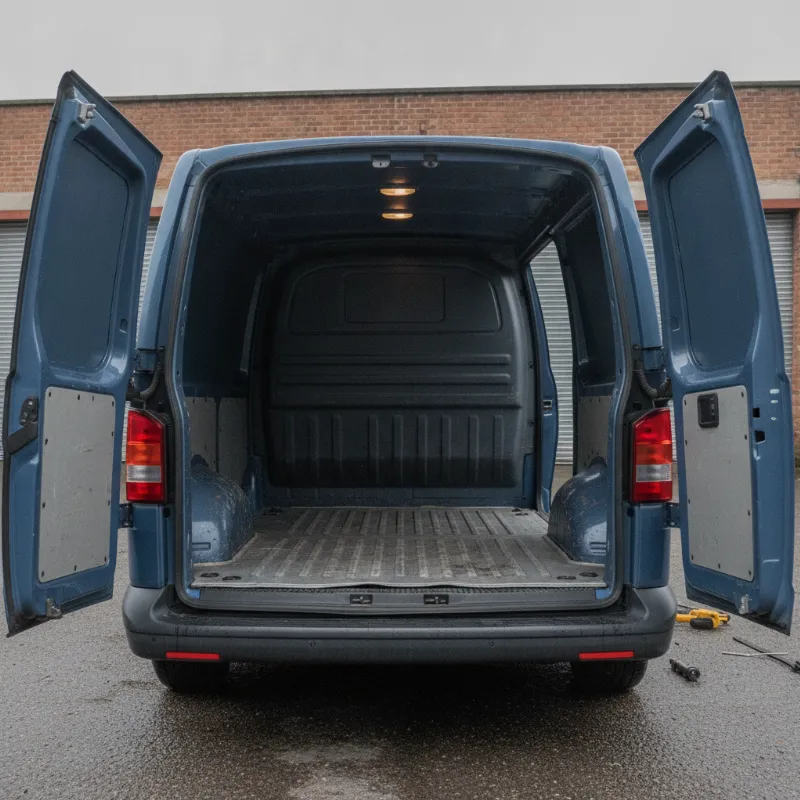
If you're thinking about buying a Volkswagen Transporter, knowing the exact dimensions is essential. Whether you need to squeeze it into a domestic garage, load full sheets of plywood in the back, or make sure it fits under the height barrier at your local car park, the numbers matter. This guide walks through the exterior and interior dimensions of the VW Transporter in detail, covers the differences between wheelbases and roof heights, and helps you work out which configuration is right for your business.
VW Transporter dimensions at a glance
The Volkswagen Transporter is a mid-size panel van that sits between smaller vans like the VW Caddy and larger models such as the VW Crafter. In its most common T6.1 form, the Transporter is offered in two wheelbases (short and long) and two roof heights (standard and high roof), giving buyers four core body configurations before you get into Kombi, crew cab and chassis variants.
As a quick summary, a standard short-wheelbase, standard-roof Transporter measures roughly 4,904mm long, 1,904mm wide (excluding mirrors) and 1,990mm tall. The long-wheelbase version stretches to around 5,304mm, and opting for the high roof takes overall height to just over 2,470mm. Kerb weights start at around 1,940kg, with gross vehicle weights ranging from 2.6 to 3.2 tonnes depending on spec.
Exterior dimensions of the Volkswagen Transporter
Understanding the outside footprint of the Transporter is the first step, particularly if you'll be parking it on driveways, in urban streets or in commercial yards. VW keeps the overall silhouette relatively car-like, which is one of the reasons the Transporter has been so popular with tradespeople and small businesses for decades.
Length: short wheelbase vs long wheelbase
The Volkswagen Transporter is available in two body lengths. The short-wheelbase (SWB) version has a total length of approximately 4,904mm with a wheelbase of 3,000mm. The long-wheelbase (LWB) model extends the rear overhang and wheelbase to give an overall length of around 5,304mm on a 3,400mm wheelbase.
That 400mm difference translates directly into extra load length in the back, so if you regularly carry longer items — such as timber, ladders or pipework — the LWB is usually the sensible choice. If your work is mostly urban, involving tight streets and multi-storey car parks, the SWB is significantly easier to manoeuvre.
Width with and without mirrors
Body width on the Transporter is 1,904mm across all versions. Once you factor in the standard door mirrors, total width increases to approximately 2,297mm. This is an important number to remember, because many older domestic garages and some width-restricted routes are designed around cars closer to 2 metres wide including mirrors.
The good news is that the Transporter's mirrors fold in electrically or manually on most trims, bringing the width back closer to the body dimension for tight parking situations.
Height and roof options
A standard-roof Transporter stands 1,990mm tall — just under the magic 2-metre mark that governs entry to most UK multi-storey and supermarket car parks. This is one of the Transporter's biggest practical advantages over larger vans and a key reason it's so popular with mobile trades who need daily access to customer sites.
Choose the high-roof option and overall height increases to around 2,476mm. You gain a significant amount of internal standing height, but you lose access to height-restricted car parks and some drive-throughs, so it's a trade-off worth thinking through carefully.
Interior load space dimensions
Exterior size is only half the story — what really matters for a working van is what you can fit inside. The Transporter's load bay is well-shaped, with squared-off sides, a low load lip and wide-opening rear barn doors or a tailgate depending on spec.
Load length, width and height
In the short-wheelbase panel van, maximum load length at floor level is approximately 2,572mm, extending to around 2,972mm in the long-wheelbase model. Load width between the wheel arches is 1,244mm — enough to slide a standard 1,200mm-wide sheet of plasterboard flat on the floor, which has always been a key design goal for VW.
Maximum load width at the widest point is 1,700mm. Load height in the standard-roof van is 1,410mm, rising to around 1,940mm in the high-roof version, which is comfortable enough for most adults to stand upright inside.
Load volume and payload
Total load volume ranges from 5.8 cubic metres in the SWB standard-roof panel van up to 9.3 cubic metres in the LWB high-roof configuration. Payloads vary by GVW rating and trim, but typically fall between around 800kg and 1,200kg for the panel van, with heavier-rated 3.2-tonne versions capable of carrying more.
Braked towing capacity is up to 2,500kg on suitable models, which makes the Transporter a genuine option if you need to pull a plant trailer or car transporter alongside carrying tools and materials.
How the VW Transporter T6 dimensions compare to the new VW T7
Volkswagen has replaced the long-running T6.1 with an all-new Transporter developed jointly with Ford, sharing its platform with the Ford Transit Custom. The new model is noticeably larger. Overall length grows to around 5,050mm for the short-wheelbase and 5,450mm for the long-wheelbase, and width increases too.
Height on the standard-roof version is now closer to 2,020mm, meaning it just tips over the 2-metre threshold that the outgoing T6.1 famously sneaked under. Load volume improves significantly as a result — the new panel van offers up to around 9 cubic metres in standard form — but buyers who specifically need sub-2m height for car parks may find late-model T6.1 vans more practical.
Will a Volkswagen Transporter fit in a standard car park or garage?
For most UK car parks the answer is yes, provided you have the standard-roof T6.1. At 1,990mm tall it clears the typical 2m height barrier, and its 1,904mm body width fits comfortably in a standard 2.4m-wide bay. Just be mindful of the 2,297mm mirror-to-mirror width when threading between pillars.
Domestic garages are more variable. A modern integral garage is usually around 5.0m long and 2.4m wide internally, which is fine for a short-wheelbase Transporter but tight for the long-wheelbase. Older single garages built in the 1960s and 70s are often only 4.6m long and 2.2m wide, and generally won't accommodate any Transporter. Always measure before you commit.
Choosing the right VW Transporter size for your business
The right configuration comes down to how you actually use the van day to day. If you're a mobile trade working in towns and cities — plumbers, electricians, mobile mechanics — the short-wheelbase, standard-roof panel van is usually the best compromise between load capacity and everyday drivability. It parks like a large car and clears the height barriers.
If you carry bulky but not especially tall loads, such as furniture, event kit or landscaping materials, the long-wheelbase standard-roof gives you the extra 400mm of load length without sacrificing car park access. The high-roof options really come into their own for couriers, mobile workshops and anyone who needs to work inside the van regularly, where standing headroom transforms how usable the load bay is.
Finally, don't forget the Kombi and crew cab variants if you need to carry a team as well as tools — these reduce load length but add a second row of seats, which can be more cost-effective than running a separate crew vehicle. Measuring your typical load, checking your access points and being honest about how often you carry passengers will point you towards the right Transporter for the job.
FAQs
What are the exterior and interior dimensions of a Volkswagen Transporter van?
A standard short-wheelbase, standard-roof VW Transporter T6.1 measures approximately 4,904mm long, 1,904mm wide (2,297mm with mirrors) and 1,990mm tall. The long-wheelbase version is 5,304mm long, and the high-roof option raises overall height to around 2,476mm. Inside, load length ranges from 2,572mm (SWB) to 2,972mm (LWB), with 1,244mm between the wheel arches and load volumes from 5.8 to 9.3 cubic metres. Payload is typically 800–1,200kg depending on GVW rating.
Will a VW Transporter fit under a 2-metre car park height barrier?
Yes — the standard-roof T6.1 Transporter is 1,990mm tall, so it clears the typical 2m barrier found at UK multi-storey and supermarket car parks. The high-roof variant, at around 2,476mm, will not. Note that the new T7 Transporter is slightly taller at around 2,020mm and no longer sneaks under the 2-metre mark in standard form.
Can you fit a standard sheet of plywood or plasterboard flat in the back of a Transporter?
Yes. The load bay is 1,244mm wide between the wheel arches, which means a standard 1,200mm-wide sheet of plywood or plasterboard can be laid flat on the floor. In the long-wheelbase model, an 8ft x 4ft sheet fits comfortably lengthways with room to spare.
What's the difference in length between the short-wheelbase and long-wheelbase VW Transporter?
The long-wheelbase is 400mm longer overall than the short-wheelbase — 5,304mm versus 4,904mm. That extra length translates directly into a longer load bay (2,972mm vs 2,572mm), making the LWB the better choice if you regularly carry ladders, timber or pipework.
How much can a VW Transporter carry and tow?
Payload varies by trim and gross vehicle weight rating, but typically ranges from around 800kg to 1,200kg for the panel van, with heavier 3.2-tonne versions capable of carrying more. Braked towing capacity is up to 2,500kg on suitable models, making it capable of pulling plant trailers, small caravans or car transporters.