Where Is the Colour Code on a VW Caravelle? A Simple Guide
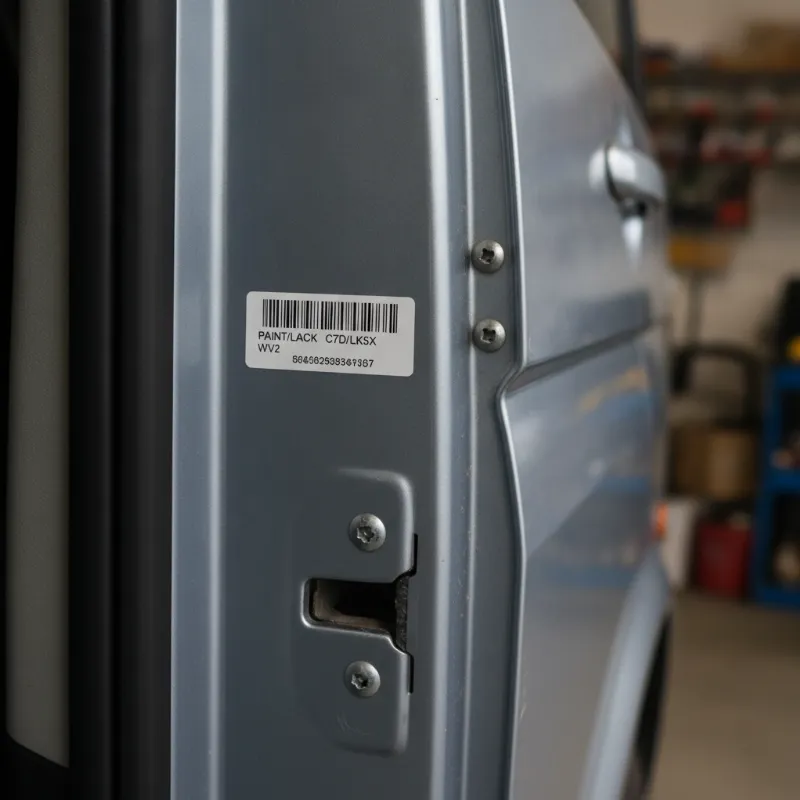
Where to Find the Colour Code on a VW Caravelle
Whether you're touching up a stone chip, ordering a full respray, or simply trying to match a wing mirror cover, knowing your VW Caravelle's exact paint colour code is essential. Volkswagen uses a specific alphanumeric code to identify every factory paint finish, and thankfully, the Caravelle makes this information relatively easy to locate — once you know where to look. Depending on the age of your van, the sticker or plate carrying that code will sit in one of two or three predictable places.
Primary location: driver's side B-pillar sticker
On most modern VW Caravelles (T5, T6 and T6.1 generations), the quickest place to find the colour code is the driver's side B-pillar. Open the driver's door and look at the vertical pillar between the front and sliding side doors. You'll usually spot a small white or silver sticker printed with a barcode, vehicle identification number, tyre pressures, and a short list of option codes. Somewhere on that sticker you'll see a paint code, typically preceded by the letters "LA" — for example, LB9A or LC9A. That's the number you'll need to quote when ordering paint.
Secondary location: under the bonnet data plate
If the B-pillar sticker has been damaged, painted over, or has simply become illegible with age, the next place to check is under the bonnet. Open the bonnet and look for a metal or plastic data plate — often on the slam panel at the front, or on the top of the radiator support. On some Caravelle variants there's also a folded-paper "vehicle data card" tucked away in the service booklet or spare wheel well, which repeats all the same option and paint codes as the B-pillar sticker.
Older models (1989–2003): boot floor and spare wheel well
For earlier T4 Caravelles built between 1989 and 2003, VW placed the vehicle data sticker in a different spot altogether. Lift the boot floor covering or the carpet in the rear load area and you'll usually find the sticker attached to the metal floor panel, often near or inside the spare wheel well. The layout of the sticker is similar to newer models, but expect it to be more faded — three decades of luggage, tools and general wear can leave the print quite worn. A torch and a gentle wipe with a soft cloth often bring the numbers back to life.
How to Read the VW Caravelle Colour Code
Once you've found the sticker or data plate, the next step is decoding what you're looking at. Volkswagen paint codes follow a consistent format across the range, so a Caravelle code will look familiar to anyone who's owned a Golf, Transporter or Passat.
Identifying the LA-prefix paint code
Nearly every VW factory paint code begins with the letter "L" — a hangover from the German word "Lack", meaning paint or lacquer. On your Caravelle sticker, look for a four-character code such as LB9A (Candy White), LC9Z (Deep Black Pearl) or LR7H (Reflex Silver). The code is usually printed on its own line or grouped with other option codes. It's important to copy it down exactly, character for character, because a single letter change can mean a completely different shade.
Matching the code to VW's official paint name
Once you have the four-character code, you can cross-reference it with VW's official paint charts to find the marketing name of your colour. Reputable paint suppliers, bodyshops and online paint databases all use these same codes, so a code like LB9A will pull up "Candy White" whether you're ordering a touch-up pen, an aerosol, or a full litre of mixed base coat. If you're planning bodywork, always give the bodyshop both the LA-prefix code and the model year, as VW occasionally tweaks paint formulations over a generation's lifespan.
Common VW Caravelle Colour Codes by Model Year
While VW offers dozens of paint options over the years, a handful of colours dominate the Caravelle range. Recognising the common codes can help you quickly identify a colour even before you find the sticker.
03 VW Caravelle and early 2000s colour codes
Caravelles from the early 2000s were commonly finished in Reflex Silver (LA7W), Candy White (LB9A), Bright Green (LK6Y) and Ravenna Blue (LA5X). Two-tone finishes were also popular on higher-spec Caravelles of this era, particularly on the Multivan variants, where a secondary lower-body colour code will also appear on the sticker.
T4 and T5 generation popular finishes
Across the T4 era (1989–2003), Pastel White (LB9A), Bamboo Yellow (LB1A) and Montana Green (LG6R) were widespread. Moving into the T5 generation (2003–2015), you'll frequently see Reflex Silver (LA7W), Candy White (LB9A), Deep Black Pearl (LC9X), Starlight Blue (LH5X) and Natural Grey (LD7X). T5.1 and T6 Caravelles introduced Indium Grey (LR7H) and Mojave Beige (LH1Z) into the mix, both of which have remained popular with private and commercial buyers alike.
What to Do If the Colour Code Sticker Is Missing or Faded
Occasionally, especially on older or ex-fleet Caravelles, the sticker is either missing entirely or too faded to read. Don't panic — there are still several ways to identify the original paint. First, check the vehicle's service book and owner's wallet: many VW dealers stamped or wrote the paint code inside during PDI or servicing. Second, contact a VW main dealer with your VIN (found on the windscreen base or V5C logbook). They can look up the original build specification, including factory paint, from VW's central records.
Finally, if all else fails, a professional bodyshop can carry out a spectrophotometer paint reading — a small handheld device that scans the existing paint and produces a formulation. This is particularly useful if the van has been resprayed at some point in the past and no longer wears its original colour. It costs a little more than reading a sticker, but it guarantees a proper match.
Buying a VW Caravelle? Browse Our Stock
If you're researching colour codes because you're considering buying a VW Caravelle — or want to be sure of getting the exact spec and finish you love — we regularly have a strong selection of Caravelles in stock, spanning T5, T6 and T6.1 generations in a range of popular colours. Every van we sell comes fully inspected, HPI-checked and prepared by our workshop, with clear photography of the B-pillar sticker and data plates available on request. Get in touch with our sales team and we'll be happy to walk you through what's available, arrange a viewing, or notify you when a Caravelle in your preferred colour arrives on the forecourt.
FAQs
Where exactly is the paint colour code located on a VW Caravelle?
On most modern VW Caravelles (T5, T6 and T6.1), the paint colour code is printed on a sticker attached to the driver's side B-pillar — the vertical panel you see when you open the driver's door. The code is a four-character combination beginning with 'L' (for example, LB9A). On older T4 Caravelles built between 1989 and 2003, the sticker is usually located under the boot floor covering, near the spare wheel well. A secondary copy of the data can often be found on a plate under the bonnet or inside the service booklet.
What does the 'L' at the start of a VW paint code mean?
The 'L' prefix comes from the German word 'Lack', meaning paint or lacquer. It's a Volkswagen convention used across the entire model range, not just the Caravelle. The three characters that follow the L identify the specific colour and finish — so LB9A is Candy White, LC9X is Deep Black Pearl, and so on.
Can I find my Caravelle's colour code using just the VIN?
Yes. If your sticker is missing or unreadable, any VW main dealer can look up the original factory paint code using your Vehicle Identification Number (VIN), which is stamped at the base of the windscreen and printed on your V5C logbook. Some independent VW specialists can do the same. This is often the most reliable method for older Caravelles where stickers have faded.
Will the sticker still be correct if the van has been resprayed?
Not necessarily. The sticker records the paint colour the van left the factory with, so if a previous owner has resprayed the vehicle in a different colour, the sticker will no longer match what you see. In this case, ask a bodyshop to take a spectrophotometer reading of the current paint — this scans the actual finish and produces a matching formulation regardless of what's on the sticker.