VW Caravelle: How Many Seats Does It Have?
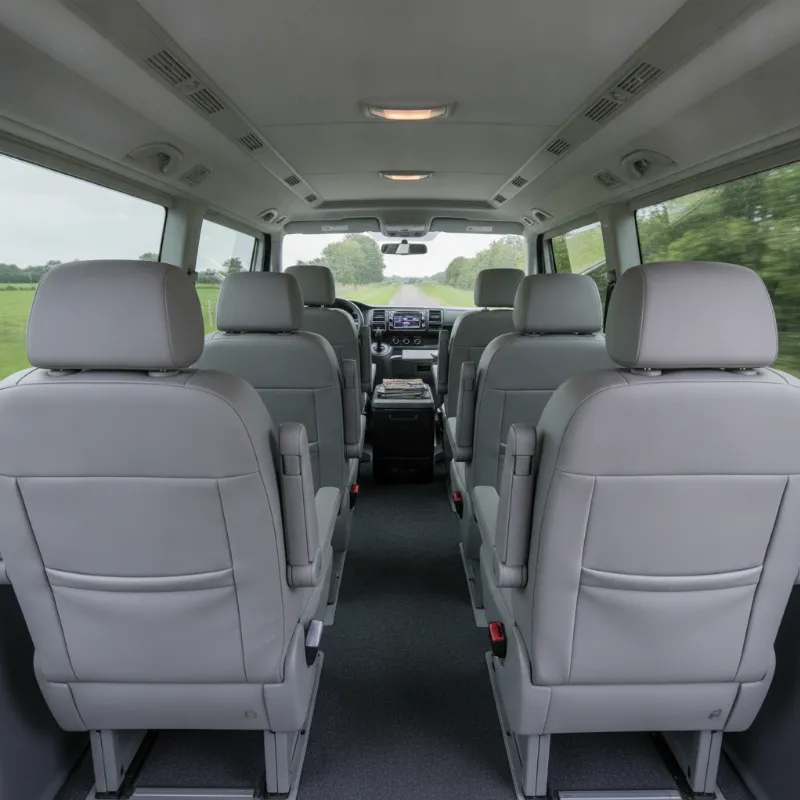
VW Caravelle: How Many Seats Does It Have?
The Volkswagen Caravelle is one of the most versatile people carriers on the UK market, and the short answer to the seating question is that most Caravelles come with seven seats as standard. That includes the driver's seat, a front passenger seat, a middle-row bench or pair of captain's chairs, and a rear three-person bench. Depending on the specification and generation, however, you can also find Caravelles configured for five, six, eight or even nine occupants, which is why so many buyers dig a little deeper before choosing one.
The Caravelle's real strength is that its cabin was designed around rails and removable seats from the outset. Rather than a fixed layout you're stuck with for life, you can reconfigure the interior for school runs, airport transfers, executive travel or family holidays. In the sections below we'll look at how the layouts have changed across the T5, T6 and T6.1 generations, how wheelbase affects legroom and load space, and how to decide which configuration suits you best.
Seating Configurations Across Caravelle Generations
Volkswagen has offered the Caravelle in the UK across three closely related generations in recent years — the T5, the T6 and the facelifted T6.1. All three share the same fundamental Transporter platform, and while the underlying seating count has stayed broadly similar, the trim structure, seat design and available options have evolved over time. If you're comparing used examples on the forecourt, it's worth knowing which generation you're looking at because the interior packaging can differ in some important details.
T5 Caravelle Seating Layout
The T5 Caravelle, produced from 2003 through to 2015 (including the T5.1 facelift from 2010), was the model that established the modern Caravelle template in the UK. Most T5 Caravelles were sold as seven-seaters, with two individual front seats, two individual captain's chairs in the middle row facing forward, and a three-person bench at the rear that could be slid along floor rails and folded down to form a bed. Higher trims such as the Executive added swivelling middle-row seats and a folding table, turning the cabin into a mobile meeting space. Some T5 Caravelles were also specified with a middle bench in place of the individual chairs, taking the total capacity up to eight.
T6 and T6.1 Caravelle Seating Layout
The T6 arrived in 2015 and the T6.1 facelift followed in 2019, bringing revised styling, updated electronics and improved driver assistance. Seating philosophy remained much the same: seven seats as the standard UK configuration, arranged as 2+2+3, with the middle-row chairs able to swivel to face the rear bench and a folding table between them. The rear bench continues to slide on floor rails and fold flat, and can be removed entirely if you need van-like load space. On the T6.1, materials and trim quality took another step up, and Executive-grade cars offer particularly plush individual seats with armrests, making them a genuine alternative to a full-size MPV or executive saloon for chauffeur work.
Short Wheelbase vs Long Wheelbase Seating
The Caravelle has traditionally been offered in both short-wheelbase (SWB) and long-wheelbase (LWB) forms, and while the seat count is usually the same seven, the experience for those occupants is very different. The SWB version gives you a more manageable overall length, which is helpful for multi-storey car parks and tight urban streets, but boot space behind the rear bench is modest — enough for a weekly shop or a few soft bags, but not a stack of suitcases.
The LWB Caravelle adds a significant chunk of length behind the rear axle, and almost all of that extra metal translates into luggage room. With seven passengers on board you can genuinely fit a full set of airport suitcases behind the rear bench, which is why the LWB is the default choice for private-hire and airport transfer operators. Legroom in the second and third rows is broadly similar between the two, because the seats sit on the same rails; the difference is really about what you can carry behind them.
Removable Seats, Rails and Rear Bench Explained
One of the Caravelle's defining features is its floor rail system. The middle-row seats and the rear bench are mounted on rails that run the length of the cabin, which means you can slide them forwards and backwards to trade legroom against luggage space, rotate the middle-row chairs to face rearwards, or lift the seats out altogether. Each individual seat is heavy — expect to need two people to remove one comfortably — but the mechanism itself is simple, using lever-operated clamps that release the seat from the rail.
The rear three-person bench is the most flexible element. It slides on the same rails, folds down to form a flat sleeping surface for two adults, and can be removed for maximum load volume when the Caravelle needs to double as a van. Combined with the swivelling captain's chairs and folding table found on higher trims, this rail system is what allows a single Caravelle to be a seven-seat family car on Monday, a mobile office on Tuesday and a weekend camper by Friday.
Is the VW Caravelle the Right People Carrier for You?
If you regularly carry six or seven people and value flexibility over outright car-like driving dynamics, the Caravelle is very hard to beat. It offers proper adult-sized seats in every row, sliding side doors that make access easy in tight parking spaces, and a cabin that can be reconfigured for almost any purpose. Fuel economy from the 2.0 TDI engines is respectable for a vehicle of this size, and residual values have historically been strong, particularly for well-specified Executive models.
Where it may not suit is if you only occasionally need the extra seats and would prefer something that drives more like a conventional SUV, or if your priority is the very latest infotainment and driver assistance technology from a passenger-car platform. But as a genuine seven-seat workhorse that can also serve as a comfortable long-distance cruiser, the Caravelle remains a benchmark.
Browse VW Caravelles for Sale or Lease in the UK
Whether you're after a used T5 for family duties, a low-mileage T6 for private-hire work, or a nearly-new T6.1 Executive for chauffeuring, it's worth taking your time to compare specifications carefully — particularly the wheelbase, trim level and exact seating layout, because two Caravelles of the same age can be configured very differently inside. Check the seat count on the V5C, ask whether all original seats are present (they're often removed and forgotten in a garage), and make sure the rails and clamps operate smoothly. Once you've found the right combination of layout, mileage and budget, the Caravelle rewards its owner with years of genuinely versatile family and business transport.
FAQs
How many seats does a VW Caravelle have?
Most UK-market VW Caravelles are seven-seaters, arranged as two front seats, two individual captain's chairs in the middle row and a three-person bench at the rear. Some versions were specified with a middle bench instead of individual chairs, giving eight seats in total, and it is possible to remove seats to reduce the capacity if you need more load space.
Can you remove the seats in a VW Caravelle?
Yes. The middle-row seats and the rear bench are mounted on floor rails and can be unclipped and lifted out entirely. Each seat is fairly heavy and usually needs two people to handle safely, but no tools are required. This is what allows the Caravelle to switch between a seven-seat people carrier and a near-van load carrier.
Do the middle-row seats swivel in a Caravelle?
On many trims, yes. The individual captain's chairs in the middle row can be rotated to face the rear bench, and higher-spec Executive versions include a folding table between the rows, turning the cabin into a conference-style space. Not every Caravelle has this feature, so it's worth checking on the specific vehicle you're considering.
What's the difference between a VW Caravelle and a Volkswagen Transporter Shuttle?
They're built on the same platform, but the Caravelle is the higher-specification passenger model with more refined interior trim, individual middle-row chairs on most versions, and options like swivelling seats and a folding table. The Transporter Shuttle is a simpler, more utilitarian minibus aimed at commercial passenger operators, typically with bench seating throughout.
Is the long-wheelbase Caravelle worth it for a family of seven?
If you regularly travel with seven people and their luggage, the long-wheelbase version is well worth considering because the extra length is dedicated almost entirely to boot space behind the rear bench. On the short-wheelbase model, luggage room with all seven seats in use is quite limited, so the LWB is the sensible choice for holidays, airport runs and larger families.