LDV Maxus Crew Van Reviews: Honest Owner and Expert Verdicts
LDV Maxus Crew Van: What Owners and Reviewers Are Saying
The LDV Maxus crew van has quietly built up a loyal following among UK tradespeople, small business owners and fleet buyers who need to move both people and kit without paying premium money. Reviews across owner forums, trade publications and van comparison sites tend to land in a similar place: this is a genuinely practical, well-equipped vehicle that punches above its price tag, provided you go in with realistic expectations about badge appeal and long-term resale.
Owners repeatedly praise the sheer amount of van you get for the money. A five or six-seat crew cab with a proper load area, decent standard kit and a manufacturer warranty tends to cost noticeably less than an equivalent Ford, Volkswagen or Mercedes derivative. Reviewers also highlight the electric variant, the e Deliver 9, as one of the more accessible ways into a zero-emission crew van without stretching a small business budget past breaking point.
The criticism is usually consistent too. Interior plastics feel functional rather than plush, the driving experience is competent rather than characterful, and dealer coverage is thinner than the mainstream brands. But for buyers who prioritise practicality and value over prestige, the consensus is that the Maxus deserves a place on any crew van shortlist.
Design, Build Quality and Cabin Space
Visually the Maxus range has moved on considerably from the older LDV models many UK drivers will remember. The current Deliver 9 and eDeliver 9 crew vans wear a fairly conservative but modern face, with LED daytime running lights, a large upright grille and clean panel work. It's not going to turn heads on the high street, but it looks the part parked outside a customer's property.
Build quality inside the cab is one of the areas most reviewers spend time on. Panel fit and switchgear are generally described as solid and honest — nothing feels flimsy, but nor does it match the soft-touch finish of a Transit Custom or a Transporter. The dashboard layout is logical, most versions get a touchscreen with Apple CarPlay and Android Auto, and there's plenty of storage for clipboards, phones, bottles and paperwork.
Second-Row Seating and Passenger Comfort
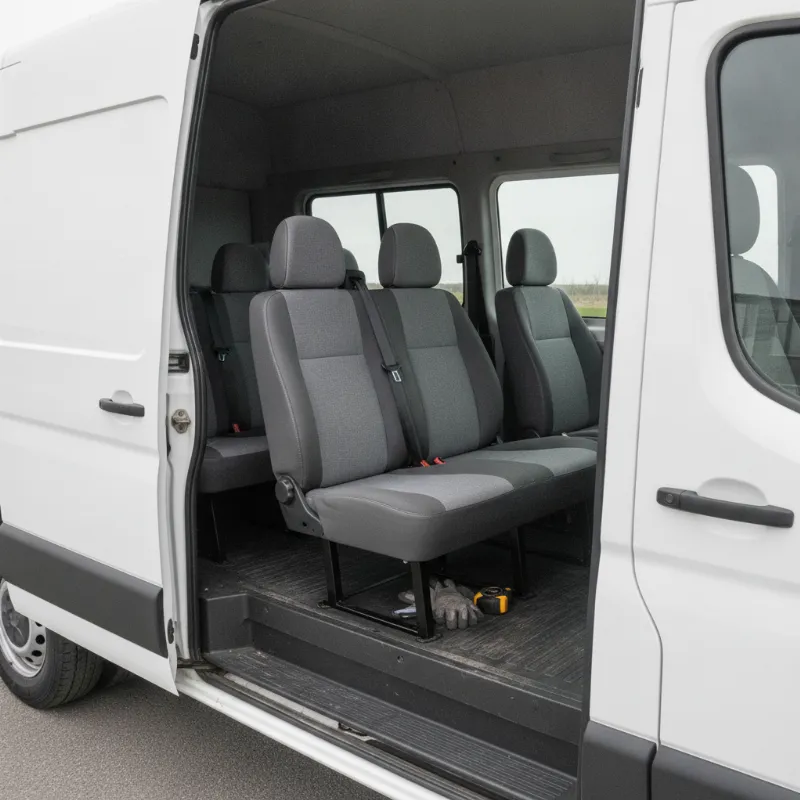
The second row is where a crew van earns or loses its money, and here the Maxus generally scores well. Owners running four or five-strong teams comment that adult passengers can sit comfortably on longer commutes to site, with usable legroom, proper three-point belts and headrests across the bench. Access through the sliding side door is straightforward, and the seat back is angled sensibly rather than sitting bolt upright like some rivals.
Heating and ventilation reach the rear reasonably well, and the bench folds or flips to free up extra load space when the full crew isn't on board. Reviewers do note that the middle seat is the usual compromise on any three-across bench, but no more so than in competitor vans.
Load Area and Payload Ratings
Behind the bulkhead, the Maxus crew van still offers a genuinely useful load bay. Depending on wheelbase and roof height you get enough length for full sheets of plywood loaded flat, and internal height is competitive for a large van in this class. Six lashing points, a plastic-lined lower load area and twin rear doors that swing wide are the sort of practical touches owners appreciate on a wet Monday morning.
Payload figures vary by trim and drivetrain — the diesel versions typically offer more than the electric eDeliver 9 once battery weight is factored in — but both remain competitive within the crew van segment. Reviewers consistently point out that gross vehicle weight and payload should be checked against the exact spec being quoted, because adding a second row of seats always eats into what you can legally carry.
Engine, Performance and Fuel Economy Feedback
Most Maxus crew vans on UK roads are powered by a 2.0-litre turbo diesel producing around 148bhp, paired with either a six-speed manual or an automatic gearbox. Owner reviews describe the engine as adequate rather than exciting — there's enough torque to shift a loaded van up motorway inclines without drama, and around town it's flexible enough not to feel like hard work.
Real-world fuel economy is generally reported in the low-to-mid 30s mpg when the van is worked hard with a full crew and payload, edging higher on steady motorway runs. That's broadly in line with rival large diesel vans rather than a standout figure. The automatic gearbox draws mixed feedback: some owners like the ease in traffic, others find it a beat behind their inputs.
The electric eDeliver 9 crew van attracts increasingly positive coverage. Range in real conditions typically lands between 120 and 180 miles depending on battery choice, load and weather, which suits urban and regional operators well. Reviewers highlight the smooth, quiet drive and low running costs, while noting that motorway efficiency drops off as it does with any large electric van.
Reliability, Common Issues and Ownership Costs
Reliability is the area where prospective buyers do the most homework, and the picture is more nuanced than the headline value story. Many owners report trouble-free running over tens of thousands of miles, with routine servicing and consumables the only real spend. Others have flagged issues around electrical gremlins, occasional sensor faults and the odd trim rattle — the sort of niggles that are annoying rather than catastrophic.
The manufacturer warranty is a strong selling point and is often cited in reviews as a reason buyers felt confident taking the plunge on a less familiar badge. Servicing costs at franchised dealers tend to be lower than premium European rivals, and independent commercial garages can usually handle routine work.
The main ownership caveat raised in reviews is dealer network density. LDV Maxus has been growing its UK presence, but coverage is still patchier than Ford or Mercedes, so buyers in more rural areas should check where their nearest approved workshop actually is before signing. Parts availability has improved significantly in recent years but is worth asking about for any specific model year.
How the Maxus Crew Van Compares to Rivals
Against the established large crew van set — Ford Transit, Mercedes Sprinter, Volkswagen Crafter, Peugeot Boxer and the Fiat Ducato — the Maxus positions itself firmly on value. Like-for-like, you're generally looking at a lower on-the-road price, often with more standard equipment thrown in such as air conditioning, cruise control, parking sensors and a decent infotainment system.
Where the rivals pull ahead is refinement, residual values and the sheer depth of aftersales support. A Transit Custom crew cab will feel more polished to drive and hold its money better at three years old, but it'll cost more up front and often more to specify to the same level. The Sprinter and Crafter sit higher again on both price and prestige.
For the electric variant, the eDeliver 9 competes with the e-Transit, eSprinter and Maxon-derived models. Reviewers tend to place it as one of the better value electric large vans, particularly for operators doing predictable regional mileage where the range is a comfortable fit.
Verdict: Is the LDV Maxus Crew Van Worth Buying?
Pulling all the reviews together, the LDV Maxus crew van earns a solid recommendation with a few sensible caveats. If your priority is moving a team and their tools around at the lowest realistic cost, with a modern cab, a proper warranty and a choice of diesel or electric power, it's very hard to argue with the value on offer. Owners who buy with their eyes open — accepting that it's a workmanlike van rather than a badge statement — tend to be genuinely happy with the choice.
Where it makes less sense is if you're planning to change vans every two or three years and rely on strong resale, or if you're based somewhere with limited access to a Maxus dealer. In those cases a mainstream rival may work out cheaper across the whole ownership cycle even at a higher purchase price.
For most small businesses, though, the verdict from real-world reviews is clear: the Maxus crew van is a credible, capable and refreshingly affordable option that deserves to be driven and priced up alongside the usual suspects before any decision is made.
FAQs
Is the LDV Maxus crew van any good?
Yes — for the money, most owners and reviewers rate it well. It offers a spacious cab, a proper second row of seats, a usable load area and a manufacturer warranty at a price that undercuts mainstream European rivals. It's not as refined or as strong on resale value as a Ford Transit or VW Crafter, but as a working van for small businesses it earns consistent praise for practicality and value.
How reliable is the LDV Maxus Deliver 9 crew van?
Reliability reports are broadly positive but not perfect. Many owners report trouble-free running with only routine servicing, while a minority flag electrical niggles or sensor faults. The manufacturer warranty gives useful peace of mind, and servicing costs are typically lower than premium rivals. Checking the nearest approved dealer before buying is sensible, as network coverage is thinner than the mainstream brands.
What is the real-world fuel economy and range of the Maxus crew van?
The 2.0-litre diesel typically returns low-to-mid 30s mpg in mixed real-world use, rising on steady motorway runs. The electric eDeliver 9 crew van generally covers 120–180 miles per charge in real conditions depending on battery size, load, weather and how much motorway driving is involved.
How does the LDV Maxus crew van compare to a Ford Transit crew cab?
The Ford Transit is more polished to drive, feels a touch more premium inside and holds its value better at resale. The Maxus counters with a lower purchase price, generous standard equipment and a competitive warranty. If budget is the priority the Maxus wins; if long-term residuals and dealer coverage matter most, the Transit tends to edge it.
Is the LDV Maxus crew van suitable for carrying five or six people plus tools?
Yes. The crew van layout provides a second row with proper three-point belts and headrests, plus a bulkhead-separated load area behind. Adult passengers have usable legroom for longer journeys to site, and there's still meaningful load length and payload for tools and materials — though payload should always be checked against the exact spec, since adding seats reduces what you can legally carry.