How to Jump Start a Citroen Relay: A Step-by-Step Guide
Before you start: safety checks and what you'll need
A flat battery is one of the most common reasons a Citroen Relay refuses to start, especially after the van has been standing for a few days or in cold weather. Before you reach for the jump leads, take a moment to make sure it really is the battery causing the problem — listen for a slow, laboured crank or a rapid clicking sound from the engine bay when you turn the key. If the dashboard lights are dim or flicker off completely, that's another strong sign the battery is the culprit.
Safety comes first. Make sure both vehicles are switched off, keys removed, and the handbrake firmly applied. Remove any metal jewellery, watches or rings that could accidentally short across the battery terminals, and if you have safety glasses to hand, wear them. Batteries can release small amounts of hydrogen gas, so never smoke or use a naked flame near the engine bay. Finally, check the battery itself for damage — if you can see cracks, bulging sides, or leaking fluid, do not attempt a jump start.
Tools and equipment (jump leads or booster pack)
For a Citroen Relay you'll want heavy-duty jump leads rated for a large diesel van — look for cables of at least 400 to 600 amps with thick, well-insulated clamps. Thin, cheap leads intended for cars often struggle to pass enough current to turn over the Relay's 2.0 or 2.2 litre diesel engine, and can even overheat during the attempt. Alternatively, a lithium or lead-acid jump starter pack of at least 1000 peak amps will comfortably start a Relay without needing a second vehicle.
It's also worth having a torch, a pair of gloves, and a clean rag to wipe any dirt or corrosion off the battery terminals before you connect anything.
Where the Citroen Relay battery is located
On most Citroen Relay models the battery sits under the driver's seat rather than in the engine bay. To access it, slide the seat fully forward, then lift the seat base — on many versions there's a release catch or lever at the front. Once the seat is tilted back you'll see a plastic cover over the battery which lifts or unclips off.
If you don't want to disturb the seat, Citroen has thoughtfully provided remote jump points under the bonnet: a red positive terminal (usually covered by a red plastic cap marked with a "+") mounted on top of the fuse box, and a dedicated earth/ground stud on the engine or chassis. These remote points are designed exactly for jump starting and are the easiest option for most owners.
How to jump start a Citroen Relay step by step
Once you've identified the battery or the remote terminals and gathered your equipment, the process itself is straightforward. Follow the steps in order — the sequence in which you attach the leads really does matter, both for your safety and for protecting the van's sensitive electronics.
Step 1: Position the donor vehicle safely
Park the donor vehicle close enough to the Relay that your jump leads will reach comfortably, but without the two vehicles touching. Nose-to-nose is usually easiest. Switch off the donor vehicle's engine, put it in neutral or park, apply the handbrake, and turn off all electrical loads such as the radio, lights and heater on both vehicles. Make sure the donor battery is at least 12 volts and, ideally, of similar or greater capacity than the Relay's.
Step 2: Connect the jump leads in the correct order
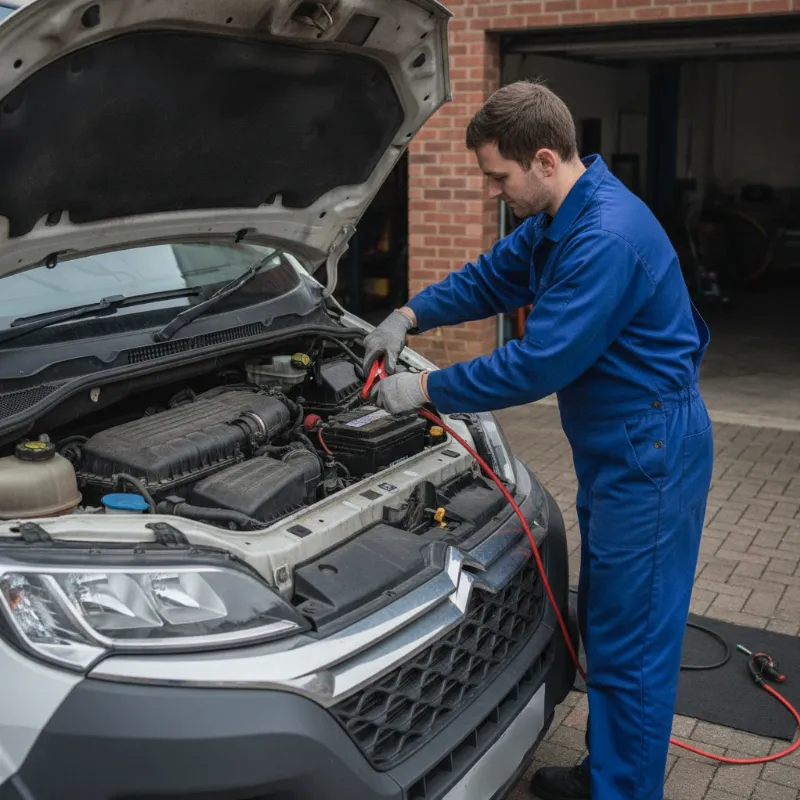
Take the red (positive) lead first. Attach one end to the positive terminal or red remote jump point on the flat Citroen Relay, then attach the other end to the positive terminal on the donor vehicle's battery. Next, take the black (negative) lead and connect one end to the negative terminal on the donor battery. Finally, attach the other end of the black lead to a solid, unpainted metal earth point on the Relay — such as the dedicated ground stud under the bonnet or a bolt on the engine block. Do not connect the final black clamp directly to the flat battery's negative terminal, as this can cause a spark near any hydrogen gas.
Double-check that all four clamps are secure and that the leads are routed well clear of any moving parts, drive belts or hot exhaust components.
Step 3: Start the engines and let the Relay charge
Start the donor vehicle's engine and let it run at a fast idle — around 1,500 to 2,000 rpm — for two or three minutes. This gives the flat battery a little top-up charge before you ask it to do any work. Then try starting the Citroen Relay. If it doesn't fire on the first attempt, wait 30 seconds and try again for no more than 10 seconds at a time to avoid overheating the starter motor.
Once the Relay is running, leave both engines running for another few minutes so the alternator can begin recharging the flat battery.
Step 4: Disconnect the leads safely
With both engines still running, remove the jump leads in the exact reverse order to how they were fitted. Start with the black clamp on the Relay's earth point, then the black clamp on the donor battery, followed by the red clamp on the donor and finally the red clamp on the Relay. Try to keep the clamps from touching each other or any metal surface while you're disconnecting.
Once disconnected, refit any terminal covers, close the bonnet, and take the Relay for a drive of at least 30 minutes at motorway speeds if possible. This gives the alternator time to properly recharge the battery — simply idling on the driveway won't be enough.
Using a jump starter pack on a Citroen Relay
A portable jump starter pack is arguably the easiest and safest way to get a Relay going, particularly if you're on your own or stranded somewhere without a second vehicle. Choose a pack rated for large diesel engines — 1000 peak amps or more is a sensible minimum for the Relay's 2.0 or 2.2 HDi engine, and 1500 to 2000 peak amps gives you plenty of headroom in cold weather.
The connection process mirrors jump leads: red clamp to the positive terminal or remote jump point, black clamp to a good earth on the engine or chassis. Switch the pack on (if it has an on/off button), wait a few seconds, then start the Relay. Most modern packs have built-in protection against reverse polarity and short circuits, but you should still take your time and double-check every connection before turning the key. Once running, remove the clamps in reverse order and recharge the pack ready for next time.
What to do if your Citroen Relay still won't start
If the Relay refuses to crank at all after a jump attempt, or only clicks weakly, the battery may be too deeply discharged or physically damaged to accept a charge. Leave the donor vehicle connected and running for 10 to 15 minutes to put more energy in, then try again. If it still won't turn over, the starter motor, starter solenoid or a poor earth connection could be to blame.
If the engine cranks strongly but doesn't fire, the issue is unlikely to be the battery at all — think about fuel level, a faulty glow plug system (particularly in cold weather), immobiliser problems, or an issue with the fuel pump or injectors. At this point, it's usually more cost-effective to call a breakdown service or arrange recovery to a Citroen specialist rather than continuing to crank the engine.
Common causes of a flat battery on a Citroen Relay
Relays lead a hard life, and there are several reasons the battery might have gone flat. Short journeys are the most common culprit — starting a large diesel engine draws a lot of current, and if you only drive a few miles at a time the alternator never gets a chance to fully replace what the starter took out. Over weeks and months, the battery gradually loses charge.
Other frequent causes include leaving interior lights, side lights or the radio on overnight; a parasitic drain from an aftermarket accessory such as a tracker, dashcam or refrigeration unit; a failing alternator that isn't charging properly while driving; and cold weather, which can knock 30 to 40 per cent off a battery's usable capacity. Corroded or loose battery terminals can also mimic the symptoms of a flat battery, so it's always worth cleaning and tightening them as a first check.
When to replace your Citroen Relay battery
Most van batteries last between three and five years, though heavy use, lots of short journeys or extreme temperatures can shorten that considerably. If you've had to jump start your Relay more than once or twice in a short period, or the battery goes flat again within a day or two of driving, it's time to think about a replacement.
A quick way to check is to have the battery load-tested — most parts shops and garages will do this free of charge. When buying a replacement, match the original specification carefully: the Relay typically needs a heavy-duty commercial battery in the 90 to 100 Ah range with a high cold-cranking amp rating. Fitting a battery that's undersized for the van will lead to the same problems all over again. If your Relay is fitted with stop-start technology, you'll need an AGM or EFB battery specifically — a standard flooded battery won't cope with the extra cycling and will fail prematurely.
FAQs about jump starting a Citroen Relay
Below are answers to some of the questions Relay owners most often ask when dealing with a flat battery.
FAQs
How do you safely jump start a Citroen Relay van with a flat battery?
Park a donor vehicle close to the Relay with both engines off. Connect the red jump lead to the positive terminal (or the red remote jump point under the bonnet) on the Relay first, then to the positive on the donor battery. Connect the black lead to the negative on the donor, then to an unpainted metal earth point on the Relay. Start the donor and let it run for a few minutes, then start the Relay. Once running, remove the leads in the exact reverse order and drive the Relay for at least 30 minutes to recharge the battery.
Where is the battery on a Citroen Relay?
On most Citroen Relay models the battery is located under the driver's seat, accessed by sliding the seat forward and lifting the base. However, there are also dedicated remote jump points under the bonnet — a red positive terminal on the fuse box and an earth stud on the engine or chassis — which are designed specifically for jump starting and are much easier to reach.
Can I damage the Relay's electronics by jump starting it?
If you follow the correct connection order and use good-quality leads or a modern jump pack with reverse-polarity protection, the risk is very low. Damage usually happens when leads are connected the wrong way round, when clamps touch each other, or when the engines are revved hard while connected. Take your time, double-check the polarity, and keep engine revs modest during the process.
How long should I drive after jump starting my Relay?
Aim for at least 30 minutes of steady driving, ideally at motorway or dual carriageway speeds, so the alternator has time to properly recharge the battery. Short town journeys won't put enough energy back in, and the battery may go flat again within a day or two. If it does, the battery is likely at the end of its life and should be replaced.
Will a car jump starter pack work on a Citroen Relay?
Only if it's powerful enough. The Relay's diesel engine needs a lot of current to crank, so use a jump pack rated at 1000 peak amps or more — 1500 to 2000 peak amps is better, especially in cold weather. Small pocket-sized packs designed for petrol cars will often struggle or fail to start a large diesel van.