How Is the Mercedes-Benz Vito E-Cell Powered? A Plain-English Guide
What Is the Mercedes-Benz Vito E-Cell?
The Mercedes-Benz Vito E-Cell was one of the first fully electric panel vans to come from a mainstream European manufacturer, launched by Mercedes-Benz back in 2010. Based on the second-generation Vito platform, it was designed specifically for urban delivery work — think inner-city couriers, utility fleets and municipal operators who needed a zero-tailpipe-emission van long before electric commercial vehicles became mainstream. Production was relatively limited and the E-Cell was primarily leased to fleet customers in Europe, which is why you'll still occasionally see them turning up on the UK used market as ex-fleet stock.
Although it looks almost identical to the diesel Vito of the same era, underneath the E-Cell is a very different vehicle. Where a diesel Vito has an engine, gearbox and fuel tank, the E-Cell carries an electric motor, a large lithium-ion battery pack and the power electronics needed to manage it all. It was Mercedes' proof of concept that a working van could run silently on electricity — and much of the engineering has since fed into today's eVito and eSprinter models.
How Is the Mercedes Vito E-Cell Powered?
In simple terms, the Vito E-Cell is powered by a front-mounted electric motor drawing energy from a lithium-ion battery pack mounted low in the vehicle's floor. There's no diesel engine, no gearbox in the traditional sense, no exhaust system and no fuel tank. Instead, electricity stored in the battery is fed through an inverter to the motor, which drives the front wheels directly through a single-speed reduction gear. Let's break down each part of that system.
The Electric Motor and Drivetrain
The Vito E-Cell uses a permanent-magnet synchronous electric motor mounted at the front of the vehicle, driving the front wheels. It produces a peak output of around 70 kW (roughly 94 bhp) and, crucially for a working van, up to 280 Nm of torque available from a standstill. That instant torque is what makes electric vans feel so brisk in stop-start city traffic, even when they're loaded up.
Rather than a conventional multi-speed gearbox, the motor drives through a single-speed reduction gear. That means smooth, seamless acceleration with no gear changes, and it's one of the reasons drivers often describe electric vans as feeling much more relaxed to drive than their diesel equivalents. Regenerative braking is also built in — when you lift off the accelerator or press the brake pedal, the motor acts as a generator, feeding energy back into the battery and slowing the van at the same time.
Battery Pack, Capacity and Range
Energy for the motor is stored in a lithium-ion battery pack with a usable capacity of around 36 kWh, mounted low in the floor of the vehicle between the axles. Positioning the battery there keeps the centre of gravity low, protects the cells in the event of a collision and — importantly for a van — leaves the load area completely unaffected.
Mercedes originally quoted a range of up to 130 km (about 80 miles) on the older NEDC test cycle. In real-world use, particularly with a full payload, cold weather or motorway driving, most operators found a realistic working range of around 50 to 70 miles per charge. That's modest by modern EV standards, but it was more than enough for the multi-drop urban delivery routes the van was built for.
Charging the Vito E-Cell
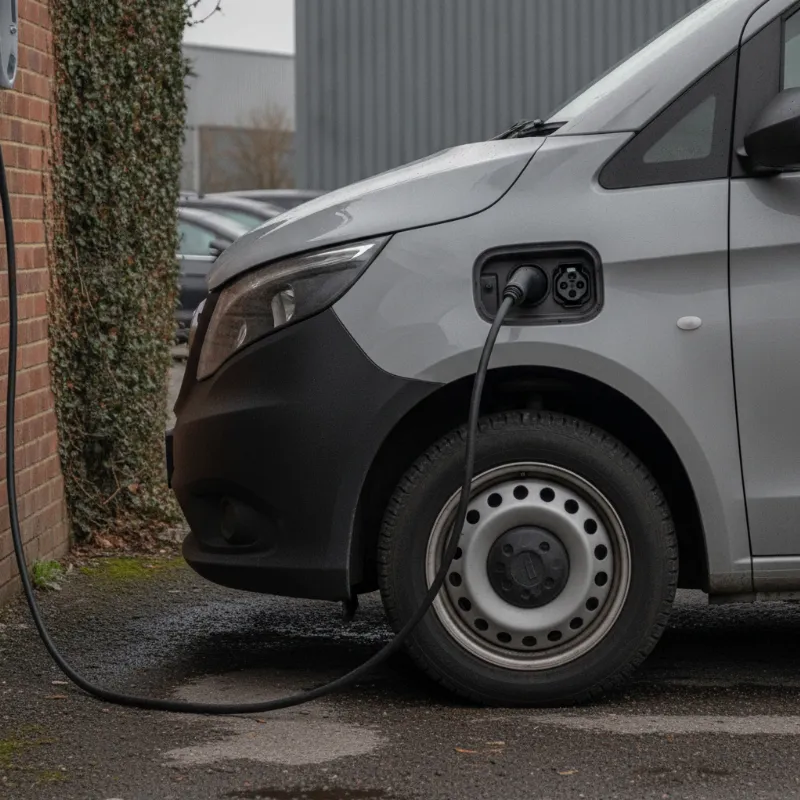
The Vito E-Cell charges via a Type 2 (Mennekes) socket, typically hidden behind a flap on the front of the vehicle. From a standard 400V three-phase supply at 16A, a full charge takes around 5 to 6 hours, which suits overnight depot charging perfectly. From a domestic single-phase supply it takes considerably longer — closer to 10 hours — so most owners installed a dedicated wallbox or depot charger. The E-Cell predates the widespread adoption of CCS rapid charging, so it doesn't support DC fast charging in the way modern electric vans do.
Vito E-Cell vs Diesel Mercedes Vito Van
Compared to a diesel Vito of the same era, the E-Cell offers near-silent running, zero tailpipe emissions and dramatically lower fuel costs — an urban courier could easily be looking at running costs of just a few pence per mile. It's also exempt from the London Congestion Charge and ULEZ, which for anyone working in central London is a substantial saving in itself.
The trade-offs are equally clear. Payload is reduced because of the battery weight, range is limited compared to a diesel that can cover 400+ miles on a tank, and the second-hand market for E-Cell parts and specialist servicing is much thinner than for a conventional Vito. If your work involves long motorway runs or unpredictable daily mileage, a diesel Vito — or one of the newer, longer-range electric alternatives — is likely the more practical choice.
The Mercedes Vito Crew Cab Sport: A Modern Alternative
For buyers drawn to the Vito nameplate but who need more range, more payload and a more versatile cabin, the Mercedes Vito Crew Cab Sport is worth a close look. Available in modern diesel form (and increasingly in electric eVito guise), the Crew Cab layout adds a second row of seats behind the driver, allowing you to carry a team of up to five or six people plus tools and equipment in the rear load area.
The Sport trim adds sharper styling, alloy wheels, a more car-like interior and infotainment tech that the original E-Cell simply couldn't offer. For tradespeople, event crews and businesses that need to move both people and kit, it's a genuinely flexible workhorse — and it feels a generation ahead of the early E-Cell in terms of refinement and safety equipment.
Payload, Seating and Practicality
Whichever Vito you're looking at, practicality is where this van really earns its keep. The Vito sits in the mid-size van class, roughly between the compact Citan/Vito predecessor and the larger Sprinter, which makes it manoeuvrable enough for city work but still large enough to swallow a serious load.
How Many Seats Does a Mercedes Vito Have?
Seating depends entirely on the body style you choose. A standard panel van Vito, including the E-Cell, has three seats in the front cab — a driver's seat and a two-person bench, giving three seats in total. Step up to a Crew Cab or Mixto version and you gain a second row of two or three seats behind the bulkhead, taking total capacity to five or six. The full Tourer passenger versions of the Vito can seat up to eight or nine depending on configuration, making them popular for airport transfers and taxi work.
Weight and Load Capacity
A diesel Vito typically has a gross vehicle weight (GVW) of around 2.8 to 3.2 tonnes depending on variant, with payloads ranging from roughly 700 kg up to around 1,300 kg. The Vito E-Cell, because of the extra weight of its battery pack, has a lower payload of around 900 kg — still perfectly usable for parcel delivery and light urban work, but worth checking against your intended loads. Load volume in the standard-length Vito is around 6 cubic metres, more than enough for most trades and light delivery duties.
Buying, Leasing or Financing a Mercedes Vito
Because the E-Cell was produced in relatively small numbers, most UK buyers today will be looking at either used ex-fleet examples or, more commonly, a newer diesel or electric Vito as an alternative. Buying outright gives you full ownership and no ongoing monthly commitment, which suits businesses with cash on hand or those planning to keep the van for many years.
Leasing — through a contract hire or business contract hire agreement — spreads the cost into predictable monthly payments and often includes maintenance, which is particularly useful for VAT-registered businesses that can reclaim a portion of the payments. Hire purchase and finance lease options are also widely available and let you build towards ownership over an agreed term. Whichever route you choose, it's worth getting quotes on the specific derivative and mileage profile you need, as monthly costs vary significantly between panel van, Crew Cab and Tourer specifications. Speaking to a specialist van dealer will help you weigh up the total cost of ownership — including fuel or electricity, servicing, insurance and residual value — rather than just the headline monthly figure.
FAQs
How is the Mercedes-Benz Vito E-Cell powered?
The Vito E-Cell is powered by a front-mounted permanent-magnet synchronous electric motor producing around 70 kW (94 bhp) and 280 Nm of torque, driving the front wheels through a single-speed reduction gear. Energy comes from a lithium-ion battery pack of around 36 kWh mounted in the floor, and the van charges via a Type 2 socket — typically taking 5 to 6 hours from a three-phase supply.
What is the real-world range of a Mercedes Vito E-Cell?
Mercedes originally quoted around 80 miles (130 km) on the older NEDC test, but most operators found a realistic working range of 50 to 70 miles depending on load, weather and driving style. It was designed for urban multi-drop work rather than long-distance motorway journeys.
Can the Vito E-Cell be rapid charged?
No — the E-Cell predates the widespread adoption of CCS DC rapid charging and only supports AC charging through its Type 2 socket. Most owners charge overnight at a depot or home wallbox, which fits the van's typical urban delivery duty cycle.
Is the Mercedes Vito E-Cell exempt from ULEZ and the Congestion Charge?
Yes. Because it produces zero tailpipe emissions, the Vito E-Cell is exempt from the London ULEZ charge and, subject to registering for the Cleaner Vehicle Discount where still applicable, has historically been eligible for Congestion Charge exemption too. That makes it particularly attractive for businesses working in central London.
How many seats does a Mercedes Vito have?
A standard panel van Vito, including the E-Cell, has three seats in the front cab. Crew Cab and Mixto versions add a second row for a total of five or six seats, while the passenger-focused Vito Tourer can seat up to eight or nine depending on configuration.