How Much Does a Mercedes Vito Van Weigh? UK Weights Explained
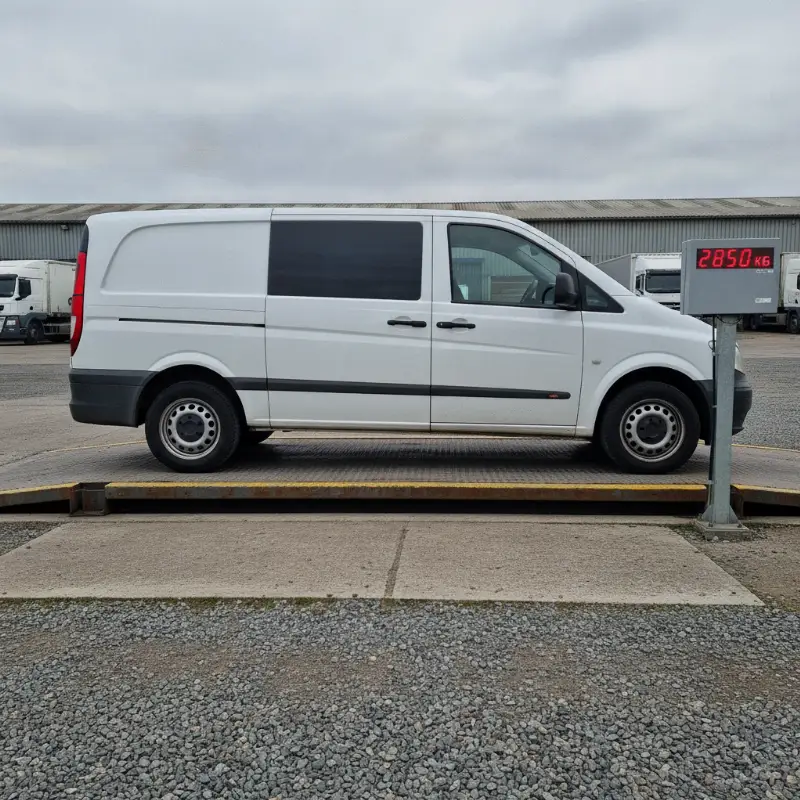
How much does a Mercedes Vito van weigh? Quick answer
A standard Mercedes-Benz Vito panel van typically weighs between 1,900kg and 2,250kg unladen (kerb weight), depending on body length, engine and specification. The Gross Vehicle Weight (GVW) usually sits between 2,800kg and 3,200kg, giving most Vito panel vans a payload capacity of around 700kg to 1,100kg. The heavier electric eVito tips the scales at closer to 2,400kg unladen due to its battery pack, while the Vito Tourer and Crew Cab variants add extra weight from additional seating and trim.
If you need a fast figure, most Long-body Vito 116 CDI panel vans in the UK weigh roughly 2,050kg empty and are plated at around 3,050kg GVW. The rest of this guide breaks down every variant so you can match a Vito to your licence, load and driving needs.
Understanding Vito weight terminology: kerb weight, GVW and payload
Before comparing Vito models, it helps to understand the three weight figures Mercedes-Benz publishes for every van. These numbers appear on the V5C logbook, the manufacturer's plate under the bonnet or on the B-pillar, and in the official technical data sheet.
Kerb weight (unladen)
Kerb weight is the weight of the Vito as it leaves the factory, including all fluids, a full tank of fuel and a 75kg allowance for the driver. It does not include cargo, passengers beyond the driver, or aftermarket accessories such as roof racks, ply-lining or racking systems. For the Vito panel van, kerb weight ranges from around 1,900kg for a Compact 110 CDI to over 2,250kg for a fully specified Extra-Long 119 CDI with automatic transmission.
Gross Vehicle Weight (GVW)
Also known as Maximum Authorised Mass (MAM) or Gross Vehicle Mass (GVM), the GVW is the absolute maximum the van is legally allowed to weigh when loaded. Exceeding it is an offence and can invalidate your insurance. Most UK Vito panel vans are plated at 2,800kg, 3,050kg or 3,200kg GVW. Crucially, all standard Vito variants stay under the 3,500kg threshold, meaning drivers with a category B car licence can legally drive them.
Payload capacity
Payload is simply GVW minus kerb weight. It tells you how much cargo, tools, passengers and equipment you can safely carry. A Compact Vito 110 CDI offers a payload of around 850kg, while heavier-plated Long and Extra-Long models can carry over 1,000kg. Remember that any conversions, racking, roof bars or bulkheads eat into that payload, so always weigh your van fully fitted-out before loading it up.
Mercedes Vito panel van weight by variant
The Vito panel van is offered in three body lengths and four engine outputs, and each combination affects both kerb weight and payload. Front-wheel-drive models are lighter than rear-wheel-drive versions, and the 9G-TRONIC automatic gearbox adds around 30–40kg over the six-speed manual.
Compact, Long and Extra-Long body lengths
The Compact Vito measures 4,895mm long and weighs from approximately 1,900kg unladen — the lightest panel van in the range. The Long body stretches to 5,140mm and adds roughly 40–60kg, typically weighing 1,950–2,050kg. The Extra-Long Vito reaches 5,370mm and is the heaviest at around 2,050–2,150kg unladen, though it also offers the largest load volume at 6.6 cubic metres and the highest payload potential.
Vito 110, 114, 116 and 119 engine variants
The Vito 110 CDI (100hp) is the lightest engine option and pairs with front-wheel drive on shorter models. The 114 CDI (136hp) and 116 CDI (163hp) are the volume sellers, adding around 20–50kg depending on drivetrain. The range-topping 119 CDI (190hp) is only available with rear-wheel drive and the 9G-TRONIC auto, pushing kerb weight to around 2,200–2,250kg. As a rule of thumb, expect payload to fall by roughly the same amount as kerb weight rises within the same GVW plating.
Mercedes Vito Tourer and 9-seater weight
The Vito Tourer is the passenger-carrying version, available in Pro, Select and premium trim levels with seating for up to nine occupants including the driver. Adding seats, seatbelts, side windows, extra trim and often air-conditioning means the Tourer weighs noticeably more than the panel van. Kerb weights typically start at around 2,150kg for a Long Tourer and rise to 2,300kg or more for an Extra-Long 9-seater with premium specification.
Because the Tourer is still plated at 3,050kg or 3,200kg GVW, its payload allowance covers passengers and their luggage rather than commercial cargo. With nine adults on board averaging 75kg each, you'll use around 675kg of that payload before adding any bags — worth remembering for airport transfers and minibus work.
Mercedes Vito Crew Cab Sport weight and specification
The Vito Crew Cab, often specified in Sport trim, combines a second row of seats for up to five occupants with a separate cargo area behind a bulkhead. It's popular with tradespeople who need to transport a team and tools in one vehicle. The extra seats, seatbelts, second-row floor and side glazing add around 100–150kg over the equivalent panel van, pushing kerb weight to roughly 2,150–2,300kg.
Sport specification adds larger alloy wheels, body-coloured bumpers, LED headlights and upgraded interior trim, all of which contribute a few extra kilos. A typical Long Vito 119 Crew Cab Sport with automatic gearbox weighs around 2,280kg unladen and offers a payload of roughly 770–920kg depending on GVW plating.
Mercedes eVito electric van weight explained
The all-electric eVito is heavier than its diesel siblings because of the lithium-ion battery pack mounted in the underfloor. The eVito panel van has a kerb weight of around 2,390–2,450kg, while the longer-range eVito Tourer with the 90kWh battery weighs closer to 2,550kg. To preserve a usable payload, the eVito is plated at 3,200kg GVW, giving a payload of approximately 800–900kg — remarkably close to the diesel equivalent.
Importantly, electric vans up to 4,250kg can be driven on a standard category B car licence under UK derogation rules, so weight is not a barrier for most drivers. The eVito's lower centre of gravity also improves handling, though tyre wear may be slightly higher due to the additional mass.
Why Vito weight matters: driving licence, road tax and load limits
Kerb weight, GVW and payload directly affect what you can legally do with your Vito. Any van with a GVW of 3,500kg or less can be driven on a standard category B licence, and every diesel Vito falls comfortably within this limit. Vehicle Excise Duty (road tax) for light commercial vehicles is charged at a flat rate rather than by weight, but heavier vans do attract higher insurance groups and consume more fuel.
Overloading is the biggest risk to watch. DVSA roadside checks weigh vans on portable scales, and fines start at £100 for minor overloads and rise to £300 plus a court summons for serious cases. Insurance claims can also be refused if a van is over its plated GVW at the time of an accident. Always factor in the weight of racking, ply-lining, roof bars, a full fuel tank, passengers, tools and stock when calculating your real-world payload.
Browse our Mercedes Vito stock and finance options
Whether you need a lightweight Compact panel van for urban delivery work, a heavy-duty Extra-Long 119 CDI for maximum payload, a nine-seat Tourer for passenger transport or the zero-emission eVito for city contracts, we have a wide selection of new and used Mercedes-Benz Vito vans in stock. Every vehicle is inspected, HPI-checked and prepared to a high standard, and our sales team can confirm the exact kerb weight, GVW and payload of any van on the forecourt before you commit.
We offer a range of finance options to suit sole traders, limited companies and fleet buyers, including hire purchase, finance lease and contract hire. Get in touch to arrange a viewing, request a full specification sheet, or discuss a bespoke finance quotation tailored to your business needs.
FAQs
How much does a Mercedes Vito van weigh?
A Mercedes-Benz Vito panel van typically weighs between 1,900kg and 2,250kg unladen (kerb weight), depending on body length, engine and specification. Gross Vehicle Weight ranges from 2,800kg to 3,200kg, providing a payload of roughly 700–1,100kg. The electric eVito is heavier at around 2,400kg unladen due to its battery pack.
Can I drive a Mercedes Vito on a normal car licence?
Yes. Every diesel Vito is plated at 3,200kg GVW or less, which is well within the 3,500kg limit for a standard category B car licence. The electric eVito is also drivable on a category B licence thanks to the UK's 4,250kg derogation for zero-emission vans.
What is the payload of a Mercedes Vito?
Payload varies by variant. A Compact Vito 110 CDI offers around 850kg, a Long 116 CDI typically carries 900–1,000kg, and Extra-Long models plated at 3,200kg GVW can transport over 1,100kg. Any racking, ply-lining or aftermarket accessories reduce the usable payload.
How much does the electric eVito weigh compared to the diesel Vito?
The eVito panel van weighs around 2,390–2,450kg unladen, roughly 300–400kg more than an equivalent diesel Vito, due to its underfloor battery pack. Mercedes offsets this with a higher 3,200kg GVW plating so the eVito still offers a competitive payload of around 800–900kg.
Where can I find the exact weight of my Vito?
The most accurate figures are on the manufacturer's VIN plate, usually located inside the driver's door pillar or under the bonnet. It lists the Gross Vehicle Weight and Gross Train Weight. The V5C logbook shows the mass in service (kerb weight), and our sales team can confirm the full weight breakdown for any Vito in our stock.