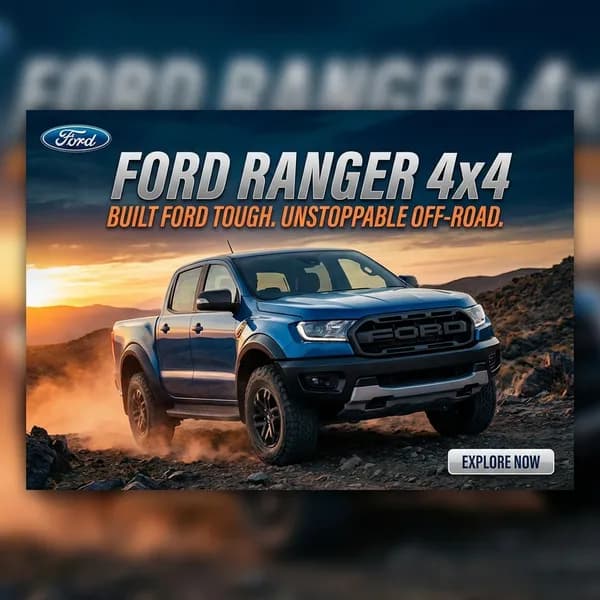
Ford Ranger 4×4
Ford Ranger 4×4
The Ford Ranger 4×4 stands as a formidable contender in the world of off-road vehicles. This rugged pickup truck has gained a reputation for its exceptional off-road capabilities, challenging terrain with ease. From rocky trails to muddy paths, the Ford Ranger’s 4×4 system equips it to handle a wide range of outdoor adventures, making it a top choice for enthusiasts seeking thrilling off-road experiences.
Designed to conquer the great outdoors, the Ford Ranger boasts impressive ground clearance and advanced off-road modes to tackle various terrains. Its robust suspension system and trail control feature enhance its performance on challenging landscapes. Additionally, the Ranger offers a range of off-road accessories and modifications to customize the vehicle for specific needs. Whether it’s rock crawling, mud driving, or water fording, the Ford Ranger proves its mettle against competitors, earning positive reviews from off-road enthusiasts and adventure seekers alike.
Ford Ranger: An Off-Road Beast
The Ford Ranger 4×4 has established itself as a true off-road powerhouse, equipped with a range of features that enable it to conquer challenging terrains with ease. This section explores the key elements that make the Ranger a formidable off-road vehicle.
Key Off-Road Features
The Ranger boasts several essential features that enhance its off-road performance. One of the most notable is the traction control system, which engages when an individual wheel slips. This system momentarily applies brakes to the slipping wheel and redirects engine power to wheels with better traction, helping to maintain movement in difficult conditions.
Another crucial feature is the off-road button, which provides quick access to off-road screens on the SYNC 4 display. This includes off-road gages and the front off-road camera, which gives drivers visibility of the road ahead, helping them avoid hazards. This camera is particularly useful when ascending steep hills, as it allows drivers to see what’s coming on the other side.
Terrain Management System
The Ranger’s Terrain Management System is a sophisticated tool that adjusts the vehicle’s driving dynamics based on the type of terrain. It uses throttle position, vehicle speed, and steering angle to determine how the vehicle is responding to driver commands. The system then adjusts torque distribution front to rear and side to side in a split second to enhance traction.
The Terrain Management System offers up to seven selectable drive modes:
- Normal
- Eco
- Tow/Haul
- Mud/Rut
- Sand
- Grass/Gravel/Snow
- Rock Crawl
Each mode optimizes the vehicle’s performance for specific conditions. For example, the Slippery mode engages four-high and shifts gears early to reduce torque at the wheels on loose surfaces like wet gravel. The Mud and Ruts mode changes the drivetrain to 4H, automatically engages the off-road front camera, and turns on the electronic differential lock.
Advanced 4×4 Capabilities
The Ranger’s advanced 4×4 system is at the heart of its off-road prowess. The system can be used both on and off-road, constantly adjusting the flow of drive between the front and rear wheels. Drivers can select from different 4×4 modes:
- 4A (Auto): Suitable for on and off-road use, constantly adjusting drive distribution.
- 4H (High): Provides extra 4×4 grip for initial off-road driving.
- 4L (Low): Best used for maximum traction and power, increasing torque in difficult terrain.
The Ranger also features a differential lock, which, when engaged, locks the rotation of the back wheels together. This helps maintain traction even when one of the rear wheels is lifted off the ground, powering the vehicle through difficult spots.
For steep descents, the Hill Descent Control system manages traction and braking. Drivers can activate this feature and use the steering wheel controls to adjust speed, allowing for safe navigation down steep inclines without applying the pedals.
These advanced 4×4 capabilities, combined with the Terrain Management System and key off-road features, make the Ford Ranger a versatile and capable off-road beast, ready to tackle a wide range of challenging terrains and conditions.
Tackling Tough Terrains
The Ford Ranger 4×4 demonstrates its versatility across various challenging terrains, showcasing its ability to handle rock crawling, mud and sand driving, and water fording with impressive capability.
Rock Crawling Performance
The Ranger’s rock crawling abilities are enhanced by its sophisticated Terrain Management System. This system includes a dedicated Rock Crawl mode, which optimizes the vehicle’s performance for navigating rocky terrain. When engaged, this mode adjusts the throttle response, steering input, and suspension settings to provide maximum control and traction on uneven surfaces.
The Ranger’s impressive ground clearance of 10.7 inches allows it to clear obstacles with ease. Its advanced four-wheel-drive system, equipped with a two-speed transfer case and front and rear locking differentials, provides excellent traction distribution. This setup enables the vehicle to maintain grip even when one wheel loses contact with the ground, a common occurrence during rock crawling.
Mud and Sand Handling
When it comes to tackling mud and sand, the Ford Ranger 4×4 excels due to its lightweight design and advanced features. The Terrain Management System offers specific modes for these conditions, including Mud/Rut and Sand modes. These settings adjust the vehicle’s dynamics to optimize performance in these challenging environments.
For sand driving, the key is to maintain low ground pressure to prevent sinking. The Ranger’s ability to accommodate larger tires (up to 32 inches) without modifications helps distribute weight more effectively. Lowering tire pressure further enhances this effect, with pressures as low as 15 psi recommended for non-bead lock wheels, and even lower for those with bead locks.
In muddy conditions, the Ranger’s lighter weight compared to larger trucks helps it stay on top of soft surfaces. The Mud/Rut mode engages the 4H (High) setting and activates the electronic differential lock, providing maximum traction in slippery conditions.
For those frequently driving in sand or mud, aftermarket modifications can further enhance performance. Wide tires help spread weight over a larger surface area, while a limited-slip or welded differential can improve traction in extreme conditions.
Water Fording Abilities
The Ford Ranger demonstrates respectable water fording capabilities, thanks to its thoughtful design elements. The air intake is positioned high in the engine compartment, reducing the risk of water ingestion during shallow water crossings. This design allows the Ranger to navigate through puddles and shallow streams without risking engine damage.
However, drivers should exercise caution when fording water, especially in saltwater environments. While the Ranger’s anti-corrosion treatment offers good protection, prolonged exposure to salt water can potentially cause damage to the vehicle’s electrical systems and accelerate corrosion.
The Ranger’s sophisticated four-wheel-drive system, combined with its Terrain Management System, provides drivers with the confidence to tackle a wide range of challenging terrains. Whether rock crawling, navigating through mud and sand, or fording water, the Ford Ranger 4×4 proves to be a capable and versatile off-road vehicle, ready to conquer the toughest trails and terrains.
Suspension and Ground Clearance
The Ford Ranger 4×4’s exceptional off-road capabilities are largely attributed to its advanced suspension system and impressive ground clearance. These features work in tandem to provide a smooth ride over rough terrain while protecting vital components from damage.
Fox Shock Absorbers
At the heart of the Ranger’s suspension system are the next-generation FOX 2.5-inch Live Valve Internal Bypass shock absorbers. These cutting-edge components offer position-sensitive damping capability, making them the most sophisticated shocks ever fitted to a Ranger Raptor. The shocks are filled with Teflon™-infused oil, reducing friction by approximately 50 percent compared to previous models.
While FOX provides the hardware, Ford Performance has meticulously tuned the suspension using a combination of computer-aided engineering (CAE) and real-world testing. This process involved adjusting spring rates, setting ride height, valve tuning, and honing ride zones to achieve the perfect balance between comfort, control, stability, and traction both on and off-road.
The Live Valve Internal Bypass system is linked to the Ranger Raptor’s revised selectable drive modes, enhancing on-road comfort and off-road ride quality at various speeds. This system adapts in real-time, providing the exact amount of support needed for different travel conditions. To prevent severe bottom-outs, FOX’s race-proven Bottom-Out Control delivers maximum damping force in the last 25 percent of shock travel.
Increased Ride Height
The Ford Ranger 4×4 boasts an impressive ground clearance of 10.7 inches, allowing it to clear obstacles with ease during off-road excursions. This increased ride height is crucial for navigating rocky terrain, deep ruts, and other challenging landscapes without risking damage to the vehicle’s undercarriage.
For the North American market, Ford has made further improvements by raising the front ride height to accommodate larger 35-inch tires, up from the 33-inch tires used in the Australian version. This modification enhances the Ranger’s off-road capabilities and gives it a more imposing stance.
Underbody Protection
Recognizing the importance of protecting vital components during off-road adventures, Ford has equipped the Ranger with robust underbody protection. This feature is essential for safeguarding the engine, gearbox, and other critical parts from potential damage caused by rocks, tree stumps, and other obstacles encountered on rugged trails.
The underbody protection kit is made from thick 4mm alloy, designed to prevent large objects from immobilizing the vehicle. This protection is suitable for a wide range of applications, including agricultural, forestry, and construction industries, as well as leisure activities like off-roading and green laning.
Installation of the underbody protection is straightforward, requiring no drilling. The kit uses existing mounting points and overlaps in places to provide seamless protection. All necessary components for mounting, such as longer bolts and washers, are supplied with the kit.
The underbody protection system typically includes guards for various components:
- Radiator Guard
- Sump Guard
- Suspension Guard
- Gearbox Guard
- Fuel Tank Guard
- Transfer Box Guard
These protective elements work together to ensure the Ranger can tackle the toughest terrains while minimizing the risk of damage to critical underbody components.
Power and Performance
The Ford Ranger 4×4 offers impressive power and performance capabilities, making it a versatile choice for both on-road and off-road adventures. With a range of engine options, substantial towing capacity, and notable payload capabilities, the Ranger stands out in its class.
Engine Options
The 2024 Ford Ranger comes with several engine choices to suit different needs:
- 2.3-liter EcoBoost: This standard engine delivers 270 horsepower and 310 pound-feet of torque, providing ample power for everyday driving and light-duty tasks.
- 2.7-liter EcoBoost V-6: Available on the LARIAT trim starting in Summer 2024, this engine produces 315 horsepower and 400 lb-ft of torque, offering enhanced performance for those seeking more power.
- 3.0-liter EcoBoost V-6: Exclusive to the Ranger Raptor, this powerhouse generates an impressive 405 horsepower, making it the most powerful Ranger ever built.
These engine options ensure that drivers have access to the right amount of power for their specific needs, whether it’s for daily commuting or tackling challenging off-road terrain.
Towing Capacity
The Ford Ranger boasts impressive towing capabilities across its lineup:
- Standard 2.3-liter EcoBoost: Up to 7,500 pounds when properly equipped
- 2.7-liter EcoBoost V-6: 7,500 pounds maximum towing capacity
- Ranger Raptor (3.0-liter EcoBoost V-6): 5,510 pounds towing capacity
To achieve these towing capacities, Ford offers the Trailer Tow Package, which includes a 4-pin/7-pin wiring harness and a Class IV trailer hitch receiver. For enhanced towing confidence, the Advanced Towing Package adds a trailer brake controller and Pro Trailer Backup Assist.
It’s worth noting that the maximum towing capacity depends on factors such as drivetrain, cab style, and the Gross Combined Weight Rating (GCWR). The Ranger has a maximum GCWR of 12,743 pounds.
Payload Capabilities
The 2024 Ford Ranger demonstrates impressive payload capabilities:
- Maximum payload: 1,805 pounds
- Ranger Raptor: 1,375 pounds maximum payload rating
These payload capacities make the Ranger suitable for hauling gear, supplies, and equipment for various activities and work-related tasks.
The combination of powerful engine options, substantial towing capacity, and impressive payload capabilities positions the Ford Ranger 4×4 as a versatile and capable pickup truck. Whether it’s for work or play, the Ranger has the power and performance to handle a wide range of tasks and adventures.
Technology for the Trail
The Ford Ranger 4×4 comes equipped with advanced technology designed to enhance off-road capabilities and provide drivers with greater control and confidence on challenging terrains. These innovative features work together to make off-road adventures more accessible and enjoyable for both novice and experienced off-road enthusiasts.
Trail Control System
Ford’s Trail Control system, also known as “cruise control for off-roading,” is a standout feature that sets the Ranger apart from its competitors. This system allows drivers to set speeds between 1 and 20 miles per hour, filling the void left by traditional cruise control, which is not designed for transient off-road environments.
The Trail Control system offers versatility across different driving modes:
- It functions in 2-High, 4-High, and 4-Low settings.
- It works in conjunction with any of the four terrain management modes.
- In 4-High, it operates up to 20 miles per hour.
- In 4-Low, it functions up to 10 miles per hour.
To activate Trail Control, drivers can use the dedicated button located in the top left corner of the dashboard, marked with an icon of a truck traversing rugged terrain alongside a speedometer. The system manages both acceleration and braking, allowing drivers to focus solely on steering. This feature proves particularly useful when navigating over rocks, logs, or other obstacles, as it modulates power and braking as needed.
One of the system’s key advantages is its ability to adapt to various terrains. When descending hills, it controls braking, and when ascending, it automatically requests propulsion torque. This versatility makes it an invaluable tool for a wide range of off-road scenarios, from rock crawling to navigating two-track trails.
360-Degree Camera
The Ranger’s 360-Degree Camera system provides drivers with a comprehensive view of their surroundings, enhancing safety and maneuverability in challenging off-road conditions. This sophisticated system utilizes four cameras strategically placed around the vehicle:
- Front camera: Located in the grille
- Rear camera: Positioned on the liftgate
- Side cameras: Mounted on the outside mirrors
The system offers multiple viewing options, accessible through the vehicle’s touchscreen:
- Normal + 360 View: Displays the normal camera view alongside a 360-degree top-down view
- Normal View: Shows what’s directly in front of or behind the vehicle
- Split View: Provides an extended view of the front or rear
When reversing, the system automatically displays a 360-degree top-down view on the right side of the screen and the normal rearview on the left. Colored guide lines help drivers gage distances, with objects in the red zone being closest to the vehicle and those in the green zone farther away.
Off-Road Navigation
The Ranger’s off-road navigation capabilities are enhanced by its advanced SYNC 4 system. This cloud-based connectivity feature offers several benefits for off-road enthusiasts:
- Comprehensive destination search results
- Real-time traffic information for dynamic route planning
- Intelligent trip planning that factors in fuel range and convenient refueling stops
The 12.4-inch digital instrument cluster complements the navigation system by displaying driver information in high definition using intuitive, easy-to-read icons. Different color themes appear for each drive mode, allowing drivers to prioritize which information is displayed, including navigation alerts.
These technological advancements work in harmony to provide Ford Ranger 4×4 drivers with the tools they need to confidently navigate challenging off-road terrains while maintaining control and awareness of their surroundings.
Real-World Off-Road Experiences
The Ford Ranger 4×4 has proven its mettle in various real-world off-road scenarios, impressing both everyday users and expert reviewers alike. Its capabilities shine through in customer testimonials, expert reviews, and comparisons with competitors.
Customer Testimonials
One Ranger owner, standing at 6 feet tall and weighing 290 pounds, found the truck surprisingly spacious. He noted, “This is the first mid-sized truck I’ve ever owned. All my others were F-150’s or Super Duty’s. So getting used to a small truck is definitely different. Not that it feels small inside. It has plenty of leg room for me.” This testament speaks to the Ranger’s ability to comfortably accommodate larger drivers while maintaining its compact form factor.
The same owner also appreciated the Ranger’s fuel efficiency, reporting, “Got about 22 MPG. Going to work and back today. That’s up and down mountains for 27 miles each way. Very little town driving.” This impressive fuel economy, especially considering the mountainous terrain, highlights the Ranger’s efficiency even in challenging conditions.
Expert Reviews
Automotive experts have put the Ranger through its paces in various off-road scenarios. One reviewer, during a launch event in Utah, tested both an XLT 4×4 and a Lariat 4×4 model or even a VW Crafter 4×4 . They noted, “Up and down some super-high Utah passes with no cargo at all, I had the power I needed but not much in reserve.” This observation suggests that while the Ranger is capable, it may benefit from the newly available larger engine option for more demanding situations.
The reviewer also praised the Ranger’s braking performance and ride quality, stating, “Braking felt great; the empty XLT panic-stopped quite swiftly and I felt like I was in total control of the trailer, too. My last piece of performance praise is a big one: The empty-bed ride quality is very nice for a pickup.”
Another expert highlighted the Ranger’s off-road-focused versions, the Tremor and Wildtrak X, which come equipped with Bilstein off-road dampers, a steel bash plate, and reworked suspension and chassis components. These models also feature Trail Control, described as “essentially a low-speed cruise control, so drivers can select a speed below 20mph and the Ranger will maintain that speed over terrain while the driver concentrates on steering.”
Comparison with Competitors
When compared to its rivals, the Ranger holds its own in various aspects. In a comparison test with the Toyota Hilux and Volkswagen Amarok, the Ranger demonstrated strong performance. While it didn’t claim the top spot, it impressed with its SUV-like cabin and the largest load bed in the group.
The test revealed that the Ranger is well-equipped in Limited trim and its cabin has much in common with modern SUVs. However, the reviewers noted that the ride can be quite firm when unladen, even by pickup standards, and refinement could be improved.
In terms of off-road capabilities, the Ranger’s Terrain Response system simplifies the task of selecting the right setup for different surfaces. It offers settings for Tarmac, Mud & Ruts, Gravel/Snow/Grass, Rock Crawling, and Sand, with the electronics adjusting the vehicle’s systems accordingly.
While the Ranger proves to be a capable off-road vehicle, it’s worth noting that, like other pickups, it still requires some compromise compared to dedicated SUVs in terms of overall refinement and on-road comfort.
Conclusion
The Ford Ranger 4×4 has proven itself as a versatile and capable off-road vehicle, ready to tackle a wide range of challenging terrains. Its advanced features, including the Terrain Management System, FOX shock absorbers, and impressive ground clearance, give it an edge in conquering rocky trails, muddy paths, and sandy dunes. The Ranger’s powerful engine options, substantial towing capacity, and notable payload capabilities further enhance its appeal for both work and play.
With its cutting-edge technology, like the Trail Control system and 360-degree camera, the Ranger offers drivers the tools to navigate tricky off-road situations with confidence. Real-world experiences from customers and experts alike highlight the Ranger’s strengths in comfort, fuel efficiency, and off-road performance. While it may face stiff competition in the mid-size truck market, the Ford Ranger 4×4 stands out as a solid choice for those seeking a reliable and capable off-road companion.
FAQs
What driving modes can be selected on the Ford Ranger?
The Ford Ranger is equipped with multiple drive modes that can be selected to suit various off-road and on-road conditions.
To what depth can the Ford Ranger safely ford water?
The Ford Ranger boasts a wading depth of 800 mm, allowing it to handle significant water crossings and perform well in both dry and aquatic environments.
What are the primary benefits of owning a Ford Ranger? The Ford Ranger MSRT offers several advantages including:
- Better maneuverability in tight city spaces.
- Improved fuel efficiency.
- Affordable pricing while maintaining robust capabilities.
- Versatility for both urban commuting and off-road excursions.
- Comfortable interiors with a wealth of features.
How reliable is the Ford Ranger? The Modified Ford Ranger is known for its durability and reliability. It has received above-average ratings from JD Power and Consumer Reports. Additionally, it has a high reliability ranking from RepairPal, scoring 4.0 out of 5, and is ranked third in its class. The model has experienced few recalls and consumer complaints, making it a dependable choice in the used truck market.