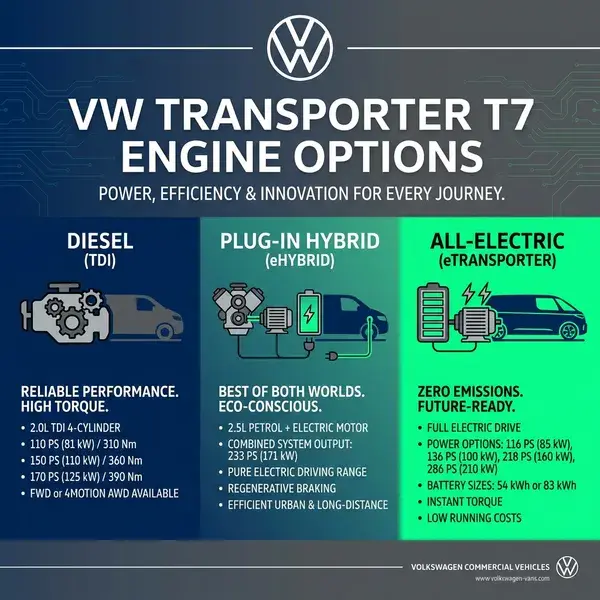
VW Transporter T7 Engine Options
VW Transporter T7 Engine
The VW Transporter T7 engine lineup has revolutionized the commercial vehicle market, offering a blend of power and efficiency that caters to diverse needs. From robust diesel options to cutting-edge hybrid technology, the T7 series provides a range of powertrains designed to meet the demands of modern businesses. These engines combine advanced engineering with practical performance, ensuring that drivers can tackle any job with confidence. Source
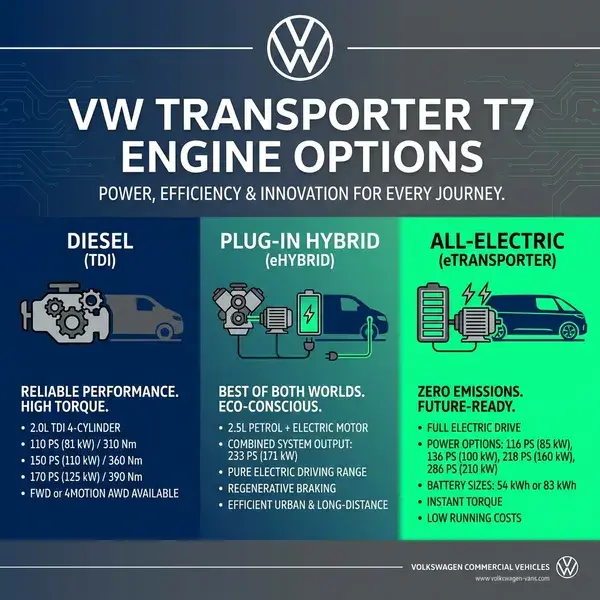 asured in kilowatt-hours for electric models, there’s a Transporter T7 to suit every requirement. Whether it’s long-haul transport or short urban deliveries, the T7’s diverse engine lineup ensures optimal performance and economy for any task. See Our New T7 Vans For Sale
Overview of VW Transporter T7 Engine Lineup
The VW Transporter T7 engine lineup offers a diverse range of powertrains, combining performance and efficiency to meet various commercial and passenger needs. This comprehensive overview explores the different engine options available across the T7 range, including the Multivan, Transporter, and Caravelle models.
Which Engine Is Best for the T7?
The T7 Multivan stands out with its petrol engine offerings, providing a powerful option for those who prefer gasoline powertrains. The lineup includes:
- 1.5 TSI: This engine VW Transporter T7 Engine, based on the EA211 platform, delivers 136 hp (101 kW; 138 PS) at 5,000-6,000 rpm and 220 N⋅m of torque at 1,750-3,500 rpm. It has a displacement of 1,498 cc and is paired with a 7-speed DSG transmission, achieving a top speed of 182 km/h and a 0-100 km/h acceleration time of 13.5 seconds.
- 2.0 TSI: The more powerful EA888 engine VW Transporter T7 Engine produces 204 hp (152 kW; 207 PS) at 5,000-6,500 rpm and 320 N⋅m of torque at 1,600-4,300 rpm. With a displacement of 1,984 cc, this engine enables the vehicle to reach a top speed of 200 km/h and accelerate from 0-100 km/h in 8.4 seconds.
These TSI engines are characterized by low consumption and impressive power, meeting premium-level expectations for performance and efficiency.
Diesel Variants
The T7 Transporter and Caravelle models offer a range of diesel engines, catering to those who prioritize fuel efficiency and torque. The diesel lineup includes:
- 2.0 TDI (EA288): This engine produces 150 hp (112 kW; 152 PS) at 3,000-3,750 rpm and 360 N⋅m of torque at 1,600-2,750 rpm. It has a displacement of 1,968 cc and achieves a top speed of 190 km/h with a 0-100 km/h time of 11.6 seconds.
- Additional TDI options: The T7 range also offers 110 PS and 170 PS variants, providing a spectrum of power outputs to suit different needs.
These state-of-the-art TDI drives provide ample torque while ensuring smooth operation through the DSG gearbox, delivering efficiency and low emissions.
Plug-in Hybrid eHybrid
The T7 VW Transporter T7 Engine lineup introduces an innovative plug-in hybrid option, combining the benefits of electric and combustion engines:
- 1.4 eHybrid (EA211): This sophisticated powertrain combines a 1.4 TSI engine producing 150 PS with an 85kW electric motor. The system output is 218 hp (163 kW; 221 PS) with 350 N⋅m of torque. Key features include:
- Pure electric range: Up to 30 miles
- Charging time: 3 hours and 36 minutes (using a 3.6kW wall box)
- Top speed: 190 km/h
- 0-100 km/h acceleration: 11.6 seconds
The eHybrid variant is available on Life and Style models of the Multivan, offering flexibility for both short urban trips and longer journeys.
All-Electric eTransporter
Completing the lineup is the all-electric eTransporter, showcasing Volkswagen’s commitment to zero-emission mobility:
- Electric powertrain options:
- Power outputs ranging from 85 to 210 kW (116 to 286 PS)
- Net battery capacity of 64 kWh (with plans for reduced output and smaller battery options)
This all-electric variant emphasizes Volkswagen’s focus on sustainability and reducing emissions in the commercial vehicle sector.
| Drive Type | T7 Multivan | T7 Transporter/Caravelle |
|---|---|---|
| Petrol | 204 PS | – |
| Diesel | 150 PS | 110 PS, 150 PS, 170 PS |
| Plug-in Hybrid | 218 PS | 232 PS |
| Electric | – | 136 PS, 218 PS, 286 PS |
This diverse range of engines in the VW Transporter T7 lineup ensures that there’s a suitable option for every commercial and passenger need, balancing power, efficiency, and environmental consciousness.
Petrol Powertrains in Detail VW Transporter T7 Engine
The VW Transporter T7 offers a range of petrol and Transporter T7 Hybrid powertrains that combine performance and efficiency, catering to various driving needs. These engines are characterized by low consumption and impressive power, meeting the expectations of a premium-level vehicle.
1.5 TSI Engine Specifications
The 1.5 TSI engine, based on the EA211 platform, serves as the entry-level petrol option for the T7 Multivan. This turbocharged inline-four engine boasts a displacement of 1,498 cc, delivering a respectable output of 136 hp (101 kW; 138 PS) at 5,000-6,000 rpm. It generates a maximum torque of 220 N⋅m (162 lb-ft) at 1,750-3,500 rpm, providing ample low-end grunt for everyday driving situations.
This engine is paired with a 7-speed DSG (Direct-Shift Gearbox), which ensures smooth and efficient power delivery. The combination of the 1.5 TSI engine and the DSG transmission allows the T7 Multivan to achieve a top speed of 182 km/h (113 mph). In terms of acceleration, it can sprint from 0 to 100 km/h (62 mph) in 13.5 seconds, offering adequate performance for most driving scenarios.
The 1.5 TSI engine has been available in the T7 Multivan lineup since November 2021, providing a balanced option for those seeking a blend of efficiency and performance in their daily drives.
2.0 TSI Performance and Efficiency VW Transporter T7 Engine
For those desiring more power, the 2.0 TSI engine, based on the EA888 platform, stands out as the top-tier petrol option in the T7 Multivan range. This larger displacement engine, with 1,984 cc, significantly ups the ante in terms of performance.
The 2.0 TSI generates an impressive 204 hp (152 kW; 207 PS) at 5,000-6,500 rpm, providing a substantial boost in power compared to its smaller sibling. The torque output is equally impressive, with 320 N⋅m (236 lb-ft) available from 1,600 to 4,300 rpm, ensuring strong pulling power across a wide rev range.
Like the 1.5 TSI, the 2.0 TSI is also mated to a 7-speed DSG transmission, which helps to harness the engine’s power effectively. This powertrain combination enables the T7 Multivan to achieve a top speed of 200 km/h (120 mph), making it well-suited for high-speed cruising on the Autobahn. The 0-100 km/h (62 mph) acceleration time is significantly reduced to 8.4 seconds, providing a more engaging driving experience.
To put these figures into perspective, here’s a comparison table of the two petrol engines:
| Specification | 1.5 TSI | 2.0 TSI |
|---|---|---|
| Displacement | 1,498 cc | 1,984 cc |
| Power Output | 136 hp (101 kW; 138 PS) | 204 hp (152 kW; 207 PS) |
| Torque | 220 N⋅m (162 lb-ft) | 320 N⋅m (236 lb-ft) |
| Top Speed | 182 km/h (113 mph) | 200 km/h (120 mph) |
| 0-100 km/h | 13.5 seconds | 8.4 seconds |
| Transmission | 7-speed DSG | 7-speed DSG |
Both petrol engines in the T7 Multivan lineup offer distinct advantages. The 1.5 TSI provides a good balance of performance and efficiency, making it suitable for urban driving and light highway use. The 2.0 TSI, on the other hand, delivers more robust performance and is better suited for those who frequently carry heavier loads or desire more spirited driving dynamics.
It’s worth noting that while these petrol engines offer smooth and quiet operation, they may not match the fuel efficiency of their diesel counterparts. However, for buyers prioritizing refinement and performance over ultimate fuel economy, these TSI engines present compelling options in the T7 Multivan range.
Diesel Engine Options Explored
The VW Transporter T7 lineup offers a range of robust and efficient diesel engines, catering to various performance needs and driving preferences. These state-of-the-art TDI (Turbocharged Direct Injection) drives provide ample torque while ensuring smooth operation through the DSG gearbox, delivering efficiency and low emissions.
2.0 TDI Variants and Outputs VW Transporter T7 Engine
The T7 Transporter and Caravelle models feature a selection of 2.0-liter TDI engines, each designed to meet specific power requirements:
- Entry-level variant: This engine produces 81 kW (110 PS), offering a balance of efficiency and adequate power for lighter loads and urban driving.
- Mid-range option: With an output of 110 kW (150 PS), this variant provides a versatile blend of performance and economy. It generates a maximum torque of 360 N⋅m (266 lb-ft) between 1,600-2,750 rpm, ensuring strong pulling power across a wide rev range.
- High-performance variant: The top-tier diesel option delivers 125 kW (170 PS), catering to those who require extra power for heavy loads or frequent highway driving.
- Flagship diesel: Some models offer a more powerful 2.0 TDI engine with an impressive output of 204 hp (152 kW) and 320 N⋅m (240 lbf⋅ft) of torque.
All these engines are based on Volkswagen’s EA288 platform, known for its reliability and efficiency. The 150 PS variant, for example, achieves a top speed of 190 km/h (118 mph) and accelerates from 0-100 km/h (0-62 mph) in 11.6 seconds.
To better illustrate the range of diesel options, here’s a comparison table:
| Engine Variant | Power Output | Torque | Top Speed | 0-100 km/h |
|---|---|---|---|---|
| Entry-level | 110 PS (81 kW) | N/A | N/A | N/A |
| Mid-range | 150 PS (110 kW) | 360 N⋅m | 190 km/h | 11.6 sec |
| High-performance | 170 PS (125 kW) | N/A | N/A | N/A |
| Flagship | 204 PS (152 kW) | 320 N⋅m | N/A | N/A |
Fuel Efficiency and Emissions
The TDI engines in the T7 lineup have been designed with a focus on efficiency and reduced emissions, aligning with Volkswagen’s commitment to sustainability. While specific fuel consumption figures for each variant are not provided, these modern diesel engines are known for their impressive fuel economy, especially on long-distance journeys.
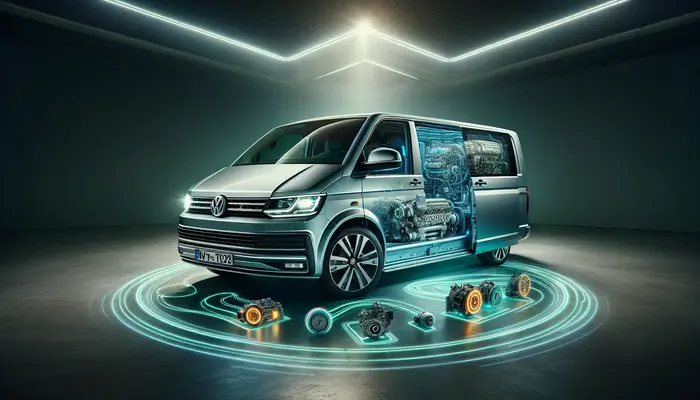
The DSG (Direct-Shift Gearbox) plays a crucial role in optimizing fuel efficiency. This advanced transmission ensures smooth gear changes and helps maintain the engine in its most efficient operating range. The result is a reduction in fuel consumption and emissions compared to traditional manual or automatic transmissions.
For those seeking even greater efficiency and lower emissions, Volkswagen offers additional powertrain options:
- eHybrid: This plug-in hybrid variant combines a petrol engine with an electric motor, providing short-distance zero-emission capability.
- eTransporter: An all-electric version is available, offering zero tailpipe emissions for environmentally conscious operators.
These alternative powertrains reflect Volkswagen’s broader strategy to reduce the environmental impact of its commercial vehicle range.
It’s worth noting that the TDI engines are compatible with 4MOTION all-wheel drive on variants from 150 PS and above. This feature provides enhanced traction and stability, particularly useful for operators who frequently encounter challenging road conditions or need to tow heavy loads.
The VW Transporter T7’s diesel engine options strike a balance between performance, efficiency, and environmental responsibility. With a range of power outputs and the latest in emission reduction technology, these TDI engines continue to be a popular choice for businesses and individuals alike, offering reliability and economy in a versatile commercial vehicle package.
eHybrid: The Best of Both Worlds VW Transporter T7 Engine
The VW Transporter T7 eHybrid represents a significant leap forward in combining the benefits of electric and combustion engine technology. This innovative powertrain offers users the flexibility to enjoy both zero-emission driving for shorter trips and the range of a traditional engine for longer journeys.
Electric Range and Charging
The T7 eHybrid boasts an impressive electric-only range, allowing for silent and emission-free driving in urban environments. According to the WLTP cycle, the vehicle can travel between 46 to 50 kilometers (29–31 miles) on pure electric power. Under the NEDC cycle, this range extends to 58–60 kilometers (36–37 miles). This capability makes the eHybrid an ideal choice for daily commutes and short trips around town without using any fuel.
Charging the T7 eHybrid is a convenient process. Using a 3.6 kW AC wall box, the lithium-ion battery can be fully charged in approximately 3 hours and 36 minutes. This relatively quick charging time ensures that the vehicle can be easily prepared for daily use, maximizing its electric driving potential. For those charging at home, connecting the charging cable to a standard socket is also an option, though charging times may vary.
Combined Power Output
The eHybrid powertrain combines a 1.4-liter TSI petrol engine with an electric motor to deliver impressive performance figures. The system’s total output is 215 HP (218 PS / 160 kW), providing ample power for various driving scenarios. The combined torque output reaches 350 Nm (258 lb-ft), ensuring strong acceleration and pulling power.
This powerful hybrid system allows the T7 eHybrid to accelerate from 0 to 62 mph (0-100 km/h) in just 9.0 seconds, with a maximum speed of 118 mph (190 km/h). These performance figures demonstrate that the eHybrid doesn’t compromise on driving dynamics despite its focus on efficiency.
To better understand the eHybrid’s capabilities, here’s a comparison of its key performance and efficiency metrics:
| Metric | Value |
|---|---|
| Total System Power | 215 HP / 218 PS / 160 kW |
| Total System Torque | 258 lb-ft / 350 Nm |
| Acceleration (0-62 mph) | 9.0 seconds |
| Maximum Speed | 118 mph (190 km/h) |
| Electric Range (WLTP) | 46-50 km (29-31 miles) |
| Electric Range (NEDC) | 58-60 km (36-37 miles) |
| Charging Time (3.6 kW AC) | 3 hours 36 minutes |
The eHybrid’s efficiency is particularly noteworthy. Under combined driving conditions, it achieves an impressive fuel economy of 157 MPG (1.5 L/100 km) according to standard measurements, or 138 MPG (1.7 L/100 km) under WLTP conditions. This translates to a theoretical range of up to 2,900 miles (4,666 km) or 2,559 miles (4,117 km) under WLTP measurements, showcasing the eHybrid’s potential for long-distance travel.
In terms of environmental impact, the T7 eHybrid demonstrates significant improvements over conventional powertrains. CO2 emissions are rated at just 34 g/km according to Volkswagen’s standard measurements, or 40 g/km under WLTP conditions. These low emission figures make the eHybrid an attractive option for environmentally conscious consumers and businesses operating in areas with strict emissions regulations.
The VW T7 eHybrid is available in Life and Style models, offering consumers the flexibility to choose a variant that best suits their needs while still benefiting from the advanced hybrid technology. With its combination of electric efficiency and combustion engine reliability, the T7 eHybrid truly represents the best of both worlds in modern commercial vehicle design.
All-Electric eTransporter: Zero Emissions Capability
The Volkswagen ABT e-Transporter 6.1 represents a significant step towards zero-emission commercial vehicles. Developed in partnership with ABT, a German electric specialist known for their Formula E racing team, this all-electric van offers a compelling option for businesses looking to reduce their carbon footprint.
Battery Options and Range
The e-Transporter comes equipped with a lithium-ion battery pack consisting of 16 cells. While the exact battery capacity is not specified, the vehicle’s range provides insight into its capabilities. According to official WLTP certification, the e-Transporter has a driving range of 82 miles on a single charge. This places it at the lower end of the electric van spectrum, especially when compared to competitors like the Vauxhall Vivaro-e, which can travel over 200 miles between charges.
Volkswagen’s decision to offer a single battery pack version at this stage has influenced the limited range. Initially, there were plans for a larger battery variant, but this has not materialized yet. The company argues that this range is sufficient for the majority of its customers who are considering an electric van, as they typically have daily mileages of 60 miles or less.
For comparison, here’s how the e-Transporter stacks up against some competitors:
| Model | Range (WLTP) |
|---|---|
| VW ABT e-Transporter 6.1 | 82 miles |
| Mercedes-Benz eVito | 92 miles |
| Vauxhall Vivaro-e | 205+ miles |
| Peugeot e-Expert | 200+ miles |
| Citroen e-Dispatch | 200+ miles |
Charging Times and Infrastructure VW Transporter T7 Engine
The e-Transporter offers flexibility in charging options, catering to various user needs and available infrastructure. It has capabilities for both AC and DC charging, allowing for convenient charging at home or rapid charging on the go.
- DC Rapid Charging:
- Compatible with 50kW rapid charging stations
- Can charge from empty to 80% in approximately 45 minutes
- Ideal for quick top-ups during longer journeys
- AC Charging:
- Compatible with typical wallbox chargers (7.2kW)
- Full charge takes around 5.5 hours
- Suitable for overnight charging at home or during workday at the office
The charging port is conveniently located under the flap by the passenger door, where you’d typically find the diesel filler on a conventional Transporter.
It’s worth noting that the UK’s charging infrastructure has significantly expanded, with more charging stations now available than petrol stations. This growth in infrastructure makes it increasingly convenient for e-Transporter owners to keep their vehicles charged and ready for use.
While the e-Transporter’s range may be limited compared to some competitors, its rapid charging capability helps mitigate this drawback. The ability to quickly recharge during short breaks can extend the vehicle’s effective range for businesses that require longer daily mileages.
In conclusion, the VW ABT e-Transporter 6.1 offers a zero-emission solution for businesses with moderate daily mileage requirements. Its rapid charging capabilities and the growing charging infrastructure in the UK help offset its limited range, making it a viable option for environmentally conscious fleet operators.
Conclusion: Choosing the Right Engine for Your Needs
The VW Transporter T7 engine is similar to the VW Crafter Engine lineup lineup showcases a wide range of engine options, catering to various needs and preferences. From powerful petrol engines to efficient diesels, and from innovative hybrid technology to all-electric variants, Volkswagen has created a versatile range that has an impact on the commercial vehicle market. This diversity allows businesses and individuals to choose a powertrain that best suits their specific requirements, whether it’s for urban deliveries, long-haul transport, or anything in between.
As the automotive industry moves towards more sustainable solutions, the T7’s eHybrid and all-electric eTransporter options and VW Transporter T7 Engine stand out as forward-thinking choices. These eco-friendly alternatives not only help to reduce emissions but also offer potential cost savings in the long run. With its blend of traditional and cutting-edge powertrains, the VW Transporter T7 range is well-positioned to meet the evolving needs of the market, providing a balance of performance, efficiency, and environmental responsibility.
FAQs VW Transporter T7 Engine
- What is the fuel efficiency of the VW Transporter T7?
The fuel consumption rates for the VW Transporter T7 Engine vary depending on the engine type. The smaller petrol engine consumes approximately 6.6 liters per 100 kilometers, whereas the more powerful petrol engine uses around 7.6 liters per 100 kilometers. - What types of engines are available in the VW Transporter T7?
The VW Transporter T7 Engine offers several engine options including turbo diesel engines with outputs of 81 kW (110 ps), 110 kW (150 ps), and 125 kW (170 ps), all under Volkswagen’s TDI nameplate. - Which engine in the VW Transporter T7 Engine lineup is considered the best?
The 2.0-liter TDI engine is highly regarded as the best engine option for the VW Transporter. It is known for its reliability, efficiency, and ease of maintenance, making it an ideal choice for both personal and commercial applications. - Which VW Transporter model is the most fuel-efficient?
The most economical VW Transporter model achieves around 40.4 miles per gallon. This efficiency is typically found in the T28 models with the lowest gross vehicle weight and the smallest engines, as well as the T30 model equipped with a 150hp 2.0-liter diesel engine.