Volkswagen Caravelle: How Many Seats Does It Have?
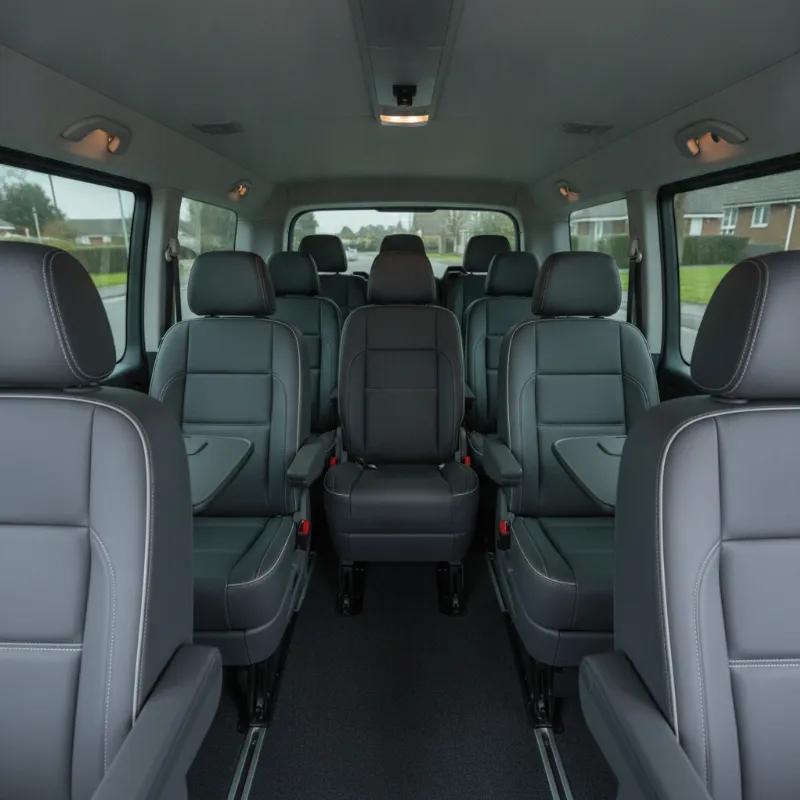
Volkswagen Caravelle Seating Explained
The Volkswagen Caravelle has built a loyal following in the UK precisely because of the way it handles people. Whether it's a growing family, an executive shuttle operator, a hotel courtesy service or a minibus taxi driver, the Caravelle offers a rare combination of van-based practicality and MPV-style comfort. At the heart of that appeal is its cabin — a properly flexible, multi-seat space that can be tailored to how you actually travel, rather than forcing you to squeeze into a fixed layout.
Before diving into the numbers, it helps to understand what the Caravelle actually is. It sits above the Transporter Shuttle and Kombi in Volkswagen's Transporter passenger range, offering carpeted floors, softer trim, individual rear seats on sliding rails, and higher levels of standard equipment. That premium positioning is why so many UK buyers still choose one over a conventional seven-seat SUV or people carrier.
How Many Seats Does a VW Caravelle Have?
The short answer is that most Volkswagen Caravelles sold in the UK are configured as seven-seaters, but depending on the model year, wheelbase and specification, you can find factory and converted versions with eight or nine seats. Longer-wheelbase (LWB) models tend to offer more flexibility for higher seat counts, while short-wheelbase (SWB) Caravelles are typically limited to the classic seven-seat layout.
Standard 7-Seat Configuration
The default and by far the most common Caravelle layout is seven seats. That's made up of two individual seats in the front (driver plus front passenger), a pair of single rear-facing or forward-facing captain's chairs in the middle row, and a three-person bench across the rear. In many configurations, the two middle seats can be rotated to face the rear bench, creating a "conference" arrangement that's genuinely useful for families on long trips or for business shuttling clients between meetings.
8-Seat and 9-Seat Configurations
Eight and nine-seat Caravelles exist too, though they're less common on UK forecourts. An eight-seat layout typically adds a third seat to the middle row, giving you 2 + 3 + 3. A nine-seat version — often described as an "8+1" when counted as driver plus eight passengers — is usually built on the long-wheelbase platform and uses an additional row or a wider middle bench. These are popular with hotels, airport transfer operators and larger families who need to move everyone in one vehicle.
Volkswagen Caravelle 8+1 Passenger Van Automatic
The "8+1 passenger van automatic" description you'll see in classified adverts refers to a Caravelle that seats one driver plus eight passengers, fitted with VW's DSG automatic gearbox. It's a specification that ticks a lot of boxes for professional operators: it falls under the standard UK car driving licence threshold for most drivers (nine seats including the driver), it's easy to drive in traffic thanks to the automatic transmission, and it still delivers the Caravelle's trademark refinement.
Typically these vehicles are built on the long-wheelbase Caravelle body to give rear passengers proper legroom, and pair the 2.0-litre TDI diesel engine with the seven-speed DSG. Options like tri-zone climate control, powered sliding doors and rear-seat air conditioning make them a genuine alternative to more expensive luxury MPVs.
What Is a VW T5 Caravelle?
The "T5" refers to the fifth-generation Volkswagen Transporter platform, produced between 2003 and 2015 (with the facelifted version, often called the T5.1, arriving in 2010). The T5 Caravelle is the passenger-focused variant of that generation, and it remains one of the most popular used buys in the UK thanks to its blend of durability, running costs and honest, boxy practicality.
T5 Caravelles were offered in short and long-wheelbase forms, with seven seats as standard and up to nine seats available depending on market and specification. Trim levels ranged from the entry SE through to the well-equipped Executive, which added leather, sat nav, parking sensors and more. If you're shopping used, the T5 is often the sweet spot between price and features.
Seat Layout and Flexibility (Rails, Removable Seats, Conference Mode)
What sets the Caravelle apart from a conventional MPV is the floor rail system. The individual middle-row seats and the rear bench slide backwards and forwards along recessed metal rails that run the length of the passenger compartment. That means you can fine-tune legroom for whichever row needs it most, or slide the middle seats right up against the front for maximum boot space.
Every rear seat can be removed entirely, either individually or as a set, turning the Caravelle into something close to a panel van when you need to move furniture, bikes or luggage. The middle-row seats can also be rotated 180 degrees to face the rear bench, creating the famous "conference mode" — perfect for card games on holiday, meetings on the move, or simply keeping an eye on children in car seats. A folding table is available as an option to sit between the facing rows.
Caravelle Seating Across Generations (T4, T5, T6, T6.1)
Seating layouts have evolved gently across the Caravelle's generations rather than being reinvented. The T4 (1990–2003) introduced the rail-mounted, rotating seat concept that later models built on, and was typically offered as a seven-seater in the UK, though larger configurations existed in Europe.
The T5 (2003–2015) refined the system, improved the seat quality significantly and made the conference-style layout more accessible. The T6 (2015–2019) brought a new front end, updated interiors and better infotainment but kept the underlying seven-seat layout with sliding, removable and rotating rear seats. The T6.1 (2019 onwards) added modern driver assistance tech, an electromechanical steering system and a digital dashboard, while retaining the same fundamentally clever seating architecture. Across all four generations, seven seats is the norm, with eight and nine-seat variants available on longer bodies.
Which Caravelle Seat Configuration Is Right for You?
If you're a family of five or six who occasionally carries grandparents or friends, a standard seven-seat short-wheelbase Caravelle is likely all you need — and it'll be easier to park than the LWB. If you regularly travel with six or seven passengers plus luggage, step up to the long-wheelbase seven-seater for the extra boot space behind the rear bench.
For businesses, larger families or anyone regularly moving eight or nine people, look specifically for an 8+1 or nine-seat model. Just double-check the V5C document to confirm the recorded seat count, as this affects insurance, MOT class and licence requirements. If flexibility matters most — camping trips, dog walking, occasional van duties — prioritise a model where all rear seats are confirmed to be present, removable and in good condition, as replacements can be expensive.
Find a Volkswagen Caravelle for Sale or Lease in the UK
Caravelles hold their value well, so it pays to look carefully at both new and used stock before deciding. New T6.1 Caravelles are available to order through Volkswagen Commercial Vehicle dealers across the UK, with lease and finance options making the monthly cost more predictable than an outright purchase. On the used market, T5 and T6 models offer excellent value, particularly in seven-seat SE and Executive trims.
Whichever generation you go for, always sit in the vehicle before buying, try folding and sliding the seats yourself, and ideally take the family along to check that everyone fits comfortably in the layout you're considering. The Caravelle's seating is its biggest selling point — make sure the configuration you choose genuinely works for the way you'll use it.
FAQs
How many seats does a Volkswagen Caravelle have?
Most UK Volkswagen Caravelles are seven-seaters, arranged as two individual front seats, two individual middle-row captain's chairs and a three-person rear bench. Depending on model year, wheelbase and specification, eight-seat and nine-seat (often described as 8+1) versions are also available, usually on the long-wheelbase body.
Can you drive a 9-seat Caravelle on a normal UK car licence?
Yes, in most cases. A standard UK category B car driving licence allows you to drive vehicles with up to nine seats including the driver, provided you're not carrying passengers for hire or reward. A 9-seat (8+1) Caravelle sits right at that limit, so it's legal for private use on a car licence, but you'll need a category D1 or PCV licence if you're using it commercially as a taxi or minibus.
Can the rear seats in a Caravelle be removed?
Yes. All rear seats in the Caravelle — both the individual middle-row seats and the rear bench — can be removed individually via the floor rail system. This lets you convert the interior into a large load space when needed. The seats are heavy, so it's usually a two-person job, and you'll want to store them somewhere clean and dry.
What's the difference between a VW Caravelle, Transporter Shuttle and Kombi?
All three are based on the same Volkswagen Transporter platform but are positioned differently. The Kombi is the most van-like, with basic trim and removable rear seats aimed at mixed cargo and passenger use. The Transporter Shuttle is a fixed-seat minibus focused on business and shuttle work. The Caravelle sits at the top, with carpeted floors, higher-quality trim, sliding and rotating individual seats, and a much more MPV-like feel inside.
Does the Caravelle have ISOFIX points for child seats?
Yes. Modern Caravelles (T5, T6 and T6.1) come with ISOFIX mounting points on the rear seats, typically on the outer positions of the rear bench and on the individual middle-row seats. This makes it straightforward to fit multiple child seats, which is one of the reasons the Caravelle is so popular with larger families.