VW Crafter AdBlue Explained: What It Is and How It Works
What is AdBlue and why does the VW Crafter need it?
AdBlue is a colourless, non-toxic fluid made from a precise blend of high-purity urea (around 32.5%) and deionised water. It isn't a fuel additive and it never mixes with your diesel — instead, it's stored in its own dedicated tank and injected into the exhaust system to help clean up harmful emissions before they leave the tailpipe.
The VW Crafter, like most modern Euro 6 diesel vans, uses AdBlue as part of its Selective Catalytic Reduction (SCR) system. When the Crafter's engine burns diesel, it produces nitrogen oxides (NOx) — pollutants that contribute to poor air quality. AdBlue reacts with these gases inside the SCR catalyst and converts them into harmless nitrogen and water vapour. Without a working AdBlue system, your Crafter wouldn't meet current emissions regulations, and the vehicle will eventually refuse to start if the tank runs dry.
How the AdBlue system works on a VW Crafter
The process is largely automatic and happens in the background while you drive. A small dosing pump measures a precise amount of AdBlue and sprays it into the hot exhaust stream just before the SCR catalyst. There, the urea breaks down into ammonia, which reacts with the NOx gases and neutralises them. The onboard computer monitors AdBlue levels, exhaust temperature and NOx output constantly, adjusting the dose as needed depending on load, engine speed and driving style.
Because everything is managed by the ECU, you don't need to do anything day-to-day beyond keeping the tank topped up. The Crafter will alert you well in advance when the level is getting low, giving you plenty of time to refill before it becomes a problem.
Where is the AdBlue tank located on a VW Crafter?
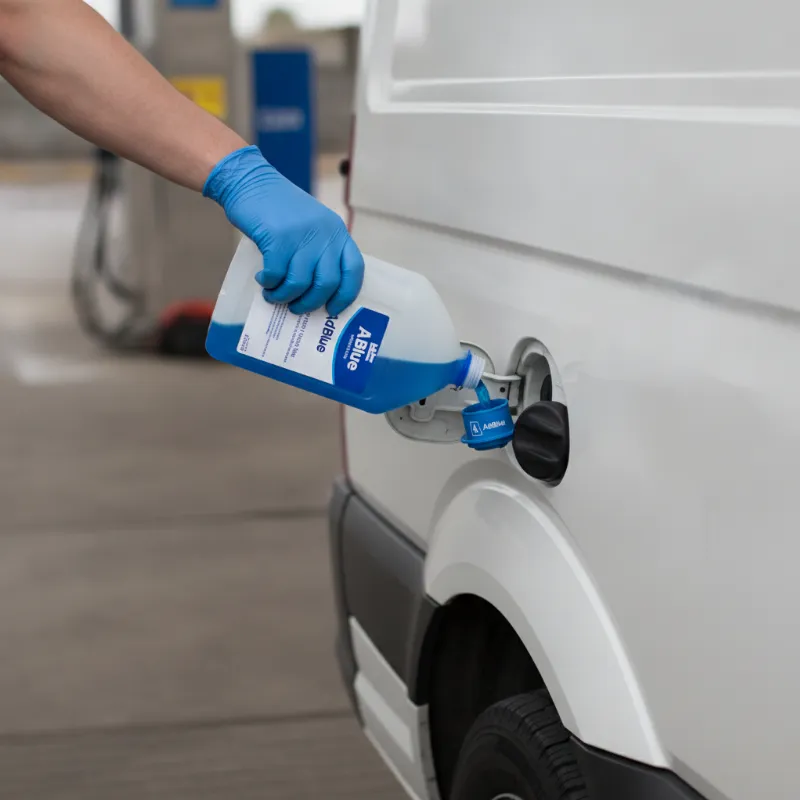
On the current-generation VW Crafter, the AdBlue filler is located next to the diesel filler under the fuel flap on the side of the van. It has a distinctive blue cap clearly marked "AdBlue" so it's almost impossible to confuse with the diesel filler. On some older Crafter models, the AdBlue neck can be found under the bonnet or, on certain variants, beneath the vehicle — always check your handbook if you're unsure, as filling the wrong tank is an expensive mistake.
How much AdBlue does a VW Crafter hold?
The Crafter's AdBlue tank typically holds around 18 to 24 litres depending on the model year and specification. That's usually enough to cover somewhere between 6,000 and 12,000 miles between top-ups, though real-world figures vary with how the van is driven and loaded. Heavier payloads, frequent motorway runs and cold weather all tend to increase consumption.
How to refill AdBlue on your VW Crafter
Refilling is straightforward and something most Crafter drivers can do themselves. AdBlue is widely available at fuel station forecourts (often at the pump alongside diesel), and also in sealed bottles or 10-litre containers from motor factors, dealers and supermarkets. Look for fluid marked ISO 22241 — this is the industry standard that guarantees purity.
To refill, park on level ground with the engine off, open the fuel flap and unscrew the blue AdBlue cap. If you're using a bottle with a screw-on nozzle, follow the instructions on the pack — most are designed to click into place and pour without spillage. Add fluid slowly until the bottle stops flowing or you reach the amount indicated by the dashboard warning. Replace the cap firmly, wait a minute or two, then start the engine so the system can register the new level. Wipe up any spills promptly, as AdBlue can crystallise on paintwork and corrode certain metals.
Common AdBlue warning messages and what they mean
The VW Crafter uses a tiered warning system so you're never caught out. The first message usually appears when there's around 1,500 miles of AdBlue range remaining — this is simply a reminder to top up when convenient. As the level drops further, warnings become more frequent and will state the exact distance remaining before a restart is prevented.
If you ignore these warnings and the tank empties completely, the Crafter will not restart once the engine is switched off — this is a legal requirement, not a fault. Other messages you might see include "AdBlue fault: see workshop", which usually indicates a sensor issue or a problem with the injector or pump, and warnings about incorrect fluid quality if non-standard AdBlue has been used. Any fault message that doesn't clear after a top-up should be checked by a technician.
AdBlue running costs and consumption on the VW Crafter
AdBlue is one of the cheaper consumables you'll deal with on a Crafter. Bought in bulk or from a forecourt pump, it typically works out at just a few pence per mile. As a rough guide, the Crafter uses roughly 1 litre of AdBlue for every 600 to 1,000 miles of driving, though this varies with engine size, load and how the van is used.
Vans that spend long periods idling, tow regularly, or carry heavy payloads will get through AdBlue faster than a lightly loaded Crafter doing steady motorway miles. Budgeting a top-up alongside every second or third service is usually a safe rule of thumb for most operators.
Looking after your VW Crafter: AdBlue tips and next steps
Keeping your Crafter's AdBlue system healthy is mostly about good habits. Top up before the tank runs low, use only ISO 22241-compliant fluid, keep bottles sealed and stored out of direct sunlight, and don't ignore warning messages. If you spill AdBlue on paint or metalwork, rinse it off with water straight away. Never dilute AdBlue with tap water or top it up with anything other than genuine product — the SCR catalyst is expensive to replace and easily damaged by contamination.
If your Crafter is due a service, or you've seen a persistent AdBlue warning that won't clear after refilling, it's worth booking it in with a specialist who knows the Crafter inside out. A quick diagnostic check can identify sensor or injector issues early, before they turn into a no-start situation that leaves you off the road.
FAQs
What is AdBlue on the VW Crafter and how does it work?
AdBlue is a urea-based fluid stored in a separate tank on your VW Crafter and injected into the exhaust as part of the Selective Catalytic Reduction (SCR) system. It reacts with harmful nitrogen oxides (NOx) produced by the diesel engine and converts them into harmless nitrogen and water vapour, allowing the Crafter to meet Euro 6 emissions standards. The system is fully automatic — all you need to do is top up the tank when the dashboard warning appears.
What happens if my VW Crafter runs out of AdBlue?
If the AdBlue tank runs completely empty, your Crafter will not restart once you switch the engine off. This is a legal emissions requirement rather than a fault. The van gives multiple warnings well in advance — usually starting around 1,500 miles before empty — so you have plenty of time to top up. If you do run out, simply add a few litres of AdBlue, wait a moment and the vehicle should start normally again.
Can I put AdBlue in the diesel tank by mistake?
It's very unlikely on a Crafter because the AdBlue filler has a distinctive blue cap clearly labelled and is a different size to the diesel filler. However, if AdBlue is accidentally added to the diesel tank (or vice versa), do not start the engine. Contact a dealer or recovery service immediately — the tank will need to be drained and the fuel system flushed to prevent serious damage.
How often does a VW Crafter need AdBlue?
Most Crafters need an AdBlue top-up every 6,000 to 12,000 miles, depending on how the van is driven and loaded. Vans doing heavy work, towing or lots of stop-start driving will use AdBlue faster than those on steady motorway runs. Many owners simply top up at every service, or whenever the first dashboard warning appears.
Where can I buy AdBlue for my VW Crafter?
AdBlue is widely available. Most motorway service stations and larger fuel forecourts have dedicated AdBlue pumps alongside the diesel, and you can also buy it in 5 or 10-litre bottles from motor factors, VW dealers, supermarkets and online. Just make sure any product you buy is marked ISO 22241 — this is the industry standard that guarantees the correct purity for your Crafter's SCR system.