Nissan NV400 Van Dimensions: Complete Size & Load Space Guide
Nissan NV400 Dimensions at a Glance
The Nissan NV400 is a full-size panel van built to compete with the likes of the Ford Transit, Mercedes-Benz Sprinter and Peugeot Boxer. It's offered in a wide range of body configurations, with four different lengths, three roof heights and both front- and rear-wheel drive layouts, giving operators plenty of choice when matching the van to a specific job.
At a glance, exterior length ranges from around 5,075mm on the shortest L1 model up to approximately 6,848mm on the extra-long L4. Overall width is 2,070mm without door mirrors and 2,470mm with them extended, while roof heights climb from roughly 2,307mm on the H1 low roof to more than 2,815mm on the H3 super-high roof. Load volumes stretch from 8m³ on the smallest van right up to 17m³ on the largest, making the NV400 one of the most versatile large vans on the road.
Exterior Dimensions: Length, Width and Height
Understanding the NV400's external footprint is essential when planning depot access, parking, height barriers and low-bridge routes. Nissan uses a straightforward "L" (length) and "H" (height) coding system, with L1 being the shortest and L4 the longest, and H1 through H3 covering low, medium and high roof options. Body width remains constant across the range at 2,070mm excluding mirrors, or 2,470mm with mirrors deployed, and the wheelbase varies to suit each length.
L1, L2, L3 and L4 Length Variants
The L1 short-wheelbase NV400 measures 5,075mm from bumper to bumper and sits on a 3,182mm wheelbase, making it the easiest to manoeuvre in tight urban environments. The L2 medium-wheelbase model stretches to 5,548mm overall on a 3,682mm wheelbase, adding useful load length without significantly increasing turning circle.
Step up to the L3 long-wheelbase version and you get an overall length of 6,198mm on a 4,332mm wheelbase, a popular choice for parcel delivery and general haulage. Finally, the L4 extra-long variant extends to 6,848mm overall — again on the 4,332mm wheelbase but with a longer rear overhang — making it the go-to option for bulky, low-density loads such as furniture or shopfitting materials.
H1, H2 and H3 Roof Height Options
Roof height is just as important as length when it comes to accessing car parks, drive-throughs and covered loading bays. The H1 low roof measures approximately 2,307mm tall and is only offered on shorter L1 and L2 variants, allowing the van to slip under most standard 2.1m barriers on many multi-storey car parks with a suitable clearance margin.
The H2 medium roof rises to around 2,488mm and is the most common specification, balancing standing height inside with sensible overall dimensions. The H3 super-high roof, offered on longer L3 and L4 bodies, reaches around 2,815mm tall and delivers enough internal height for taller operatives to work comfortably upright — ideal for mobile workshops, welfare vans and courier operations that need shelving stacked high.
Interior Load Space Dimensions
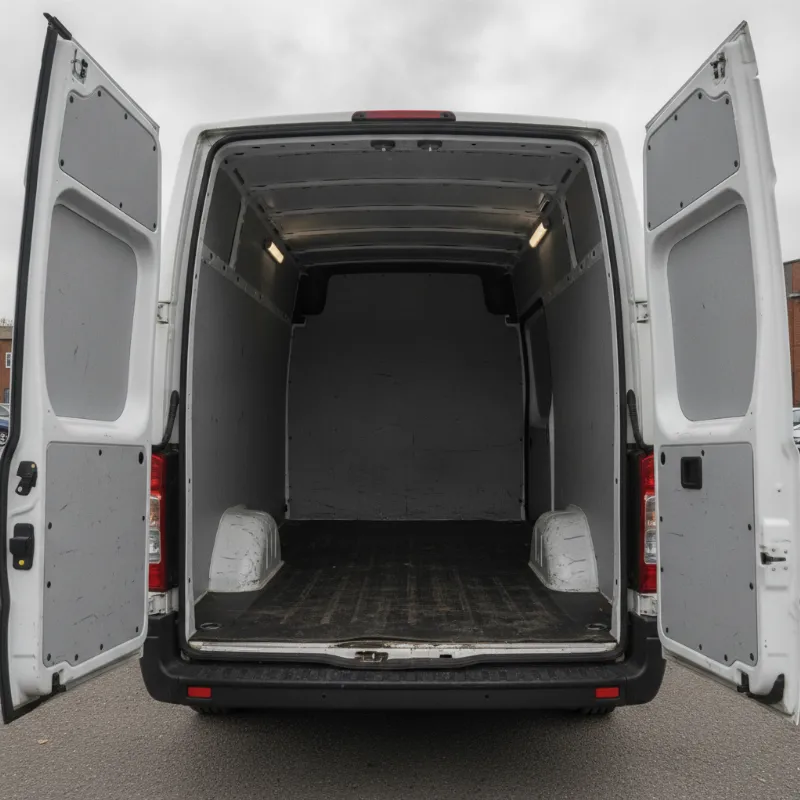
Inside the load bay, the NV400 offers a squared-off cargo area with minimal wheel arch intrusion, making it easy to slide Euro pallets in through the rear and fit standard racking along the sidewalls. All measurements below refer to the panel van; chassis cab, dropside and Luton conversions will differ depending on the bodybuilder specification.
Load Length, Width and Height
Maximum load length behind the bulkhead ranges from 2,583mm in the L1 model up to 4,383mm in the L4. Load width is a consistent 1,765mm at its widest point, narrowing to 1,380mm between the rear wheel arches — comfortably wide enough to accept a standard Europallet loaded across the van. Internal load height starts at 1,700mm under the H1 roof, rises to 1,894mm under the H2 and reaches 2,144mm under the H3, giving genuine walk-in access on high-roof models.
Load Volume by Body Configuration
Load volumes scale predictably with body size. The L1H1 offers approximately 8.0m³, while the L2H2 provides around 10.8m³. The popular L3H2 configuration gives 13.0m³ of usable space, and the L3H3 pushes that up to 14.9m³. At the top of the range, the L4H2 delivers 15.0m³ and the L4H3 tops the panel-van line-up at 17.0m³ — enough for well over a tonne of typical parcel freight or several rounds of bulky white goods deliveries.
Rear Door and Side Loading Door Apertures
The rear barn doors open to 270 degrees as standard, latching back against the sides of the van to keep them out of the way during loading. Rear aperture width is 1,580mm across all models, with aperture height varying from 1,520mm on H1 vans to 1,700mm on H2 and 1,891mm on H3 versions. The nearside sliding side door offers an opening of 1,270mm wide by 1,780mm tall on H2 models — big enough to accept a Europallet through the side with a pump truck.
Payload, Gross Vehicle Weight and Towing Capacity
The NV400 is offered in a range of Gross Vehicle Weight (GVW) ratings from 2.8 tonnes up to 4.5 tonnes, allowing operators to match load capacity to their driving licence and operational needs. Standard 3.5-tonne panel vans typically carry payloads between 1,100kg and 1,700kg depending on body size, drivetrain and specification, while heavier-duty 3.9-tonne and 4.5-tonne rear-wheel-drive versions can lift up to around 2,100kg.
Braked towing capacity is up to 3,000kg on suitably specified models, with a maximum gross train weight of around 6,000kg. That makes the NV400 a practical choice for businesses that need to tow plant trailers, car transporters or catering units alongside a decent onboard payload — but always cross-check the exact figures on the V5C and vehicle plate before hitching up.
Dimensions Across Model Years (2012, 2013, 2014 and Later)
The Nissan NV400 launched in the UK in 2011 as a rebadged version of the Renault Master and shares its underpinnings, body panels and dimensions with that van and the Vauxhall Movano. Early 2012 and 2013 models used the original front-end styling and the M9T 2.3-litre dCi engine, but exterior dimensions and load volumes remained unchanged through this early production run.
A facelift arrived for the 2014 model year, bringing a redesigned front bumper, grille and headlights. Although the nose looked different, overall exterior lengths, load volumes and aperture sizes stayed the same, so bodybuilders' racking, ply lining and conversion templates continued to fit across the generations. A further update in 2019 refreshed the interior, added new safety systems and introduced a Euro 6d-compliant engine range, again without altering the core body dimensions — meaning a 2013 L3H2 has the same load bay as a 2020 L3H2.
Nissan e-NV400 Electric Van Dimensions
Nissan also offered the fully electric e-NV400 (built on the Renault Master Z.E. platform) with the same body shell as the diesel model, so exterior length, width and height figures are identical to the equivalent diesel L1, L2 and L3 variants. The battery pack is packaged beneath the load floor, meaning load length, width, height and door apertures also remain unchanged.
Payload is slightly reduced compared with diesel models due to the weight of the battery, typically sitting between 950kg and 1,100kg depending on body configuration, and GVW is capped at 3.5 tonnes so the van can be driven on a standard Category B licence. Towing is not recommended on the electric version, which is worth factoring in if you need to pull a trailer.
Choosing the Right NV400 Size for Your Business
Selecting the right NV400 comes down to balancing load capacity against the practicalities of where the van will operate. If most of your work is in city centres, an L1H1 or L2H2 will slot into standard parking bays and clear the majority of height barriers, while still offering enough space for tools, stock or a modest delivery round. Trades that carry long items like copper pipe, timber or ladders will appreciate the extra load length of an L3 or L4.
For high-volume, low-weight operations such as parcel courier work, furniture removal or event logistics, the L3H3 and L4H3 configurations offer maximum cubic capacity without stepping up to a 7.5-tonne chassis. And if payload is the priority — think builders, landscapers or plant hire firms — a heavier-duty 3.9 or 4.5-tonne rear-wheel-drive NV400 gives you the weight allowance and towing muscle to match. Whichever combination you choose, take the time to measure your typical load, check your depot access heights and confirm the vehicle plate figures before you commit.
FAQs
What are the exterior dimensions of the Nissan NV400?
The NV400 comes in four lengths — L1 at 5,075mm, L2 at 5,548mm, L3 at 6,198mm and L4 at 6,848mm — with a consistent width of 2,070mm (2,470mm with mirrors). Three roof heights are offered: H1 at around 2,307mm, H2 at 2,488mm and H3 at 2,815mm, so overall size varies significantly depending on the configuration you choose.
How much load space does the Nissan NV400 offer?
Load volume ranges from 8.0m³ in the smallest L1H1 panel van up to 17.0m³ in the largest L4H3. Maximum load length behind the bulkhead is 4,383mm on the L4, load width is 1,765mm at its widest (1,380mm between the wheel arches), and internal load height reaches 2,144mm on H3 super-high-roof models.
Will a Nissan NV400 fit under a standard car park height barrier?
Only the L1H1 and L2H1 low-roof versions, at around 2,307mm tall, will fit under most standard 2.1m-plus car park barriers with a small clearance margin. H2 medium-roof (2,488mm) and H3 high-roof (2,815mm) versions are too tall for most multi-storey car parks and require careful route planning to avoid height-restricted areas.
What is the payload and towing capacity of the Nissan NV400?
Payload varies from around 1,100kg on lighter 3.5-tonne panel vans up to approximately 2,100kg on heavier-duty 4.5-tonne rear-wheel-drive versions. Braked towing capacity is up to 3,000kg on suitably specified diesel models, with a gross train weight of about 6,000kg. Always confirm the exact figures on the vehicle's V5C and VIN plate before loading or towing.
Are the dimensions of the electric e-NV400 the same as the diesel?
Yes — the e-NV400 uses the same body shell as the diesel NV400, so exterior length, width, height, load volume and door apertures are identical for each L and H configuration. The main differences are a slightly lower payload (typically 950–1,100kg) due to the battery weight and a fixed 3.5-tonne GVW.