How to Clean the DPF Filter on a Peugeot Partner: A Driver's Guide
What Is a DPF and Why Does Your Peugeot Partner Have One?
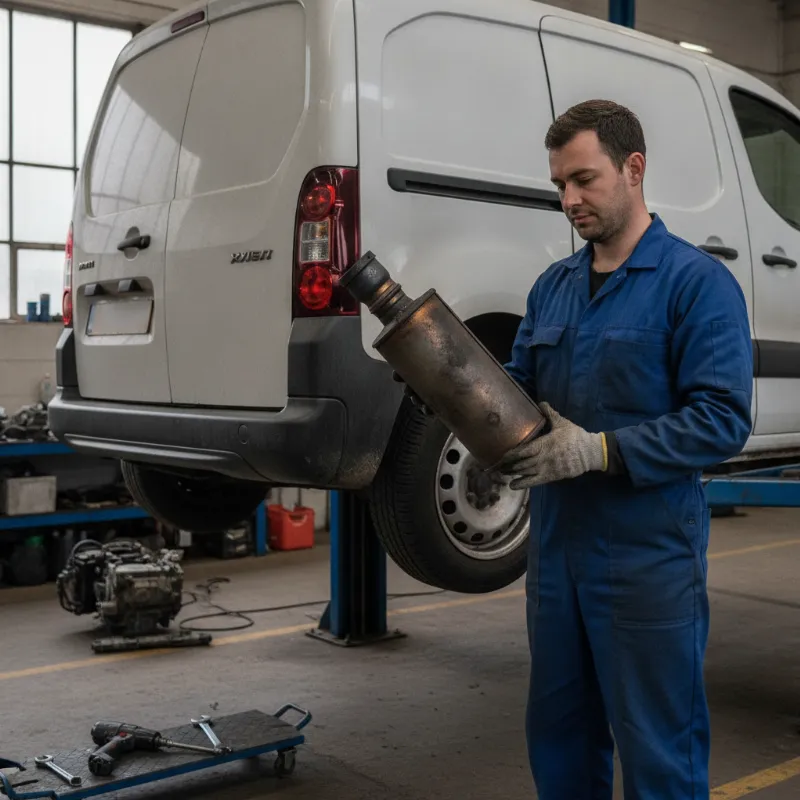
The Diesel Particulate Filter (DPF) sits in the exhaust system of every modern diesel Peugeot Partner and is designed to trap the fine soot particles produced when diesel burns. Since the introduction of Euro 5 emissions standards, every diesel light commercial vehicle sold in the UK has been fitted with one, and the Partner is no exception. Without it, your van would pump considerably more particulate matter into the atmosphere — which is exactly what stricter emissions rules and clean air zones like London's ULEZ are trying to reduce.
In normal operation the DPF collects soot until it reaches a certain threshold, at which point the van triggers a regeneration cycle that burns off the trapped particles at very high temperatures, leaving only a small amount of ash behind. On a Peugeot Partner used for regular motorway or A-road journeys this happens quietly in the background and you'd never notice. On a Partner used mostly for short, stop-start urban deliveries, the exhaust often never gets hot enough to complete a regeneration — and that's when the trouble starts.
Signs Your Peugeot Partner DPF Needs Cleaning
Catching a partially blocked DPF early is far cheaper and easier than dealing with a fully clogged one. Peugeot Partner drivers usually get plenty of warning if they know what to look for, both from the dashboard and from the way the van drives.
Dashboard warning lights to watch for
The most obvious clue is the amber DPF warning light, which looks like a rectangular filter symbol with dots inside it. When this illuminates on its own, the van is telling you that the soot load is getting high but that you can still clear it yourself by driving in a way that allows regeneration to complete. If you ignore it, the engine management light (a yellow engine outline) and sometimes the coil/preheat light will join in, indicating that regeneration has failed and the ECU has begun restricting performance. On later Partner models you may also see a written message in the driver information display such as "Anti-pollution fault" or "Particle filter additive minimum level" — the latter refers to the Eolys fluid used to lower the burn temperature during regeneration.
Performance symptoms (loss of power, poor MPG, limp mode)
Even without a warning light, a blocked DPF will make itself known through the way the Partner drives. You may notice a gradual loss of pulling power, particularly when loaded or on inclines, along with worse fuel economy as the engine works harder to push exhaust gases through a restricted filter. The cooling fan may run for longer after switching off, there can be a faint hot or acrid smell from the exhaust, and idling may become slightly rougher. If the DPF becomes badly blocked the ECU will drop the van into limp mode, capping revs and speed to protect the engine — at that point self-regeneration is no longer possible and you'll need to intervene manually.
How to Clean a DPF Filter on a Peugeot Partner: Step by Step
There is no single method that suits every situation. The right approach depends on how blocked the filter is, whether warning lights are showing, and how the van is normally used. Below are the five main options open to Peugeot Partner drivers, in roughly the order you should try them.
Method 1: Passive regeneration (motorway driving)
Passive regeneration is the simplest and cheapest fix — it costs you nothing but a tank of diesel and about 40 minutes of your time. As soon as you see the DPF light appear on its own (with no other warnings), find a stretch of dual carriageway or motorway and drive the Partner at a steady 50–70 mph in a lower gear than normal, keeping the revs at around 2,500–3,000 rpm. You want the exhaust gas temperature high and sustained. After 20 to 40 minutes the ECU should complete a regeneration cycle and the light will go out. Don't stop early — interrupting the process means starting again from scratch next time.
Method 2: Active regeneration
Active regeneration is what the Partner tries to do on its own during ordinary driving. The ECU injects a small amount of extra fuel on the exhaust stroke to raise the temperature in the DPF to around 600°C, burning off the accumulated soot. You can help this along without a motorway run by simply driving for a longer continuous period — 20 minutes or more at A-road speeds, avoiding short trips and repeated cold starts. Signs that active regeneration is happening include a slight change in engine note, higher idle speed, the cooling fan running more aggressively and a temporary drop in fuel economy. Let it finish before switching off.
Method 3: Forced/static regeneration via diagnostic tool
If the DPF is too blocked for the van to attempt regeneration on its own — typically once you're in limp mode or the engine management light is on — you'll need a forced regeneration. This is a workshop procedure carried out with a diagnostic tool (such as Peugeot's own DiagBox, or a good aftermarket scanner) that commands the ECU to run a static regeneration cycle while the van is stationary. It usually takes 30–45 minutes with the engine running at elevated revs, and it should only be done in a well-ventilated space away from anything flammable because the exhaust gets extremely hot. Most independent diesel specialists and Peugeot dealers offer this service, and it's a lot cheaper than a new filter.
Method 4: DPF cleaning additives and fuel treatments
Fuel-borne DPF cleaners are poured into the tank and work by lowering the temperature at which soot ignites, giving the van a better chance of completing regeneration on a normal drive. They can be very effective as a preventative measure or on a lightly blocked filter, but they won't rescue a severely clogged DPF and they aren't a substitute for the correct driving cycle. Choose a product suitable for HDi engines and always follow the dosing instructions on the bottle. Note that the Peugeot Partner also uses a separate cerium-based Eolys additive stored in its own tank, which is topped up during servicing — this is not the same thing as a bottle of aftermarket cleaner.
Method 5: Professional off-vehicle DPF clean
When regeneration no longer works — usually because the filter is full of ash rather than soot, or because it has become saturated with unburnt fuel from failed regen attempts — the DPF can be removed from the van and cleaned professionally. Specialists use pressurised water, chemical baths, ultrasonic tanks or pneumatic reverse-flushing to strip out the residue, then flow-test the filter to confirm it's back within tolerance. Expect to pay somewhere in the region of £250–£450 depending on the specialist, which is still a fraction of the cost of a new DPF. It's a good option for a Partner with an otherwise healthy engine and plenty of working life left.
DPF Cleaning on the Peugeot Partner LWB (Long Wheelbase)
The Long Wheelbase Partner is a particularly popular choice with couriers, mobile tradespeople and multi-drop delivery operators, and the way these vans are typically used has a direct bearing on DPF health.
Why LWB Partner vans often see more DPF issues (urban delivery use)
LWB Partners rack up big mileages, but a lot of those miles are made up of short hops between drops in urban and suburban areas. The engine barely reaches full operating temperature before it's switched off again, and the exhaust rarely gets hot enough or stays hot long enough for a regeneration to complete. Add in a heavier payload — the LWB is often loaded with parcels, tools or stock — and the engine is working harder while producing more soot at exactly the point in the cycle where the DPF can least deal with it. The result is that LWB Partners tend to see DPF warning lights sooner and more often than SWB vans used on longer runs.
Driving cycle tips for LWB Partner drivers
If your route allows it, try to build one longer leg into every working day — even 20 minutes on a dual carriageway between drops is enough to let the DPF regenerate. If you spot the DPF light in the morning, take the long way to your first job rather than leaving it until later. Avoid switching off the engine mid-regeneration; if the cooling fan is still running hard after you park up, that's often a clue. And keep an eye on service intervals — the Eolys additive tank needs periodic topping up, and skipped services are a common reason for chronic DPF problems on high-mileage LWB Partners.
How to Prevent DPF Blockages in Your Peugeot Partner Van
Prevention is far easier than cure. Stick to the correct oil grade (low-SAPS, C2 or as specified in the handbook) because the wrong oil produces excess ash that permanently loads the filter. Keep on top of servicing, including the Eolys additive top-up, and don't ignore the DPF light when it first appears — deal with it that same day. Avoid running the fuel tank down to the last few litres, as the Partner disables regeneration below a certain fuel level to protect the tank from the extra heat. Where you can, mix your usage: a Partner that gets a good long run once or twice a week will look after itself. And if you use additives, use them consistently as a preventative rather than only in a crisis.
When to Replace Rather Than Clean the DPF
There comes a point where cleaning is no longer worthwhile. If a professional off-vehicle clean has already been done once and the filter is blocking again quickly, or if flow-testing shows the substrate is cracked or partially melted (usually the result of runaway regenerations or oil contamination), replacement is the only sensible option. The same applies where the DPF is genuinely full of ash rather than soot — ash cannot be burnt off and eventually fills the filter to the point where cleaning can't recover enough capacity. A new original-equipment DPF for a Partner isn't cheap, but pattern-part and remanufactured units are widely available and are a legitimate route on an older van. Never be tempted to remove or hollow out the DPF: it's an MOT failure, it's illegal on the public road, and it will fail any ULEZ or Clean Air Zone check.
Thinking of Upgrading? Peugeot Partner Vans for Sale and Lease
If your current Partner has become a serial DPF offender — or the running costs of keeping an older van on the road are starting to outweigh the savings — it might be time to consider something newer. The latest Peugeot Partner is available in both diesel and fully electric e-Partner form, and the electric version sidesteps the DPF issue entirely, making it especially well suited to the urban delivery work that hammers diesel filters in the first place. Whether you're after a low-mileage used Partner, a brand-new van on finance, or a business contract hire deal with a fixed monthly cost, it's worth speaking to the sales team about what fits your usage pattern. A van that suits how you actually drive will always be cheaper to run than one that doesn't.
FAQs
How do I clean the DPF filter on my Peugeot Partner van?
The easiest way is to trigger a regeneration by driving the Partner for 20–40 minutes at a steady 50–70 mph on a dual carriageway or motorway in a lower gear, keeping revs around 2,500–3,000 rpm. If the DPF light is on alongside the engine management light, or the van is in limp mode, self-regeneration won't work and you'll need a forced regeneration via a diagnostic tool at a garage. A badly blocked filter can be removed and professionally cleaned off the vehicle for around £250–£450.
How long does it take to regenerate a Peugeot Partner DPF?
A passive regeneration on a motorway run typically takes 20 to 40 minutes of continuous driving. A forced static regeneration at a workshop usually takes 30 to 45 minutes with the engine running at raised idle. The key point is not to switch the engine off partway through — an interrupted cycle has to start again from the beginning.
Can I drive my Peugeot Partner with the DPF light on?
Yes, if the amber DPF light is showing on its own with no other warnings, you can and should keep driving — ideally straight onto a dual carriageway to let the filter regenerate. If the engine management light is also on, or the van has dropped into limp mode, you should stop driving normally and book it in for a forced regeneration, as continuing risks permanent damage to the filter and injectors.
Do DPF cleaning additives really work on a Peugeot Partner?
Fuel-borne DPF cleaners can genuinely help by lowering the temperature at which soot burns, making it easier for the van to complete a regeneration. They work best as a preventative measure or on a lightly blocked filter — they won't unblock a severely clogged DPF or replace a proper motorway run. Make sure the product is suitable for HDi diesel engines and remember it's separate from the Eolys additive topped up at service.
How much does it cost to replace a DPF on a Peugeot Partner?
A brand-new original-equipment DPF fitted at a Peugeot dealer can run into four figures once labour is added. Pattern-part and remanufactured units are considerably cheaper and are widely used by independent specialists. Before replacing, it's almost always worth trying a professional off-vehicle clean first, which typically costs £250–£450 and can restore the existing filter if the substrate is still sound.