 Call us on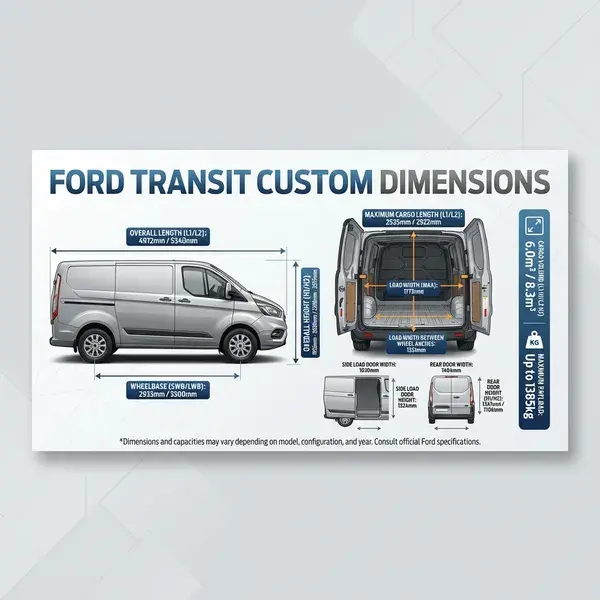
Ford Transit Custom Dimensions
Ford Transit Custom Dimensions:
The Ford Transit Custom Dimensions is a versatile and popular commercial van that has become a cornerstone for businesses and converters alike. Understanding its dimensions is crucial for those looking to maximize its potential for their specific needs. From its overall length and width to its load space capacity, the Ford Transit Custom’s measurements play a vital role in determining its suitability for various tasks and modifications. Source
This comprehensive guide delves into the Ford Transit Custom dimensions, covering everything from exterior measurements to internal cargo space. It explores the van’s height, length, and width variations across different models, including short wheelbase (SWB) and long wheelbase (LWB) versions. The article also examines payload weights, door sizes, and how the Transit Custom lease deals stacks up against other Ford vans. Whether you’re a business owner planning fleet additions or a converter seeking the perfect base vehicle, this guide aims to provide all the dimensional information you need to make informed decisions.
Ford Transit Custom Exterior Dimensions
The Ford Transit Custom Dimensions, the UK’s best-selling commercial vehicle, offers a range of exterior dimensions to suit various business needs. This versatile van comes in different body lengths and heights, providing options for diverse applications.
Length Ford Transit Custom Dimensions
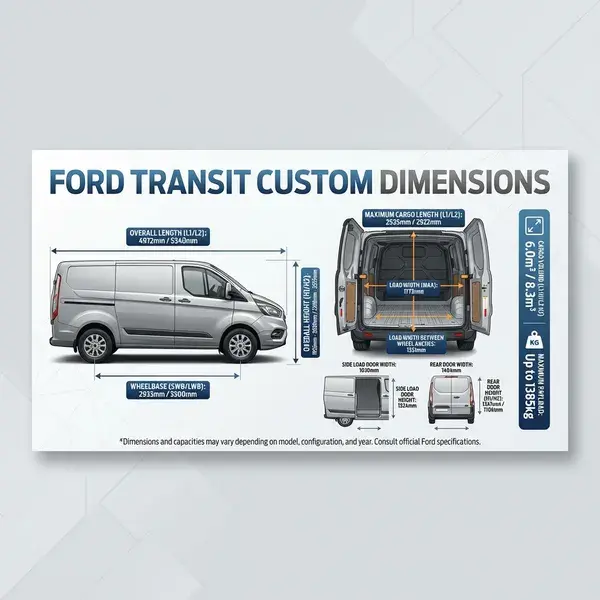
The Ford Transit Custom Dimensions is available in two distinct lengths. The standard size, known as L1, has an overall length of 4,973mm. For those requiring more space, the longer L2 model extends to 5,340mm, offering an additional 367mm in length. This variation allows businesses to choose the most suitable size for their specific requirements.
Inside the van, the loadspace length varies accordingly. The L1 Transit Custom provides an internal length of 2,554mm, while the L2 model offers an extended loadspace length of 2,921mm. For added versatility, Ford has included a load-through bulkhead option, facilitating the transport of longer items such as wood batons or pipes.
Width Ford Transit Custom Dimensions
The width of the Ford Transit Custom Dimensions is consistent across all models, measuring 1,986mm at its widest point. However, when considering the overall width, it’s important to factor in the mirrors. With mirrors extended, the van’s width increases to 2,772mm. For tighter spaces, the mirrors can be folded in, reducing the width to 2,080mm.
Inside the van, the maximum loadspace width is 1,775mm. Between the wheelarches, the loadspace narrows to 1,351mm, which is an important consideration when planning cargo placement.
Height Ford Transit Custom Dimensions
The Ford Transit Custom Dimensions offers two roof height options to accommodate different cargo needs. The standard roof height, designated as H1, measures 2,000mm. For businesses requiring additional vertical space, the high roof option (H2) increases the height to 2,366mm, providing an extra 366mm of clearance.
It’s worth noting that the actual height can vary slightly depending on the van’s load status:
- L1H1 (standard length, standard roof):
- Laden height: 1,925mm
- Unladen height: 2,000mm
- L2H1 (long length, standard roof):
- Laden height: 1,922mm
- Unladen height: 1,979mm
- L1H2 (standard length, high roof):
- Laden height: 2,286mm
- Unladen height: 2,366mm
- L2H2 (long length, high roof):
- Laden height: 2,285mm
- Unladen height: 2,343mm
These height variations are crucial for businesses to consider when planning routes that involve low bridges or parking structures with height restrictions.
The Ford Transit Custom’s diverse range of exterior dimensions allows it to cater to a wide array of business needs, from urban deliveries to long-distance transport. By offering multiple options in length and height, Ford ensures that businesses can find a Transit Custom model that aligns perfectly with their specific requirements.
Interior Cargo Space Measurements
The Ford Transit Custom Dimensions offers a versatile interior cargo space designed to meet various business needs. The van’s loadspace ranges from 6 cubic meters (6m3) to 8.3 cubic meters (8.3m3), depending on the model configuration.
Load Length Ford Transit Custom Dimensions
The Transit Custom provides two options for load length. The L1 model features an inside length of 2,554mm, while the L2 model extends to 2,921mm. These measurements are taken from the back doors to the bulkhead. For businesses requiring additional length, Ford offers a load-through bulkhead option. This feature allows for the transport of longer items such as wood batons or pipes. With the load-through bulkhead, the total maximum loadspace length increases to 3,037mm for the L1 van and 3,404mm for the L2 van.
The load-through bulkhead includes a hatch that enables the use of space under the front seats, accommodating slightly longer items. This clever design maximizes the van’s cargo capacity without compromising its exterior dimensions.
Load Width Ford Transit Custom Dimensions
The maximum loadspace width of the Ford Transit Custom Dimensions van is 1,775mm. However, it’s important to note that the wheels intrude into the loadspace, affecting the usable width. For businesses moving bulky items or using pallets, the critical dimension is the width between the wheelarches, which measures 1,351mm.
Load Height Ford Transit Custom Dimensions
The Ford Transit Custom’s loadspace height varies depending on the roof configuration. The H1 (low roof) model offers a loadspace height of 1,406mm, while the H2 (high roof) model provides 1,778mm of vertical space. These measurements represent the available space within the cargo area of the van.
It’s worth noting that the load volumes differ across various configurations:
- Short wheelbase, low roof (L1H1): 5.4 cubic meters
- Long wheelbase, low roof (L2H1): 6.2 cubic meters
- Short wheelbase, high roof (L1H2): 6.6 cubic meters
- Long wheelbase, high roof (L2H2): 7.7 cubic meters
The Transit Custom also features a low rear load height, making it easier to load and unload cargo. The loading height, which is the distance from the floor to the load bed, is 588mm when the van is empty and reduces to 444mm when fully laden.
To enhance accessibility, the van is equipped with a pallet-sized sliding door on both the driver (optional) and passenger sides. The rear doors have wide openings with 180° hinges, allowing businesses to make the most of the available space. For improved visibility, the loadspace is fitted with interior lights (two in L1, four in L2), and super-bright LED lighting is available as an option, providing superior illumination of the interior for a more comfortable working environment.
Payload and Capacity Ford Transit Custom Dimensions
The Ford Transit Custom offers impressive payload capabilities, making it a versatile choice for businesses with diverse transportation needs. The van’s payload capacity varies depending on factors such as engine type, trim level, fitted equipment, and body size.
Maximum Payload Ford Transit Custom Dimensions
The Transit Custom’s payload ranges from just under 700kg to nearly 1,500kg, surpassing many vans in the large van class. This wide range allows businesses to choose a model that best suits their specific requirements.
For the pre-2018 2.0-liter EcoBlue Transit Custom, the maximum payload rating was 1,474kg. Following the MCA facelift, this figure slightly decreased to 1,469kg, but the Ford Transit Custom remains one of the heaviest lifters in the medium van class. On the other hand, the minimum payload rating increased to 695kg post-facelift, thanks to an increase in the basic gross vehicle weight from 2.5 to 2.6 tons (2,600kg), known as the 260 series.
The 2.0-liter 136hp front-wheel-drive van in Leader trim with the manual gearbox boasts the highest payload capacity at 1,407kg. However, it’s worth noting that some models have payloads below 1,000kg, so it’s essential to choose the right configuration for specific needs.
To calculate payload, one needs to consider two factors: the vehicle’s gross vehicle mass (GVM) and its kerb mass. GVM is the maximum permissible weight of the vehicle when loaded and ready to go, including the weight of the vehicle itself, ancillaries, driver and crew (assuming the industry standard weight of 75 kg/person), fluids, fuel tank 90% full, optional and aftermarket equipment, and cargo.
Ford Transit models are designated according to their GVM. For example, a 290 has a GVM of approximately 2,900 kg, while a 310 has a GVM of about 3,100 kg. The kerb mass is the weight of a standard-specification Base series vehicle, including fluids and fuel tank 90% full, but without the driver, crew, or cargo. The payload is the difference between the GVM and kerb mass.
Cargo Volume Ford Transit Custom Dimensions
The Ford Transit Custom offers a range of cargo volumes to accommodate various business needs. The loadspace capacity varies depending on the model configuration:
- L1 H1 (short wheelbase, low roof): 6.0 cubic meters
- L2 H1 (long wheelbase, low roof): 6.8 cubic meters
- L1 H2 (short wheelbase, high roof): 7.2 cubic meters
- L2 H2 (long wheelbase, high roof): 8.3 cubic meters
These spacious interiors allow for the transport of three Europallets on the floor, making the Transit Custom both practical and stylish. The van features a full-height DIN/ISO compliant bulkhead as standard, ensuring cargo safety and driver compartment separation.
For businesses requiring extra length capacity, the Transit Custom offers a load-through bulkhead option. This feature increases the maximum load length to 3,037mm for L1 models and 3,404mm for L2 models, allowing for the transport of longer items such as pipes and ladders.
The Transit Custom’s design prioritizes ease of use, with low side and rear load heights, and a pallet-sized sliding door on both the driver (optional) and passenger sides. The rear doors feature wide openings with 180° hinges, maximizing accessibility and making the most of the available space.
Door and Access Dimensions
The Ford Transit Custom offers convenient access to its cargo area through strategically designed doors. These access points are crucial for efficient loading and unloading of goods, making the van a practical choice for various business needs.
Side Door Dimensions Ford Transit Custom Dimensions
The Transit Custom comes standard with a large sliding door on the passenger side, with an option to add a second sliding door on the driver’s side. This feature enhances the van’s versatility, allowing for easy access from both sides of the vehicle.
The side door dimensions are consistent across all Transit Custom models:
- Side door entry width: 1,030mm
- Side door entry height: 1,324mm
These dimensions ensure that the side door can accommodate a wide range of cargo, including standard-sized pallets. The 2024 model of the Transit Custom has introduced a slight improvement to the side loading door design. It now features a dropped entry step, making it easier for users to enter and exit the cargo area. This small but significant change has the potential to reduce fatigue for workers who frequently access the van’s interior.
For added convenience, Ford has introduced a new option for a powered sliding side door with hands-free operation. This feature can be particularly useful when the user’s hands are full, further enhancing the van’s practicality.
Rear Door Dimensions Ford Transit Custom Dimensions
The rear doors of the Ford Transit Custom are designed to provide wide access to the cargo area, facilitating easy loading and unloading of larger items. The rear door dimensions vary depending on the roof height of the van:
| Roof Height | Rear Door Entry Width | Rear Door Entry Height |
|---|---|---|
| Low Roof (H1) | 1,404mm | 1,347mm |
| High Roof (H2) | 1,404mm | 1,706mm |
As evident from the table, while the rear door entry width remains constant at 1,404mm for both roof heights, the entry height increases significantly with the high roof option. This additional height can be crucial for businesses that need to transport taller items or require more vertical space for their operations.
The rear doors of the Transit Custom open wide, featuring 180° hinges. This design allows for maximum utilization of the available space and provides excellent access to the cargo area. The wide opening is particularly beneficial when using forklifts or pallet jacks for loading and unloading.
To further enhance the usability of the cargo space, Ford has improved the lighting in the rear area of the 2024 model. The increased number and quality of lights provide better illumination, making it easier to work in low-light conditions or during night-time operations.
It’s worth noting that all panel van versions of the Transit Custom include a metal bulkhead with a load-through hatch as standard. This feature allows for the transportation of longer items such as pipes and planks, extending the maximum loadspace length to 3,037mm for L1 models and 3,404mm for L2 models.
Model Variations Ford Transit Custom Dimensions
The Ford Transit Custom offers a range of model variations to cater to diverse business needs. These variations primarily focus on two key aspects: wheelbase options and roof height options. This versatility allows businesses to choose a configuration that best suits their specific requirements.
Wheelbase Options
The Ford Transit Custom comes in two wheelbase lengths, designated as L1 and L2:
- L1 (Short Wheelbase):
- Overall length: 4,973mm
- Wheelbase: 2,933mm
- L2 (Long Wheelbase):
- Overall length: 5,340mm
- Wheelbase: 3,300mm
The longer wheelbase (L2) provides additional cargo space, making it suitable for businesses that need to transport larger loads. The L2 models offer an increased loadspace length of 2,921mm compared to 2,554mm in the L1 models.

Roof Height Options Ford Transit Custom Dimensions
In addition to wheelbase options, the Ford Transit Custom is available in two roof heights, known as H1 and H2:
- H1 (Low Roof):
- Overall height ranges from 1,922mm to 2,020mm, depending on the model and load
- H2 (High Roof):
- Overall height ranges from 2,280mm to 2,389mm, depending on the model and load
The high-roof version (H2) provides significantly more vertical space, increasing the cargo volume considerably. For instance, in the L1 configuration, the H1 model offers 6.0 cubic meters of loadspace, while the H2 model increases this to 7.2 cubic meters.
These variations in wheelbase and roof height result in four main configurations:
- L1H1: Short wheelbase, low roof
- L1H2: Short wheelbase, high roof
- L2H1: Long wheelbase, low roof
- L2H2: Long wheelbase, high roof
Each configuration offers different cargo volumes:
- L1H1: 6.0 cubic meters
- L1H2: 7.2 cubic meters
- L2H1: 6.8 cubic meters
- L2H2: 8.3 cubic meters
The Ford Transit Custom for sale is also available in different body styles to suit various business needs:
- Van: Standard cargo van configuration
- Double Cab-in-Van: Combines passenger and cargo space
- Kombi: Flexible configuration for passenger and cargo transport
The Double Cab-in-Van and Kombi models offer unique measurements and cargo volumes. For example, the Double Cab-in-Van L1H1 has a maximum loadspace of 3.5 cubic meters behind the bulkhead, while the L2H1 version increases this to 4.4 cubic meters.
It’s worth noting that all models maintain the same overall width, measuring 2,272mm with mirrors and 1,986mm without mirrors and handles. This consistency in width across all variations helps maintain maneuverability in tight spaces.
Comparison to Other Ford Vans
The Ford Transit lineup offers a range of vans to suit various business needs. While the Transit Custom has gained significant popularity, it’s essential to understand how it compares to other Ford vans in terms of size, capacity, and functionality.
Transit vs Transit Custom Size Differences
The Ford Transit Custom and the larger Ford Transit (also known as the Transit 350) have distinct differences in their dimensions and capabilities. The Transit Custom, designed as a medium-sized van, strikes a balance between maneuverability and cargo capacity. It comes in two wheelbase options: Short Wheelbase (SWB) and Long Wheelbase (LWB).
The Transit Custom SWB has an exterior length of 5050mm, a width of 2148mm with mirrors folded (1999mm for body only), a height of 1963mm, and a wheelbase of 3100mm. The LWB version adds 400mm to both length and wheelbase while being slightly shorter in height by 2mm.
In comparison, the larger Transit 350 offers more substantial dimensions. For instance, the Mid Roof version of the Transit 350 provides a cargo bay with 11 cubic meters of load volume. Its load floor is 3533mm long and 1784mm wide, with 1392mm between the wheel housings. This allows it to carry three 1165mm-square Australian pallets or four 1200 x 800mm Euro pallets.
The Transit Custom, while smaller, still offers impressive cargo capacity. The SWB version provides 5.2 cubic meters of cargo space, while the LWB version increases this to 6.0 cubic meters. Both variants can accommodate three Euro pallets.
When it comes to payload, the Transit Custom Trend SWB has a payload capacity of 1269kg, while the LWB version offers 1223kg. The Transit 350, being a larger van, naturally has a higher payload capacity. For example, a Transit 350L with a kerb weight of 2639kg and a Gross Vehicle Mass (GVM) of 4250kg has a payload rating of 1611kg.
The Transit Custom also stands out with its versatility. It’s available in six trim levels: Leader, Trend, Limited, Active, Sport, and Trail. Each trim is designed to cater to specific business needs, from basic functionality to more specialized applications.
For businesses requiring a smaller van, Ford offers the Transit Connect and Transit Courier. The Transit Connect fills the gap between the Transit Custom and the compact Transit Courier. It has a payload capacity of up to 750kg, depending on the model. The Transit Courier, being the smallest in the range, can carry 600kg with a load length of 1.6m.
The Transit Custom’s popularity has been growing rapidly, to the point where it’s becoming the van people often refer to when they say ‘Transit’. In fact, in the UK, it was the best-selling vehicle overall in 2021 and 2022, surpassing even passenger cars.
This comparison highlights the Transit Custom’s position as a versatile, mid-sized van within Ford’s range. It offers a balance of capacity and maneuverability that makes it suitable for a wide range of businesses, while its larger and smaller siblings cater to more specific needs in terms of payload and size.
Conclusion Ford Transit Custom Dimensions
The Ford Transit Custom has established itself as a versatile and reliable workhorse for businesses of all sizes. Its range of dimensions and configurations allows it to adapt to various needs, from urban deliveries to long-distance transport. The van’s thoughtful design, which includes features like the load-through bulkhead and wide-opening doors, shows Ford’s commitment to making the most of every inch of space.
To sum up, the Transit Custom’s balance of cargo capacity, maneuverability, and customization options has cemented its position as a top choice in the commercial van market. Its success, even outselling passenger cars in some markets, is a testament to its ability to meet the evolving demands of modern businesses. As Ford continues to refine and improve this popular model, it’s likely to remain a go-to option for companies looking for a dependable and flexible commercial vehicle.

FAQs Ford Transit Custom Dimensions
What are the standard dimensions of the Ford Transit Custom van? The dimensions of the Ford Transit Custom van vary based on the model and configuration but typically include measurements for length, width, and height.
How do the L1 and L2 models of the Transit Custom differ? The L1 and L2 models of the Transit Custom differ primarily in length. The L1 model is shorter than the L2, with a difference of 367mm in their overall lengths.
Can you explain the difference between the 280 and 300 models of the Transit Custom? The numbers in the model names of the Transit Custom, such as 280 and 300, refer to the Gross Vehicle Weight (GVW) in kilograms multiplied by 100. For instance, the 280 model has a GVW of 2,800kg, while the 300 model has a GVW of 3,100kg. Generally, a higher GVW indicates a higher payload capacity.
What are the various models of the Transit Custom available? As of the latest updates, the Ford Transit Custom is available in several trim levels including Leader, Trend, Limited, Trail, and Active. The Leader trim serves as the entry-level option, equipped with essential features suitable for general van use.