Dimensions of a Peugeot Boxer Van: Full Size Guide
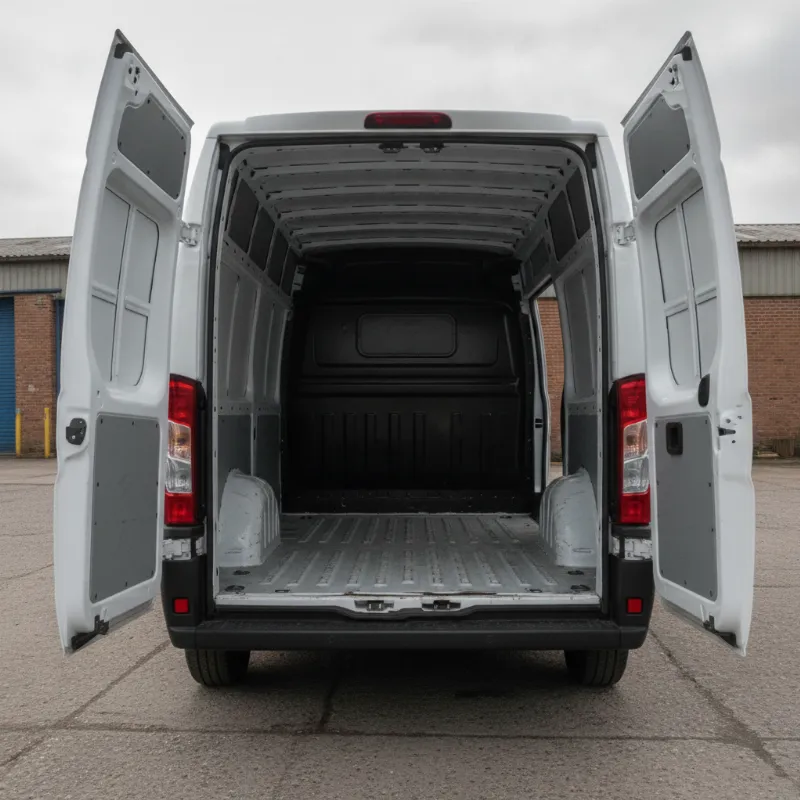
Peugeot Boxer van dimensions at a glance
The Peugeot Boxer is one of the most versatile large panel vans on the UK market, offered in a wide range of body sizes to suit everything from urban courier work to long-haul plant delivery. Across the current line-up you can choose from four overall lengths (L1 to L4) and three roof heights (H1 to H3), giving a total of eight practical body configurations plus chassis cab and dropside variants for conversions.
In broad terms, exterior lengths run from around 4.96 metres for the compact L1 up to just under 6.36 metres for the extra-long L4. Overall height ranges from roughly 2.25 metres on H1 low-roof models to around 2.76 metres on the H3 super-high-roof. Width is a consistent 2.05 metres across the body (2.52 metres including door mirrors), which is worth remembering when planning access through yard gates, loading bays and low-height car parks.
Below we break every dimension down variant by variant, look at the load bay in detail, cover payload and towing figures, and compare today's Boxer against the older 2005 and 2007 shape vans that still turn up regularly on the used market.
Exterior dimensions by length and height variant
Peugeot uses a straightforward naming convention for Boxer body sizes. The letter L refers to overall vehicle length, while H refers to overall roof height. Both are measured from the ground and include standard-fit roof mouldings, so the figures reflect what you'll actually need to clear a barrier or garage door.
Wheelbase varies with length: L1 sits on a 3.00m wheelbase, L2 and L3 share a 3.45m wheelbase, and L4 stretches to 4.04m between the axles. That longer wheelbase is what allows the L4 to carry so much load volume without a huge rear overhang, but it does affect turning circle and manoeuvrability in tight urban streets.
L1, L2, L3 and L4 lengths explained
The L1 Boxer measures approximately 4.96m from bumper to bumper, making it the closest thing in the range to a medium van. It's a good match for city-centre work where kerb-to-kerb turning matters more than absolute capacity.
The L2 grows to around 5.41m overall, adding useful length in the load bay without dramatically changing how the van drives. This is the most popular size for general trades, mobile workshops and multi-drop parcel work.
L3 stretches to about 5.99m and is the size most fleet buyers picture when they think of a "Boxer". With a longer rear overhang than the L2, it swallows Euro pallets and long items with ease while still fitting most standard parking bays.
The flagship L4 measures roughly 6.36m, giving maximum cargo length at the expense of turning circle and ease of parking. It's the go-to choice for removals, event logistics and any application where load volume trumps agility.
H1, H2 and H3 roof heights explained
H1 is the low-roof option at around 2.25m overall, offered only on shorter body lengths. It's the version to choose if you regularly need to enter multi-storey car parks or height-restricted delivery bays.
H2 is the medium roof at approximately 2.52m, and it's the most common combination in the range. It provides enough internal standing height for most operators to work in the back without stooping while still being manageable at typical trade premises.
H3 is the super-high roof at around 2.76m, available on L3 and L4 bodies. It's designed for conversions such as mobile workshops, welfare units and racking-heavy fit-outs where every centimetre of vertical space earns its keep.
Load area dimensions and cargo volume
The cargo bay is where the Boxer really justifies its reputation. Total load volume ranges from around 8 cubic metres on the smallest L1H1 up to a class-leading 17 cubic metres on the L4H3. That upper figure puts it among the largest sealed cargo areas you can buy without stepping up to a Luton or box body.
Load length, width and height
Internal load length runs from approximately 2.67m on the L1, through 3.12m on the L2, 3.70m on the L3, and up to 4.07m on the L4. Every length variant will accept two Euro pallets loaded lengthways, and the L3 and L4 can carry three or four respectively when loaded through the rear.
Width between the wheel arches is a consistent 1.42m across the range, which is critical: it's wide enough to load a standard 1.2m Euro pallet flat on the floor. Maximum internal width is 1.87m at shoulder height. Internal load height sits at around 1.66m for H1, 1.93m for H2 and 2.17m for H3, so even tall operatives can work upright in the H2 and H3 versions.
Rear door and side loading door apertures
Standard rear doors open to 180 degrees and can be released to swing back flush against the sides at 270 degrees, which is invaluable for forklift loading. Rear aperture width is approximately 1.56m and aperture height ranges from 1.52m (H1) through 1.79m (H2) to 2.03m (H3).
The nearside sliding side door offers an opening of around 1.25m wide and between 1.48m and 1.75m high depending on roof height. That's generous enough to swing a Euro pallet through sideways, which most rivals can't match without an optional wide-door upgrade.
Payload, gross vehicle weight and towing capacity
Peugeot offers the Boxer at 3.0-tonne, 3.5-tonne and 4.0-tonne gross vehicle weights, with the 3.5-tonne being the sweet spot for standard car licence holders. Payload varies with body size and specification but typically ranges from around 1,150kg on higher-spec long-wheelbase models up to 1,500kg or more on lighter, shorter variants. The 4.0-tonne Heavy version pushes usable payload beyond 1,900kg, though drivers will need the correct category licence.
Braked towing capacity is up to 3,000kg on suitably specified models, giving a gross train weight that comfortably handles a plant trailer, twin-axle caravan or car transporter. Unbraked towing is limited to 750kg as with most vans in the class. Always check the individual V5C and VIN plate before hitching anything sizeable, as final approved figures depend on engine, gearbox and body combination.
How Peugeot Boxer dimensions compare to older models (2005 and 2007)
The current Boxer shape launched in 2006 and received significant updates in 2014 and again in more recent years, but the fundamental body architecture has remained impressively consistent. That's good news if you're replacing an older van with a newer used example, because racking, ply-lining kits and roof racks are often directly transferable.
Pre-2006 Boxers (the original 1994–2006 shape, which includes 2005 model-year vans) are noticeably smaller. Load lengths and volumes were around 15–20% down on today's figures, and the L4 body simply wasn't offered, so the biggest old-shape Boxer is closer in capacity to a modern L3H2. The 2007 model year, by contrast, was one of the first of the current-generation vans, so its dimensions align almost exactly with today's Boxer — an important detail when sourcing second-hand stock or matching a fleet to an existing conversion spec.
Interior width between the arches has stayed at 1.42m throughout, which is why Euro-pallet-friendly racking designed for a 2007 Boxer will still bolt straight into a current van.
Choosing the right Peugeot Boxer size for your business
Picking the correct combination comes down to three questions: what are you carrying, where are you driving, and who's driving it? For urban multi-drop and courier work, an L1H1 or L2H2 balances capacity against manoeuvrability and car-park access. For general trades, plumbers, electricians and mobile fitters, the L3H2 is the default choice thanks to its blend of standing height and pallet capacity.
Removals firms, event companies, parcel networks and anyone racking out a mobile workshop typically gravitate to the L3H3 or L4H3 for maximum cube. If payload matters more than volume — think tiling, stonework or plant parts — consider the shorter L2 or L3 on the 3.5-tonne chassis, or step up to the 4.0-tonne Heavy for genuine 1.9-tonne-plus carrying capacity.
Finally, don't forget the practicalities: measure your yard entrance, height-restricted client sites and depot bays before committing. A 2.76m H3 roof looks great on paper but is no use if your workshop door is 2.5m. Getting the dimensions right first time saves years of daily inconvenience over the life of the van.
FAQs
What are the exterior and load area dimensions of a Peugeot Boxer van across its length and height variants?
The Peugeot Boxer is offered in four lengths (L1 4.96m, L2 5.41m, L3 5.99m, L4 6.36m) and three roof heights (H1 2.25m, H2 2.52m, H3 2.76m). Width is 2.05m across the range (2.52m with mirrors). Internal load length runs from 2.67m on L1 up to 4.07m on L4, load width between the wheel arches is a consistent 1.42m (Euro-pallet friendly), and internal load height ranges from 1.66m on H1 to 2.17m on H3. Cargo volume spans 8m³ on the L1H1 up to 17m³ on the L4H3.
Will a Euro pallet fit in a Peugeot Boxer?
Yes. The 1.42m width between the rear wheel arches is specifically designed to accept a 1.2m x 0.8m Euro pallet flat on the floor. Depending on body length, a Boxer will carry two pallets (L1), three (L2/L3) or four (L4) loaded through the rear doors, and the side loading door is wide enough to accept a pallet sideways.
How tall is a Peugeot Boxer van for car parks?
Overall height depends on the roof variant: H1 low-roof models are around 2.25m, H2 medium-roof around 2.52m, and H3 high-roof around 2.76m. If you regularly use height-restricted multi-storey car parks (typically 2.0m to 2.1m), no standard Boxer will fit — you'd need to look at a smaller Peugeot Partner or Expert instead.
What's the payload of a 3.5-tonne Peugeot Boxer?
Payload on a 3.5-tonne Boxer typically ranges from around 1,150kg on the larger, higher-spec L4H3 models up to 1,500kg or more on shorter, lighter variants. If you need more, the 4.0-tonne Heavy version pushes usable payload beyond 1,900kg, though it requires the appropriate driving licence category.
Are Peugeot Boxer dimensions the same as the Citroen Relay and Fiat Ducato?
Yes. The Peugeot Boxer, Citroen Relay and Fiat Ducato are built on a shared platform as part of the Sevel joint venture and share virtually identical exterior and load area dimensions. Racking, ply-lining, roof racks and conversion parts are generally interchangeable across all three, which makes sourcing accessories and used stock much easier.