Dimensions of a Fiat Ducato Van: Full UK Size Guide
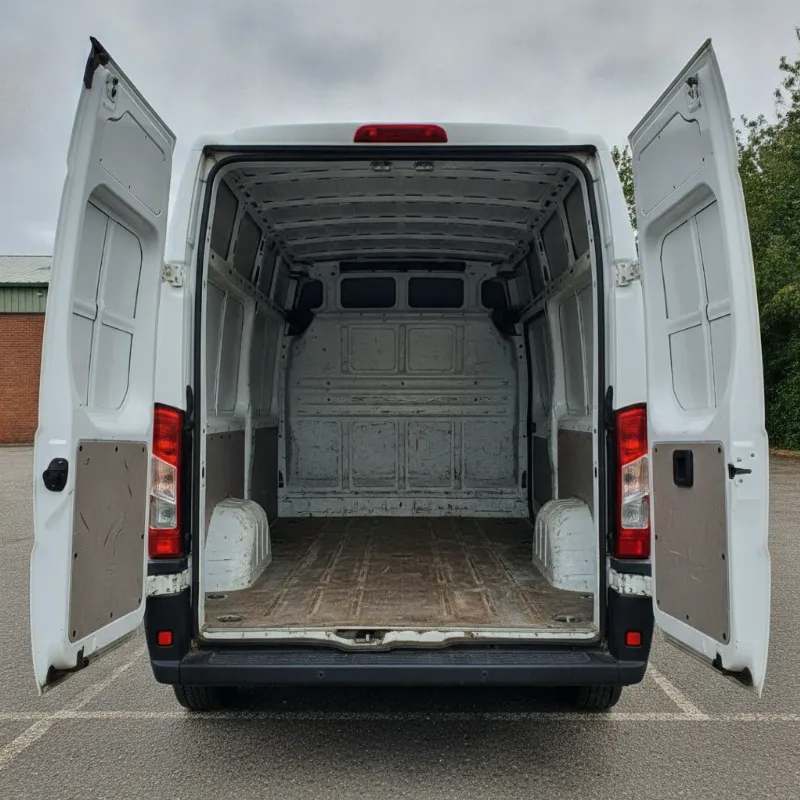
Fiat Ducato dimensions at a glance
The Fiat Ducato is one of the most versatile large panel vans on the UK market, offered in a wide range of body sizes to suit everything from urban parcel delivery to long-distance haulage and motorhome conversion. Across the current range, buyers can choose from four length designations (L1, L2, L3 and L4), three roof heights (H1, H2 and H3) and two wheelbase options, giving a combined total of several distinct body configurations.
Overall exterior length ranges from around 4,963mm on the compact L1 through to 6,363mm on the extended L4, with roof heights climbing from 2,254mm on the H1 up to 2,764mm on the tallest H3. Load volumes stretch from roughly 8m³ at the smaller end to 17m³ on the biggest L4H3, and gross vehicle weights are available in 3.0, 3.3, 3.5 and 4.25 tonne ratings. Whether you need something manoeuvrable enough for tight city streets or a cavernous long-wheelbase van for bulky loads, there is a Ducato size that fits.
Exterior dimensions: length, width and height
The Ducato's exterior footprint is dictated by three main variables: the body length code, the roof height code and the wheelbase. Fiat uses a straightforward L and H naming convention shared across the Stellantis large van family, which also underpins the Peugeot Boxer and Citroën Relay, so the exterior figures below will look familiar to anyone comparing across the group.
Length variants (L1, L2, L3, L4)
The shortest L1 Ducato measures approximately 4,963mm from bumper to bumper and rides on a 3,000mm wheelbase, making it the easiest variant to park and manoeuvre in car parks and multi-storey environments. Step up to the L2 and overall length grows to around 5,413mm on a 3,450mm wheelbase, adding useful load length without significantly increasing overall footprint.
The L3 is the most popular choice for general fleet use, stretching to roughly 5,998mm on a 4,035mm wheelbase and balancing capacity with day-to-day usability. At the top of the range, the L4 extends to about 6,363mm on the same 4,035mm wheelbase, thanks to a longer rear overhang that maximises load length without altering how the van pivots at the front.
Height variants (H1, H2, H3)
Roof height affects both loading practicality and where you can park. The H1 stands at approximately 2,254mm tall, keeping it under the 2.3m barrier common at many UK car parks and drive-thrus. The mid-height H2 rises to around 2,522mm, offering enough internal standing room for most operators to work inside comfortably. The tallest H3 measures roughly 2,764mm and is reserved for the longer L3 and L4 bodies, providing maximum cubic capacity for lightweight, bulky loads.
Width, wheelbase and turning circle
Regardless of length or height, the Ducato measures 2,050mm wide across the body excluding mirrors, or 2,524mm with the mirrors extended. This is an important figure to check against loading bay widths, garage doors and width restrictions. Wheelbases are 3,000mm on the L1, 3,450mm on the L2 and 4,035mm on both the L3 and L4. Turning circles range from around 11.1 metres kerb-to-kerb on the shortest L1 up to approximately 13.8 metres on the L4, which is well worth bearing in mind if your driver regularly navigates tight yards or residential streets.
Interior load area dimensions and payload
Interior dimensions are ultimately what determine whether a van will do the job, and the Ducato has been designed to maximise usable space within its exterior envelope. The load area is squared-off with near-vertical sidewalls, and the wheel arch intrusion is kept sensibly narrow to allow standard Euro pallets to be loaded side by side on most variants.
Load length, width between wheel arches and load height
Maximum load length at floor level runs from about 2,670mm in the L1, through 3,120mm in the L2 and 3,705mm in the L3, up to 4,070mm in the L4. Width between the wheel arches is a consistent 1,422mm across the range, which comfortably accepts standard 1,200mm x 800mm Euro pallets loaded transversely. Maximum load width at the widest point is around 1,870mm.
Internal load height depends on the roof: expect approximately 1,662mm in the H1, 1,932mm in the H2 and 2,172mm in the H3. That extra head height in the H2 and H3 makes a real difference for operators fitting racking or working inside the van during multi-drop shifts.
Load volume and payload capacity by variant
Load volumes step up in a logical progression across the range. The L1H1 offers around 8m³, the L2H1 about 10m³ and the L2H2 around 11.5m³. Move to the L3H2 and you get roughly 13m³, while the L4H2 opens up to about 15m³. The largest L4H3 delivers approximately 17m³ of cargo space, making it one of the biggest volumes available in the panel van class.
Payload varies with body size, engine, trim and gross vehicle weight. At 3.5 tonnes GVW, expect payloads broadly between 1,300kg and 1,700kg depending on specification, while the 4.25-tonne Ducato Maxi variants push payload comfortably above 2,000kg on some configurations. Always check the individual vehicle's plate for exact figures, as options such as air conditioning, tow bars and additional bulkheads all reduce headline payload.
Rear and side door aperture dimensions
Access to the load area is a critical practical consideration, particularly for operators who load from kerbside or use forklifts at depots. The Ducato's rear door aperture measures approximately 1,562mm wide, with an aperture height of 1,520mm on H1 vans, 1,790mm on H2 vans and 2,030mm on H3 vans. Rear doors open to 180 degrees as standard and can be specified to swing through 270 degrees, folding flush against the side of the van for full-width forklift access.
The nearside sliding side door aperture is around 1,250mm wide on standard specifications, with door heights of approximately 1,485mm on H1, 1,755mm on H2 and 1,961mm on H3 variants. A twin sliding door with a second aperture on the offside is available as an option and is popular with mobile workshop, courier and utility operators who need flexible access from either side of the vehicle.
Fiat Ducato dimensions for motorhome and campervan conversions
The Ducato is by some distance the most popular base vehicle for European motorhome and campervan conversions, and its dimensions are a big reason why. The 2,050mm body width gives converters enough space for a transverse rear bed on longer wheelbases, while the H2 roof height allows most adults to stand upright inside without needing a pop-top or high-top conversion.
Converters typically favour the L2H2, L3H2 and L4H2 chassis cab and panel van variants, along with the low-profile AL-KO chassis for coachbuilt motorhomes. The 4,035mm wheelbase L3 offers a good balance of internal living space and drivability, while the L4's extended rear overhang is ideal for garage-style storage compartments at the back of the van. Payload figures on 3.5-tonne conversions can be tight once fitted out, so many buyers step up to the 4.25-tonne Maxi chassis, which is now drivable in the UK on a standard category B licence for motorhome use under recent regulatory changes.
How the Ducato compares on size to rival panel vans
Because the Ducato shares its platform with the Peugeot Boxer and Citroën Relay, its dimensions are identical to those of its Stellantis siblings. Compared with rivals, the Ducato is broadly similar in footprint to the Ford Transit, Mercedes-Benz Sprinter, Volkswagen Crafter, Renault Master and Vauxhall Movano, but there are subtle differences worth knowing.
The Ducato tends to be slightly wider between the wheel arches than the Transit, which can be decisive for pallet operators. Its H3 roof also delivers marginally more internal height than the Sprinter in equivalent long-wheelbase form. Where the Sprinter and Crafter often lead is on payload at the 3.5-tonne rating, while the Master and Movano offer very similar figures to the Ducato thanks to their own shared platform. For pure load volume in a manageable footprint, the Ducato L4H3's 17m³ remains one of the strongest offerings in the class.
Choosing the right Fiat Ducato size for your business
Picking the right Ducato comes down to an honest assessment of what you carry, where you carry it and how often you park in restricted spaces. For urban courier work with height barriers to navigate, the L2H1 or L3H1 usually hits the sweet spot. For general trade use, mobile workshops and multi-drop delivery where standing headroom matters, the L3H2 is the default choice for good reason. Operators moving bulky but light loads, such as furniture, insulation or parcels, will benefit most from stepping up to the L4H3 for its class-leading 17m³ capacity.
Also factor in gross vehicle weight. If your loaded weight regularly pushes toward the top of a 3.5-tonne plate, the 4.25-tonne Maxi variants give you valuable extra payload headroom and reduce the risk of overloading fines. Test drive shortlisted configurations where possible, measure your typical loads and check the specific vehicle's V5C and payload plate before committing – small differences in trim and options can meaningfully change the numbers on paper.
FAQs
What are the exterior and interior dimensions of a Fiat Ducato van across its different variants?
The Fiat Ducato comes in four lengths (L1 4,963mm, L2 5,413mm, L3 5,998mm, L4 6,363mm) and three heights (H1 2,254mm, H2 2,522mm, H3 2,764mm). Body width is 2,050mm without mirrors. Internally, load length ranges from around 2,670mm on the L1 to 4,070mm on the L4, with a consistent 1,422mm between the wheel arches. Internal load height is approximately 1,662mm in H1, 1,932mm in H2 and 2,172mm in H3, delivering load volumes from 8m³ up to 17m³.
Will a Fiat Ducato fit in a standard UK car park?
Only the H1 (low roof) Ducato will fit under the typical 2.0–2.1m UK car park height barrier – and even then it's marginal, so always check the specific vehicle's exact height including any roof-mounted accessories. The H2 (2,522mm) and H3 (2,764mm) will not fit in most height-restricted car parks and are better suited to depots, kerbside parking and open sites.
How many Euro pallets can a Fiat Ducato carry?
Thanks to the 1,422mm gap between the wheel arches, the Ducato can accept standard 1,200mm x 800mm Euro pallets loaded side by side. The L1 typically carries 3 Euro pallets, the L2 holds 4, the L3 fits 5 and the L4 can accommodate 6 Euro pallets, subject to payload limits.
What is the payload of a 3.5-tonne Fiat Ducato?
Payload on a 3.5-tonne Ducato typically ranges between roughly 1,300kg and 1,700kg depending on body size, engine, trim and fitted options. For heavier duties, the 4.25-tonne Ducato Maxi variants can carry over 2,000kg. Always check the individual vehicle's payload plate, as options such as air conditioning, tow bars and bulkheads reduce the headline figure.
Is the Fiat Ducato the same size as the Peugeot Boxer and Citroën Relay?
Yes. The Fiat Ducato shares its platform, body and dimensions with the Peugeot Boxer and Citroën Relay as part of the Stellantis large van family. Exterior length, width, height, wheelbase, load area and door aperture measurements are effectively identical across all three vans, so specification, price and dealer support tend to be the deciding factors rather than size.