 Call us on
Small Vans With 3 Seats
In the world of compact vehicles, small vans with 3 seats have become increasingly popular for businesses and individuals alike. These versatile vehicles offer a unique combination of passenger capacity and cargo space, making them ideal for a variety of applications. From urban deliveries to family outings, 3 seater small vans provide a practical solution for those seeking efficiency without sacrificing functionality. Source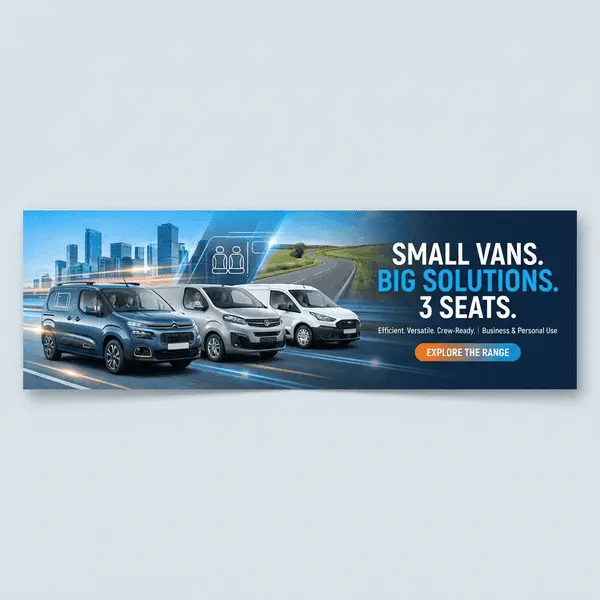
This article explores the top small vans with 3 front seats available in the market today. It delves into the key features that set these vehicles apart, including their payload capacity and fuel economy. Additionally, the benefits of 3 seater small vans for businesses are examined, highlighting how these compact vehicles can maximize passenger capacity while maintaining a small footprint. By the end, readers will have a comprehensive understanding of the options and advantages offered by these versatile vans. See all Small Vans
Small Vans With 3 Seats
The small van market has seen a surge in popularity for vehicles that offer both compact size and versatile seating arrangements. Among these, three-seater small vans stand out for their ability to maximize passenger capacity without sacrificing cargo space. Let’s explore three top contenders in this category. See all small van lease deals
Compact 3-Seat Van Options
The Citroen Berlingo has been a dominant force in the small-van market for several years. This versatile vehicle comes in two body lengths: the standard Size M measuring 4.4m and the extended XL version at 4.75m. The Berlingo’s three front seats make it a flexible option for businesses and individuals alike.
Key features of the Citroen Berlingo include:
- Class-leading payload capacity of up to one ton
- Load volume ranging from 3.3 to 3.8 cubic meters
- Low floor for easy loading
- Ability to fit two Europallets in the back with ease
- Payload ratings from 667kg to just over a ton
The Berlingo offers a choice of engines, including a 1.2-liter PureTech three-cylinder turbo petrol, a 1.5-liter BlueHDi diesel, and a fully electric powertrain. The E-Berlingo, the zero-emissions variant, uses a 50kWh battery and a single motor.
For those needing extra versatility, the Extenso Pack adds two passenger seats, with the middle seat featuring a folding backrest. This configuration allows for through-loading of longer items, increasing the van’s practicality.
Peugeot Partner Small Vans With 3 Seats
Another major player in the small van sector is the Peugeot Partner. This three-seater van shares many similarities with the Citroen Berlingo, offering a blend of practicality and modern features. see Peugeot Partner Lease
The Peugeot Partner’s standout features include:
- Available in two lengths, similar to the Berlingo
- Choice of 1.2-liter Puretech petrol or 1.5-liter BlueHDi Euro 6 diesel engines
- Innovative i-Cockpit for intuitive control and modern esthetics
- Maximum payload of up to 1,000kg, making it highly capable in its class
- Ability to carry two Europallets in the load area (Partner Standard length)
The Partner also offers an electric variant, the e-Partner, which provides quiet, comfortable, and agile driving. This eco-friendly option gives businesses unrestricted access to low-emission zones and potential savings on fuel and maintenance costs.
Ford Transit Connect Small Vans With 3 Seats
The Ford Transit Connect rounds out our top three with its practical design and reliable performance. This small van comes in two different lengths and has recently undergone updates to enhance its appeal.
Key aspects of the Ford Transit Connect include:
- Sophisticated new look and comprehensively updated interior
- Advanced technology features
- Decent driving dynamics, making it one of the best options in its class to handle
- Well-thought-out interior design
- Impressive cargo capacity for a small van
The Transit Connect Active variant offers even more versatility, with up to 3.6 cubic meters of loadspace and the ability to carry up to 913 kg of cargo. For those needing extra traction, an optional mechanical Limited-Slip Differential is available, making driving on difficult terrain effortless.
Engine options for the Transit Connect include a 1.5-liter diesel engine, providing a balance of performance and efficiency. The van also features an auto start/stop system to further improve fuel economy.
These three small vans with 3 seats offer businesses and individuals a range of options to suit various needs. Whether prioritizing payload capacity, fuel efficiency, or driving dynamics, the Citroen Berlingo, Peugeot Partner, and Ford Transit Connect provide versatile solutions in the compact van market.

Key Features of 3-Seater Small Vans
Small vans with three seats have become increasingly popular among businesses and individuals who require a versatile vehicle that can transport both passengers and cargo efficiently. These compact vehicles offer a range of features that make them ideal for various applications, from urban deliveries to family outings. Let’s explore the key features that set these 3-seater small vans apart.
Seating Capacity
One of the most significant advantages of 3-seater small vans is their ability to accommodate three people in the front. This feature is particularly beneficial for businesses that need to transport small teams to job sites or for families requiring extra seating capacity without sacrificing cargo space. The three-seat configuration typically includes a driver’s seat and a passenger bench that can comfortably seat two adults.
Many models, such as the Citroen Berlingo and Peugeot Partner, offer innovative seating solutions. For instance, some vans come with an Extenso Pack that adds two passenger seats, with the middle seat featuring a folding backrest. This configuration allows for through-loading of longer items, increasing the van’s practicality without compromising on passenger capacity.
Cargo Space Small Vans With 3 Seats
Despite their compact size, 3-seater small vans offer impressive cargo space, making them suitable for a wide range of business needs. These vans are designed to maximize load capacity while maintaining a small footprint, which is crucial for navigating tight urban environments.
Key cargo space features include:
- Load Volume: Small vans typically offer a load volume ranging from 3.3 to 4 cubic meters, depending on the model and configuration.
- Payload Capacity: Many 3-seater small vans boast impressive payload capacities, with some models capable of carrying up to 1,000 kg.
- Versatile Loading Options: Most vans in this category come with wide-opening doors and low floor heights, facilitating easy loading and unloading of cargo.
- Europallets Compatibility: Many models can accommodate two Europallets in the load area, enhancing their utility for businesses.
For example, the Fiat Doblo stands out with its class-leading payload capacity of 1,005 kg and a load volume of up to 5 cubic meters in its larger configurations. This combination of high payload and spacious cargo area makes it an attractive option for businesses requiring substantial carrying capacity in a compact vehicle.
Fuel Efficiency Small Vans With 3 Seats
Fuel efficiency is a crucial factor for businesses and individuals looking to minimize operating costs. 3-seater small vans are designed with fuel economy in mind, offering a range of efficient engine options to suit different needs and preferences.
Key aspects of fuel efficiency in these vans include:
- Engine Options: Most manufacturers offer a choice between petrol, diesel, and increasingly, electric powertrains. For instance, the Citroen Berlingo provides options including a 1.2-liter PureTech petrol engine, a 1.5-liter BlueHDi diesel, and a fully electric E-Berlingo variant.
- Advanced Technologies: Many vans incorporate fuel-saving technologies such as start-stop systems and regenerative braking to further improve efficiency.
- Aerodynamic Design: Despite their boxy appearance, modern small vans are designed with aerodynamics in mind to reduce fuel consumption at higher speeds.
- Eco-Driving Modes: Some models feature eco-driving modes that optimize the vehicle’s performance for maximum fuel efficiency.
The focus on fuel efficiency not only helps reduce running costs but also contributes to lower emissions, making these vans an environmentally friendly choice for businesses operating in urban areas with strict emission regulations.
In conclusion, 3-seater small vans offer a unique combination of passenger capacity, cargo space, and fuel efficiency, making them an attractive option for a wide range of users. Their versatility and practicality have contributed to their growing popularity in the compact vehicle market.
Benefits of 3-Seater Small Vans for Businesses
Small vans with three seats offer numerous advantages for businesses, making them an ideal choice for various industries. These compact vehicles provide a perfect balance between passenger capacity and cargo space, catering to the diverse needs of small teams and entrepreneurs.
Increased Versatility Small Vans With 3 Seats
Three-seater small vans provide businesses with enhanced flexibility in their operations. The ability to transport both personnel and equipment simultaneously makes these vehicles highly versatile for a wide range of applications. For instance, couriers, valeters, electricians, bricklayers, hospitality managers, cleaners, and delivery drivers can all benefit from the practical design of these vans.
The roomy interior of three-seater vans offers comfort for small teams traveling together. This setup allows for better communication and team bonding during transit, which can be particularly beneficial for businesses that require frequent on-site visits or deliveries. Moreover, with three people in the front, the rear space becomes available for additional storage, increasing the van’s overall utility.
Many models, such as the Citroen Berlingo, Ford Transit Connect, and Volkswagen Caddy, come in different configurations and lengths. This variety allows businesses to choose a van that best suits their specific needs. For example, the Ford Transit Connect is available in two different lengths, providing options for businesses with varying space requirements.
Cost-Effectiveness Small Vans With 3 Seats
One of the primary concerns for businesses when choosing a vehicle is its return on investment. Three-seater small vans excel in this aspect, offering several cost-effective features that can benefit businesses in the long run.
Fuel efficiency is a crucial factor in determining a van’s cost-effectiveness. Many three-seater small vans come with a range of fuel-efficient engines, including petrol, diesel, and increasingly, electric options. Diesel vans, in particular, are often more economical than their petrol counterparts due to their more efficient combustion process and higher energy output per unit of fuel.
To maximize fuel efficiency, businesses can adopt smooth driving techniques, such as anticipating braking and employing gentle acceleration. Additionally, reducing highway speeds from 75mph to 60mph can significantly slow down fuel consumption on long trips.
The advent of low emission zones in urban areas has made it essential for businesses to have vehicles that comply with the latest emission standards. Leasing a new three-seater small van ensures compliance with these regulations, helping businesses avoid potential financial penalties when operating in cities.
Improved Team Mobility
Three-seater small vans significantly enhance team mobility, allowing businesses to transport small groups of employees efficiently. This feature is particularly beneficial for companies that require regular site visits or need to move teams between locations.
The Mercedes-Benz Citan, for example, is noted for its comfort and ease of driving, making it an excellent choice for small teams traveling longer distances. Similarly, the Toyota Proace City offers a roomy interior that comfortably accommodates three people in the front, despite its compact exterior dimensions.
Many three-seater small vans come equipped with advanced features that further improve team mobility. The Peugeot Partner, for instance, boasts the innovative i-Cockpit, providing an intuitive and modern control system. This feature can be particularly appealing to businesses whose employees frequently undertake long journeys and appreciate additional comfort.
Moreover, some models, like the Vauxhall Vivaro, offer a ‘car-like’ modern interior with high-tech features, making the driving experience more comfortable and efficient for business teams. The Renault Trafic goes a step further by incorporating safety features such as automatic emergency braking, blind-spot monitoring, and lane-departure warning, ensuring the well-being of the team during transit.
Comparing Payload Capacity
When selecting a small van with three seats, payload capacity is a crucial factor to consider. This measure determines how much weight a vehicle can safely carry, including passengers, cargo, and additional equipment. Let’s compare the payload capacities of three popular models: the Citroen Berlingo, Peugeot Partner, and Ford Transit Connect.
Citroen Berlingo Payload Small Vans With 3 Seats
The Citroen Berlingo offers impressive payload capabilities, ranging from 642kg to 1010kg, depending on the specific model. This wide range allows businesses to choose a version that best suits their needs. The van’s gross vehicle weight (GVW) varies between 2.1 and 2.3 tons, which directly impacts its payload capacity.
Here’s a breakdown of payload allowances for different Berlingo models:
| Berlingo Model | Payload Allowance (kg) |
|---|---|
| Berlingo L1H1 | 625 |
| Berlingo L2H1 | 750 |
| Berlingo L2H1 | 850 |
The Berlingo’s long-wheelbase versions typically have a higher GVW, resulting in increased payload capacity. This van also boasts a commendable towing capability of up to 1500kg, further enhancing its versatility for businesses requiring additional transport options.
Peugeot Partner Payload
The Peugeot Partner, sharing many similarities with the Citroen Berlingo, offers payload capacities ranging from approximately 600kg to 1000kg. This variation depends on the specific model, configuration, and year of manufacture.
Payload ratings for the Peugeot Partner vary as follows:
- Standard models: 552kg to 856kg
- Electric models: 552kg (L2) to 636kg (L1)
The BlueHDi 100 engine version in the basic ‘X’ trim offers the highest payload capacity at 856kg. It’s worth noting that the electric models have lower payload capacities due to the weight of the battery systems.
The Partner also offers impressive towing capabilities: See all Peugeot Partner for sale
- Unbraked trailer: 640kg to 740kg
- Braked trailer: 1100kg to 1250kg
Ford Transit Connect Payload
The Ford Transit Connect provides a range of payload options across its various models. The payload capacity varies depending on factors such as body length, engine type, and trim level.
Here’s a comparison of payload capacities for different Transit Connect models:
| Model | Gross Payload (kg) |
|---|---|
| Transit Connect 200 SWB | 625 |
| Transit Connect 220 SWB | 825 |
| Transit Connect 230 LWB | 900 |
It’s important to note that the payload capacity can be affected by additional equipment. For instance, Ford points out that adding air conditioning to a Base model will decrease the stated payload by approximately 13kg.
Prior to the introduction of Euro 6.2 emissions standards, the Transit Connect’s maximum payload rating was 967kg for the High Payload 240 series 1.5-liter TDCi turbodiesel L2 panel van with 120hp. However, after the implementation of Euro 6.2, the maximum payload has decreased to 865kg, now applicable to the 100hp 1.5-liter EcoBlue diesel in the shorter L1 body in the 220 High Payload series.
When comparing these three models, it’s evident that they all offer competitive payload capacities suitable for various business needs. The Citroen Berlingo and Peugeot Partner provide options exceeding 1000kg in some configurations, while the Ford Transit Connect offers a range of payload options with its different series and body lengths. Businesses should carefully consider their specific requirements and the trade-offs between payload capacity, fuel efficiency, and overall vehicle size when making their selection.
Fuel Economy and Engine Options
When selecting a small van with three seats, fuel economy and engine options play a crucial role in determining the vehicle’s overall efficiency and performance. These factors have a significant impact on running costs and environmental considerations.
Petrol vs. Diesel Options Small Vans With 3 Seats
Diesel engines have long been the dominant choice for commercial vehicles, with 97% of vans driven on the continent being diesel-powered. This popularity stems from several factors:
- Excellent fuel economy
- Strong residual values
- Higher payloads
- Quieter Euro 6D engines
- No restrictions on range for national or international use
However, petrol engines are making a comeback in the van market. They offer some advantages over diesel, including:
- Lower CO2 emissions
- Absence of a Diesel Particulate Filter (DPF)
- Potentially lower outright purchase costs
- Better driver acceptance due to cleaner refueling
It’s important to note that petrol vans generally have higher fuel consumption compared to diesel engines. They may also face challenges in ultra-low emission zones and have lower residual values, making them potentially more expensive to run over their lifetime.
Hybrid and Electric Variants
As the automotive industry evolves, hybrid and electric vans are gaining traction in the market. These vehicles offer unique benefits:
- Hybrid Vans:
- Combine electric motors with conventional engines (usually petrol)
- Offer improved fuel efficiency
- Come in various types: conventional hybrids, plug-in hybrids (PHEVs), and mild hybrids (MHEVs)
- Electric Vans:
- Run solely on electric power
- Offer zero tailpipe emissions
- Provide access to low emission zones without charges
- Have lower running and maintenance costs
Notable electric van models include:
- Ford E-Transit: 217-mile range
- Vauxhall Vivaro-e: 205-mile range
- Nissan e-NV200: 187-mile range
Fuel Consumption Comparison Small Vans With 3 Seats
Fuel efficiency is a critical factor in choosing a van. Here’s a comparison of the top 5 most economical small vans based on miles per gallon (MPG) ratings:
- Ford Transit Courier: 57.6 mpg
- Volkswagen Caddy Cargo: 57.2 mpg
- Ford Transit Connect: 55.4 mpg
- Renault Kangoo: 53.3 mpg
- Citroen Berlingo / Vauxhall Combo / Peugeot Partner / Fiat Doblo / Toyota Proace City / Fiat Fiorino: 51.4 mpg
It’s important to note that these figures are based on the Worldwide Harmonized Light Vehicle Testing Procedure (WLTP), which aims to provide more realistic fuel economy figures compared to previous testing methods.
To maximize fuel efficiency, consider the following tips:
- Regular vehicle maintenance
- Smooth driving techniques
- Proper tire pressure
- Reducing unnecessary weight
- Route planning to minimize idling and congestion
When choosing between fuel types, consider your specific needs. Diesel vans generally offer better fuel economy for long-distance driving, while petrol vans may be more suitable for urban use. Hybrid and electric options provide excellent fuel efficiency and environmental benefits but may have higher initial costs.
Conclusion Small Vans With 3 Seats
Small vans with three seats have proven to be versatile and practical solutions for businesses and individuals alike. These compact vehicles offer a unique blend of passenger capacity and cargo space, making them ideal for a wide range of applications. From urban deliveries to family outings, 3-seater small vans provide an efficient way to transport both people and goods without sacrificing functionality.
The market for these vehicles continues to grow, with manufacturers offering a variety of options to suit different needs. Whether prioritizing payload capacity, fuel efficiency, or driving dynamics, there’s a 3-seater small van to meet diverse requirements. As the automotive industry evolves, we can expect to see further advancements in this segment, including more hybrid and electric options, to address the changing needs of businesses and environmentally conscious consumers.
FAQs Small Vans With 3 Seats
What are some small vans that offer three seats?
Several small vans provide three-seat configurations, including the Renault Trafic SL30 Advance Van, Citroen Berlingo M 100PS BHDI Driver, Citroen Dispatch M 100PS BHDI Enterprise, Peugeot Boxer L3 H2 BHDI 140PS Professional, and Citroen Relay L3 140PS BHDI Low Floor Luton.
Which small van offers the largest cargo capacity?
When it comes to payload capacity, the top small vans include the Fiat Doblo Cargo Maxi L2H1 with a payload of 1005kg, and closely followed by models like the Citroen Berlingo M1000, Peugeot Partner 1000 Standard, Vauxhall Combo L1 2300, and Toyota Proace City Long, each offering around 1000kg. The Ford Transit Connect 220L1 offers 876kg, while the Renault Kangoo L3H1 and Nissan NV250 L2 have a payload of 800kg. The Volkswagen Caddy C20+ provides a payload of 738kg.
Can you name a Ford Transit Connect model with three seats?
The 2021 Ford Transit Connect LIMITED SPEC comes with three seats and is finished in black.
What is considered the most reliable small van?
Among the most reliable small vans are the Renault Kangoo/Nissan Townstar, Ford Transit Courier, Citroen Berlingo, Fiat Doblo, Peugeot Partner, Toyota Proace City, Vauxhall Combo, Mercedes Citan, Volkswagen Caddy Cargo, Ford Transit Connect, and Toyota Corolla Commercial. These models are highly regarded for their dependability in the small van category.