How to Remove the Speed Limiter on a VW Crafter: What UK Drivers Need to Know
What is the speed limiter on a VW Crafter?
The speed limiter on a Volkswagen Crafter is a factory-programmed electronic control that caps the van's top speed at a set threshold. Volkswagen fits limiters as standard on Crafter models to help meet EU and UK type-approval rules, protect the drivetrain and improve fuel economy on long motorway runs. Depending on the model year, trim and gross vehicle weight, most Crafters leave the factory limited somewhere between 90 mph and 100 mph, with heavier variants and chassis cabs often capped considerably lower.
The limiter isn't a physical device — it's a software instruction inside the engine control unit (ECU) that reads wheel-speed signals and cuts fuel delivery once the van approaches the programmed maximum. Drivers usually notice it as a firm "wall" the accelerator hits: the engine simply won't pull any harder, no matter how much you press the pedal.
Is it legal to remove the speed limiter on a VW Crafter in the UK?
This is where a lot of Crafter owners get caught out. Whether you can legally remove or raise the limiter depends almost entirely on how your van is classified, how it's used, and how much it weighs when loaded. UK road traffic law treats vans very differently from cars, and the rules tighten sharply once you cross certain weight thresholds.
Speed limiter rules for vans over 3.5 tonnes
Vans with a gross vehicle weight (GVW) above 3.5 tonnes fall into the light goods / heavy goods category and are subject to mandatory speed-limiter legislation. In practice, any Crafter plated over 3.5t used for the carriage of goods must have a working limiter set no higher than 90 km/h (around 56 mph) under EU-derived UK regulations. Removing or disabling that limiter is an offence and can result in fines, prohibition notices at the roadside, and points on the driver's licence.
For Crafters under 3.5t, the picture is more relaxed — there is no specific legal requirement for a manufacturer speed limiter to remain active. However, UK national speed limits for goods vehicles still apply: 60 mph on motorways, 60 mph on dual carriageways and 50 mph on single carriageways, regardless of what the van is technically capable of.
Insurance and warranty implications
Even where removing the limiter isn't illegal, it counts as a modification. Your insurer must be told, and many commercial vehicle policies either load the premium or decline cover altogether once the ECU has been tampered with. Failing to disclose an ECU change can invalidate a claim entirely, which is a very expensive way to gain a few extra mph.
Volkswagen's warranty is another consideration. Any unauthorised remap or ECU alteration will normally void driveline warranty cover, and franchised dealers can detect ECU changes during routine diagnostics. If your Crafter is still within its manufacturer warranty period, or on a finance or lease agreement, altering the limiter is almost always a bad idea.
How the VW Crafter speed limiter works
The Crafter's limiter lives inside the engine ECU alongside fuelling maps, emissions strategies and torque limits. The ECU constantly monitors road speed via the ABS wheel sensors and, once the pre-set value is approached, it progressively trims fuel injection and, on newer TDI models, adjusts turbo boost to hold the van at the ceiling. It's a soft cut rather than a hard shutdown, which is why the Crafter feels like it "runs out of puff" rather than jolting.
Some Crafter variants — particularly newer 2E and SY-series models built from 2017 onwards — also integrate the limiter with adaptive cruise control, lane assist and predictive speed functions. That makes the software architecture more complex than earlier generations and means casual tinkering carries a real risk of triggering fault codes across multiple modules.
Options for adjusting or removing the speed limiter
Assuming your Crafter is under 3.5t, isn't under warranty, and your insurer has agreed to cover the modification, there are two mainstream routes: an official dealer or specialist reprogramming through the diagnostic port, or an aftermarket ECU remap.
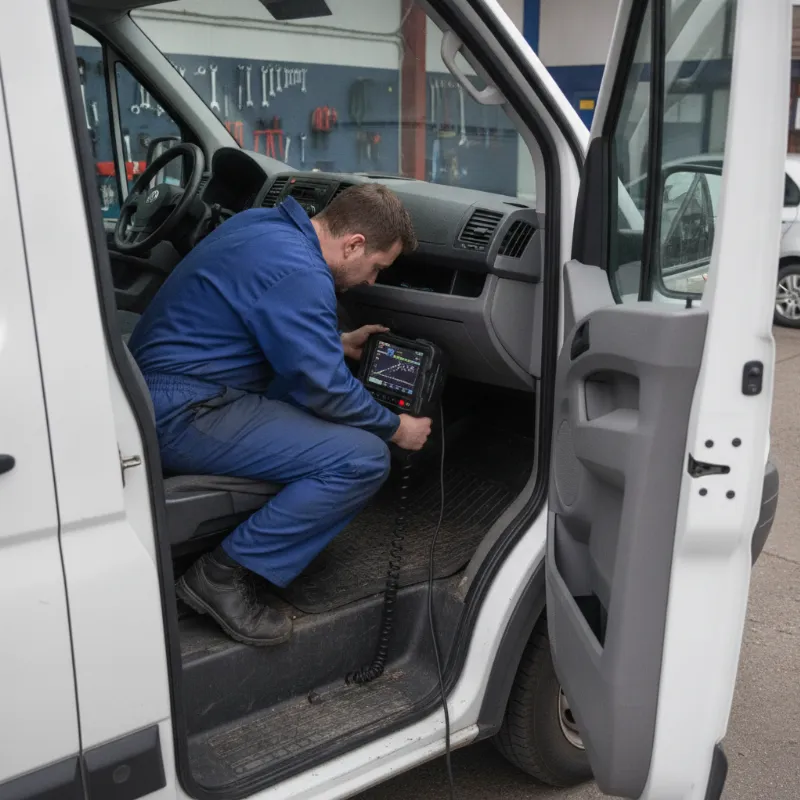
Dealer reprogramming via VCDS/OBD
VW-approved workshops and independent VAG specialists can use factory-level diagnostic tools — VCDS (Ross-Tech) or ODIS — to adjust certain limiter values through the OBD port. On some Crafter models the maximum speed is a "coded" parameter that can be raised within Volkswagen's own permitted range, typically to match the highest factory setting for that engine and gearbox combination. This is the cleanest, most reversible option and doesn't rewrite the fuelling maps.
The downside is that dealer reprogramming won't remove the limiter entirely — it only shifts it to another VW-approved value. If your van is a heavier variant that left the factory capped low for load-carrying reasons, the ceiling you can code to may still be modest.
Third-party ECU remaps
Aftermarket tuners can rewrite the ECU software directly, removing the limiter altogether and often adjusting fuelling, boost and torque curves at the same time. A reputable remapper will provide a written specification, keep a copy of the original file for reversal, and pressure-test the changes on a rolling road. Expect to pay several hundred pounds for a quality job.
Be wary of very cheap "chip tuning" boxes sold online. They rarely address the limiter properly, can trigger persistent fault codes, and are easily spotted by any workshop plugging into the OBD port.
Risks to consider before removing the limiter
Beyond the legal, insurance and warranty issues, there are practical risks. Crafter tyres are load-rated to specific speeds — usually to match the factory limiter — and running consistently above that speed can cause premature wear or, in worst cases, sudden failure under load. Brakes, cooling systems and the DSG or manual gearbox are all engineered around the original ceiling too.
Fuel economy takes a noticeable hit at higher sustained speeds. A loaded Crafter driven at 80 mph will burn dramatically more diesel than the same van at 60 mph, wiping out most of the time savings on a typical UK route where motorway congestion sets the average pace anyway. DPF and AdBlue systems can also behave unpredictably if fuelling is altered without proper calibration, leading to expensive emissions repairs down the line.
For most operators, the honest answer to "should I remove the limiter?" is no. The gains are marginal, the legal exposure is real, and the wear-and-tear costs quickly outweigh the benefit.
Getting your VW Crafter set up for work — beyond the limiter
If your Crafter feels underpowered or awkward to drive at motorway speeds, the limiter often isn't the real problem. Overloading, worn turbo actuators, clogged EGR valves, tired injectors and out-of-date software can all leave a Crafter feeling flat long before it reaches its programmed ceiling. A proper diagnostic health check will usually restore performance far more effectively — and legally — than chasing an extra 10 mph at the top end.
If you're weighing up whether to modify your current van or move on to something better suited to the job, it's worth looking at what's available on the used market. We keep a rotating stock of VW Crafter for sale across a range of wheelbases, roof heights and engine outputs, so you can often find a factory-spec van that already delivers the performance and payload you need without any ECU work at all. Getting the right base vehicle first is almost always cheaper, safer and easier than trying to engineer more out of the wrong one.
FAQs
Can you remove the speed limiter on a VW Crafter, and should you?
Technically yes — on Crafters under 3.5 tonnes the limiter can be raised via VCDS/OBD coding or fully removed through an ECU remap. On Crafters over 3.5t it's illegal to disable the limiter under UK goods vehicle regulations. Even where it's legal, it's rarely worth doing: you'll need to declare the modification to your insurer, you'll likely void your warranty, and the real-world gains in journey time and usability are small compared with the added wear, fuel cost and legal risk.
What speed is a VW Crafter limited to from the factory?
It varies by model, engine and plated weight. Most standard panel van Crafters under 3.5t are limited somewhere between 90 and 100 mph, while heavier variants over 3.5t are legally capped at around 56 mph (90 km/h) to comply with UK and EU goods vehicle rules.
Will removing the speed limiter improve fuel economy?
No — usually the opposite. The limiter itself doesn't cost you any MPG; it simply stops you exceeding a set speed. If you remove it and then drive faster, aerodynamic drag rises sharply and fuel consumption goes up noticeably. A well-calibrated remap can improve economy at cruising speeds, but that benefit comes from the fuelling changes, not from lifting the limiter.
Do I have to tell my insurer if I remap my Crafter?
Yes. Any ECU change, including raising or removing the speed limiter, is a modification and must be declared. Failing to tell your insurer can invalidate your policy and any claim you make, even for something unrelated to the modification. Some commercial vehicle insurers won't cover remapped vans at all, so it's worth checking before you book any work in.
Will a dealer be able to tell if my Crafter has been remapped?
In most cases, yes. Volkswagen's diagnostic tools can read ECU checksums and software versions, and a non-standard map or altered limiter value will usually show up. That's one reason unauthorised remaps typically void the driveline warranty and can affect part-exchange value when you come to sell or trade the van in.