How to Check the Coolant Level in a Fiat Doblo
Why checking your Fiat Doblo coolant level matters
The Fiat Doblo is a hard-working small panel van, and like any hard-working vehicle it relies on its cooling system to keep the engine running at a safe operating temperature. Coolant (sometimes called antifreeze) circulates through the engine block, absorbing heat and carrying it away through the radiator. If the level drops too low — whether through a slow leak, evaporation over time, or a failing hose — the engine can quickly overheat, warp the cylinder head, or in the worst case seize entirely.
For owners and operators of a Doblo used for daily deliveries, trades work or family duties, a two-minute coolant check every couple of weeks is one of the cheapest forms of preventative maintenance you can do. It's especially important on higher-mileage examples, and it's something worth doing before you buy any used van — including any of the Fiat Doblo vans for sale you might be considering.
Before you start: safety and what you'll need
Coolant checks are straightforward, but the cooling system runs under pressure and at very high temperatures when the engine is hot. A little preparation makes the job safe and mess-free.
Tools and fluids for the job
You won't need much. A clean cloth or paper towel is useful for wiping the expansion tank so you can read the level markings clearly. Have a funnel handy to avoid spills when topping up, and a small container of the correct coolant ready to go. Fiat generally specifies an OAT (Organic Acid Technology) long-life coolant for the Doblo — check your owner's handbook or the label on the expansion tank cap for the exact specification. If you can't find your original coolant, pre-mixed 50/50 red or orange OAT coolant suitable for Fiat vehicles is widely available from motor factors. Avoid mixing different colours or types, as this can cause the coolant to gel and block the radiator.
Wait for a cold engine
This is the golden rule. Never remove the coolant expansion tank cap on a hot engine. The system is pressurised and the coolant inside can be well above boiling point — releasing the cap can send a jet of scalding fluid into the air. Ideally, check the level first thing in the morning before the van has been driven, or leave it standing for at least a couple of hours after any journey. Park on level ground so the reading is accurate.
How to check the coolant level in a Fiat Doblo, step by step
Once the engine is cold and the van is on flat ground, checking the coolant is a quick job that anyone can do without any mechanical experience.
Locating the coolant expansion tank
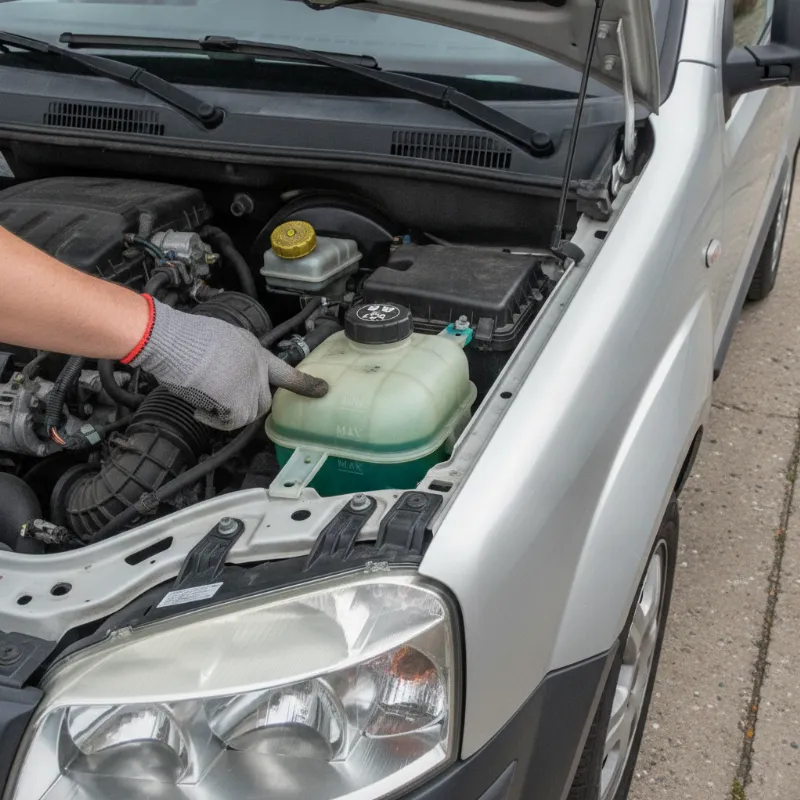
Open the bonnet and secure it on its stay. On most Fiat Doblo models — including the popular 1.3 and 1.6 MultiJet diesels as well as the petrol variants — the coolant expansion tank is a translucent plastic reservoir mounted on one side of the engine bay, usually towards the front and near the radiator. It has a screw-on cap, often black or blue, marked with a warning symbol and the word "coolant" or a thermometer icon. Don't confuse it with the windscreen washer bottle, which is normally larger and has a windscreen graphic on the cap.
Reading the MIN and MAX markings
Look at the side of the tank. You'll see two moulded lines labelled MIN and MAX (sometimes shown as "L" and "F", or with hatched markings). With the engine cold, the coolant should sit between these two marks — closer to MAX is ideal. If the fluid is at or below the MIN line, it needs topping up. Also take a moment to look at the colour and clarity: healthy coolant is bright and translucent. If it looks brown, rusty, milky or has debris floating in it, that suggests contamination or an internal problem and needs a mechanic's attention rather than a simple top-up.
Topping up with the correct coolant
Slowly unscrew the cap — even on a cold engine, turn it a quarter-turn first to release any residual pressure before removing it fully. Using your funnel, pour the correct coolant in gradually until the level reaches the MAX mark. Don't overfill, as the coolant expands when it heats up and excess will simply be pushed out of the overflow. Refit the cap firmly until it clicks or stops turning, then wipe up any spills. Start the engine, let it idle for a minute, and re-check the level once it has cooled again the next day — a small drop is normal as the system settles, but repeated drops point to a leak.
Model variations: Doblo, Doblo Maxi and estate versions
The Fiat Doblo has been sold in the UK in several forms — the standard short-wheelbase panel van, the longer Doblo Maxi (also known as Cargo Maxi), and the passenger-carrying Doblo estate or MPV. The good news is that the coolant check procedure is essentially identical across all of them, because they share the same engine range and cooling system layout. The expansion tank sits in the same corner of the engine bay, and the MIN/MAX markings work the same way. The only real difference is total system capacity — the larger 1.6 and 2.0 MultiJet engines fitted to some Maxi models hold slightly more coolant, so a full flush and refill will need a bit more fluid, though a routine top-up rarely uses more than a few hundred millilitres. Pre-2010 first-generation Doblos and the second-generation model launched in 2010 both follow the same basic process.
Signs your Fiat Doblo van has a coolant problem
Regular checks help you spot trouble early, but there are other warning signs worth watching for. The most obvious is the temperature gauge on the dashboard creeping higher than its normal position, or a coolant warning light illuminating. You may notice a sweet, syrupy smell around the van after a drive — that's the distinctive scent of leaking coolant. Puddles of green, orange or pink fluid beneath the engine bay when parked are a clear sign of a leak, as are white steamy plumes from the exhaust that don't clear once the engine is warm (which can indicate coolant entering the combustion chamber via a failed head gasket). Inside the cabin, a heater that blows cold air even when the engine is at operating temperature often points to a low coolant level or an airlock in the system.
When to see a mechanic
Topping up occasionally is normal maintenance and nothing to worry about. However, if you find yourself needing to add coolant every week or two, if the level drops noticeably between checks, or if you spot any of the warning signs above, it's time to have the van looked at by a qualified mechanic. Persistent coolant loss with no visible external leak can indicate an internal problem such as a head gasket failure, cracked cylinder head, or a leaking heater matrix — all of which are far cheaper to address early than after the engine has overheated. Similarly, if the coolant looks contaminated or you're unsure which type to use, a garage can flush the system and refill it with the correct specification. A few pounds spent on a diagnostic check can save thousands in engine repairs.
FAQs
How do you correctly check and top up the coolant level in a Fiat Doblo van?
Park the van on level ground and wait until the engine is completely cold. Open the bonnet and locate the translucent coolant expansion tank near the radiator. Check that the fluid sits between the MIN and MAX markings on the side of the tank. If it's low, slowly release the cap to relieve any pressure, then top up using the correct OAT-specification coolant (as stated in your handbook) until the level reaches MAX. Refit the cap firmly and re-check the level the following day.
What type of coolant does a Fiat Doblo use?
Most Fiat Doblo models use an OAT (Organic Acid Technology) long-life coolant, typically supplied pre-mixed in a red or orange colour. Always check the label on your expansion tank cap or the owner's handbook for the exact specification, and avoid mixing different coolant types or colours as this can damage the cooling system.
How often should I check the coolant in my Fiat Doblo?
A quick visual check every two weeks or before any long journey is good practice. It only takes a minute and helps you catch slow leaks or evaporation early, before they can lead to overheating.
Can I use just water to top up the coolant in a Fiat Doblo?
In an emergency you can add a small amount of clean water to get you home, but this dilutes the antifreeze and corrosion inhibitors in the system. As soon as possible, have the system drained and refilled with the correct coolant mixture to protect the engine from freezing in winter and from internal corrosion year-round.
Why does my Fiat Doblo keep losing coolant with no visible leak?
Coolant that disappears without any puddles under the van often points to an internal issue such as a failing head gasket, a cracked cylinder head, or a leaking heater matrix inside the dashboard. White steam from the exhaust or a heater that blows cold are common accompanying signs. This needs a mechanic's diagnosis promptly, as continuing to drive can cause serious engine damage.