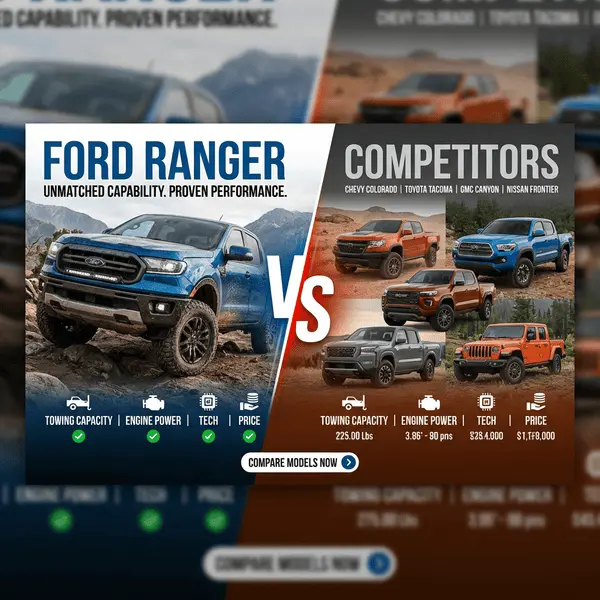
Ford Ranger VS Competitors
Ford Ranger vs. Competitors
The Ford Ranger has been making waves in the midsize pickup truck market, sparking curiosity about how it measures up against its rivals. As consumers seek the perfect balance of performance, functionality, and value, comparing the Ranger to competitors like the Toyota Tacoma, Chevrolet Colorado, and Nissan Frontier has an impact on purchasing decisions. This fierce competition has resulted in advancements across the board, from towing capacity to fuel efficiency and technology features.
In this comprehensive analysis, we’ll examine how the Ford Ranger stacks up against its main competitors. We’ll explore design elements, performance capabilities, interior comfort, and technology offerings. The comparison will also cover crucial factors such as towing capacity, payload, off-road prowess, and overall value. By the end, readers will have a clear understanding of where the Ranger shines and where it may fall short compared to other midsize trucks in the market.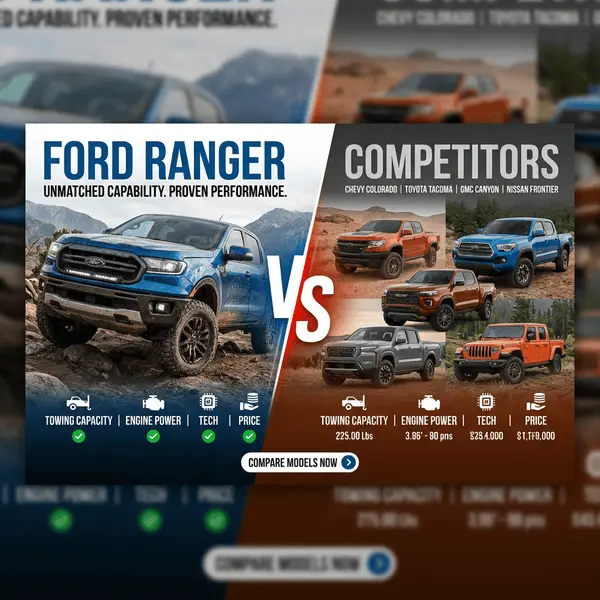
Design and Exterior
Ford Ranger Design Ford Ranger VS Competitors
The 2024 Ford Ranger showcases a bold and modern design that sets it apart from its predecessors. Its prominent LED headlights lead the way, giving the truck a distinctive and eye-catching front fascia. The body has been significantly updated, featuring a more muscular and boxed-out appearance that exudes strength and capability.
One of the most notable changes in the new Ranger is its crew cab configuration, which is now the only option available. This design choice reflects Ford’s commitment to providing ample interior space and versatility for passengers and cargo alike. The integration of large screens and thoughtful storage spaces within the cab demonstrates a focus on both functionality and esthetics.
The exterior of the 2024 Ranger has been carefully crafted to make a strong visual impact. Its sculpted lines and well-defined contours contribute to an overall appearance that is both rugged and refined. This design evolution marks a significant departure from the previous generation, making the outgoing Ranger’s exterior seem comparatively understated.
Competitor Designs Ford Ranger VS Competitors
When it comes to competitor designs, the Toyota Tacoma stands out as a notable contender in the midsize truck segment. Entering its fourth generation, the Tacoma’s design philosophy leans towards evolution rather than revolution. It retains its familiar fascia, which has become a signature element of the model over the years. The truck’s exaggerated sculpting gives it a modern twist while still maintaining a clear connection to its predecessor.
Other competitors in the market, such as the Chevrolet Colorado and Nissan Frontier, also bring their unique design elements to the table. Each manufacturer strives to create a distinct visual identity for their midsize trucks, balancing traditional truck styling cues with modern design trends.
Design Comparison Ford Ranger VS Competitors
When comparing the Ford Ranger to its competitors, several key differences emerge. The Ranger’s design appears to be more forward-thinking and contemporary, with its prominent LED headlights and muscular body lines making a strong statement. In contrast, the Toyota Tacoma takes a more conservative approach, evolving its design gradually to maintain brand recognition while incorporating modern elements.
The Ranger’s focus on a single crew cab configuration sets it apart from some competitors that offer multiple cab options. This decision by Ford emphasizes the importance of interior space and comfort in the midsize truck segment.
In terms of interior design, the new Ranger distinguishes itself with a more premium and tech-forward approach. The integration of large screens and modern design flourishes in the cabin creates a stark contrast to the previous generation’s more utilitarian interior. This upgrade in interior quality and technology integration may give the Ranger an edge over some competitors that have not yet made such significant interior updates.
It’s worth noting that while the Ranger’s design is new to the U.S. market, it has been available in other global markets for a couple of years. This global-first approach has allowed Ford to refine the design based on international feedback before introducing it to American consumers.
Overall, the 2024 Ford Ranger’s design and exterior represent a significant step forward in the midsize truck segment. Its bold styling, advanced features, and thoughtful design elements position it as a strong contender against established competitors like the Toyota Tacoma and other midsize trucks in the market.
Performance and Powertrain
Ford Ranger Performance
The 2024 Ford Ranger showcases impressive performance capabilities that set it apart in the midsize truck segment. At the heart of its powertrain is a robust twin-turbo petrol V6 engine, delivering a formidable 292 horsepower. This powerplant offers a significant boost over its predecessor, providing ample power for various driving scenarios.
The Ranger’s performance is further enhanced by its 10-speed automatic transmission, which ensures smooth and efficient power delivery. This combination results in brisk acceleration, although it’s worth noting that the gearbox prioritizes smoothness over rapid shifts. The vehicle’s performance can be fine-tuned through different driving modes, with Sport mode offering firmer steering and improved chassis control for a more engaging driving experience.
One of the standout features of the new Ranger is its advanced suspension system. The truck employs unique dampers that contribute to a smooth ride quality, striking a balance between firmness and comfort across various speeds. This suspension setup also helps in limiting pitch and roll, especially at higher speeds, enhancing overall stability and control.
Competitor Performance
When comparing the Ford Ranger to its competitors, several key differences emerge. The Toyota Tacoma, a long-standing rival in the midsize truck segment, offers a range of engine options. Its most powerful variant comes with a 236-horsepower V6, which falls short of the Ranger’s output. Similarly, the Honda Ridgeline, another competitor, offers less horsepower compared to the Ranger, with the Ford boasting 125 more horses and 25 more horses per ton.
The Nissan Frontier also trails behind the Ranger in terms of raw power. The Ford offers 95 more horsepower and 9 more horses per ton compared to the Frontier, giving it a significant edge in performance metrics.
Performance Comparison
In a head-to-head comparison, the 2024 Ford Ranger demonstrates several advantages over its competitors:
- Power Output: With over 400 horsepower in its top-tier configuration, the Ranger outperforms many of its rivals, offering better overall performance and towing capabilities.
- Torque: The Ranger’s impressive torque output of 430 lb.-ft. surpasses competitors like the Toyota Tacoma (317 lb.-ft.) and the Nissan Frontier (281 lb.-ft.), providing superior pulling power and acceleration, especially when carrying heavy loads.
- Drivetrain Options: The Ranger offers a rear-wheel drive configuration, which contributes to increased traction, acceleration, and braking power. This feature, combined with the optional turbocharged engine, enhances both safety and fuel economy.
- Braking Performance: In terms of stopping power, the Ranger excels, offering 15 more horses in braking power per ton compared to the Nissan Frontier. This advantage is particularly beneficial when carrying heavy loads or navigating steep gradients.
- Off-Road Capabilities: The Ranger, especially in its Raptor variant, showcases exceptional off-road performance. The Baja mode, in particular, allows for high-speed off-road driving with impressive control and suspension performance, absorbing bumps effectively and handling jumps with minimal suspension compression.
- Fuel Efficiency: Despite its powerful engine, the Ranger manages to maintain competitive fuel economy, striking a balance between performance and efficiency.
In conclusion, the 2024 Ford Ranger’s performance and powertrain characteristics position it as a strong contender in the midsize truck market. Its combination of power, torque, advanced transmission, and versatile suspension system provides a compelling package that outperforms many of its competitors in key areas. Whether it’s for everyday driving, towing, or off-road adventures, the Ranger demonstrates a well-rounded performance profile that caters to a wide range of driving needs and preferences.
Interior and Technology
Ford Ranger Interior
The 2024 Ford Ranger brings elements of SUV style, comfort, and refinement to the pickup truck class. Its interior showcases a thoughtful, well-crafted design that prioritizes functionality and comfort. Upon entering, drivers and passengers will notice the spacious and ergonomic layout, with controls and switches strategically placed within easy reach.
The Ranger now comes exclusively in a crew cab configuration, enhancing comfort and versatility. Whether opting for durable cloth upholstery or luxurious leather-trimmed seats, occupants enjoy ample support on long drives. Available power-adjustable front seats with lumbar support further improve the experience, while heated and ventilated front seats provide year-round comfort.
Attention to detail is evident throughout the cabin, from premium materials to decorative stitching adorning surfaces. Clever storage solutions, including a deep center console and various cubbies, help maintain an organized and clutter-free interior.
The Ranger’s infotainment system serves as a gateway to an array of features and functions. Entry-level trims feature a 10-inch touchscreen, while higher-end models boast a larger 12-inch display. Standard Apple CarPlay and Android Auto compatibility allow for seamless smartphone integration.
Competitor Interiors
While the Ranger has made significant strides in interior quality and technology, competitors in the midsize truck segment also offer compelling interiors. The Toyota Tacoma, for instance, has been a long-standing rival in this class. However, specific details about its interior were not provided in the given information.
Other competitors, such as the Volkswagen Amarok, which shares a platform with the Ranger due to a collaboration between Ford and Volkswagen, likely offer similar interior features and quality.However, the Amarok undergoes some light interior design tweaks to differentiate it from the Ranger.
Interior Comparison
When comparing the Ford Ranger’s interior to its competitors, several key points emerge:
- Refinement: The Ranger is designed to bring SUV-like comfort and refinement to the pickup class. However, it’s noted that while the latest pickups are much better than their predecessors, they still don’t match the refinement of a proper 4×4 SUV.
- Equipment: In Limited trim, the Ranger is well-equipped, with its cabin sharing many features with modern SUVs.
- Technology: The Ranger boasts a user-friendly infotainment interface with an intuitive touchscreen display. It offers advanced features such as wireless charging (although this may not be compatible with all mobile phones), voice control functionality, and connectivity options including Bluetooth, Apple CarPlay, and Android Auto.
- Navigation: The Ranger’s car navigation system is equipped with advanced GPS technology, ensuring precise navigation whether on remote off-road trails or city streets. It often includes real-time traffic updates to help drivers avoid congested routes.
- Entertainment: Long drives become more enjoyable with the Ranger’s entertainment features, including the ability to watch movies, stream music, or play games on the infotainment system.
- Comfort: While the Ranger offers improved comfort, it’s noted to be less comfortable when used as a family car compared to the Volkswagen Amarok.
- Driver Assistance: The Ranger offers various driver-assist features, although these are supplemental and don’t replace the driver’s attention and control.
In conclusion, the 2024 Ford Ranger’s interior and technology offerings position it as a strong contender in the midsize truck segment. Its blend of comfort, functionality, and advanced features cater to both work and leisure needs, although it still falls short of matching the refinement of traditional SUVs.
Towing and Payload Capacity Ford Ranger VS Competitors
Ford Ranger Capabilities
The Ford Ranger showcases impressive towing and payload capabilities that position it as a strong contender in the midsize truck segment. With a maximum available towing capacity of 7,500 pounds, the Ranger demonstrates its ability to handle substantial loads. This capability is supported by its robust 2.3-liter EcoBoost engine, which delivers 270 horsepower and 310 pound-feet of torque.
The Ranger’s towing prowess is further enhanced by advanced features such as the available Pro Trailer Backup Assist. This innovative system allows drivers to steer their trailer by simply turning a knob, making the often-challenging task of reversing with a trailer significantly easier. Additionally, the Ranger offers a bird’s-eye view camera system, providing drivers with a comprehensive view of their surroundings, which is particularly useful when maneuvering with a trailer.
In terms of payload, the Ranger offers a competitive capacity, although specific figures vary depending on the configuration. The truck’s bed is designed for versatility, featuring an available integrated box side step for easy access. With up to 9.3 inches of ground clearance, the Ranger is well-equipped to handle various terrains and obstacles, whether loaded or unloaded.
Competitor Capabilities Ford Ranger VS Competitors
When comparing the Ford Ranger to its competitors, several key differences emerge:
- Toyota Hilux: While capable, the Hilux faces challenges in high-speed stability when towing, particularly during emergency maneuvers. Its slower steering can cause the trailer to weave, which may be unsettling for drivers.
- Nissan Frontier: The Frontier falls short in power output compared to the Ranger. Its 2.5-liter DOHC 4-cylinder engine produces 152 horsepower, while even its 6-cylinder option only reaches 261 horsepower. This power deficit results in a lower towing capacity of 3,800 pounds, significantly less than the Ranger’s 7,500-pound capability.
- Ssangyong Musso: The Musso stands out with its impressive payload capacity of 1,095 kg (2,414 lbs), which it can maintain even while towing a 3,500 kg (7,716 lbs) trailer. It also boasts the widest load bed and aperture among competitors, making it a strong contender for hauling large items.
- Isuzu D-Max: Known for its reliability, the D-Max matches the class standard with a 3.5-ton (7,716 lbs) towing capacity. However, its engine outputs fall short of the Ranger’s capabilities.
Capability Comparison Ford Ranger VS Competitors
In a head-to-head comparison, the Ford Ranger demonstrates several advantages:
- Towing Performance: In towing tests, the Ranger outperforms many competitors. It accelerated from 30-60 mph while towing a caravan in just 12.5 seconds, significantly faster than rivals like the Isuzu D-Max, which took 17.4 seconds.
- Stability: The Ranger exhibits impressive high-speed stability when towing, maintaining control even during emergency lane changes. This stability is a crucial safety feature when hauling heavy loads.
- Versatility: While some competitors like the Ssangyong Musso offer higher payload capacities, the Ranger provides a well-rounded package. Its longer bed, although narrowing towards the bulkhead, offers flexibility for various cargo types.
- Power-to-Towing Ratio: The Ranger’s EcoBoost engine provides a favorable balance of power and towing capacity, outperforming competitors like the Nissan Frontier in both aspects.
- Technology Integration: Features like Pro Trailer Backup Assist give the Ranger an edge in ease of use, particularly for those who frequently tow trailers.
In conclusion, while each competitor brings unique strengths to the table, the Ford Ranger’s combination of towing capacity, payload capability, and advanced features positions it as a top contender in the midsize truck segment for those prioritizing towing and hauling capabilities.
Off-Road Capabilities Ford Ranger VS Competitors
Ford Ranger Off-Road Features
The Ford Ranger has established itself as a formidable contender in the off-road arena. Its off-road prowess is enhanced by several key features that cater to enthusiasts and adventurers alike. The Ranger offers a low-range four-wheel-drive system that allows drivers to make effective use of the engine’s torque for low-speed crawling. This system, combined with the ability to lock the rear differential, provides excellent traction in challenging terrains.
One standout feature is the Ranger’s off-road cruise control system, which maintains a set speed of up to 18 mph, allowing drivers to focus on navigating their surroundings. This feature proves particularly useful when tackling difficult terrain that requires precise control and attention.
For those seeking even more off-road capability, the Ranger Raptor variant takes things to the next level. It boasts coil suspension tuned specifically for off-road handling and features beefier bodywork with skid plates to protect the underside from rocks and other obstacles. The Raptor also offers a choice between a 2.0-liter diesel engine for efficiency or a powerful 3.0-liter 288bhp V6 petrol engine for those craving more performance.
Competitor Off-Road Features Ford Ranger VS Competitors
When it comes to off-road capabilities, the Ford Ranger faces stiff competition from several notable rivals:
- Toyota Tacoma: The Tacoma stands out with its disconnecting sway bar, a £785.63 option that significantly enhances its rock-crawling abilities. This feature allows for greater wheel articulation, enabling the Tacoma to navigate challenging obstacles with ease.
- Chevrolet Colorado: The Colorado boasts a robust low-range four-wheel-drive system and impressive torque output, making it well-suited for off-road tasks. However, it lacks manual control over the locking rear differential, which can be a drawback in certain situations.
- Ineos Grenadier: This newcomer to the market shines in off-road conditions. Trailmaster models come equipped with locking front and rear differentials and all-terrain tires, making them nearly unstoppable in rough terrain. The Grenadier’s hill-descent control system offers smooth progress even on very steep slopes.
- Land Rover Defender: The Defender comes with the Terrain Response system, which simplifies off-road driving by allowing users to select the appropriate setting for various surfaces. It also boasts impressive ground clearance and wading depth, surpassing many competitors in these aspects.
Off-Road Comparison Ford Ranger VS Competitors
When comparing the Ford Ranger to its competitors in off-road scenarios, several key points emerge:
- Traction Control: The Ranger’s locking rear differential provides excellent traction, although the control being located in the touchscreen may be less convenient than physical buttons found in some competitors.
- Ground Clearance: While the Ranger offers decent ground clearance for day-to-day tasks, it falls short compared to more specialized off-road variants like the ZR2, Raptor, or TRD Pro models. This lower stance may result in more frequent contact with obstacles in challenging terrains.
- Suspension Performance: The Ranger Raptor’s adaptive dampers significantly improve ride comfort both on and off-road, giving it an edge over competitors like the Isuzu D-Max AT35 in terms of overall comfort during long-distance off-road driving.
- Technology Integration: The Ranger’s forward-facing camera proves more helpful in navigating obstacles compared to some competitors with lower quality camera systems.
- Versatility: While specialized off-road vehicles like the Ineos Grenadier may outperform the Ranger in extreme conditions, the Ford offers a better balance between on-road comfort and off-road capability, making it a more versatile choice for many users.
In conclusion, the Ford Ranger holds its own in the competitive off-road segment, offering a compelling mix of features and capabilities. While it may not lead in every category, its well-rounded performance and adaptability make it a strong contender for those seeking a vehicle that can handle both daily driving and weekend adventures with ease.
Conclusion Ford Ranger VS Competitors
The Ford Ranger has shown itself to be a strong contender in the midsize truck market, offering a well-rounded package that caters to a wide range of needs. Its bold design, powerful performance, and advanced technology features give it an edge in many areas. The Ranger’s impressive towing capacity and off-road capabilities also make it a versatile choice for both work and play.
When compared to its rivals, the Ranger holds its own and often excels in key areas such as power output, fuel efficiency, and interior comfort. While some competitors may have specific strengths, the Ranger’s overall package makes it a compelling option for those in the market for a midsize truck. As the automotive landscape continues to evolve, the Ranger’s combination of capability, comfort, and technology positions it well to meet the changing needs of truck buyers.
FAQs Ford Ranger VS Competitors
- What vehicles are comparable to the Ford Ranger?
- The 2024 Chevy Colorado and GMC Canyon are noteworthy competitors to the Ford Ranger. These models stand out with their advanced off-road capabilities, optional factory lift kits, and a wide array of technological features.
- Which is better: Ford Ranger or Isuzu?
- The Ford Ranger Wildtrak and Isuzu D-MAX X-Terrain are both strong contenders in the dual-cab four-wheel-drive utility segment. While both offer good value, the Ford Ranger Wildtrak is considered superior if budget allows, setting a high standard in its class.
- Does the Ford Ranger have more power than the Toyota HiLux?
- The Ford Ranger and Toyota HiLux have similar power outputs, with the Ranger at 154 kW and 500 Nm of torque, and the HiLux close behind at 150 kW and 500 Nm. However, the Ranger uses a smaller 2.0-liter turbo-diesel engine compared to the HiLux’s 2.8-liter turbo-diesel, which means the Ranger’s engine may need to work harder to deliver its performance.
- What makes the Ford Ranger special?
- The 2024 Ford Ranger is praised for its ease of driving and comfort, making it an excellent choice for both daily use and heavy-duty tasks like towing and hauling. Additionally, it features a visually appealing and well-equipped cabin, incorporating many of Ford’s latest technologies and driver assistance systems.