Ford Ranger Raptor Engine
Ford Ranger Raptor Engine
The Ford Ranger Raptor has been causing a revolution in the mid-size pickup truck market with its formidable engine. This high-performance variant of the popular Ranger model boasts a powerplant that sets it apart from its competitors. The Ford Ranger Raptor engine combines raw power with advanced engineering to deliver exceptional performance both on and off the road. Source
Under the hood, the Ford Ranger Raptor engine specs reveal a robust powertrain designed to tackle challenging terrains. The 2024 Ford Ranger Raptor engine offers impressive horsepower and torque figures, making it a force to be reckoned with in its class. This article will explore the engine’s key features, including its turbocharging system, transmission, and performance capabilities. We’ll also look at its fuel efficiency, towing capacity, and how it stands up to the demands of off-road enthusiasts.
The Heart of the Beast: Ford Ranger Raptor Engine Specifications
The Ford Ranger Raptor’s engine stands as a testament to advanced automotive engineering, offering a blend of power, efficiency, and durability. This powerplant has an influence on the vehicle’s exceptional performance both on and off the road, setting it apart in the mid-size pickup truck segment.
Ranger Raptor Engine Specifications
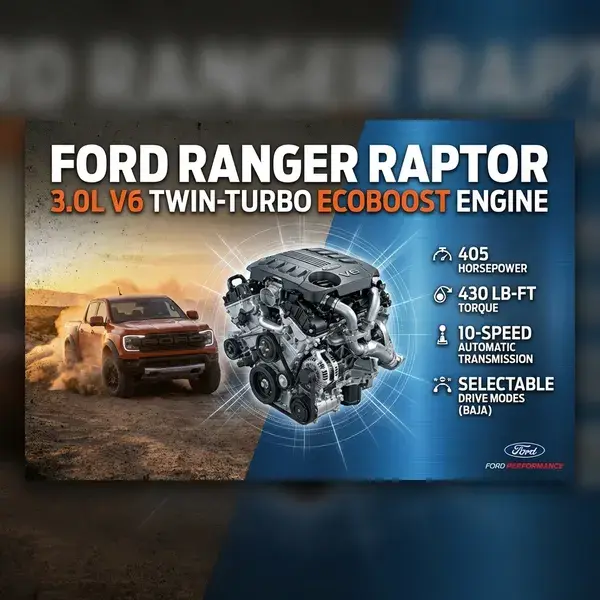
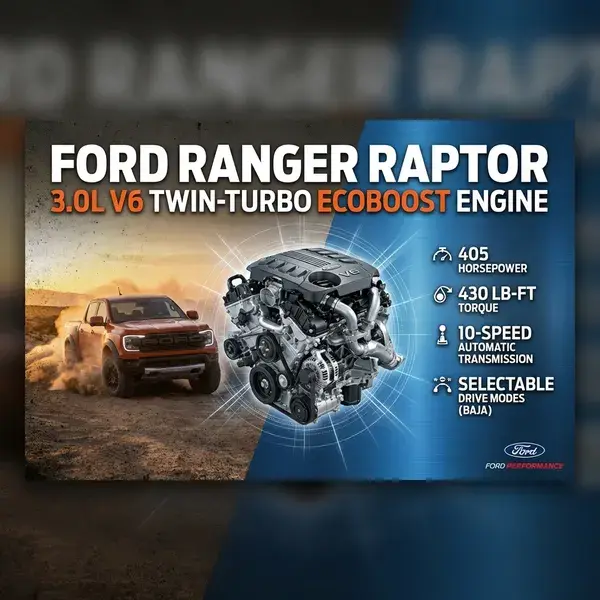
At the core of the Ranger Raptor lies a 3.0-liter EcoBoost® V6 engine. This powerhouse features a twin-turbocharged and intercooled configuration, utilizing a compacted graphite iron block paired with aluminum heads. The engine’s architecture incorporates dual overhead camshafts (DOHC) with four valves per cylinder, complemented by twin independent variable camshaft timing to optimize performance across various driving conditions.
The engine’s bore and stroke measurements are 3.36 x 3.38 inches (85.4 mm x 86.0 mm), resulting in a displacement of 180.0 cubic inches or 2,949 cubic centimeters. With a compression ratio of 10.5:1, this engine is designed to deliver robust performance while maintaining efficiency. The ignition system employs a coil-on-plug design, ensuring reliable and precise spark delivery.
Power and Torque Output
The Ranger Raptor’s engine showcases impressive output figures, though these can vary depending on the market and specific model year. In its standard configuration, the engine produces 405 horsepower and 430 lb.-ft. of torque. However, it’s worth noting that power outputs may differ across regions.
For instance, in the UK market, the Raptor’s 3.0-liter V6 petrol engine generates 292 horsepower, which is unique to this model and sets it apart from the more conservative diesel powertrains available in the Ranger lineup. Interestingly, Australian-delivered versions of the pickup produce even more power, boasting 392 horsepower and 583 Nm of torque.
Ford has also introduced performance packages in certain markets, further enhancing the engine’s capabilities. In the United States, a new tune increases the outputs from 302 kW of power and 583 Nm of torque to an impressive 339 kW and 727 Nm, representing a substantial boost of 37 kW and 144 Nm.
Fuel Efficiency and Emissions
While the Ranger Raptor prioritizes performance, fuel efficiency and emissions are also important considerations. The engine utilizes a combination of port fuel and direct injection systems, optimizing fuel delivery for both power and efficiency. It’s recommended to use 91 octane fuel, ensuring optimal performance and longevity of the engine.
The fuel tank capacity stands at 20.3 gallons, providing a decent range for both on-road and off-road adventures. However, it’s important to note that fuel consumption figures can be significant due to the engine’s high-performance nature.
| Specification | Value |
|---|---|
| Fuel Consumption | 13.8l/100km |
| CO2 Emissions | 315g/km |
| Annual Road Tax (Ireland) | €1,494 |
These figures highlight the trade-off between performance and environmental impact, a common characteristic in high-performance vehicles. It’s worth mentioning that the addition of dealer-fitted accessories after registration could have an impact on the vehicle’s fuel consumption and emissions.
The Ranger Raptor’s engine, with its impressive specifications and output, truly embodies the “heart of the beast.” Its combination of advanced engineering, robust power delivery, and adaptability to various driving conditions makes it a standout choice in the high-performance pickup truck market. As emission regulations evolve and the automotive industry shifts towards electrification, the V6 Raptor could potentially be one of the last of its kind, making it a significant model in Ford’s lineup.
Advanced Engineering: Turbocharging and Intercooling
The Ford Ranger Raptor’s impressive performance is largely attributed to its advanced engineering, particularly in the areas of turbocharging and intercooling. These technologies work in tandem to enhance the engine’s power output and efficiency, making the Ranger Raptor a formidable force both on and off the road.
Twin-Turbo Technology
At the heart of the Ranger Raptor’s powerplant lies a sophisticated twin-turbo system. This configuration employs two turbochargers working in harmony to boost the engine’s performance across a wide range of operating conditions. The twin-turbo setup allows for more efficient air compression, resulting in increased power output and improved throttle response.
The 3.0-liter EcoBoost® V6 engine utilizes this twin-turbo technology to deliver an impressive 292 horsepower in the UK market, while Australian-delivered versions produce even more power at 392 horsepower. This significant difference in output highlights the versatility of the twin-turbo system, which can be tuned to meet various market requirements and performance standards.
One of the key advantages of the twin-turbo setup is its ability to provide substantial torque at lower engine speeds. With 362 lb-ft of torque available from just past 2,000 rpm, the Ranger Raptor offers easy-access pace, ensuring responsive acceleration when needed. However, it’s worth noting that some drivers have observed that the engine feels slightly restrained at higher revs, suggesting that Ford has tuned the powerplant for a balance of performance and reliability.
Intercooler Design and Efficiency
Complementing the twin-turbo system is an advanced intercooler design that plays a crucial role in maximizing the engine’s performance and efficiency. The intercooler’s primary function is to cool the compressed air from the turbochargers before it enters the engine, increasing its density and, consequently, the amount of oxygen available for combustion.
While the stock intercooler provides adequate cooling for standard driving conditions, aftermarket solutions have emerged to further enhance the Ranger Raptor’s performance. For instance, the Wagner Tuning Performance Intercooler Kit offers significant improvements over the factory setup:
| Feature | Stock Intercooler | Wagner Tuning Intercooler |
|---|---|---|
| Core Size | Not specified | 480mm x 209mm x 110mm |
| Volume Increase | Baseline | 69% more than stock |
| Construction | Standard | Bar and plate with internal turbulators |
| End Tanks | Standard | Cast aluminum |
This aftermarket intercooler kit has been engineered to eliminate OEM bottlenecks, optimize airflow, and improve charge cooling characteristics. The larger core size and increased volume allow for more efficient heat dissipation, which can lead to lower intake temperatures and potentially higher power output.
Another notable aftermarket option is the COBB Front Mount Intercooler upgrade, designed specifically for the 2024+ Ranger Raptor. This intercooler is a direct replacement for the factory unit and offers significantly improved cooling efficiency. COBB’s development process involved digital analysis to create smooth end tank designs that increase flow evenly and reduce airflow turbulence. The outlet port features a large chamfer to provide a smooth transition into the throttle body tube, further optimizing airflow dynamics.
These aftermarket solutions demonstrate the potential for enhancing the Ranger Raptor’s already impressive turbocharging and intercooling systems. By improving cooling efficiency and reducing intake temperatures, these upgrades can lead to more consistent power delivery and potentially increased overall performance.
The combination of twin-turbo technology and advanced intercooling in the Ford Ranger Raptor showcases the manufacturer’s commitment to pushing the boundaries of mid-size pickup truck performance. As the automotive industry continues to evolve, these engineering advancements serve as a testament to the ongoing pursuit of power, efficiency, and reliability in high-performance vehicles.
Transmission and Drivetrain: Delivering Power to the Wheels
The Ford Ranger Raptor’s impressive engine performance is complemented by an advanced transmission and drivetrain system, designed to deliver power efficiently to the wheels in various driving conditions. This sophisticated setup ensures that the Raptor maintains its prowess both on and off the road.
10-Speed Automatic Transmission
At the heart of the Ranger Raptor’s drivetrain lies an advanced 10-speed automatic transmission. This gearbox plays a crucial role in delivering rewarding acceleration while maintaining outstanding fuel efficiency. The transmission’s standout feature is its real-time adaptive shift-scheduling capability, which allows it to effortlessly adapt to changing conditions. Whether the driver is cruising on the motorway or tackling difficult off-road terrain, the transmission ensures that the vehicle is always in the right gear at the right time.
The 10-speed automatic transmission is paired with the Ranger Raptor’s powerful 2.0-liter EcoBlue diesel engine, which produces 213PS and 500Nm of torque. This combination results in smooth and responsive power delivery across a wide range of driving scenarios. The transmission’s multiple gears allow for optimal engine performance, ensuring that the Raptor can efficiently utilize its impressive torque output in various situations.
4×4 System and Differential Locks
The Ranger Raptor boasts a sophisticated 4×4 system that enhances its versatility and off-road capabilities. This system allows drivers to switch between 4WD and 2WD on the fly, providing flexibility for different driving conditions. When cruising on smooth roads, the vehicle can remain in 2WD for improved fuel efficiency. However, as soon as the terrain becomes challenging or the driver decides to go off-road, they can effortlessly switch into 4WD.
The Raptor’s advanced e-4WD system takes this capability a step further. It monitors inputs from various sensors to automatically vary the torque sent to both the front and rear axles. This intelligent system ensures optimal traction and stability in diverse driving conditions without requiring constant driver intervention.
For those who prefer more control, the Ranger Raptor offers selectable drive modes, including:
- Normal
- Sport
- Grass/Gravel/Snow
- Mud/Sand
- Rock Crawl
These modes allow drivers to optimize the vehicle’s performance for specific terrains and conditions, further enhancing the Raptor’s off-road prowess.
One of the standout features of the Ranger Raptor’s 4×4 system is its electronic locking differentials. The vehicle is equipped with both front and rear locking differentials, providing enhanced traction and control in challenging off-road situations. The rear electronic locking differential can be engaged automatically via the selected drive mode (Sand, Mud/Ruts, or Rock Crawl) or manually when in four-wheel drive high (4H) and four-wheel drive low (4L).
The front electronic locking differential, on the other hand, can only be engaged in four-wheel drive low (4L) at speeds up to 32 km/h. It automatically disengages above this speed to prevent potential drivetrain damage. These locking differentials ensure that all four wheels receive maximum drive, whether they’re on or off the ground, allowing for more gentle off-road driving and reducing driveline stresses.
For precise control in low-speed off-road situations, the Ranger Raptor features Trail Control. This system acts as a low-speed, off-road cruise control, allowing drivers to set a speed that the vehicle will maintain when going up or down hills or over rugged terrain. This feature significantly reduces the stress of navigating challenging off-road conditions, allowing drivers to focus on steering and obstacle avoidance.
The combination of the 10-speed automatic transmission, advanced 4×4 system, and electronic locking differentials makes the Ford Ranger Raptor a formidable machine capable of conquering a wide range of terrains. From smooth highways to rocky mountain trails, this drivetrain setup ensures that the Raptor can deliver its impressive power to the wheels effectively and efficiently.
Performance on the Road: Acceleration and Top Speed
The Ford Ranger Raptor’s performance on the road is a testament to its powerful engine and advanced engineering. While primarily designed for off-road prowess, this high-performance pickup truck demonstrates impressive capabilities on paved surfaces as well.
0-60 mph Times
The Ranger Raptor showcases remarkable acceleration for a vehicle of its size and weight. In recent tests, the truck achieved a 0-60 mph time of 5.86 seconds. This impressive figure was recorded with the vehicle carrying a 3/4 tank of fuel and a driver weighing 618 pounds. It’s worth noting that these conditions may have slightly impacted the acceleration times.
To put this performance into perspective, here’s a breakdown of the Ranger Raptor’s acceleration:
| Measurement | Time | Speed |
|---|---|---|
| 0-60 mph | 5.86s | 60 mph |
| 1/8 mile | 9.19s | 77.70 mph |
| 1/4 mile | 14.42s | 86.60 mph |
These figures demonstrate the Ranger Raptor’s ability to deliver quick acceleration, especially considering its size and weight. However, it’s important to note that the truck’s performance could potentially be enhanced under different conditions. For instance, running on 93 octane fuel, carrying less weight, and reducing the fuel load could result in slightly quicker times.
One interesting aspect of the Ranger Raptor’s acceleration is its launch behavior. In 2-wheel drive mode, the truck experiences higher RPMs and better turbo spool, but this can lead to rear tire spin during launches. Conversely, in 4-wheel drive mode, the computer limits RPMs and turbo spool, causing the truck to momentarily hesitate before accelerating rapidly. This characteristic 60-foot performance suggests that the vehicle’s electronic systems are carefully managing power delivery to optimize traction and acceleration.
Maximum Speed and Limitations
While the Ranger Raptor demonstrates impressive acceleration, its top speed is electronically limited to ensure safety and stability. During testing on an abandoned airfield, it was discovered that the Ranger Raptor has a maximum speed of 107 mph. This limitation is likely implemented to account for the truck’s high center of gravity and off-road-oriented tires, which may not be optimized for sustained high-speed driving.
Despite this top speed limitation, the Ranger Raptor exhibits commendable on-road manners. It rounds off obvious potholes effectively, although it’s important to note that it doesn’t provide a plush ride due to its off-road-focused suspension setup. The steering, while slow and lacking in road-surface feedback, is appropriate for a vehicle designed primarily for off-road use.
Surprisingly, the Ranger Raptor maintains excellent noise levels at highway speeds. Despite its aggressive off-road tires, there’s very little road noise at 70 mph, and wind noise is kept to an acceptable level. This makes the truck a comfortable option for long-distance highway driving, despite its rugged nature.
It’s worth mentioning that the Ranger Raptor’s performance capabilities extend beyond mere straight-line speed. Its advanced suspension system, featuring Fox shocks, allows it to maintain high speeds over rough terrain. In off-road testing, the truck demonstrated the ability to traverse undulating surfaces at speeds up to 50 mph while maintaining exceptional stability and comfort.
While the current performance figures are impressive, enthusiasts and tuners believe there’s potential for even more. As aftermarket solutions become available, it’s possible that future modifications could unlock additional performance from the Ranger Raptor’s powertrain, potentially improving both acceleration times and top speed.
Off-Road Prowess: Engine Characteristics for Tough Terrain
The Ford Ranger Raptor’s engine characteristics play a crucial role in its exceptional off-road performance. With a powerful 3.0-liter EcoBoost V6 engine producing 405 horsepower and 430 lb-ft of torque, the Ranger Raptor outperforms many of its competitors in the mid-size truck segment. This impressive powertrain gives the vehicle a significant advantage in various off-road scenarios, from rock crawling to high-speed desert runs.
Low-End Torque for Rock Crawling
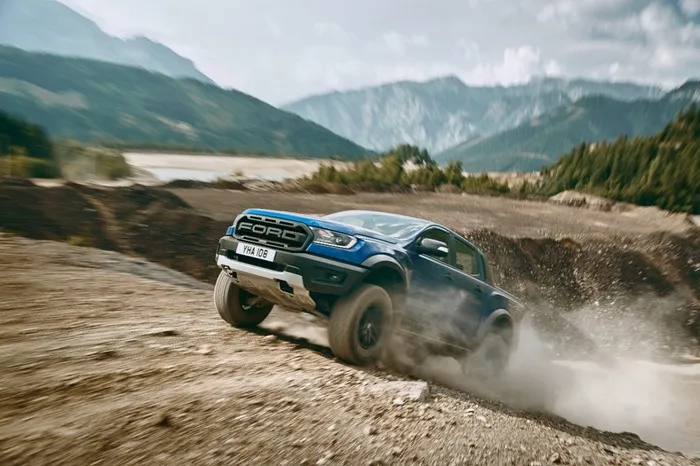
When it comes to navigating challenging rocky terrain, the Ranger Raptor’s engine delivers the necessary low-end torque for controlled and precise movements. The truck’s advanced 4×4 system, coupled with its powerful engine, allows for excellent performance in low-speed, technical off-road situations.
The Ranger Raptor features a 2-speed transfer case and lockable front and rear differentials, which work in tandem with the engine’s torque output to provide optimal traction in difficult conditions. These lockers activate quickly, ensuring that power is distributed effectively to all four wheels when needed. In low range, the gearing allows for controlled crawling, giving drivers the ability to navigate obstacles with precision.
Ford’s “Trail Control” feature further enhances the Ranger Raptor’s rock crawling capabilities. This off-road cruise control system allows drivers to set speeds as low as 1.5 mph or 2 mph, providing excellent control over technical obstacles. The system manages throttle and braking, allowing the driver to focus solely on steering and obstacle avoidance.
The truck’s advanced suspension system, featuring next-generation FOX™ 2.5-inch Live Valve Internal Bypass shocks, complements the engine’s low-end torque. These shocks adapt to various driving modes, including a specific Rock Crawl mode, which optimizes damping performance for low-speed, high-torque situations.
High-RPM Power for Desert Running
While low-end torque is crucial for rock crawling, the Ranger Raptor truly shines when it comes to high-speed desert running. The 3.0-liter EcoBoost V6 engine’s 405 horsepower output gives the truck a significant advantage in power-to-weight ratio compared to its competitors. This translates to superior performance when bashing up steep dunes or racing across desert terrain.
In Baja mode, one of the truck’s specialized drive modes, the engine and transmission are optimized for high-speed off-road performance. The FOX™ Live Valve Internal Bypass system adjusts damping performance to handle the rigors of high-speed desert running, allowing the wheels to follow the terrain for maximum grip while keeping the body relatively steady.
The Ranger Raptor’s suspension has been significantly reworked to withstand the demands of high-speed off-road use. It offers increased travel, improved geometry control, and enhanced damping to handle extended wheel motion. This suspension setup, combined with the powerful V6 engine, allows the truck to maintain high speeds over undulating surfaces, with reports of the vehicle traversing rough terrain at speeds up to 50 mph while maintaining exceptional stability and comfort.
The truck’s performance in desert conditions is further enhanced by its advanced cooling system, which helps maintain optimal engine performance even under extreme conditions. The coil-over shocks at the front and piggyback reservoirs at the rear work to reduce heat build-up, ensuring uninterrupted performance throughout extended off-road sessions.
In conclusion, the Ford Ranger Raptor’s engine characteristics make it a versatile and capable off-road machine. Whether crawling over rocks at low speeds or racing across desert terrain, the powerful V6 engine, combined with advanced suspension and drivetrain technologies, ensures that the Ranger Raptor can handle a wide range of challenging off-road conditions with ease.
Conclusion: The Ranger Raptor Engine’s Place in Ford’s Lineup
The Ford Ranger Raptor’s engine stands out as a powerhouse in the mid-size pickup truck market. Its impressive blend of raw power and advanced engineering has a significant impact on both on-road and off-road performance. The twin-turbo system, coupled with efficient intercooling, allows this beast to deliver exceptional torque and horsepower across various driving conditions.
To wrap up, the Ranger Raptor’s engine, transmission, and drivetrain work together seamlessly to conquer tough terrains and deliver thrilling on-road experiences. Whether it’s rock crawling at low speeds or racing across desert landscapes, this truck’s powertrain proves its versatility and capability. As the automotive world evolves, the Ranger Raptor’s engine serves as a benchmark for high-performance mid-size pickups, showcasing Ford’s commitment to pushing boundaries in this segment.
FAQs
Who manufactures the engine for the Ford Ranger Raptor?
The engine in the Ford Ranger Raptor is a Ford Performance-tuned EcoBoost twin-turbocharged 3.0-liter V6, which delivers 405 horsepower and 430 pound-feet of torque. This engine is paired with a standard 10-speed automatic transmission.
What is the maximum speed of the Ranger Raptor?
The Ranger Raptor and Raptor R have their maximum speed electronically capped at 112 mph, primarily due to the speed rating of the tires used on these models.
How fuel efficient is the Ford Ranger Raptor?
The Ford Ranger Raptor, equipped with a 3.0-liter twin-turbo V6 and a 10-speed 4WD drivetrain, achieves fuel efficiency of 16 MPG in the city, 18 MPG on the highway, and 17 MPG combined. Despite having a 20.3-gallon fuel tank, the vehicle can travel approximately 345 miles on a full tank of premium fuel.
What are the acceleration and speed performance metrics for the Ranger Raptor?
On the test track, the Ranger Raptor accelerates from 0 to 60 mph in 5.3 seconds and completes the quarter-mile in 14.1 seconds at 97 mph. In comparison, its close competitor, the Chevrolet Colorado ZR2, takes 6.8 seconds to reach 60 mph and 15.2 seconds to finish the quarter-mile.