3.5 Tonne Box Van Dimensions: A Complete UK Size Guide
What Is a 3.5 Tonne Box Van?
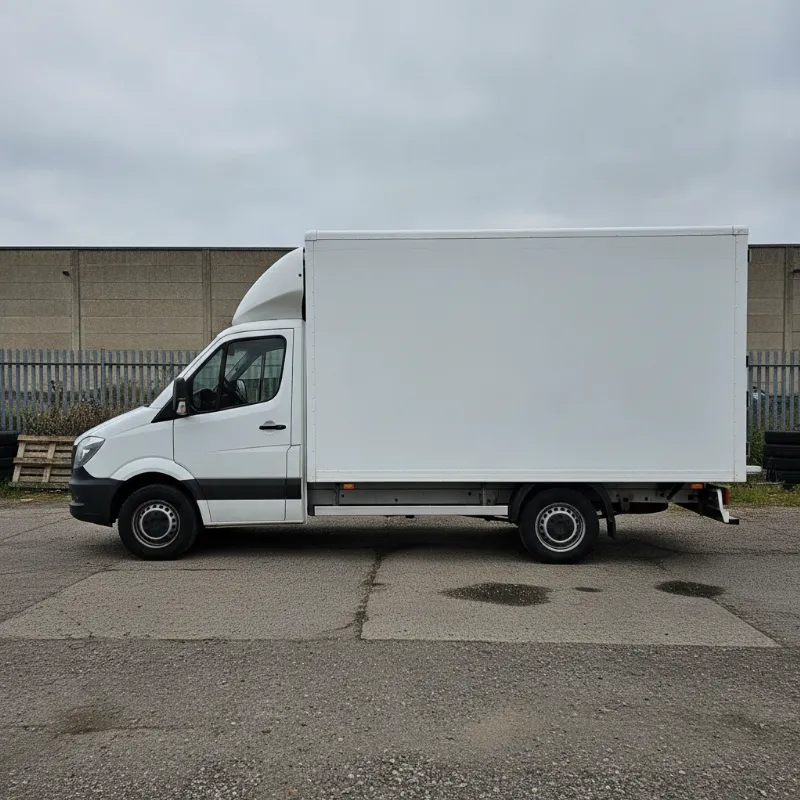
A 3.5 tonne box van is a light commercial vehicle built on a chassis cab platform with a rigid, cuboid load body fitted behind the driver's cab. The "3.5 tonne" figure refers to the Gross Vehicle Weight (GVW), meaning the total permissible weight of the van, its fuel, driver and cargo combined must not exceed 3,500kg. This weight bracket is the sweet spot for UK businesses because it sits right at the upper limit of what can legally be driven on a standard category B car licence obtained after 1997.
Unlike a standard panel van, where the load area shares the same shell as the cab, a box van has a separate purpose-built body — typically constructed from GRP (glass-reinforced plastic), aluminium, or plywood-lined panels. The result is a taller, wider, and squarer load space that maximises usable cubic capacity. You'll see these vans everywhere in the UK, from parcel delivery fleets and removals firms to catering suppliers, event hire companies and tradespeople carrying bulky stock.
Typical 3.5 Tonne Box Van Dimensions (External)
External dimensions vary depending on the base chassis and the body builder, but there are recognisable ranges that most 3.5 tonne box vans fall within. Knowing these figures upfront helps you plan for depot access, low bridges, multi-storey car parks and residential drop-offs.
Overall Length, Width and Height
A typical 3.5 tonne box van measures between 6.5 and 7.5 metres in overall length, though extra-long specifications can push beyond 8 metres. Overall width, including the body and mirrors, is usually around 2.2 to 2.5 metres — the body itself is generally 2.1 to 2.35 metres wide, with wing mirrors adding a further 30 to 40cm each side. Overall height sits between 2.9 and 3.4 metres, with the majority landing around 3.0 to 3.2 metres. This is a critical measurement to note: many height barriers, drive-thrus and older car parks are set at 2.1 metres, so a box van will need dedicated commercial routes and loading bays.
How Wheelbase Affects Overall Size
The wheelbase — the distance between the front and rear axles — is the main variable that determines how long a box van becomes. Common 3.5 tonne chassis are offered in medium-wheelbase (around 3.75m), long-wheelbase (around 4.03m) and extra-long-wheelbase (around 4.35m) configurations. A longer wheelbase supports a longer body, giving more load length, but it also increases the turning circle and reduces manoeuvrability in tight urban environments. Shorter wheelbase versions are easier to handle around city streets but obviously sacrifice cubic capacity, so the choice comes down to balancing route conditions against volume needs.
Internal Load Area Dimensions
The internal load area is where the real value of a box van lies. Because the body is a squared-off box rather than a shaped panel van shell, you get near-vertical walls, a flat floor and consistent width from front to back — ideal for stacking pallets, wheeled cages and stillages efficiently.
Load Length, Width and Height
Internal load lengths on a 3.5 tonne box van typically range from 3.9 metres on shorter wheelbase versions up to 4.8 metres, and in some extra-long builds beyond 5 metres. Internal width is usually between 2.0 and 2.2 metres, which comfortably accommodates two Euro pallets side by side (a Euro pallet is 1.2m x 0.8m). Internal load height generally sits between 2.1 and 2.3 metres, giving you enough clearance to stack pallets two high in most cases and to load tall items such as wardrobes, display units or refrigeration cabinets upright.
Load Volume and Floor Area
Total load volume on a 3.5 tonne box van typically falls between 18 and 24 cubic metres, with some large-body specifications reaching 27m³ or more. To put that in context, that's enough space for around 10 to 14 UK standard pallets on the floor, or the contents of a two to three bedroom house in a single load. Floor area ranges from roughly 8m² on medium-wheelbase versions up to around 10.5m² on long-wheelbase builds. Many operators specify a tail lift, which does slightly reduce usable internal length (usually by 100 to 200mm at the rear) but transforms loading efficiency, especially for solo drivers handling heavy goods.
Payload and Gross Vehicle Weight Explained
Payload is the weight of cargo you can legally carry, calculated by subtracting the vehicle's kerb weight (the empty weight of the van including fuel and driver allowance) from its 3,500kg GVW. On a 3.5 tonne box van, kerb weight is typically between 2,100kg and 2,500kg depending on the chassis, body construction, and options like a tail lift or twin rear wheels. That leaves a usable payload of somewhere between 1,000kg and 1,400kg.
It's essential to be realistic here. Heavy options — such as a steel tail lift (which alone can weigh 250 to 400kg), refrigeration units, racking, or a curtainside body — all eat into payload. Overloading a 3.5 tonne van is a serious offence in the UK: DVSA roadside checks routinely weigh commercial vehicles, and penalties include fixed penalty fines, prohibitions and invalidated insurance. Always ask for the individual vehicle's certified unladen weight rather than relying on the manufacturer's brochure figure, as body specification can vary significantly.
Popular 3.5 Tonne Box Van Models Compared
The UK market for 3.5 tonne box vans is dominated by a handful of well-established chassis cabs. The Mercedes-Benz Sprinter 516 CDI is a firm favourite, offering long wheelbase options with load lengths around 4.7 metres and volumes up to 24m³. The Ford Transit chassis cab is popular for its running costs and network support, with typical body builds giving 4.1 to 4.5 metre load lengths. The Iveco Daily 35S is widely respected in the higher-payload end of the segment, thanks to its robust ladder-frame chassis and generous payload ratings even at 3.5 tonnes GVW.
Other notable options include the Peugeot Boxer, Citroen Relay and Fiat Ducato — all sharing the same platform and offering good value box conversions — plus the Renault Master and Volkswagen Crafter. Each has slightly different cab ergonomics, engine choices and dealer support networks, but the load area dimensions across converters tend to cluster within the same general ranges. Fleet buyers often make the final decision based on total cost of ownership, service intervals, and residual value rather than a few centimetres difference in load space.
Choosing the Right Size Box Van for Your Business
Selecting the right specification starts with a clear picture of what you actually carry. If you move pallets, count how many Euro or UK standard pallets your typical load contains and work backwards from that — remembering to leave space for straps, load bars or cage restraints. Removals firms and event hire businesses tend to prioritise cubic volume over payload, so an extra-long, high-cube body makes sense. Trade counters, builders' merchants and refrigerated distributors, on the other hand, are usually payload-limited, so a lighter body and shorter wheelbase can be the better call.
Also think about where the van will operate. Long-wheelbase vehicles struggle on narrow rural lanes and tight urban delivery drops, while shorter builds may leave you making two runs. Consider access equipment: a column tail lift, cantilever tail lift or slider each suit different loading environments. Finally, factor in future needs — a van that suits your business today may be too small in eighteen months if you're growing, and going one size up now can save the cost and hassle of an early replacement.
Driving Licence and Legal Considerations at 3.5 Tonnes
The reason 3.5 tonnes is such an important figure in the UK is that it marks the upper limit of the standard category B car driving licence. Anyone who passed their test after 1 January 1997 can drive a vehicle up to 3,500kg GVW on a normal licence without needing any additional entitlement. Drivers who passed before that date usually hold "grandfather rights" (category C1) allowing them to drive vehicles up to 7,500kg, but for the majority of the workforce today, 3.5 tonnes is the ceiling.
Beyond licensing, 3.5 tonne box vans are subject to commercial vehicle regulations that don't apply to cars or smaller vans. They require an annual MOT from the third anniversary of first registration (or first year in some cases), they must comply with drivers' hours rules if used for hire and reward beyond certain thresholds, and they are increasingly affected by Clean Air Zone and ULEZ charges in major cities — so specifying a Euro 6 diesel or an electric drivetrain is worth serious thought. Speed limits are also lower than for cars: 50mph on single carriageways and 60mph on dual carriageways in most of the UK. Understanding these rules upfront ensures the van you buy actually works for the drivers who will use it.
FAQs
What are the typical dimensions of a 3.5 tonne box van in the UK?
A typical 3.5 tonne box van in the UK measures around 6.5 to 7.5 metres in overall length, 2.2 to 2.5 metres wide including mirrors, and 3.0 to 3.2 metres tall. Internally, the load area is usually 3.9 to 4.8 metres long, 2.0 to 2.2 metres wide and 2.1 to 2.3 metres high, giving between 18 and 24 cubic metres of load volume. Payload typically ranges from 1,000kg to 1,400kg depending on the chassis and body specification.
How many pallets can a 3.5 tonne box van carry?
Most 3.5 tonne box vans can carry between 10 and 14 UK standard pallets on the floor, depending on wheelbase and body length. The 2.0 to 2.2 metre internal width comfortably accommodates two Euro pallets side by side. However, always check payload as well as floor space — pallet weight can exhaust your 1,000 to 1,400kg payload allowance long before you fill the floor.
Do I need a special licence to drive a 3.5 tonne box van?
No, provided the vehicle's Gross Vehicle Weight does not exceed 3,500kg, it can be driven on a standard UK category B car licence. This applies to all drivers, including those who passed their test after 1 January 1997. If you want to drive anything heavier, up to 7,500kg, you'll need a C1 licence, which requires additional medical checks and a separate driving test.
What's the difference between a Luton van and a 3.5 tonne box van?
A Luton van is a specific type of box van that features a distinctive overhang, or 'pod', extending forward over the cab roof to add extra load length. A standard box van has a body that stops behind the cab. Both can be built on a 3.5 tonne chassis, and Lutons typically add around 500 to 800mm of extra load length, making them popular for removals and furniture delivery.
How much payload will I lose by fitting a tail lift?
A tail lift typically weighs between 250kg and 400kg depending on the type — cantilever, column or slider — and its lifting capacity. That weight is subtracted directly from your available payload, so a 1,300kg payload van could drop to around 900kg to 1,050kg once a tail lift is fitted. Always confirm the certified unladen weight of the finished vehicle rather than relying on the base chassis brochure figures.