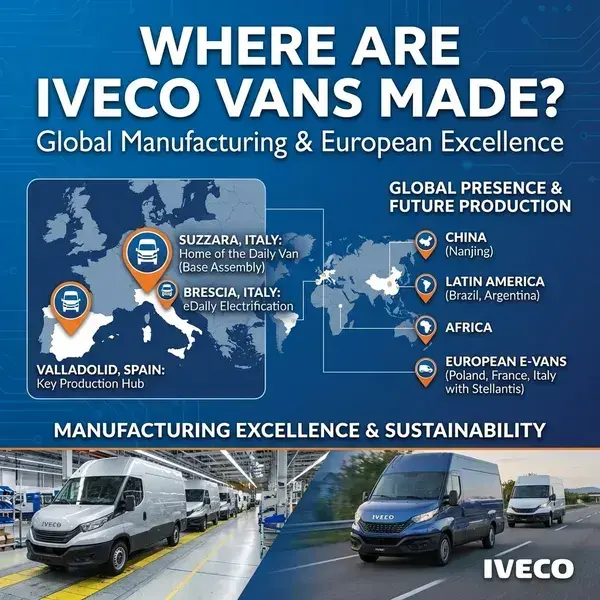
Where Are Iveco Vans Made?
Where Are Iveco Vans Made?
Where Are Iveco Vans Made? Five prestigious truck brands within the Fiat Group – Fiat, OM, Lancia, Unic, and Magirus Deutz – joined forces to create a powerhouse in commercial vehicle manufacturing back in 1975. The company has grown by a lot over the last several years and established the Iveco Group on January 1, 2022. Source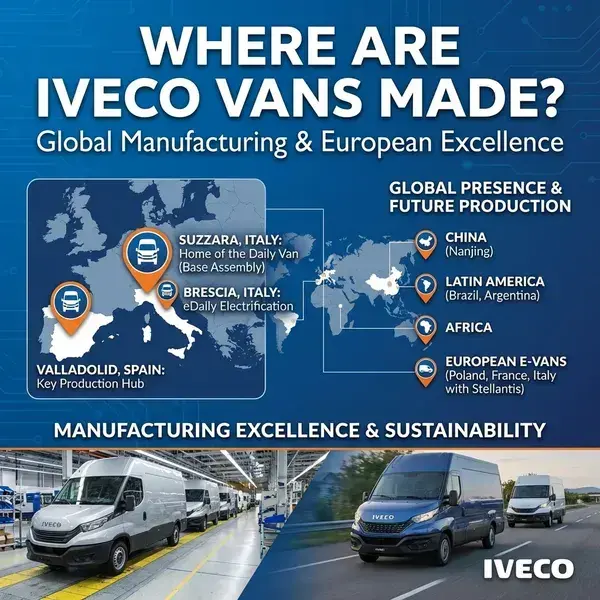
The Iveco Daily showcases this rich heritage and has remained in continuous production since 1978. This remarkable van boasts impressive capabilities with a gross vehicle weight rating of up to 7.0 tons and engine options ranging from 116hp to 210hp. The van’s excellence gets verification from its Euro NCAP Gold safety rating and industry-leading five-year, 100,000-mile warranty. See Iveco Daily Variants
Let’s explore the locations where Iveco manufactures its vans while dissecting the company’s global production facilities. These facilities play a crucial role in maintaining their renowned quality standards. See Iveco Daily Dimensions
Iveco’s Main European Production Facilities
Two world-class facilities are the life-blood of Iveco’s European manufacturing network that illustrate manufacturing excellence. See Iveco Daily Service Dimensions
Suzzara Plant, Italy – Home of the Daily Van
The Suzzara facility in Mantua, Italy, shows manufacturing excellence with its 200,000 square meters of space and annual production of over 50,000 Daily vehicles. The plant reached an impressive milestone of 1,800,000 Daily vehicles produced. About 2,000 workers keep the facility running, and they can produce 282 vehicles each day.
Valladolid Plant, Spain – Key Van Production Hub Where Are Iveco Vans Made?
Where Are Iveco Vans Made?. Iveco acquired the Valladolid facility in 1990, and it has grown into a vital manufacturing center. The plant celebrated a milestone when it produced its 700,000th Daily vehicle. Workers now build 140 Daily vehicles each day and offer more than 6,000 product variants. The plant has earned recognition as a measure of Industry 4.0 in Spain because of its state-of-the-art digital transformation projects.
Historical Significance of European Manufacturing. Where Are Iveco Vans Made?
Where Are Iveco Vans Made?. Both facilities highlight Iveco’s steadfast dedication to manufacturing excellence. The Suzzara plant runs on a specialized production system since 2007 that aims for zero faults, wastage, and accidents. The Valladolid facility reached Gold Level in World Class Manufacturing in 2019, which recognizes its remarkable progress in quality, environmental protection, and production innovation. See Iveco Daily Dimensions
These manufacturing hubs hold ISO 9001 and ISO 14000 certifications, which shows their commitment to quality management and environmental stewardship. These facilities have become the life-blood of Iveco’s global manufacturing strategy and deliver high-quality commercial vehicles to markets worldwide.
Global Manufacturing Network
Iveco has a reliable global manufacturing network that extends well beyond European borders and spans multiple continents. See Iveco Vans for sale
Nanjing Production Facility in China Where Are Iveco Vans Made
The Qiaolin plant in Nanjing serves as Iveco’s crown jewel in Asia through its NAVECO joint venture. This state-of-the-art facility covers 843,000 square meters, with 250,000 square meters under roof. The plant can produce up to 100,000 vehicles yearly after a 1.8 Billion RMB investment. The facility stands out with its automation features: Iveco Daily Utility Van
- Over 130 robotized welding stations
- Advanced 3D laser cutting technology
- State-of-the-art paint line with robotized application
- Environmentally responsible energy systems with solar power generation
African and Middle Eastern Assembly Plants. Where Are Iveco Vans Made?
Iveco runs Completely Knocked Down (CKD) assembly facilities in Algeria and Tunisia to meet local market needs. These plants put together the Daily van model through seven distinct assembly stations. Each vehicle comes with special features for local conditions – Euro 3 tropical specifications and equipment built for extreme climates.
Strategic Manufacturing Partnerships
Iveco’s manufacturing approach relies on strategic collaborations with industry leaders. The company works closely with Hyundai Motor Company to develop electric heavy-duty trucks. A new deal with Ford Otosan explores ways to create cabin structures that will meet 2028/2029 regulations. These partnerships help Iveco lead in environmentally responsible transport solutions and expand its tech capabilities.
Every global facility holds ISO 9001 and ISO 14000 certifications. This shows Iveco’s steadfast dedication to quality management and environmental care in its worldwide operations. See Iveco Daily Tipper
Van Models and Their Production Locations
The iconic Iveco Daily van boasts an impressive production record of over 1.8 million units across multiple manufacturing facilities. See Iveco Daily Luton
Daily Van Manufacturing Locations
The Daily van lineup features six distinct models with power outputs ranging from 105 HP to 127 HP. These models include:
- Single wheel vans at 3.55t GVW that excel in urban deliveries
- Twin rear wheel variants at 4.2t or 5t GVW built for challenging applications
- Specialized models offering capacities from 8m³ to 15.4m³
eDaily Production Specifics. Where Are Iveco Vans Made?
The eDaily marks a significant milestone in Iveco’s manufacturing progress. The production process happens in two stages – workers assemble the base vehicle at the Suzzara plant and complete the electrification at the Brescia facility. This electric variant achieves remarkable performance with 140kW power output and 400Nm of torque. The vehicle’s charging system supports rapid charging at 80kW and adds 62 miles of range in just 30 minutes.
Specialized Van Variant Production
The Daily’s reach extends to international markets through mutually beneficial alliances. Naveco has manufactured the model under license in China since 1991, with the first version branded as the Deyi. The Chinese market has welcomed several variants over time. The Xindeyi made its debut in 2011, followed by the Quanxindeyi in 2023. Based on the third-generation Daily, the Power Daily served the market from 2009 to 2017. An electric version was also available between 2018 and 2021.
Manufacturing Quality and Innovation
Where Are Iveco Vans Made?. Iveco pushes quality standards higher at its manufacturing facilities. The company plans to invest €5.5 billion between 2024 and 2028 to keep up with industry trends.
Advanced Production Technologies Where Are Iveco Vans Made?
The manufacturing process blends human expertise with state-of-the-art automation. Robots handle 50% of welding operations at Suzzara, while skilled technicians take care of complex welding tasks by hand. Eisenmann’s paint system runs at 80% automation. This system applies a protective coating 80 microns thick through a 15-hour process.
Quality Control Processes Where Are Iveco Vans Made
Iveco’s facilities maintain strict quality assurance through several inspection stages:
- Continuous monitoring throughout production
- Regular inspections with random checks
- Full quality assessment before shipment
- Specialized testing for fleet operator modifications
Quality excellence goes beyond simple checks. Suzzara’s facility takes special anti-corrosion measures. They galvanize 60% of vehicle components. Each vehicle gets a 25-minute bath in a 300m³ cataphoresis tank. This system uses an innovative positive-negative charge system for complete coverage.
Sustainability in Manufacturing Where Are Iveco Vans Made?
Where Are Iveco Vans Made?. Environmental protection stands at the heart of Iveco’s operations. The company beat its water recycling target with 64% recycling across global facilities by 2023. In spite of that, they’ve set a higher goal of 75% water recycling by 2026.
Their manufacturing processes feature several eco-friendly innovations. The paint shop runs on environmentally friendly water-based systems. Iveco wants to power all operations with renewable electricity by 2026. This shows their commitment to eco-friendly manufacturing practices.
Conclusion. Where Are Iveco Vans Made?
Where Are Iveco Vans Made? Manufacturing excellence is the life-blood of Iveco’s success story. The company maintains exceptional quality standards through state-of-the-art facilities in Europe, Asia, and Africa. These facilities challenge traditional sustainable manufacturing methods effectively.
Iveco’s Daily van showcases this excellence perfectly. The journey begins at its birthplace in Suzzara, Italy and extends to the advanced Valladolid facility in Spain. Each production site adds unique capabilities to Iveco’s manufacturing network. Their facilities combine state-of-the-art automation with skilled craftsmanship that delivers consistently high-quality products.
Iveco’s future looks promising with a €5.5 billion investment plan through 2028. The company aims for ambitious sustainability targets by 2026 – 75% water recycling and 100% renewable electricity usage. These goals show clear environmental leadership. Advanced production technologies and strict quality control processes make Iveco a forward-thinking manufacturer ready for future challenges.
Iveco’s global manufacturing presence, backed by mutually beneficial alliances and continuous breakthroughs, will give their vans a lasting reputation for reliability and performance.
FAQs Where Are Iveco Vans Made
Q1. Where are Iveco vans primarily manufactured? Iveco vans are primarily manufactured in Europe, with key production facilities located in Suzzara, Italy, and Valladolid, Spain. These plants are responsible for producing the popular Daily van model, with the Suzzara facility capable of manufacturing up to 282 vehicles daily.
Q2. What is the production capacity of Iveco’s main European facilities? The Suzzara plant in Italy produces over 50,000 Daily vehicles annually, while the Valladolid facility in Spain manufactures 140 Daily vehicles per day. Together, these plants have produced millions of vehicles, with Suzzara recently celebrating its 1,800,000th Daily van.
Q3. Does Iveco have manufacturing facilities outside of Europe? Yes, Iveco maintains a global manufacturing network. Notable facilities include the Qiaolin plant in Nanjing, China, which can produce up to 100,000 vehicles annually. Additionally, Iveco operates assembly plants in Africa and the Middle East, particularly in Algeria and Tunisia.
Q4. What innovative technologies are used in Iveco’s manufacturing process? Iveco employs advanced production technologies, including robotized welding stations, 3D laser cutting, and automated paint application systems. At the Suzzara plant, robots handle 50% of welding operations, while the paint system achieves 80% automation, ensuring high-quality and consistent production.
Q5. How does Iveco ensure sustainability in its manufacturing processes? Iveco is committed to sustainable manufacturing practices. The company has surpassed its water recycling target, achieving 64% recycling across global facilities by 2023, with a goal of 75% by 2026. Additionally, Iveco aims to source 100% of its electricity from renewable sources by 2026 and utilizes environmentally friendly water-based systems in its paint shops