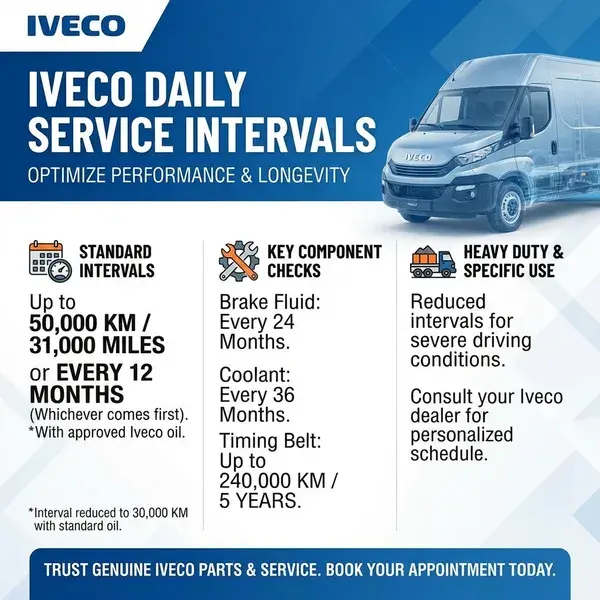
Iveco Daily Service Intervals
Iveco Daily Service Intervals: Essential
The Iveco Daily service intervals leads the van sector with reaching 60,000 kilometers (37,000 miles), setting new standards in maintenance efficiency. Daily owners need to learn about proper maintenance timing with the complete five-year, 100,000-mile warranty and service intervals of 25,000 miles. Source 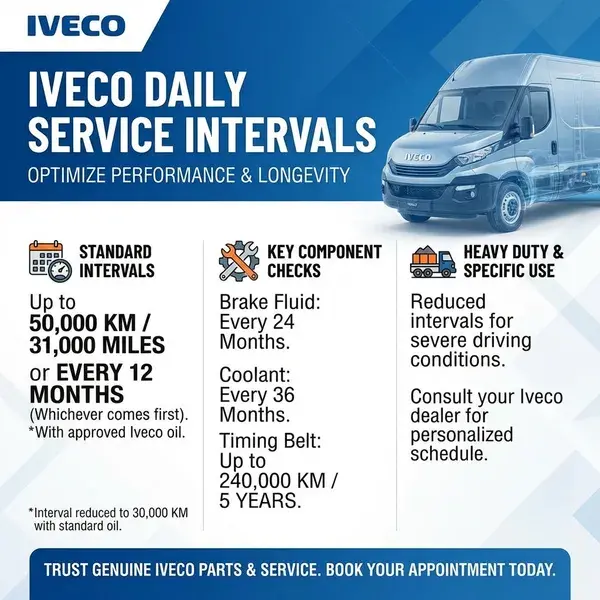
The 2022 Iveco Vans model comes with better features that boost fuel economy by 6%. Its predictive maintenance technology warns owners before breakdowns happen. Daily owners can access a wide dealer network that operates extended hours and stays open on Sundays to make maintenance scheduling easier.
This Iveco Vans piece covers everything about maintenance procedures, common problems, and preventive steps to keep your Daily performing at its best. You’ll find detailed information to handle both routine service needs and specific issues that help maintain your vehicle properly. See all Iveco Minibus
Understanding Iveco Daily Service Intervals
Regular maintenance is the key to keeping your Iveco Daily running longer. The latest Daily models can go up to 50,000 kilometers between services, which gives you 20% more time on the road. This improvement comes from components that last longer and better consumables. See Iveco Canper Vans
Factory-recommended maintenance schedule
Your maintenance timing depends on the type of oil you use and how you drive. Vehicles with approved Iveco oil can run for 40,000 kilometers between services, while those with standard oil need service every 30,000 kilometers. The service includes oil changes, new filters, and detailed system checks. These longer service intervals help owners save 12% on maintenance and repair costs. See Iveco Daily Vans for sale
Service indicator lights and warnings Iveco Daily Service Intervals
The Electronic Diesel Control (EDC) system helps diagnose problems. When the EDC light comes on, it could be one of 4,000 different issues. The system also has these warning lights: See Iveco Daily Dropside
- Engine oil warning light – Shows when you need an oil change or have oil dilution problems
- Yellow engine-shaped light – Points to environmental issues
- Red EDC circle – Warns about problems that could damage your engine
Iveco daily service reset procedures
You’ll need to follow these steps to reset the service indicators after maintenance:
- Turn ignition to ON position (engine off)
- Press accelerator pedal fully for 15 seconds
- Pump brake pedal 10 times with one-second intervals
- Turn off ignition
- Wait five seconds before restarting
This reset works for the service interval counter. But if your vehicle has particulate filters, you’ll need to visit an authorized service center to reset the regeneration counter. This prevents filter clogging and keeps your engine running at its best. See Iveco Tipper
Essential Fluid and Filter Maintenance Iveco Daily Service Intervals
Your Iveco Daily’s reliability depends on proper fluid maintenance. Understanding the right specifications and service intervals will give your vehicle optimal performance and a longer life. See Iveco Daily Minibus
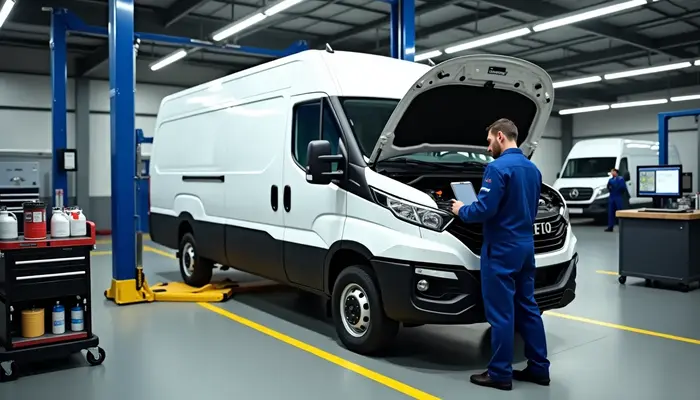
Engine oil change guidelines Iveco Daily Service Intervals
The Daily needs PETRONAS URANIA DAILY FE 0W-30 engine oil that we developed to protect the engine better and save fuel. The engine needs 5.7 liters of oil. You can go 40,000 kilometers between services when using Iveco-approved oils, while standard oils require changes at 30,000 kilometers. You must change the oil yearly if you drive less than 40,000 kilometers annually. See Iveco Daily Dimensions
Iveco daily fuel filter replacement intervals
Your common rail injection system needs proper fuel filtration to stay protected. Both the fuel filter and pre-filter need yearly replacement. Vehicles running in tough conditions might need more frequent changes based on what the clogging indicator shows. Winter operations need extra attention – check the transparent pre-filter reservoir for water buildup after each trip. See Iveco Camper Van
Coolant and brake fluid maintenance Iveco Daily Service Intervals
A systematic approach to fluid maintenance keeps your systems running smoothly:
- Coolant System:
- Total capacity: 9 liters
- Change interval: Every 36 months
- You need yearly level and concentration checks
- Brake Fluid:
- System capacity: 1.11 liters
- DOT 4 Synthetic specification required
- Replace every 24 months
Bleeding the cooling system regularly stops air from building up that could cause poor coolant flow and damage your engine. Your hydraulic brake system needs checking every 40,000 kilometers or 12 months. See Iveco Daily Luton
Critical Component Inspections Iveco Daily Service Intervals
Your Iveco Daily needs well-maintained critical components to run safely and perform at its best. Regular inspections will prevent unexpected breakdowns and make your vehicle last longer. See Iveco Vans For Sale
Brake system maintenance and replacement
You should check the braking system thoroughly every 30,000 kilometers. The system has several components that need regular checks:
- ABS sensors and rings
- Brake disk covers and calipers
- Pad wear sensors
- Master cylinders
- Vacuum tanks
- Brake cables
The upgraded braking system comes with tougher brake pads that boost efficiency and last longer. You’ll need to replace brake pads when the wear indicator alerts you or after driving 50,000 kilometers. See Iveco Daily 4×4
Starter motor and electrical system checks Iveco Daily Service Intervals
The starter motor needs extra care because it sits in a tricky spot under the engine. Getting to this component isn’t simple – you’ll need a step-by-step approach: See Iveco Daily Dimensions
Start by draining the radiator and disconnecting electrical connectors for indicators and headlamps. Then remove the turbo pipe and alternator, followed by the exhaust downpipe. The smart EcoSwitch PRO system keeps track of vehicle load and adjusts power automatically for the best performance. See Iveco Daily Vans for Sale
To check the electrical system, start with battery voltage (it should be at least 12.6V). Look at ground connections between battery, chassis, and engine, as bad grounding can cause many electrical problems. The Body Control Module (BCM) runs various electrical systems, including lights and door locks. See Iveco Daily 4×4
Transmission and drivetrain maintenance
Automatic transmissions need oil changes more often than manual ones – every 60,000 kilometers compared to 250,000 kilometers for manual transmissions. The HI-MATIC transmission gives you better safety and a more comfortable drive. See all Iveco Daily vans for sale
With automatic transmissions, keep an eye on the oil color – reddish means it’s good, while darker colors mean you should change it. Here’s how to maintain the transmission:
- Drain the oil
- Remove transmission pan
- Replace filter and gasket
- Refill transmission
- Run through gears
- Check fluid levels again
Your driveline will last longer if you maintain proper engine and transmission speeds. Regular checks help prevent transmission problems and keep gear changes smooth.
Common Problem Prevention Iveco Daily Service Intervals
Your Iveco Daily needs systematic maintenance and quick action to prevent common problems. Understanding warning signs early helps you avoid repairs that can get pricey and keep your vehicle off the road.
Avoiding iveco daily overheating problems
A bad thermostat usually causes overheating problems and drives up operating costs. The coolant system maintenance should include:
- Proper coolant quality and level checks
- Thermostat condition inspections
- Replacement at manufacturer-recommended intervals
- Quality replacement parts
- Regular technical inspections
Air trapped in the cooling system blocks proper coolant flow and causes engine overheating. You should bleed the cooling system if you notice high coolant use or the cabin getting too hot.
Managing handbrake problems effectively
Seized mechanisms cause most handbrake problems, so regular maintenance keeps them working properly. The handbrake needs service every 18 months. Here’s what to do with stuck handbrakes:
- Remove the wheel to access the caliper
- Disconnect the handbrake cable
- Work the lever back and forth with penetrating oil
- Apply copper grease where the lever enters the caliper
- Reconnect components and adjust tension
Replacing handbrake cables costs nowhere near as much as replacing the entire caliper. The system needs inspection right after you notice more lever travel or less holding power to prevent complete failure.
Addressing semi auto transmission issues Iveco Daily Service Intervals
Semi-automatic transmission problems demonstrate specific warning signs. Watch for these signs that show your transmission control module needs attention:
- Transmission jumping to neutral
- Service gearbox messages appearing
- Erratic shifting behavior
- Loss of gear engagement
Start diagnostic work by checking transmission fluid levels and looking for damaged wiring harnesses. Transmission problems usually come from:
- Faulty sensors affecting gear position detection
- Transmission Control Module (TCM) malfunctions
- Solenoid or valve body problems
- Mechanical wear in clutches or gears
Transmission problems can restrict your vehicle to only first through fourth gears until fixed. Professional diagnostic scanning helps identify specific error codes and shows what repairs you need.
Emergency Repairs and Troubleshooting
Your Iveco Daily needs quick diagnosis and proper emergency response to minimize downtime. We identified issues accurately by knowing simple troubleshooting procedures and determined the right action steps.
Simple diagnostic procedures
A compatible scanning tool connects as the first diagnostic step. Generic OBD scanners give simple readings, but Iveco vehicles need specific diagnostic tools for detailed analysis. The Maxi-ECU scanner reads fault codes and monitors live data.
To diagnose accurately:
- Check battery voltage (minimum 12.6V required)
- Look at ground connections between battery and chassis
- Check the fuel system for leaks or restrictions
- Look for air bubbles in fuel lines
- Check electrical connections and fuses
Essential emergency repair kit
Emergency kits are a great way to get help during roadside breakdowns. Yes, it is true that Iveco Daily needs specific tools and equipment to work for emergency repairs. Your kit should have:
- Digital battery tester for power system checks
- Simple hand tools for minor repairs
- Tire repair kit with sealant
- Warning triangle and high-visibility vest
- Emergency fuel filter
- Replacement fuses
- Simple diagnostic tool
Tire repair kits show mixed results. Success rates change based on puncture type and location. A proper spare wheel gives more reliability for tire-related emergencies.
When to seek professional help Iveco Daily Service Intervals
Some situations need professional assistance. Iveco Assistance Non-Stop program runs 24/7 and gives emergency support through their Customer Center. You need professional help especially when you have:
- Engine management system failures
- Transmission control issues
- Complex electrical problems
- Fuel system malfunctions
- Safety-critical component failures
Before calling assistance, keep this information ready:
- Vehicle documentation details
- Precise location information
- Nature of the breakdown
- Any warning lights or messages displayed
The Customer Center gives you a unique file number to track assistance status on the web. They work with the nearest Iveco center to ensure quick response and proper technical support for your vehicle.
Professional diagnostic services employ advanced tools like Iveco Easy that offer detailed fault analysis and coding capabilities. Notwithstanding that, you can do some simple repairs on your own if you have proper tools and knowledge.
Conclusion Iveco Daily Service Intervals
Your Iveco Daily’s reliability and longevity depend on proper maintenance. This piece covers everything you need to know about keeping your Daily performing at its best, from simple service schedules to emergency repairs.
Your vehicle performs better when you follow maintenance schedules, especially when you have extended 50,000-kilometer intervals. Critical systems stay protected through proper fluid maintenance and regular engine oil changes with fuel filtration. The vehicle’s life extends further when you systematically check brakes, electrical systems, and transmission components. This prevents unexpected breakdowns.
Prevention of common problems matters just as much. You can avoid repairs that get pricey by maintaining the cooling system, caring for the handbrake, and monitoring the transmission. Quick responses during unexpected situations come from emergency repair guidelines and troubleshooting steps we discussed above.
Your Daily gets complete support through this integrated maintenance approach and Iveco’s large dealer network with 24/7 assistance program. Your Daily’s performance, reliability, and value will stay strong throughout its service life when you follow these guidelines.
FAQs Iveco Daily Service Intervals
Q1. What is the recommended service interval for an Iveco Daily? Iveco Daily models have extended service intervals of up to 50,000 kilometers (31,000 miles). However, the exact interval depends on the type of oil used. Vehicles using approved Iveco oil can maintain 40,000-kilometer intervals, while those using standard oil require service at 30,000 kilometers. It’s recommended to service your Daily at least once a year if the annual mileage is less than the maximum interval.
Q2. What are some common issues with Iveco Daily vehicles? Common issues with Iveco Daily vehicles include faulty injectors, particularly in older models, warning light malfunctions, door reflector problems, and electrical system issues. Additionally, owners should be aware of potential overheating problems, handbrake mechanism seizures, and semi-automatic transmission complications. Regular maintenance can help prevent or address these issues early.
Q3. How long can an Iveco Daily last? An Iveco Daily can potentially last up to 268,000 miles (431,000 kilometers) before reaching its upper life expectancy limit. However, the actual lifespan of the vehicle depends on various factors such as maintenance regularity, driving conditions, and usage patterns. Proper care and timely servicing can significantly extend the vehicle’s operational life.
Q4. How do you reset the service light on an Iveco Daily? To reset the service light on an Iveco Daily, follow these steps: Turn the ignition to ON position (engine off), press the accelerator pedal fully for 15 seconds, pump the brake pedal 10 times with one-second intervals, turn off the ignition, and wait five seconds before restarting. This procedure resets the service interval counter. For vehicles with particulate filters, the regeneration counter must be reset at authorized service centers.
Q5. What should be included in an emergency repair kit for an Iveco Daily? An essential emergency repair kit for an Iveco Daily should include a digital battery tester, basic hand tools for minor repairs, a tire repair kit with sealant, a warning triangle, a high-visibility vest, an emergency fuel filter, replacement fuses, and a basic diagnostic tool. It’s also advisable to carry a proper spare wheel for more reliable tire-related emergency solutions.