Ford Transit Van Warning Lights
Ford Transit Van Warning Lights: What Lights Mean
Ford Transit Van Warning Lights. Your Ford Transit warning lights work as its communication system. Critical brake system indicators alert you about worn brake pads. Engine management alerts prevent severe mechanical damage. Each dashboard symbol provides vital information about your vehicle’s health. Warning lights like engine coolant overheating or oil pressure can get pricey if ignored. This detailed guide explains every warning light on your Ford Transit dashboard and shows you the right way to respond to each alert. See all Ford Transits
Understanding Ford Transit Dashboard Warning Systems
Ford Transit Van Warning Lights. The instrument cluster in Ford Transit vans works as a sophisticated communication system between the vehicle and driver. The vehicle runs a quick check at startup, and various warning lights light up briefly to check if everything works properly. See all Ford Transit Vans for sale
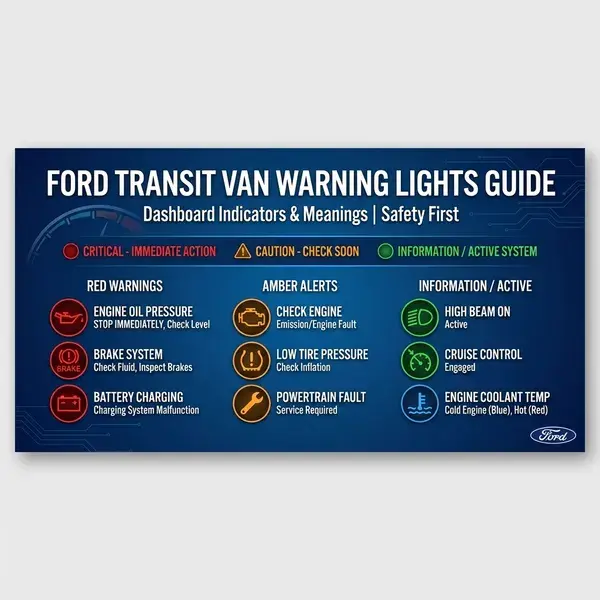
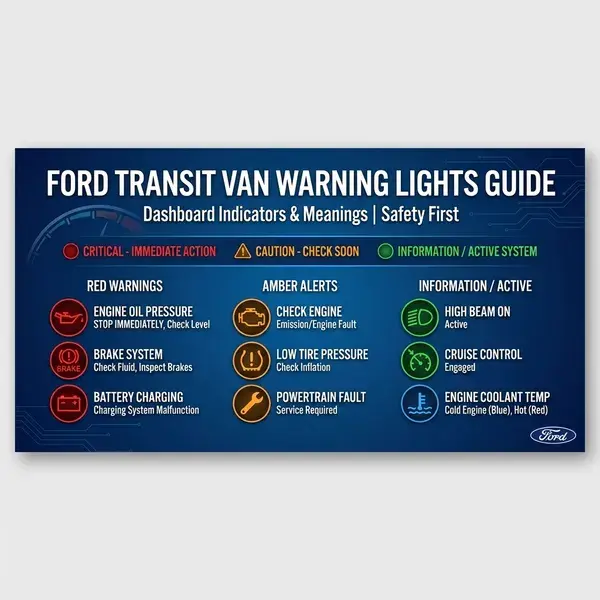
Traffic Light Colour System Explained Ford Transit Warning Lights
Ford Transit Van Warning Lights. Ford Transit’s warning system uses a simple colour-coding scheme that helps drivers quickly understand what’s happening. The system has three distinct levels:
- Green Indicators: Show that systems work properly or features are active
- Yellow/Amber Alerts: Point out problems that need attention but aren’t urgent
- Red Warnings: Just need immediate action and might require stopping the vehicle
Modern Ford Transit vans have sensors that monitor how every system behaves. On top of that, the message indicator lights up in red or amber based on how serious the problem is. See all Ford Van Lease Deals
Warning Light Display Patterns Ford Transit Warning Lights
Ford Transit’s warning lights show different patterns to tell drivers what’s happening. We noticed some warnings appear briefly during routine checks, while others stay on until someone fixes the problem. Some messages disappear automatically after a short time, but others need you to press the OK button to clear them. See Ford Transit Luton van
System-specific symbols usually appear next to message indicators to give you more details about what’s wrong. These patterns change based on how urgent the problem is, which helps drivers get clear, applicable information.
Digital vs Analogue Dashboard Differences
Ford Transit Van Warning Lights. The development from analogue to digital dashboards has changed how drivers see information. Modern Ford Transit vans with digital displays can show information in many different ways. These displays can show several things at once – from navigation directions to entertainment options and vehicle diagnostics.
Analogue gauges, though traditional, have their own benefits. Note that knowing how to track changes through physical motion makes it easier to spot differences in your side vision. Notwithstanding that, digital displays give more exact measurements, especially for speed, and can show information down to the smallest unit.
Digital clusters excel at showing lots of information at the same time. They also let you customise layouts and change their look based on different driving modes. Analogue clusters, however, can have problems with parallax errors and physical limits of gauge motors. See Ford Transit Tipper for sale
Critical Safety Warning Lights
Safety-critical warning lights in Ford Transit vans just need immediate attention and understanding. These indicators protect against what it all means of vehicle malfunctions that could compromise safety.
Brake System Indicators Ford Transit Van Warning Lights
The red brake warning light signals several issues that require quick attention. We noticed this indicator lights up when the driver engages the handbrake. The light staying on after releasing the handbrake points to low brake fluid levels, which is more concerning.
The brake warning system works through multiple components. Both ABS and brake warning lights lighting up together shows a serious brake system malfunction. Drivers might experience these problems:
- Brakes locking during operation
- Unbalanced brake response
- Reduced brake fluid reaching the callipers
The brake warning light activating while driving means you should keep your speed low and avoid sudden braking manoeuvres. Diagnostic equipment can identify specific issues when the light stays on, though it sometimes fails to connect with the ABS pump and module.
Airbag Warning Symbols Ford Transit Warning Lights
The airbag warning light, also called the Supplemental Restraint System (SRS) indicator, lights up when critical safety components need attention. This warning activates if any part of the airbag safety system fails, including:
- Faulty airbag module sensors
- Loose or damaged wiring connections
- Depleted airbag module battery
- Seatbelt pretensioner issues
The system’s self-check runs during each ignition cycle. The light goes out by itself if no fault exists, unlike other warning lights. The passenger airbag indicator’s centre panel should show ‘on’ or ‘off’ status clearly, and any deviation needs immediate attention.
Objects placed on the seat or sensor malfunctions can trigger the airbag warning light in Ford Transit vans with passenger seat sensors. The seatbelt pretensioner can also trigger this warning if it gets damaged or malfunctions. See Ford Transit 4×4
An illuminated airbag warning light means the entire system becomes inactive. Vehicle safety gets compromised substantially since airbags might not deploy during an accident or could deploy unexpectedly. You need professional inspection because airbag systems require specialised diagnostic tools and expertise to assess and repair properly. See Ford Transit 350
Engine Management Warning Lights
Ford Transit vans use warning lights to alert drivers about mechanical problems through specific patterns and colours.
Check Engine Light Scenarios Ford Transit Van Warning Lights
The check engine light, also called the engine management light, shows different patterns based on how serious the problem is. A steady amber light points to a non-urgent problem that you should check, while a flashing light signals serious issues such as engine misfire.
Your engine management warning could light up because of:
- Broken electrical sensors or components
- Problems with emission control systems
- Issues with the catalytic converter
- Problems in the fuel system
The check engine light’s flash could mean unburned fuel is leaking into your exhaust system. You risk permanent engine damage if you keep driving while this warning light flashes.
Engine Temperature Warnings
Several indicators make up the engine temperature warning system. A yellow thermometer icon shows low coolant levels, while a red warning needs immediate action. Steam coming from under your hood with the temperature warning means you should: Is the Ford Transit Gearbox Any Good?
- Pull over safely right away
- Let the engine cool down naturally
- Look at coolant levels after the engine cools
- Check the system for any visible leaks
Coolant leaks or serious problems like head gasket failure could trigger the temperature warning. Your engine could suffer major damage if you drive with an active red temperature warning.
Oil Pressure Alerts
The oil pressure warning appears if oil gets too hot or pressure drops too low. This warning needs quick attention because low oil pressure can seize your engine.
The oil pressure warning means you should check:
- The ground under your vehicle for oil leaks
- Oil levels with the dipstick
- Oil for signs of contamination
- The engine for strange noises
Your oil pressure warning might signal various problems, from low oil to faulty oil pumps. The vehicle needs an immediate oil change if both oil pressure and engine warning lights come on together. See 100,000 miles in a Ford Transit
Transmission and Drivetrain Alerts
Warning lights in Ford Transit vans give us vital information about gearbox health and drivetrain performance. These indicators help us avoid getting pricey repairs by catching problems early. See All Ford Transit Tipper
Gearbox Warning Indicators Ford Transit Warning Lights
The automatic transmission warning light usually comes on for two main reasons: the transmission fluid gets too hot or runs too low. The van might switch to ‘safe’ mode at the time this happens, which cuts back performance to protect the gearbox.
You might see these transmission-related messages on your dashboard:
- Transmission Malfunction Service Now (Red): You’ll just need to get it checked by a professional right away
- Transmission Over Temperature (Amber): Your transmission is overheating and needs to cool down immediately
- Transmission Limited Function (Amber): The system has restricted functionality and needs service
The transmission warning might pop up at the time you’re driving uphill or pushing hard on the gas, and the vehicle could go into ‘limp home’ mode. This safety feature keeps your transmission from complete failure by limiting performance.
Differential System Lights Ford Transit Van Warning Lights
A yellow spanner symbol shows up as the powertrain warning lamp to signal problems with your engine, transmission, or drivetrain parts. You should pay attention to this warning when:
- The light stays on while you’re driving
- It starts flashing during your trip
- Your vehicle suddenly changes how it performs
You can still drive with a lit powertrain light, but you’ll need to be extra careful. The warning could point to several mechanisms, from sensor issues to mechanical problems in the differential system.
The control module might be acting up if you see the powertrain fault along with transmission warnings. You’ll often hear harsh thudding or clunking noises during gear changes – these usually mean the valve body is wearing out.
Automatic transmission vans often show signs like hesitation or trembling during gear changes before the warning light turns on. Keeping an eye on these physical signs and your dashboard helps catch developing problems before they turn into major mechanical failures.
Fuel and Emissions Warning Lights
Fuel and emission warning lights in Ford Transit vans help prevent engine damage and keep performance at its best. These indicators monitor your fuel levels, emission control systems, and the status of your particulate philtre.
Low Fuel Warnings
The low fuel warning system kicks in when your tank hits 10% to 15% of its capacity. You’ll see a steady amber light that starts to flash as fuel levels become critical. Your Distance to Empty display shows an estimated range that changes based on how you drive.
Highway driving might trigger the low fuel alert with up to 80 miles left in the tank. The warning comes on much earlier if you’re towing or idling a lot – around 35 miles of range. Once your warning light starts to flash, you need to find a fuel station quickly to protect your engine.
AdBlue System Alerts Ford Transit Warning Lights
Ford Transit vans use an AdBlue system to control emissions through the Selective Catalytic Reduction (SCR) system. The system shows warnings in different stages:
- System malfunction alerts
- Distance-to-no-restart warnings
- Service required notifications
These warnings usually pop up because of low AdBlue fluid or problems with the SCR system. Your warning light stays on even with a full AdBlue tank if sensors fail or crystallisation happens. You’ll need professional diagnostic equipment to reset the system and clear those stubborn warnings.
DPF Warning Lights
The Diesel Particulate Philtre (DPF) warning light tells you when your philtre needs cleaning or maintenance. This warning light might come on because of:
- Blocked philtre requiring regeneration
- Failed temperature or pressure sensors
- Faulty exhaust gas recirculation valve
- Wrong oil type usage
The DPF warning appears and you can usually fix it by driving above 40mph for 10 to 15 minutes to start the regeneration process. Sometimes the warning light comes on without a blocked philtre, which points to other issues like sensor problems.
Your DPF system cleans itself during normal driving. Professional cleaning becomes necessary if regular regeneration doesn’t work. Ignoring DPF warnings is a big deal as it means that your philtre might block completely, which leads to poor engine performance and potential MOT failure.
Regular motorway driving helps keep your DPF in good shape. The system needs the right conditions to complete its regeneration cycle, which happens during sustained high-speed driving. Poor DPF maintenance leads to restricted performance and higher repair costs.
Battery and Electrical System Indicators
The electrical system in Ford Transit vans uses advanced monitoring circuits to detect voltage fluctuations and charging issues. These warnings appear on the instrument cluster through specific patterns and symbols.
Charging System Warnings
A red battery symbol with positive and negative terminals serves as the battery warning light to indicate charging system problems. The Engine Control Module activates this warning when it doesn’t detect proper field current from the alternator.
A healthy battery should maintain 12.6 volts or higher. These voltage readings show different battery conditions:
- 12.8V with engine off indicates proper charge
- 14.9V with engine running shows normal charging
- 12.4V or lower signals recharging needed
- 10.5V whilst running suggests alternator failure
The battery warning light might light up while driving even with normal voltage readings. This happens because of problems in the sensing circuit or damaged wiring connections. White or green deposits on battery terminals can trigger these warning lights.
Alternator Alert Meanings
The “Battery System Service Now” message usually shows up as the alternator warning. This alert can flash on and off or stay lit based on what’s causing the problem. A bad alternator stops proper battery charging and lets the vehicle run only until the battery dies.
Several things can trigger alternator-related warnings:
- Damaged alternator belt
- Loose electrical connections
- Corroded battery terminals
- Failed one-way drive clutch
Alternator problems often start as occasional warnings that happen more often as time passes. Sometimes the warning might show up 20 times during a six-hour trip. The system keeps track of voltage output all the time and triggers alerts when readings bounce between 10V and 13V.
Bad repairs or wrong alternator replacements can make warning lights stay on. Aftermarket parts sometimes don’t work well with the van’s computer system. The charging system warning light connects straight to the alternator through its own wiring, just like older generator warning systems.
The three-pin multi-plug connector needs checking if the battery light stays on after replacing the alternator. Broken wires in this connector, especially the red one, can keep triggering warnings even with a working alternator.
Driver Assistance Warning Lights Ford Transit Van Warning Lights
Driver assistance systems in Ford Transit vans use advanced monitoring technology to prevent accidents and keep vehicles stable. These systems connect through sensors and electronic controls that give immediate feedback through dashboard warning lights.
ABS System Indicators
Ford Transit Van Warning Lights. The Anti-lock Braking System (ABS) warning light is a vital safety indicator. The light suggests a potential fault in the ABS components when it lights up during normal driving. The standard brakes work fine, but the anti-lock feature stops working. This affects vehicle control during emergency braking.
Several issues can trigger the ABS warning light:
- Damaged wheel speed sensors
- Faulty ABS pump components
- Corroded electrical connections
- Malfunctioning control module
Ford Transit Van Warning Lights. A diagnostic scan shows specific fault codes stored in the ABS control module. The light might also turn on briefly during self-checks when you start the vehicle. It turns off once the system confirms everything works properly.
Traction Control Lights Ford Transit Van Warning Lights
Ford Transit Van Warning Lights. The Ford Transit Warning Lights Traction Control System (TCS) warning light shows up as a car symbol with wavy lines. The system watches for wheel spin and applies brake pulses to individual wheels automatically. You’ll see the warning light flash when the system kicks in to control traction.
The system displays warnings in these situations:
- Active control on slippery surfaces
- System turns off (manually or automatically)
- Sensor problems
- Modules stop communicating
Most persistent traction control warnings come from problems in the Engine Control Module, ABS system, or Transmission Control Module. Software updates can fix certain warning light issues, especially when modules briefly lose communication.
ESP Warning Meanings Ford Transit Van Warning Lights
Ford Transit Van Warning Lights. The Electronic Stability Programme (ESP) warning light points to possible stability control issues. This advanced system combines sensors from anti-lock braking and traction control to keep the vehicle stable. Roll Stability Control watches driving conditions and triggers ESP if there’s a risk of rollover.
ESP warnings show up in different ways:
- Light flashes during active control
- Solid light means system fault
- Warnings appear with other systems
Ford Transit Van Warning Lights. The ESP system needs all its components to work properly. Wheel speed sensors track individual wheel speeds, and the steering angle sensor tells the system what the driver wants to do. Problems with these parts often trigger ESP warnings.
Regular diagnostic checks help find specific issues when ESP warnings appear. The system might limit its performance until repairs are done, which affects how the vehicle handles. You need professional diagnostic equipment to accurately find ESP-related faults because standard OBD scanners can’t access all the data.
Maintenance Required Indicators Ford Transit Van Warning Lights
Ford Transit vans have warning lights that show when service is needed and oil changes are due. These systems give vital alerts that help you keep your van running at its best through timely maintenance.
Service Due Lights Ford Transit Van Warning Lights
A spanner symbol appears on the dashboard when service is required. This warning light turns on based on how many miles you’ve driven and how long the engine has been running. The system tracks several maintenance items:
- Engine oil condition
- Philtre replacements
- General vehicle health checks
- Brake system inspections
The service warning might turn on without warning if there are mechanical problems. You’ll need professional diagnostic tools to find the exact issue. The warning system Ford Transit Van Warning Lights uses advanced circuits to monitor how you use your vehicle and track parts wear.
Your Ford Transit will run better and hold its value when you follow the scheduled service programme. Vans under three years old benefit most from manufacturer-recommended service intervals. A professional service has detailed health checks of:
- Wheels and tyres
- Brake components
- Bodywork condition
- Steering mechanisms
- Suspension systems
- Headlight operation
- Wiper blade condition
- Fluid levels
- Philtre conditions
Oil Change Indicators Ford Transit Van Warning Lights
Advanced sensors in Ford Transit van warning lights monitor oil life. Some models display specific messages about oil change needs. You must reset the system after each oil service to ensure accurate monitoring.
Oil Change Reset Procedure:
- Switch ignition on without starting engine
- Press accelerator and brake pedals simultaneously
- Hold pedals for three seconds until reset message appears
- Continue holding for 25 seconds until completion message displays
- Release pedals and switch ignition off
The oil warning light might come on with a spanner symbol to show immediate service is needed. Driving with active oil warnings can damage your engine due to poor lubrication. Regular oil changes offer several benefits:
- Better fuel economy (up to 3% boost)
- Longer engine life
- Lower CO2 emissions
- Protected manufacturer warranty
The oil life monitor checks various factors that affect oil condition. The system might trigger warnings before scheduled intervals based on:
- Driving conditions
- Temperature variations
- Engine load patterns
- Trip lengths
Ignoring maintenance warnings can reduce performance and void your warranty. Using the wrong oil type or skipping changes increases CO2 emissions and shortens engine life. You can find detailed information about recommended maintenance intervals in your owner’s manual or FordPass account.
Professional service ensures the use of Ford Original Equipment parts to keep your vehicle reliable. Regular health checks during scheduled service help catch problems early. Good maintenance keeps your van running well and helps you avoid repairs that can get pricey through early detection of wear.
Conclusion Ford Transit Van Warning Lights
Ford Transit warning lights are the foundations of safe and efficient vehicle operation. A simple traffic light colour system helps drivers quickly assess any situation that needs attention. Red lights just need immediate action, amber ones point to developing problems, and green indicators show everything works properly.
Critical Ford Transit Van Warning Lights about brakes and airbags protect your vehicle and everyone inside. Engine management lights help prevent mechanical damage, especially when you have flashing signals that indicate serious issues. You can avoid pricey repairs when transmission alerts catch potential problems early.
Your vehicle’s fuel, Ford Transit Van Warning Lights emissions, and electrical system warnings work in harmony. They keep performance at its best and prevent parts from getting damaged. AdBlue and DPF warnings are crucial for diesel vehicles to meet emission standards and protect key components.
A smart maintenance tracking system will give you timely service reminders to extend your vehicle’s life and keep it reliable. Paying attention to warning lights and following scheduled maintenance helps you dodge expensive repairs and maintain resale value. This detailed warning light system acts as a vital link between your vehicle and you to keep Ford Transit vans running safely and efficiently.
FAQs Ford Transit Warning Lights
Q1. What do the different colours of warning lights on a Ford Transit dashboard signify? The Ford Transit uses a traffic light colour system for warning lights. Green indicates proper functioning or active features, yellow/amber suggests issues requiring attention but not immediate action, and red demands immediate response and potential vehicle stoppage.
Q2. What should I do if the check engine light starts flashing on my Ford Transit? If the check engine light is flashing, it indicates a severe problem such as engine misfire. You should reduce speed immediately and have your vehicle inspected as soon as possible. Continuing to drive with a flashing warning light risks causing irreparable damage to your engine.
Q3. How often should I service my Ford Transit? Ford Transit vans have a sophisticated maintenance tracking system that activates a service warning light based on mileage intervals and engine running hours. It’s best to follow the manufacturer’s recommended service intervals, which are typically more frequent for vehicles under three years old. Regular servicing helps maintain optimal performance and preserve resale value.
Q4. What does the DPF warning light mean on a Ford Transit? The Diesel Particulate Philtre (DPF) warning light indicates that the philtre requires cleaning or maintenance. This could be due to a blocked philtre needing regeneration, sensor issues, or other related problems. If the light appears, try driving at speeds over 40mph for 10-15 minutes to initiate the regeneration process.
Q5. How can I reset the oil change indicator on my Ford Transit? To reset the oil change indicator, switch the ignition on without starting the engine, then press the accelerator and brake pedals simultaneously for about 25 seconds until you see a reset confirmation message. This should be done after each oil change to maintain accurate monitoring of oil life.