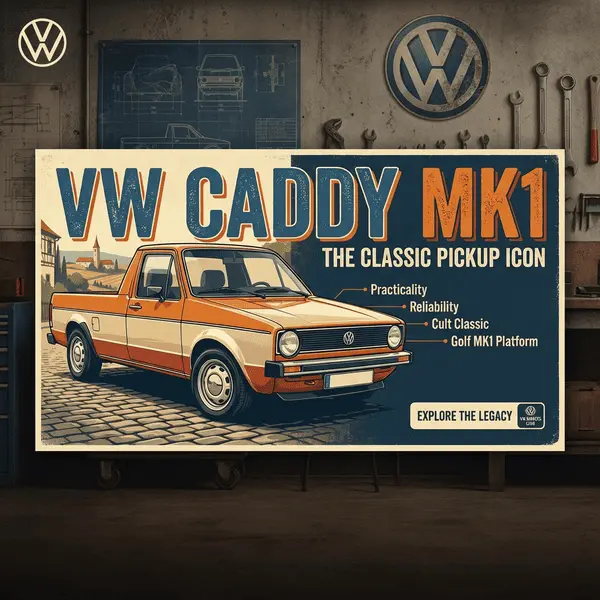
VW Caddy MK1
The Original VW Caddy That Started a Classic Legacy
The Volkswagen Caddy Mk1 has been a staple in the commercial vehicle market for decades, evolving from its humble beginnings as the VW Caddy Mk1. This versatile van has seen significant changes over the years, adapting to the needs of businesses and families alike. Its journey from a simple utility vehicle to a modern, multi-purpose transport solution reflects the changing demands of the automotive industry and consumer preferences. Source 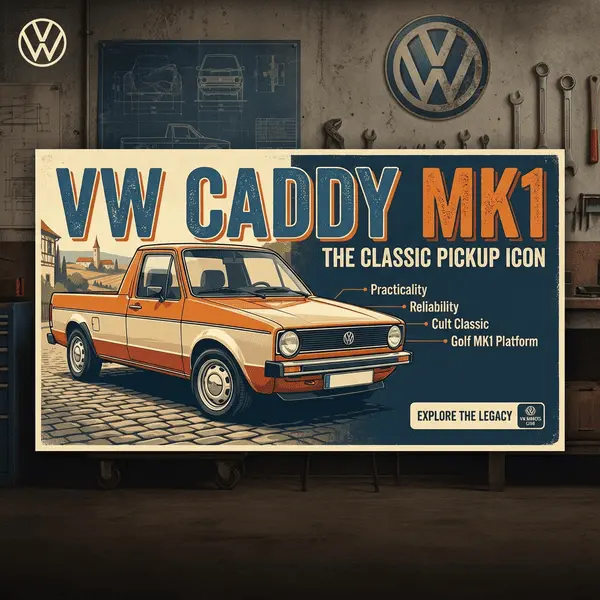
Throughout its history, the VW Caddy has gone through several generations, each bringing new design elements and technological advancements. From the VW Caddy Mk2 to the latest VW Caddy Mk5, each iteration has built upon its predecessor’s strengths while addressing market trends. This article will explore the Caddy’s evolution, looking at its design changes, technological improvements, and market position from its inception to the present day, including recent models from 2014 to 2024. The cheapest way to buy is lease purchase or finance lease on the VW Caddy.
The Birth of the VW Caddy
The story of the Volkswagen Caddy begins in an unexpected place, far from its eventual European home. This versatile vehicle, which has become a staple in the commercial vehicle market, has its roots in the United States during a time of significant change in the automotive industry. See all VW vans for sale
Ideal for collectors, enthusiasts and classic Volkswagen fans
The Caddy’s journey started in the late 1970s when Volkswagen of America was experimenting with derivatives of the popular Golf model. Among these experiments were an estate version and a pickup truck with a 1.83-meter-long (6.0 ft) bed. This experimentation came at a crucial time, as the automotive industry was grappling with the effects of the Oil Crisis. Volkswagen saw an opportunity to create a practical, fuel-efficient vehicle that could meet the changing needs of American consumers. See all VW Caddy for sale
The Rabbit Pickup VW Caddy MK1
Volkswagen’s American division showed particular interest in the pickup concept. As a result, the company released the Volkswagen Rabbit Pickup in North America. Production of this new vehicle began in 1978 at the Volkswagen Westmoreland Assembly Plant in Pennsylvania. The first models under the name Rabbit Pickup were sold in the United States in late 1979 for the 1980 model year, slightly delayed from a planned spring 1979 rollout. See all VW Caddy Lease Deals
The Rabbit Pickup was designed to be a practical, no-frills answer to the Oil Crisis. It was nine inches longer than the standard Rabbit hatchback, with the tail lopped off at the B-pillar and the wheelbase extended to accommodate the small pickup bed at the rear. Despite its humble hatchback underpinnings, the Rabbit Pickup had impressive hauling capabilities, able to carry up to almost 500 kilograms on its six-foot bed. See VW Caddy Kombi Vans for sale
Volkswagen offered the Rabbit Pickup with various trim packages, including the highly-desirable Sportruck option. Around 500 Sportruck editions were produced, distinguished by special features such as Sportruck side-stickers, unique wheel rims, an upgraded color-coordinated interior with brushed aluminum trim, bucket seats, and a steering wheel borrowed from the Mk1 Scirocco.
European Introduction VW Caddy MK1
The concept of the compact pickup made its way to Europe in 1982. Production started in Sarajevo, and it was at this point that the Caddy nameplate was first applied. Based on the Mk1 VW Golf, the European Caddy 1 retained the 1.83-meter-long loadbay, giving it good versatility for its size. One notable option for the European market was a tall fiberglass hardtop that effectively transformed the pickup into a small van.
The introduction of the Caddy to Europe marked a significant expansion of the vehicle’s market. While it had been designed initially for the pickup-dominated American market, its compact size and versatility proved equally appealing to European consumers and businesses.
Despite its eventual popularity, the original Rabbit Pickup was a relatively rare breed in the United States. Only 75,947 units were sold from its introduction in 1979 up to when VW stopped production in 1983. This number is remarkably low considering the Golf, upon which it was based, has sold over 35 million units since its launch six years prior.
The birth of the VW Caddy represents a fascinating chapter in automotive history. It demonstrates how a vehicle concept can evolve and adapt to different markets, from its origins as an American pickup to its transformation into a European commercial van. This versatility and adaptability have been key factors in the Caddy’s enduring success, with over three million models sold across four generations – including over 200,000 in the UK alone.
First Generation (Mk1) Caddy
The first generation Volkswagen Caddy, also known as the Mk1, made its debut in 1979. Based on the Volkswagen Group A1 platform, which it shared with the Volkswagen Golf Mk1, this versatile vehicle marked the beginning of a long-standing legacy in the commercial vehicle market.
Design and Features VW Caddy MK1
The Mk1 Caddy originated from Volkswagen of America’s experiments with Golf derivatives. Initially conceived as a pickup truck with a 1.83-meter-long (6.0 ft) bed, it was designed to be a practical, no-frills answer to the Oil Crisis. The vehicle was nine inches longer than the standard Golf hatchback, with the tail cut off at the B-pillar and an extended wheelbase to accommodate the pickup bed.
In Europe, the Caddy nameplate was first applied in 1982 when production began in Sarajevo. The European Caddy 1 retained the 1.83-meter-long loadbay, offering good versatility for its size. One notable option for the European market was a tall fiberglass hardtop that effectively transformed the pickup into a small van. This fiberglass-reinforced plastic box cap increased the enclosed cargo volume to 2.65 m3 (94 cu ft), and it could also be used as a caravan with an appropriate in-bed unit.
The maximum interior width of the bed was 64.4 in (1,640 mm), and the rated payload was an impressive 1,100 lb (500 kg). This capacity made the Caddy a practical choice for both commercial and personal use.
Engine Options
The Mk1 Caddy was offered with a range of engine options to suit different markets and needs:
- In North America, two engines were available:
- 1.6L diesel engine producing 52 hp (39 kW)
- 1.7L petrol engine delivering 78 hp (58 kW)
- In Europe, the engine lineup included:
- 1.6 petrol engine (75 bhp)
- 1.6 diesel engine (54 bhp)
- 1.8 K-Jet fuel-injected engine (95 bhp)
The diesel engine came with a unique feature – a five-speed gearbox with the fifth gear, carrying a 0.76:1 ratio, labeled as “E” for “Economy”. This configuration contributed to impressive fuel efficiency. The EPA rated fuel consumption for the petrol engine with a four-speed manual at 23/32 mpg‑US (city/highway), while the diesel with a five-speed manual achieved 41/54 mpg‑US.
Market Reception VW Caddy MK1
The Mk1 Caddy found success in various markets, adapting to different needs and preferences. In North America, where it was known as the Volkswagen Rabbit Pickup, it competed with other compact pickups such as the Ford Courier, Datsun Truck, Toyota Hilux, Dodge Rampage, and Subaru BRAT. Despite its eventual popularity, the Rabbit Pickup was relatively rare in the United States, with only 75,947 units sold from 1979 to 1983.
In Europe, the Caddy quickly established itself as a versatile commercial vehicle. Production continued in Sarajevo until 1992 when it was interrupted by the Bosnian war. Interestingly, the original Caddy remained in production in Uitenhage, South Africa, from 1981 until 2007, alongside the first generation Golf (which was sold until 2009). This extended production run in South Africa gave the Mk1 Caddy a remarkable 29-year lifespan.
The global success of the first-generation Caddy is evident in its sales figures. Worldwide production of the Typ 14 Rabbit Pickup/Caddy totaled more than 207,000 vehicles, with 6,730 units sold in the UK alone. This success laid the foundation for future generations of the Caddy, cementing its position in the light commercial vehicle market.
Second Generation Caddy
Major redesign
The second-generation Volkswagen Caddy, introduced in 1995, marked a significant departure from its predecessor. Based on the Volkswagen Polo Mk3 platform, this new iteration represented a major redesign that transformed the Caddy from its pickup truck origins into a versatile light commercial vehicle. The Volkswagen Caddy Typ 9K, also known as the Volkswagen Polo Caddy, was designed by Volkswagen’s Spanish subsidiary SEAT and derived from the SEAT Ibiza 6K.
This new Caddy retained its versatility, offering multiple configurations to suit various needs. It was available as a pickup truck, panel van, and passenger van, catering to both commercial and personal use. The panel van version featured asymmetrical rear doors, providing easy access to the cargo area. With a cargo floor area of 2.6 m2 (28 sq ft) and a loading volume of 2.9 m3 (102 cu ft), the Caddy offered ample space for its size. The typical payload capacity was an impressive 550 kg (1,210 lb), depending on the specific drivetrain and market requirements.
New platforms
The second-generation Caddy was built on the Volkswagen Group A03 platform, which brought several improvements over its predecessor. This new platform allowed for enhanced safety features, reflecting the changing market demands. Standard safety equipment included a driver airbag, with a passenger airbag available as an option. Additionally, ABS and Volkswagen’s Electronic Differential Lock (EDL) were offered to improve handling and traction.
The EDL system, despite its name, was not a true differential lock. Instead, it used sensors to monitor wheel speeds and applied braking to a slipping wheel, effectively transferring power to the wheel with better traction. This innovative feature enhanced the Caddy’s performance in challenging driving conditions.
Expanded lineup VW Caddy MK1
The second-generation Caddy saw an expansion of its lineup to cater to diverse market needs. In 1996, Volkswagen introduced a rebadged Škoda Felicia Utility as the entry-level light commercial vehicle for the VWCV range. This variant, known as the Typ 9U Caddy, was built in Škoda Auto’s Kvasiny plant in the Czech Republic.
The success of the previous Caddy pickup with a hardtop led to the development of a high-roof ‘estate’ version, offering even more versatility. In 1997, Volkswagen launched the Caddy Family, marking the first generation of a Caddy MPV, which would later evolve into the Caddy Life.
Volkswagen also experimented with concept vehicles during this period. The 1995 Vantasy concept previewed a proper Caddy camper, showcasing the potential for leisure-oriented variants.
The second-generation Caddy was powered by a range of petrol and diesel engines, with power outputs ranging from 60 to 110 horsepower. By the end of its production run, it was available with Volkswagen’s efficient 1.9-liter TDI engine, further enhancing its appeal to cost-conscious buyers.
Production of the second-generation Caddy took place primarily at the Martorell factory of SEAT in Spain from 1996 to 2004. However, it continued to be manufactured in Argentina until 2008 for the Latin American market, extending its lifespan in certain regions.
The second-generation Caddy proved to be a commercial success, with a total of 520,000 units sold worldwide, including the SEAT and Škoda versions. In the UK alone, 26,089 units found homes, demonstrating its popularity in one of Europe’s key markets. This success laid the foundation for future generations of the Caddy, solidifying its position as a versatile and reliable commercial vehicle in Volkswagen’s lineup.
Third Generation: A Modern Makeover
The third generation of the Volkswagen Caddy, introduced at the end of 2003 at the RAI Commercial Vehicle Show in Amsterdam, marked a significant leap forward in design and functionality. Production of this new model, known as the Typ 2K, began in May 2004. This iteration shared 50% of its modules with the Volkswagen Golf Mk5 and Volkswagen Touran, indicating a move towards more car-like features and comfort.
Variant Introductions VW Caddy MK1
The Typ 2K Caddy introduced an expanded range of body sizes and configurations to cater to diverse market needs. The lineup included two main body sizes: “normal” and Maxi. These could be configured as:
- Panel Van
- Window Panel Van
- Kombi (a basic passenger version)
- Caddy Life (family version)
- Caddy Tramper or Caddy Life Camper (camping version)
The Caddy Life or Kombi could seat up to five passengers in two rows, while the Caddy Life Maxi or Kombi Maxi offered seating for up to seven in three rows. The Life version featured interior trimmings similar to a conventional five-seater wagon, whereas the Kombi was essentially a panel van with windows and seats.
The Caddy Panel grew in size compared to its predecessor, the Caddy Typ 9K. It measured 4,405 mm in length, 1,802 mm in width, and 1,833 mm in height, with a wheelbase of 2,682 mm. This increased size allowed for a payload of 750 kg and a loading volume of 3.2 m³.
In 2007, Volkswagen Commercial Vehicles unveiled the Caddy Maxi Life at the Frankfurt Motor Show.This people-mover version of the Maxi range was 470 mm longer than the standard Caddy, offering 4.2 m³ of loading space. The extended wheelbase measured 3,002 mm, with an increased rear overhang of 151 mm and additional space between the sliding doors and the rear axle. The payload capacity for commercial versions ranged from 800 kg to 810 kg.
Technological Advancements
The third-generation Caddy introduced several technological advancements that enhanced its appeal in the commercial vehicle market. Some key improvements included:
- Introduction of a 5-inch infotainment touchscreen in the center of the dashboard
- Upgraded 6.5-inch ‘Composition Media’ display option
- Improved build quality from the Polish factory
- Rectangular air vents replacing the previous circular design
Performance Improvements VW Caddy MK1
The Caddy’s performance saw significant enhancements with this generation. At the 2008 IAA (Hannover Motor Show), Volkswagen Commercial Vehicles introduced the all-wheel drive Caddy 4Motion range, paired with the 1.9 TDI engine and manual transmission. This addition improved the vehicle’s versatility and handling in challenging conditions.
In 2010, the Caddy underwent a facelift to align with Volkswagen’s new design language. Changes included a redesigned front with new headlights and grille from the Touran Mk2, similar to the Volkswagen Golf Mk6. This update not only refreshed the Caddy’s appearance but also brought it in line with the broader Volkswagen family design.
The engine lineup also saw improvements. The introduction of Euro6-compatible 2.0-liter TDI diesel engines replaced the previous 1.6-liter units. These new engines were offered in three states of tune, providing better performance and efficiency. The 102 PS unit, for example, offered a decent turn of speed with 250 Nm of torque, enough to tow a 1,300 kg braked trailer. It also delivered impressive fuel economy, with a combined cycle of 61.4 mpg and CO2 emissions of 120 g/km (NEDC figures).
Fourth Generation: The Present Day Caddy
The fourth-generation Volkswagen Caddy, introduced in 2015, represents a significant evolution in the popular compact van series. This iteration builds upon the success of its predecessor, which sold over 1.5 million units during its eleven-year production run. The latest Caddy aims to continue this legacy while introducing modern features and improvements.
Latest Features
The new Caddy impresses with its sharper design and clearly defined surfaces, giving it a more stylish and distinctive appearance. The redesigned front and rear, along with new lighting elements, contribute to its unmistakable character. While maintaining its functionality, the Caddy has gained a noticeable presence on the road.
One of the standout features of the fourth-generation Caddy is its enhanced safety offerings. Volkswagen has incorporated numerous driver assistance systems, setting a new standard in the urban delivery van segment. The ‘Front Assist’ surroundings monitoring system, including City Emergency Braking, automatically applies the brakes if an obstacle is detected at speeds below 30 km/h (19 mph). This feature aims to prevent collisions or reduce their impact.
Another notable addition is the Adaptive Cruise Control (ACC), available for the first time in a Caddy. This system is active at speeds of 0-160 km/h (0-100 mph) with DSG transmission or 30-160 km/h (19-100 mph) with a manual transmission. Using radar sensors, it monitors the distance and relative speed to vehicles ahead, adjusting the Caddy’s speed accordingly. When paired with DSG, the ACC can even bring the vehicle to a complete stop in traffic situations.
Electrification VW Caddy MK1
In response to the growing demand for eco-friendly vehicles, Volkswagen developed an electric version of the Caddy, dubbed the e-Caddy. Built in collaboration with electrification specialists ABT, this model aimed to compete with established electric vans like the Renault Kangoo ZE and Nissan e-NV200. However, plans for right-hand drive production were shelved due to the imminent arrival of a new Caddy model.
For those seeking improved fuel efficiency, the Caddy BlueMotion variant offers impressive performance. Through aerodynamic enhancements, revised gear ratios, low rolling resistance tires, and ECU remapping, this model achieves CO2 emissions of 104g/km and fuel economy exceeding 70 mpg.
Market Positioning VW Caddy MK1
The fourth-generation Caddy positions itself as a premium option in the compact van market. While not necessarily the most practical or cheapest option, it appeals to buyers who value Volkswagen’s brand image, build quality, and modern features. The Caddy competes with respected rivals such as the Fiat Doblo Cargo, Ford Transit Connect, and Mercedes Citan.
Volkswagen has acknowledged the strength of competition in the small van sector, particularly from the Citroen Berlingo, Peugeot Partner, Toyota Proace City, and Vauxhall Combo Cargo. These vehicles offer a compelling mix of practicality, refinement, fuel economy, technology, and value, pushing Volkswagen to continually improve the Caddy to maintain its competitive edge.
As the fourth-generation Caddy nears the end of its production cycle, Volkswagen is preparing to launch an all-new model in early 2021. This upcoming version, officially named the Volkswagen Caddy Cargo, will be based on the MQB platform used across the Volkswagen Group’s passenger car range. It promises to bring significant advancements in technology, driving dynamics, and overall refinement, setting a new benchmark in the compact van segment.
Conclusion VW Caddy MK1
The Volkswagen Caddy’s journey from a simple utility vehicle to a modern, multi-purpose transport solution showcases its remarkable adaptability over the years. Its evolution reflects the changing demands of the automotive industry and consumer preferences, with each generation bringing new design elements and technological advancements. The Caddy’s transformation from an American pickup to a European commercial van demonstrates its versatility and has been a key factor in its enduring success.
Looking ahead, the Caddy continues to push boundaries with its latest generation, offering enhanced safety features, improved fuel efficiency, and even electrification options. Its position as a premium option in the compact van market, competing with respected rivals, underscores its ongoing relevance and appeal. As Volkswagen prepares to launch an all-new model based on the MQB platform, the Caddy seems poised to maintain its significant role in the commercial vehicle landscape, setting new benchmarks in technology, driving dynamics, and overall refinement.
FAQs VW Caddy MK1
What is the historical background of the VW Caddy vans for sale?
The VW Caddy first made its appearance in North America in 1980 and later in Europe in 1982. The first two generations of the Caddy included a pick-up variant known as the coupe utility. Various other vehicles related to the VW Caddy are also produced by the Volkswagen Group. Buy on a VW Caddy Lease Deal
When was the VW Caddy Mk1 produced?
The first generation of the VW Caddy, known as Caddy Mk1, was manufactured from 1978 to 1992. During the 1980s, the Caddy was also available with caravan-style units that transformed it into a compact camper. Although production in Europe ceased in 1992, it continued in the South African factory in Uitenhage until 2007.
In which year did the VW Caddy undergo a major redesign?
The VW Caddy underwent a significant redesign starting from the year 2003. It was later joined by the Caddy Maxi in 2007 and received a facelift in 2010.
How does the new Caddy differ from the older models?
The new Caddy features a standard short wheelbase that is 73mm longer and has an overall length increase of 93mm compared to the older models. Additionally, there is a ‘Maxi’ version that offers an extra 215mm of space between the axles and a 138mm extended rear overhang.