Camping in a Ford Tourneo Custom: The Complete Camper Conversion Guide
Why the Ford Tourneo Custom Makes a Great Camper Base
The Ford Tourneo Custom has quietly become one of the most popular camper conversion bases in the UK, and for good reason. It sits in the sweet spot between compact car-derived vans and full-size motorhomes: big enough to sleep two adults comfortably and carry everything you need for a weekend away, yet small enough to use as an everyday family vehicle and to park in a standard bay. Unlike a panel van, the Tourneo Custom starts life as a passenger vehicle, which means it comes with proper side windows, carpeted interiors, factory soundproofing and rear heating — a huge head start when you're planning a camper build.
Ford's mechanical package is another big plus. The 2.0-litre EcoBlue diesel is well proven, parts and servicing are widely available at any Ford dealer, and the driving position feels closer to a large estate than a commercial vehicle. Add in the availability of automatic gearboxes, all-wheel-drive variants on some generations, and now a fully electric E-Tourneo Custom option, and you have a base that can suit almost any camping style — from Cornish surf trips to Highlands off-grid adventures.
Camper Ford Tourneo Custom: Popular Conversion Layouts
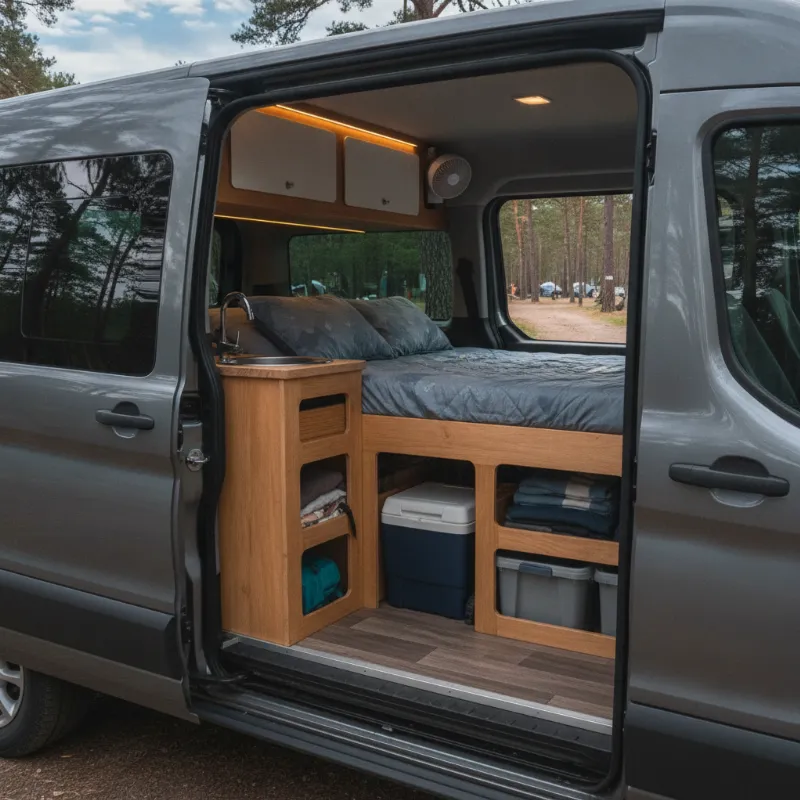
Because the Tourneo Custom is offered in both short-wheelbase (SWB) and long-wheelbase (LWB) formats, converters have developed a wide range of interior layouts to suit different trip lengths and family sizes. The most common approach mirrors the classic VW California layout: a rock-and-roll bed along the offside, a small kitchen unit behind the driver's seat, swivelling front seats to create a lounge, and either a fixed high-top or an elevating roof to sleep additional passengers.
SWB conversions typically prioritise everyday drivability, while LWB builds often add a fixed rear kitchen, a wet room, or even a small washroom cassette. Because the Tourneo comes with factory-fitted rear seat rails, many converters use compatible mounting points, which keeps the build both safer and easier to reverse if you ever want to return the vehicle to standard.
Rock-and-Roll Bed and Pop-Top Roof Options
A crash-tested rock-and-roll bed is the backbone of most Tourneo Custom campers. During the day it forms a rear bench seat with three-point belts for travelling passengers; at night it folds flat to create a double bed roughly 1.9m long and 1.1–1.2m wide. Look for beds that come with M1 certification and are bolted to reinforced floor plates — not every "camper" conversion on the used market meets this standard, and it matters both for insurance and for family safety.
Pop-top roofs from established brands such as SCA, Reimo and Skyline transform how usable the van feels. Standing height inside jumps from around 1.35m to over 2m, and most pop-tops include an upper double bed suitable for children or a slim adult. Elevating roofs preserve the low overall height of the standard Tourneo (usually under 2m), meaning you can still use height-restricted car parks, ferries and multi-storey garages without drama.
Kitchen Pods, Storage and Off-Grid Power
The kitchen is where a camper really earns its keep. In a Tourneo Custom you'll typically find either a fixed side kitchen with a two-burner gas hob, compressor fridge and sink, or a modular "pod" system that slides out when you're on site and leaves the boot area free during the week. Compressor fridges (usually 40–50 litres) run happily off a leisure battery and are far more effective than the three-way absorption fridges of older campers.
Off-grid power is where modern conversions have really moved on. A 100–200Ah lithium leisure battery, a 200–300W roof solar panel, a smart split-charge relay and a small pure sine wave inverter will let most couples wild camp for three or four days without hookup — running the fridge, lights, water pump, phone charging and a modest coffee machine. If you need more, larger battery banks and DC-to-DC chargers make extended off-grid trips genuinely practical.
Ford Tourneo Custom Camper Van: New vs Converted Base Vehicles
One of the biggest decisions when planning a Tourneo Custom camper is whether to start with a brand-new base vehicle and commission a bespoke conversion, or to buy an already-converted example on the used market. Both routes have their merits, and the right choice really depends on your budget, your patience and how personal you want the finished van to feel.
Starting With an All-New Ford Tourneo Custom
Beginning with a factory-fresh Tourneo Custom gives you complete control over the specification: engine, transmission, wheelbase, paint colour, trim level and every option box. You then hand the vehicle to a specialist converter who fits the layout you've designed together. The advantages are obvious — a full manufacturer warranty on the base vehicle, the latest safety and driver assistance kit, and a build that's tailored exactly to how you camp.
The trade-off is time and money. Lead times on new Tourneo Customs can stretch to several months, and a professional conversion typically adds another 8–16 weeks on top. You'll also want to check that the converter's work is covered by its own warranty and that any modifications don't compromise the Ford warranty on drivetrain and electrical systems.
Choosing the Ford Tourneo Custom Sport Van as a Camper Base
The Sport Van variant has become a particular favourite among camper builders. It combines a more powerful engine tune, sports suspension, body-coloured bumpers, twin bonnet stripes and larger alloy wheels — giving the finished camper a much more distinctive road presence than a standard fleet-spec Tourneo. Inside, the upgraded trim, heated seats and higher-end infotainment carry through into the living area, which really lifts the ambience on a wet evening in a campsite.
Sport models command a premium both new and used, but they also tend to hold their value better once converted, which is worth factoring in if you might sell the van on in a few years. If you want a camper that feels genuinely special every time you drive it, rather than a workmanlike box, the Sport is a strong starting point.
Buying, Leasing or Financing Your Tourneo Custom Camper
Funding a camper build is more complex than buying a standard car, because you're often paying for two things: the base vehicle and the conversion work. Outright purchase is the simplest route, but many buyers use hire purchase or a personal contract purchase agreement on the base van, then either pay cash for the conversion or roll it into a separate leisure loan.
Leasing an unconverted Tourneo Custom is possible, but be aware that finance and lease companies will usually not allow structural modifications during the agreement — meaning you'd need to wait until the vehicle is yours outright before commissioning a conversion. Specialist campervan finance providers have emerged in recent years and will fund the whole package (base vehicle plus professional conversion) as a single agreement, often with longer terms of five to ten years that keep monthly costs manageable. Whichever route you choose, get written quotes for insurance before you commit, as converted campers are rated very differently from standard passenger Tourneos.
Interior Space, MPG and Real-World Camping Practicality
On paper, the Tourneo Custom offers roughly 5.3 cubic metres of load space in SWB form and just over 6 cubic metres in LWB — plenty for a couple with bikes, paddleboards and a dog. Real-world fuel economy from the 2.0 EcoBlue diesel is typically 34–40mpg when loaded up as a camper, dropping into the high 20s if you're towing or driving into a stiff headwind. That's competitive with the VW Transporter and noticeably better than larger coachbuilt motorhomes.
Day-to-day, the Tourneo drives like a large MPV rather than a van. Parking sensors, a reversing camera and adaptive cruise are available on higher trims, and the ride quality is genuinely comfortable on long motorway stretches. The trade-off compared with a larger high-top motorhome is standing headroom without the pop-top raised, and the fact that on-board toilet and shower facilities are usually limited — most Tourneo Custom campers rely on campsite facilities or a portable cassette loo stowed in a locker.
How to Get Started With Your Ford Tourneo Custom Camper Build
The best first step is honestly the least glamorous: work out how you actually camp. A couple doing long weekends has very different needs from a family of four touring Europe for a month, and the layout that suits one will frustrate the other. Draw up a priority list — fixed bed vs rock-and-roll, indoor cooking vs awning kitchen, on-board loo or not — and use that as the brief when you speak to converters.
From there, visit a couple of shows or converter open days to see finished builds in the metal, get quotes on both the base vehicle and the conversion, and confirm insurance and finance in principle before signing anything. Whether you're commissioning a bespoke new-build Sport or picking up a well-converted three-year-old example, the Ford Tourneo Custom remains one of the most versatile, drivable and family-friendly camper bases on the UK market — and with the right layout, it can genuinely handle everything from an overnight stopover in the Peak District to a two-week tour of the Alps.
FAQs
Is the Ford Tourneo Custom a good base vehicle for a camper van conversion?
Yes — the Tourneo Custom is one of the best camper bases on the UK market. It starts life as a passenger vehicle, so it comes with factory windows, carpeted trim, rear heating and soundproofing already fitted, which saves significant time and cost during conversion. Combined with a proven 2.0 EcoBlue diesel, available automatic gearbox, both short and long wheelbases, and now a fully electric variant, it suits everything from weekend surf trips to extended European tours.
What's the difference between a Ford Tourneo Custom and a Transit Custom for a camper conversion?
Mechanically the two are almost identical, but the Tourneo is the passenger version and the Transit is the panel van. The Tourneo comes with factory side windows, insulation, carpeted floor and rear seating as standard, which makes it a more comfortable starting point but also more expensive to buy. The Transit Custom is cheaper up front but requires you (or your converter) to fit windows, insulation and lining before the interior build even begins.
Can you sleep four people in a Tourneo Custom camper?
Yes, most conversions with a pop-top roof will sleep four. The rock-and-roll bed downstairs makes up into a double roughly 1.9m by 1.1m, while the elevating roof provides a second double bed above, usually rated for two children or one slim adult. LWB models can also accommodate a longer fixed bed layout if you'd rather not raise the roof each night.
How much does it cost to convert a Ford Tourneo Custom into a camper?
Professional conversions in the UK typically start around £15,000–£20,000 for a basic build on a customer-supplied van, with mid-range conversions including a pop-top roof, rock-and-roll bed, kitchen and leisure electrics coming in around £25,000–£35,000. High-end bespoke builds with lithium power systems, premium upholstery and full off-grid capability can exceed £40,000 on top of the base vehicle cost.
What fuel economy can I expect from a Tourneo Custom camper?
A converted Tourneo Custom with the 2.0 EcoBlue diesel typically returns 34–40mpg in mixed real-world driving when loaded for a trip. Motorway cruising at 60–65mph is usually the most efficient, while heavy loads, roof boxes, headwinds or towing can drop economy into the high 20s. That's noticeably better than most coachbuilt motorhomes of similar interior size.