Where Is the Fuse Box on a Peugeot Expert? Location & Access Guide
Where Is the Fuse Box on a Peugeot Expert?
The Peugeot Expert actually has two fuse boxes, and knowing where each one sits will save you a lot of head-scratching when an electrical component suddenly stops working. One is inside the cab within easy reach of the driver, and the other is under the bonnet handling the higher-current circuits that feed the engine and its ancillaries. The exact positioning has stayed broadly consistent across the second-generation (2007–2016) and third-generation (2016 onwards) Expert models, though the layout of the fuses themselves differs between them.
Before you start prodding around, it's worth grabbing your owner's handbook if you have one to hand. Peugeot prints a fuse map inside that identifies each circuit, and cross-referencing it with what you actually find in the van is the quickest way to diagnose a problem. If the handbook has gone missing, the fuse box lids themselves usually carry a printed or moulded diagram on the inside.
Primary Fuse Box: Driver's Side Dashboard
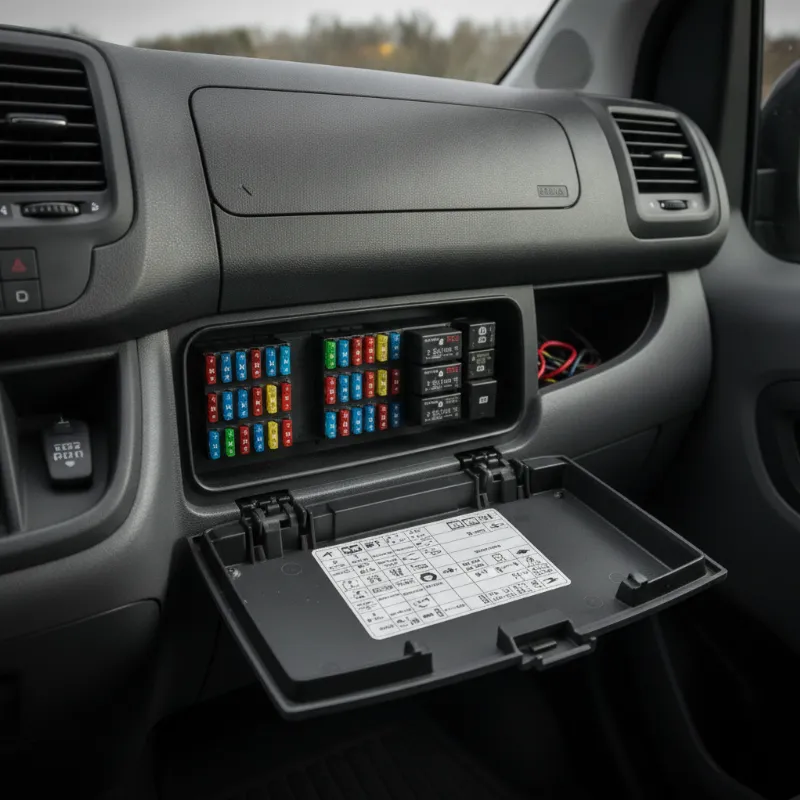
The main interior fuse box on a Peugeot Expert is tucked away on the driver's side of the dashboard, behind a removable panel at the end of the fascia. On right-hand drive UK vans you'll find it to the right of the steering wheel, roughly level with your knee when seated. Open the driver's door fully and look at the end of the dashboard — you'll see a plastic cover, sometimes marked with a small fuse symbol, that clips off to reveal the fuse bank behind it.
This is the box that controls most of the "cabin" electrical circuits: interior lighting, the radio, cigar lighter and 12V sockets, wipers, indicators, central locking, the instrument cluster and various dashboard warning systems. If something inside the van has stopped working, this is almost always the first place to check.
Engine Bay Fuse Box Location
The second fuse box lives under the bonnet, mounted in a black plastic housing on top of or next to the battery. Depending on the model year and engine variant, it may sit on the left-hand side of the engine bay or in the centre-left area. The lid clips off with a couple of plastic tabs and often has the fuse layout printed on the underside.
The engine bay fuse box handles the heavier-duty circuits: the starter motor feed, glow plugs, cooling fans, ABS, headlights, engine management (ECU), and the fuel pump. Blown fuses here tend to point to more serious issues than a simple cabin fault, so tread carefully and never substitute a higher-rated fuse than the one that failed.
How to Access the Peugeot Expert Fuse Box
Accessing either fuse box on the Expert is straightforward and doesn't require any workshop-grade tools. It's a job any competent driver can handle on the driveway in a few minutes, provided you take a couple of sensible precautions first.
Tools You'll Need
For the interior fuse box you really only need your fingers and, occasionally, a flat-blade screwdriver to lever the cover off if it's stiff. Peugeot includes a small plastic fuse puller clipped inside the cover on most Experts — it looks like a pair of miniature tweezers and makes extracting fuses far easier than trying to pinch them out by hand. A torch is well worth having too, as the footwell area gets dim even in daylight.
For the engine bay fuse box, add a clean cloth to wipe away any road grime around the lid before you open it (you don't want dirt dropping onto the terminals) and a set of replacement fuses in the common ratings — 5A, 7.5A, 10A, 15A, 20A and 30A blade fuses cover almost everything on the Expert.
Step-by-Step Access Guide
Start by turning the ignition off and removing the key — it's a small step but it prevents any accidental short while you're working. For the dashboard fuse box, open the driver's door, sit sideways or crouch in the footwell, and locate the panel on the end of the dashboard. Get a fingernail or a flat screwdriver behind the lip and pull it firmly outwards; it's held on by clips, so it will pop off with a bit of persuasion. Once removed, you'll see the rows of colour-coded fuses.
For the engine bay box, release the bonnet from inside the cab, prop it open, and locate the plastic housing near the battery. Depress the retaining clips on the lid and lift it off. Set the lid aside upside down so you can read the fuse map on its inner surface. When you're finished, refit the lid firmly — a loose cover in the engine bay can let moisture in and cause corrosion on the terminals.
Reading the Fuse Box Diagram and Identifying Blown Fuses
Every fuse in the Peugeot Expert is a standard automotive blade fuse, colour-coded by amperage. Tan is 5A, brown is 7.5A, red is 10A, blue is 15A, yellow is 20A, clear or white is 25A and green is 30A. The diagram on the fuse box lid, or in your handbook, will list each numbered slot alongside the circuit it protects — for example, "F12 — front wipers, 20A" or "F30 — cigar lighter, 15A".
To identify a blown fuse, pull it out with the plastic puller and hold it up to the light. A healthy fuse has an unbroken metal strip inside the clear plastic body; a blown one will have a visible break or a burnt, discoloured strip. If you can't tell by eye, a cheap multimeter set to continuity will confirm it in seconds. Always replace a blown fuse with one of the exact same amperage — fitting a higher-rated fuse to "stop it blowing again" is a genuine fire risk and will invalidate your insurance if it causes damage.
If the replacement fuse blows immediately or within a few minutes of use, you've got an underlying fault in that circuit — usually a chafed wire, a failed component or water ingress — and the vehicle needs proper diagnosis rather than another fuse.
Common Peugeot Expert Electrical Faults Linked to Fuses
Certain fuse-related faults come up again and again on the Expert. The cigar lighter and 12V socket fuse is a frequent culprit, particularly on vans used with dash-cams, phone chargers and inverters — overloading the circuit will pop the fuse without warning. Wiper fuses can blow after heavy snow or leaves jam the blades and stall the motor. The radio and infotainment fuse sometimes fails after a battery disconnection or a jump-start gone wrong.
On the engine bay side, glow plug relay fuses are worth checking if you've got hard starting on cold mornings, and the ABS fuse should be an early suspect if the ABS or ESP warning lights come on together. Central locking issues, particularly on higher-mileage Experts, can also trace back to a tired fuse in the body control module circuit rather than the locks themselves.
It's worth remembering that fuses don't fail for no reason. A single blown fuse might be a one-off caused by a voltage spike, but recurring failures point to something further down the wiring that needs investigating.
When to See a Specialist vs DIY Repair
Swapping a blown fuse is a genuine DIY job — it takes a couple of minutes, costs a few pence and requires no mechanical experience. If a new fuse of the correct rating restores the circuit and it stays working, you're done. Keep an eye on it for a week or so, but there's no need to book the van in.
Where you should hand the job to a specialist is when fuses keep blowing, when multiple unrelated circuits fail together, when there's a burning smell from the fuse box, or when warning lights on the dashboard don't clear after the fuse is replaced. These symptoms typically indicate wiring damage, a failing control module or a short circuit that needs proper diagnostic equipment to trace. A Peugeot main dealer or an independent van specialist with the correct diagnostic software will find the fault far more quickly than trial and error, and it usually works out cheaper in the long run than chasing the problem yourself.
Thinking of Upgrading? Explore Our Peugeot Expert Range
Chasing electrical gremlins on an older van is sometimes the point at which owners decide it's time for a change. If your Expert is starting to show its age and the fuse box is seeing more action than it used to, it might be worth looking at what a newer example could offer — better fuel economy, updated safety systems, improved infotainment and, of course, fewer nagging faults.
We stock a strong selection of Peugeot Expert vans across trim levels, wheelbases and payloads, from tidy used examples to nearly-new models with the balance of manufacturer warranty still in place. Whether you're a sole trader looking for a reliable workhorse or running a fleet and need multiple units, our team can talk you through the options, part-exchange your current van and arrange finance to suit. Get in touch to arrange a viewing or a test drive at your convenience.
FAQs
Where is the fuse box located on a Peugeot Expert van and how do I access it?
The Peugeot Expert has two fuse boxes. The main one is inside the cab, behind a clip-off panel on the driver's side end of the dashboard — open the driver's door and you'll see the cover level with your knee. The second is under the bonnet, in a black plastic housing on or next to the battery. Both lids simply unclip by hand or with a flat screwdriver, and each has a fuse layout diagram printed inside the cover.
Why does the same fuse keep blowing on my Peugeot Expert?
A fuse that repeatedly blows is telling you there's an underlying fault in that circuit — typically a chafed or shorted wire, a failing component drawing too much current, or water ingress into a connector. Never fit a higher-rated fuse to stop it happening, as this is a genuine fire risk. Instead, have the circuit diagnosed by a Peugeot specialist or auto electrician.
What amp fuses does the Peugeot Expert use?
The Expert uses standard automotive blade fuses in the usual colour-coded ratings: 5A (tan), 7.5A (brown), 10A (red), 15A (blue), 20A (yellow), 25A (clear) and 30A (green). Always replace a blown fuse with one of the exact same amperage as the original — the rating is printed on the top of the fuse and listed on the fuse box diagram.
Can I drive my Peugeot Expert with a blown fuse?
It depends entirely on which fuse has blown. A failed radio or cigar lighter fuse is an inconvenience but safe to drive with. A blown fuse affecting headlights, indicators, wipers, ABS or engine management is not safe and, in some cases, would make the van unroadworthy under UK law. If you're unsure what the fuse controls, check the diagram before continuing your journey.