Peugeot Expert Won't Start When Warm: Causes & Fixes
Why Your Peugeot Expert Won't Start When Warm: Quick Overview
Few things are more frustrating than a van that fires up perfectly first thing in the morning but refuses to restart after a delivery run or a lunch stop. If your Peugeot Expert cranks over but won't catch when the engine is warm — or won't crank at all until it has cooled down for twenty minutes — you're dealing with a classic "hot start" fault. It's a well-documented issue on the Expert, particularly the 1.6 and 2.0 HDi models, and the good news is that the cause is usually one of a handful of known culprits.
In the vast majority of cases, the problem points to the crankshaft position sensor, a fuel delivery issue, or a heat-soaked electrical component. Because the fault only shows up when things are hot, it can be tricky to replicate on a cold workshop bench — which is why so many owners end up chasing the wrong part. This guide walks you through the most likely causes, how to narrow the fault down yourself, and what a proper repair should cost.
Most Common Causes of a Hot-Start Problem on the Peugeot Expert
A warm-start failure is almost always down to a component that behaves normally at ambient temperature but changes behaviour once heat builds up under the bonnet. Here are the faults we see time and again on the Expert.
Faulty Crankshaft Position Sensor
The crankshaft position sensor (CPS or CKP) tells the ECU where the crank is in its rotation, which is essential for the injectors and, on diesels, the timing of fuel delivery. When these sensors fail, they very often fail with temperature — the internal windings expand, resistance changes, and the signal drops out. Cold, they read fine. Warm, they read nothing, and the engine simply won't fire.
On the Peugeot Expert, and its Citroen Dispatch and Fiat Scudo siblings, the crank sensor is one of the single most common reasons for a hot no-start. Typical symptoms include the engine cranking healthily but refusing to catch, no fault codes at first (the sensor may still test as intermittent), and the van starting perfectly again once it has cooled for 20–30 minutes.
Fuel Pressure and Injector Issues (HDi Engines)
The HDi common-rail system relies on very high fuel pressure to atomise diesel through the injectors. If the high-pressure pump is tired, if a fuel pressure regulator is leaking, or if one or more injectors are back-leaking excessive fuel to the return line, the system may not build enough pressure to start when hot. Warm diesel is thinner, which makes any weakness in the system worse.
A tell-tale sign here is prolonged cranking before the engine catches, sometimes with a puff of white smoke, and a rough idle for the first few seconds. A workshop can measure injector back-leak with a simple test kit and check live rail pressure on a diagnostic scanner.
Starter Motor Heat Soak
The Expert's starter motor sits close to the exhaust manifold and turbo, so it takes a battering from radiated heat. As the solenoid or internal windings warm up, resistance climbs and the motor may crank slowly or not at all. If you turn the key and hear a click or a laboured crank when hot — but everything is fine cold — heat soak is a strong suspect. A quality replacement starter with a heat shield usually solves it for good.
Battery, Earth Straps and Weak Cranking
Never overlook the basics. A battery that measures 12.4 volts at rest can still collapse under load once its internal resistance rises with age. Corroded or loose earth straps between the engine, chassis and battery are another regular offender on higher-mileage Experts. If the dashboard flickers or the glow plug light dims when you crank, you're looking at a supply or earth problem before anything more exotic.
Immobiliser and Key Fault
Less common, but worth knowing about: the transponder chip in the key or the immobiliser aerial ring around the ignition barrel can fail intermittently, often when warm. The engine will crank normally but not fire because the ECU is refusing to authorise injection. A flashing security light on the dash while cranking is the giveaway. Try the spare key — if the van starts, you've found your fault.
How to Diagnose the Fault Yourself
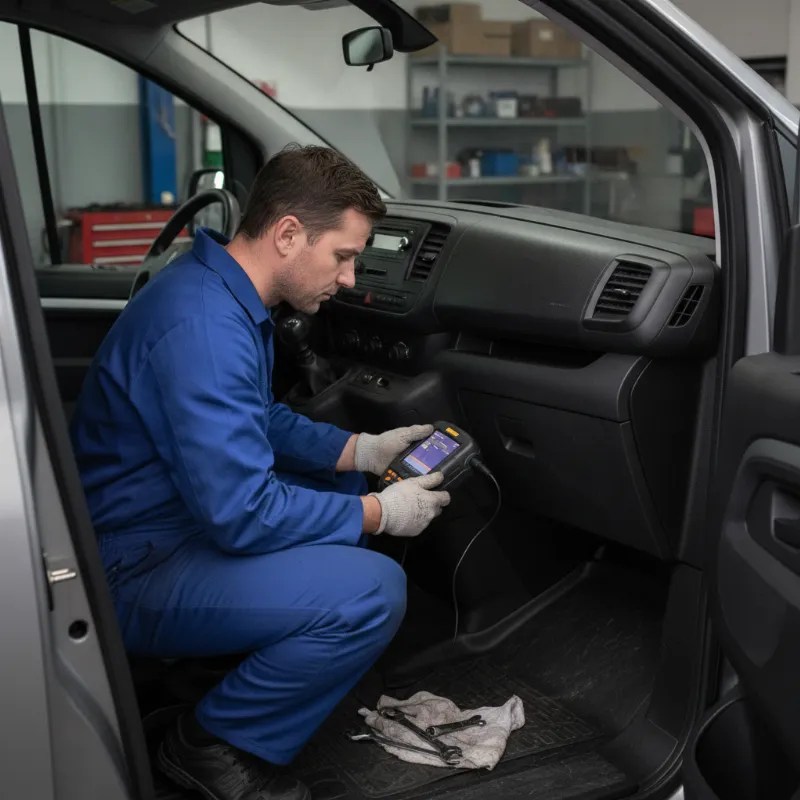
You don't need a main-dealer bay to make real progress on a hot-start fault. A basic OBD scanner, a multimeter and a bit of patience will get you a long way.
Checking for Fault Codes
Plug an OBD2 scanner into the port under the steering column and read both stored and pending codes. Codes in the P0335–P0339 range point to the crankshaft position sensor. P0087 or P0088 suggest fuel rail pressure problems. P1336 and related codes can flag injector or timing issues. Don't clear the codes straight away — take a note, then drive the van until the fault reappears and see what new codes drop.
Remember that a hot-start fault often leaves no permanent code because the ECU sees the sensor recover on the next cold start. A live-data capable scanner is far more useful, because you can watch the crank sensor RPM signal actually disappear during a failed hot crank.
Testing the Crank Sensor When Hot
If you suspect the crank sensor, the definitive test is to measure it at the moment the van won't start. Get the engine fully up to temperature, switch off, then immediately try to restart while a helper watches the RPM value on a live-data scanner clipped to the OBD port. If the tacho shows zero RPM while the engine is cranking, the ECU isn't seeing a crank signal — replace the sensor. The part itself is inexpensive, and on most Expert engines it's accessible from above or via the bellhousing area with basic hand tools.
Repair Costs and When to Call a Mechanic
Costs vary depending on the underlying fault, but as a rough guide: a crankshaft position sensor replacement at an independent garage is typically one of the cheaper repairs, usually well under a couple of hundred pounds parts and labour. A replacement starter motor with heat shielding is a mid-range job. Injector back-leak faults or a failing high-pressure fuel pump are the big-ticket repairs and can run into four figures once new injectors, coding and rail work are factored in.
If you're comfortable with basic spanner work, swapping a crank sensor or cleaning up earth straps is well within DIY territory. Anything involving high-pressure fuel lines, injector removal or ECU coding should go to a diesel specialist — common-rail pressures are genuinely dangerous, and modern injectors need to be coded to the ECU after fitting. A specialist will also have the live-data tools to prove the diagnosis before you spend money on parts.
Is It Time to Replace Your Peugeot Expert Van?
A single hot-start fault is rarely a reason to give up on an otherwise sound Expert — these are tough, capable vans and most owners get many more years out of them after a targeted repair. However, if your van is high-mileage and you're stacking up injector issues, DPF problems, EGR faults and turbo wear on top of a hot-start problem, the maths can quickly tip the other way. Weigh the likely repair bill against the van's trade value, factor in downtime lost to your business, and be honest about how much more life is realistically left in the drivetrain.
If the numbers point to moving on, a newer Expert or one of its rivals will bring better fuel economy, a fresher warranty and modern safety kit. Either way, don't ignore a warm-start fault — they tend to worsen until the van refuses to restart at all, usually at the least convenient moment.
Frequently Asked Questions
Below are answers to some of the questions Peugeot Expert owners most commonly ask when dealing with a hot-start problem.
FAQs
Why won't my Peugeot Expert start when the engine is warm, and how do I fix it?
The most common cause is a failing crankshaft position sensor that drops its signal once heat builds up under the bonnet, followed by fuel pressure issues on HDi engines, a heat-soaked starter motor, or tired battery earths. The fix depends on the cause: replacing the crank sensor is a cheap, straightforward job that resolves the majority of cases, while fuel system faults need diagnosis by a diesel specialist with live-data equipment. Start by scanning for fault codes and monitoring the crank sensor RPM signal during a failed hot start — that usually pinpoints the culprit quickly.
Can I still drive my Peugeot Expert if it won't start when warm?
You can drive it, but you're gambling on being able to restart it after every stop. Most owners find the fault worsens over a few weeks until the van won't restart at all, so it's better to diagnose and fix it before you're stranded on a job. If you must keep using it, avoid switching off in awkward locations and carry a jump pack in case the battery is contributing to the problem.
How much does it cost to replace the crankshaft sensor on a Peugeot Expert?
At an independent garage, replacing the crankshaft position sensor on a Peugeot Expert typically costs well under £200 including parts and labour, depending on engine variant and access. The sensor itself is inexpensive, and the labour is usually under an hour. If you're mechanically confident, buying a quality OE-equivalent sensor and fitting it yourself can bring the cost down to the price of the part alone.
Could it just be a flat battery causing my Expert not to start when hot?
It's possible but less likely if the van cranks strongly cold and only fails when hot. A weak battery usually shows the opposite pattern — worse when cold, better when warm. That said, an ageing battery combined with corroded earth straps can produce odd hot-start behaviour, so it's always worth load-testing the battery and cleaning the engine-to-chassis earth points as a first, cheap step before chasing sensors or fuel components.
Is the hot-start fault common on Citroen Dispatch and Fiat Scudo too?
Yes. The Peugeot Expert, Citroen Dispatch and Fiat Scudo share the same platform, engines and much of the electronics, so the same hot-start faults affect all three — particularly on the 1.6 and 2.0 HDi diesels. The crankshaft position sensor issue in particular is well known across the whole range, and the diagnosis and repair are identical whichever badge is on the grille.