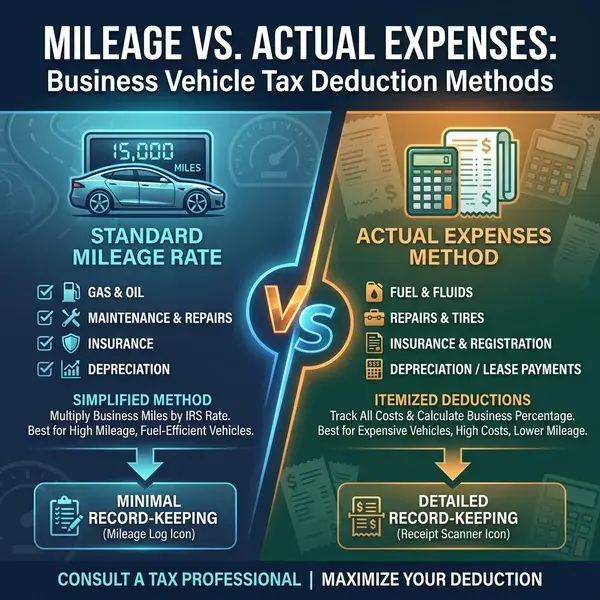
Mileage vs Actual Expenses: The Ultimate Comparison
Mileage vs Actual Expenses: The Ultimate Comparison
Using a truck or van for business activities, you can subtract some correlated expenses from your taxes. However, you need to meet specific requirements to take the write-offs. The two approaches available to taxpayers are the actual vehicle expenses and the standard mileage rate. This article provides details on mileage vs actual expenses. By learning how the standard mileage rate vs actual expenses works, you can determine which one is appropriate for you.
Various rules exist concerning using the standard mileage vs actual expenses technique. Thus, compare the actual expenses vs mileage mode before you select one that gives you a more significant tax deduction. Bear in mind that it is impossible to use standard mileage for vehicles regarded as “qualified nonpersonal use vehicles.” In such a case, you need to report the actual car expenses for them. Such vehicles include passenger buses, semi-trailer trucks, delivery trucks with a seat for the driver only, moving vans and hearses.
The actual expenses to deduct in your taxes include items like lease payments, depreciation, repairs, maintenance, tires, oil, gasoline, registration and license fees and insurance. Other vehicle-related costs like tolls, parking fees, interest, local and state property taxes are considered as separate non-vehicle deductions.
The standard mileage rates
This deduction is also referred to as mileage per diem. It involves calculating the overall number of miles one has driven and multiplying that number using the standard mileage rate. This rate changes every year. The year 2022 had two standard rates due to the high gas prices. It was 58.5 cents for each mile from January to June, and 62.5 cents for each mile from July to December.
Standard mileage encapsulates every operating expense for a vehicle in one number, and this also includes depreciation. Depreciation is a yearly deduction that helps recover the expense or other basis or investment or business property over a specific number of years.
Depreciation begins when the owner first uses the property in a business or to produce income. The property stops being depreciable when its cost or other basis is fully recovered or when the owner sells or stops using it for business purposes, whichever occurs first. Taxpayers report depreciation on their tax returns on Form 4562.

When comparing standard mileage vs actual expenses, note that you must choose the former the first year you place a vehicle in business service. In future years, you can change it to actual expenses, but you cannot revert it to standard mileage. If you have leased a vehicle, switching from standard mileage to actual expenses is not possible.
You must decide to use standard mileage for a vehicle before the time frame in which you need to file returns lapses. It is impossible to use standard mileage if you have five or more cars in use in your business activities.
How mileage per mile is calculated?
Let us take an example of a person who drove 40 miles through their monthly business trip in 2022. The calculation appears as follows:
January to June
58.5 x 40 x 6 months = 140.4
July to December
62.5 x 40 x 6 months = 150
150 + 140.4 = 290.4
The amount that can be deducted from your taxes as business travel rate is $290.4. You can use this rate to take deductions if:
- You do not use more than 4 vehicles in your business operations.
- You have been using this mileage rate deduction since you bought or leased the vehicle the first time.
- You have a leased vehicle and are planning to utilize the standard mileage method for the lease’s entirety.
When can you not use standard mileage?
You cannot use it in the following situations:
- If you already utilized the actual expenses tax deduction and claimed accelerated depreciation in the past.
- If you have ever asked for a Section 179 deduction.
What is impossible to deduct?
When using the standard mileage method, it is impossible to deduct the following:
- Depreciation
- Actual car expenses
- Lease payments
You can subtract expenses related to doing business like:
- Tolls and parking fees.
- Applicable registration fees and taxes.
You may start with the actual expense technique in the future. Yet, you can only employ the straight-line depreciation methods. You cannot use accelerated reduction.
Understanding the Actual Expenses Technique

The actual expenses method for subtracting driving-related expenditures is ideal in certain situations. You can utilize this process when you cannot or do not want to utilize the standard mileage rate. In the actual expense method, you must sum up your vehicle’s running costs such as lease payments, registration fees, gas, tolls, parking fees, and others.
You should use this method if:
- You have over 4 vehicles that you use concurrently for your professional activities.
- You have a leased vehicle and are not planning to use the standard mileage rate for the lease’s entirety.
- You utilized the actual expense deduction method when you first used the vehicle for business-related activities.
Actual expenses
You can decide to deduct a vehicle’s actual expenses at any time during its useful life. Once you choose to do so, it is impossible to change it to standard mileage.
If you have changed to this calculation method after using the standard mileage rate, then you must use straight-line depreciation for the rest of the years the vehicle remains in service.
Caveats
- If you use actual expenses to determine the deduction for a leased vehicle, there are regulations affecting the amount of lease payments you can subtract.
- Members of the armed forces who use their vehicles to travel for work can deduct the standard mileage rate or actual expenses to determine the deductible expenses of operating their vehicles for the unreimbursed business cost deduction on form 2106.
- You cannot depreciate a vehicle you purchased and sold in the same year.
You can subtract the following when employing the actual expenses method:
- Tolls and parking fees.
- Interest in your car loan.
- Car depreciation
- Garage rent
- Insurance
- Lease payments
- Tax and registration fees
- Oil
- Gasoline
- Tires
- Repairs
- Maintenance
- Registration fees
- License plates
Calculating actual expenses deduction
Using an example of a person who rode 20,000 miles throughout 2020, but the distance covered for business activities was 8,000. That is 40 percent of the entire driving throughout the year. The actual vehicle costs for the 20,000 miles were $4,000.

Here is how the calculation would appear:
4,000 x 40% = $1600
You may subtract $1,600 from your taxes.
Which one is superior?
As you compare standard mileage vs actual expenses, you might wonder which one is better. The most suitable method to use depends on several factors, the kind of automobile you ride and its operating expenses.
If the vehicle does not consume much gasoline, it would be more advantageous to take the mileage deduction. If your car has low gas mileage and high operating expenses, you may get better results if you take the actual expense deduction.
If you are an Uber driver, your car’s business use is your most significant business expense. By taking advantage of this tax deduction, you can reduce your tax burden and taxable income. This is vital because you must pay two separate taxes on your ridesharing income, one for self-employment tax and one for income tax. Both taxes depend on your enterprise’s net profit. You can reduce it for obtaining a deduction for using your vehicle for business purposes.
Standard mileage vs actual expenses – merits and demerits
Standard mileage method
The merits of using this method include:
- It usually results in larger deductions for business owners who drive many miles.
- It permits more flexibility because you can choose to change to another method in the future.
- It is often simpler to keep records while using this method. Some apps can perform the calculations for you.
- Typically, it is straightforward to compute your deductions using the internal revenue service’s rate each mile.
The drawback of this method is:
- You may end up getting a lesser deduction if your vehicle was not driven much all through the year.
Actual expenses method
The benefits of using this system include:
- It allows taxpayers to keep track of their car depreciation in their deduction, beyond and above what can be included in the standard mileage method.
- People with costlier vehicles can get higher deductions.
- It is ideal when one has a huge car-related expenditure such as an unavoidable repair.
The drawback of using this method includes:
- The recordkeeping required is more extensive
- If you choose to use this technique in the first year, you cannot switch to the usual mileage rate.
Conclusion
Comparing the standard mileage vs actual expenses method of calculating tax deductions is essential. Both methods have benefits and disadvantages. What is considered a merit or demerits depends on a person’s circumstances when filing taxes. As you compare mileage deduction vs actual expenses, some factors to consider include the vehicle’s value, how much you drive it and if you are ready to keep track of your costs.