Mercedes Sprinter Seats: How Many Does It Have?
Mercedes Sprinter Seating Explained: How Many Seats Does It Have?
The Mercedes Sprinter is one of the most versatile large vans on the UK market, and the number of seats it offers depends entirely on the body style and trim you choose. In its most common panel van form, the Sprinter typically carries two or three people up front, but move up to a crew cab and you can seat five to seven, while the factory-built Traveliner minibus versions carry anywhere from nine to seventeen passengers. That single model name therefore covers everything from a two-seat delivery workhorse to a full-size seventeen-seat people carrier.
Understanding the seat count matters for more than just comfort. It affects how you tax the vehicle, which driving licence category you need, how insurers class the vehicle, and whether it counts as a commercial van or a passenger-carrying vehicle in the eyes of HMRC and the DVSA. Below we walk through each Sprinter configuration in turn, explain the popular ten-seat minibus in detail, and help you match the right seating layout to your business needs. If you want to browse current stock as you read, our full range of Mercedes Sprinter vans for sale covers most of the configurations mentioned here.
Sprinter Panel Van vs Crew Van vs Minibus: Seat Counts Compared
Mercedes-Benz builds the Sprinter on a common chassis but offers three broad body families that dictate how many people it can carry. Each family has its own typical seat range, its own use case, and its own implications for tax and licensing.
Panel Van (2–3 Seats)
The standard Sprinter panel van is the workhorse of the range and is designed primarily to carry cargo rather than people. It comes with two or three seats in the front cab: a single driver's seat and either a single passenger seat or a bench that seats two, giving a total of two or three occupants. The rear of the vehicle is a fully enclosed load bay with no side windows or additional seating.
Three-seat cabs are by far the most common on UK fleets because they let a driver take two colleagues to a job without sacrificing any load space. This is the classic delivery, courier, plumbing, joinery and mobile-workshop configuration, and it is taxed and insured as a light commercial vehicle.
Crew Cab / Dualliner (5–7 Seats)
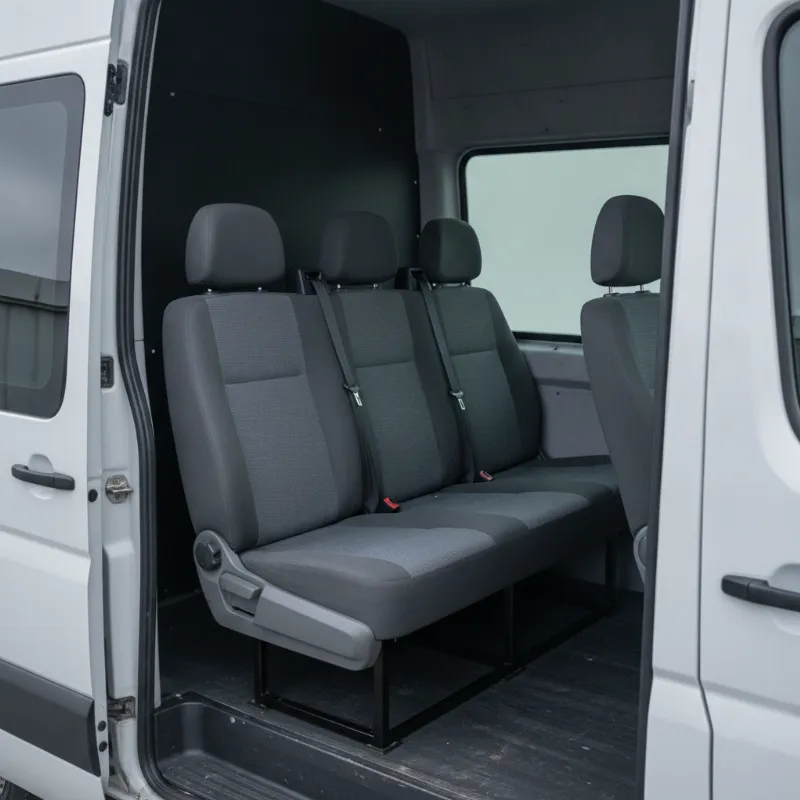
The crew cab Sprinter, sometimes badged as the Dualliner or Crew Van, adds a second row of seating directly behind the front cab. This typically gives five seats in total — three in the front and two or three in the back — though certain long-wheelbase or specially converted versions can carry six or seven.
Behind that second row you still get a useful load area, usually separated by a bulkhead with a small window. This layout is popular with construction firms, groundworkers, scaffolders and utility contractors who need to transport a full crew and their tools to site in a single vehicle. Because there is still a dedicated cargo area, most crew vans remain classed as commercial vehicles for tax purposes.
Minibus / Traveliner (9–17 Seats)
At the passenger end of the range sits the Sprinter Traveliner, Mercedes' factory-built minibus. Depending on wheelbase, roof height and trim, the Traveliner is available in nine-seat, twelve-seat, fifteen-seat, sixteen-seat and seventeen-seat versions. The rear cabin is fully glazed, trimmed like a passenger vehicle and fitted with three-point seatbelts on every seat.
Nine-seaters are especially popular because they sit within the standard car driving licence limit of eight passengers plus a driver. Larger versions are widely used by schools, care homes, community transport groups, airport shuttle operators and private hire firms.
10 Seat Mercedes Sprinter Minibus: Layout and Uses
A ten-seat Sprinter minibus is a slightly less common but very practical configuration, usually created by adding one row of two seats behind a nine-seat layout, or by removing a row from a twelve-seat minibus to free up luggage space. The typical layout is three seats in the front cab (driver plus two) and seven seats in the rear cabin, arranged in rows of two with a central aisle.
Ten-seaters are a favourite with hotels, wedding venues, sports clubs and small tour operators because they carry a meaningful group of people while still leaving room for suitcases, kit bags or equipment at the very back. They also strike a good balance between capacity and manoeuvrability, being no larger to drive than a long-wheelbase panel van. Just remember that carrying nine or more passengers plus the driver takes the vehicle over the standard car licence threshold, which we cover below.
10 Seat Luxury Mercedes Sprinter Minibus: Premium Trim and Features
Luxury ten-seat Sprinter minibuses take the same seating footprint and add executive-level trim, making them ideal for chauffeur work, corporate transfers, VIP airport runs and high-end wedding hire. Typical upgrades include individual leather captain's chairs with armrests and recline, extra legroom between rows, climate-controlled rear air conditioning, tinted privacy glass, wood or piano-black interior trims, mood lighting, USB charging points at every seat and often a rear entertainment screen.
Externally, luxury conversions usually feature alloy wheels, an electric side step, and colour-coded bumpers and mirrors, while the seat count is deliberately kept low at ten to give each passenger business-class levels of space. For operators looking to charge a premium rate per journey, a luxury ten-seater delivers a very different experience to a standard fifteen or seventeen-seat Traveliner without changing the underlying vehicle or licence requirements.
How Seat Count Affects Licence, Tax and Insurance
The number of seats fitted to your Sprinter has a direct bearing on how you can legally drive, tax and insure it. Under UK licensing rules, a standard category B car licence lets you drive a vehicle with up to eight passenger seats plus the driver — so nine seats in total. As soon as your Sprinter has ten or more seats, including the driver's, it is classed as a minibus and you will normally need a D1 entitlement on your licence, unless you qualify for the limited not-for-profit exemption for drivers who passed their test before 1997.
For road tax (VED), panel vans and most crew vans are taxed at the light commercial vehicle rate, while minibuses with nine or more passenger seats fall under the PLG or PSV categories depending on use. Insurance follows a similar pattern: two and three-seat panel vans are quoted as commercial vans, crew vans as combi or dual-purpose vehicles, and anything with ten or more seats will need a minibus or PSV policy, often with additional requirements around driver age, experience and any hire-and-reward activity. It's always worth confirming the exact seat count on the V5C before you commit, as retrofitted seats can change the vehicle's legal classification.
Choosing the Right Sprinter Seating Configuration for Your Business
The right Sprinter for you comes down to how you split your time between carrying people and carrying cargo. If you rarely need more than a driver and one or two colleagues on board, a two or three-seat panel van gives you the maximum load volume and the simplest tax and licensing position. If you regularly move a full team of five to seven to site along with their tools, a crew cab is almost always the smarter choice than running two separate vans.
Once you need to move eight or more people, a Traveliner minibus becomes the obvious answer, with the nine-seat version being the sweet spot for anyone who wants to stay on a standard car licence. Step up to a ten-seater or larger and you unlock genuine passenger transport capability, whether that's a luxury executive shuttle or a seventeen-seat community minibus. Whichever configuration suits your work, you'll find a broad selection of body styles, wheelbases and seat counts across our current stock of Mercedes Sprinter vans for sale, and our team is happy to talk you through the licence and tax implications before you buy.
FAQs
How many seats does a Mercedes Sprinter van have?
It depends on the body style. A standard Sprinter panel van has 2 or 3 seats, all in the front cab. A crew cab (Dualliner) version typically has 5 seats, though some are configured for 6 or 7. The Sprinter Traveliner minibus is available with 9, 12, 15, 16 or 17 seats. Bespoke conversions such as 10-seat luxury minibuses are also common.
Can I drive a Mercedes Sprinter on a normal car licence?
Yes, provided it has no more than 9 seats in total (8 passengers plus the driver) and is under 3.5 tonnes. That covers all panel vans, crew vans and 9-seat Traveliner minibuses. From 10 seats upwards it is classed as a minibus and you'll normally need a D1 entitlement on your licence.
What is the difference between a Sprinter Crew Van and a Sprinter Traveliner?
A Crew Van (or Dualliner) has a second row of seats behind the driver but retains a large enclosed cargo area at the rear, making it a commercial vehicle designed for a work crew and their tools. A Traveliner is a full minibus with fully glazed sides, passenger trim and seatbelts on every seat, designed purely for carrying people.
Is a 10-seat Sprinter minibus classed as a PSV?
If it is used to carry passengers for hire or reward, a minibus with 9 or more passenger seats is generally classed as a Public Service Vehicle and needs to meet PSV operator, driver and insurance requirements. Used privately or under the Section 19 not-for-profit permit rules, the requirements are lighter, but you should always check the current DVSA guidance for your specific use case.