 Call us on
How to Get Van Finance When Self-Employed
How to Get Van Finance When Self-Employed when four million includes many professionals who face challenges getting van finance. Your business might depend on reliable transportation, and you’re part of a large community. Recent data from March 2022 shows the UK’s self-employed population has grown significantly, with many needing van finance to run their businesses effectively. Source
 verify your income. See vans on finance
The UK’s business landscape shows remarkable changes, with more than 30% of companies switching to electric vehicles, which expands eco-friendly van finance options. This piece covers everything you need about guaranteed van finance for self-employed traders. You’ll learn the required documentation and ways to maximise tax benefits. The best part? Your business can fully deduct van leasing costs from taxes. See van leasing deals
Can You Get Van Finance When Self-Employed?
Yes, you can get van finance if you’re self-employed. Many people think being your own boss might stop you from getting funding for a commercial vehicle. That’s not true at all. You just need to meet specific requirements, and knowing these is vital to get your application approved.
Who qualifies as self-employed
Lenders call you self-employed if you work for yourself instead of a company. This applies to sole traders, freelancers, contractors and small business owners who run their own show. The UK had over four million self-employed workers registered as of March 2022. That’s a big chunk of the workforce.
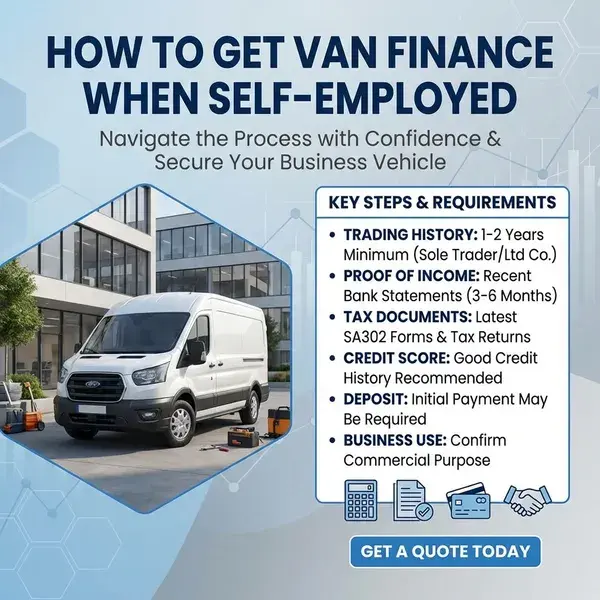
Most lenders want you to meet these requirements to get van finance:
- You should have been trading for at least 12 months, though some want two years minimum
- Your business needs to be registered officially with a company number
- You need proof of steady income through bank statements
- Your credit history should be reasonable (don’t worry if it’s not perfect)
Your net worth might need to be twice the amount you want to borrow. This shows you can handle the repayments easily. On top of that, lenders want to know if you’ll use the van just for business, personal stuff, or both.
Common misconceptions about eligibility
People often think self-employed workers can’t get van finance. This myth needs busting. The process might need more paperwork than regular employment, but van finance is definitely available if you work for yourself.
There’s another reason why people hesitate – they think perfect credit is a must. Good credit helps, but many lenders specialise in helping self-employed people who don’t have spotless credit records. These lenders get that self-employment can mean ups and downs in your finances.
Many self-employed folks think they need years of trading history. Most lenders like to see 12-24 months of business activity, but some specialist providers help people who’ve been self-employed for less time.
Irregular income doesn’t mean automatic rejection. Lenders understand that self-employed income goes up and down. In spite of that, you’ll need to show you can make monthly payments, usually through bank statements rather than cash.
The application process isn’t as complex as people think. Getting van finance while self-employed is like applying for a regular bank loan. The main difference lies in the paperwork you need to prove your income and business status.
Knowing these requirements and seeing through these myths puts you in a better position to get the van finance your business needs.
What Documents Do You Need to Apply?
Self-employed people need proper documentation to prove financial stability when getting van finance. Your lenders want to be sure you can handle regular repayments, so preparing paperwork becomes a vital step in your application.
Proof of income and tax returns
Your van finance application’s success depends heavily on showing stable income. Self-employed people don’t get regular payslips, so lenders ask for other documents:
- Business bank statements from the last three months that show regular income
- Your latest tax return documents
- An SA302 form from HMRC that confirms your declared earnings
- Proof of your work history or contracts from the past three years
Lenders know that self-employed earnings go up and down naturally. They look for steady earnings that cover your van finance payments. Many lenders want bank statements more than tax returns because these show your income patterns clearly.
Business registration and trading history
Your business structure changes how you apply and what documents you need:
As a sole trader, you’ll make a personal application even though you run a business. You need to show you own the business along with your personal details.
Limited companies and partnerships must provide their company registration number and VAT number if they have one. This proves your business is legitimate.
Your business should be at least two years old for most lenders. In spite of that, some specialist lenders work with newer businesses, depending on your industry. These cases might need extra documents like management accounts, or limited companies might need a director’s guarantee.
Credit history and address verification
Lenders will check your identity and credit thoroughly, no matter how well your business does:
You need valid ID first – a UK photo-card driving licence or passport is enough. Your current address needs proof through recent utility bills or bank statements from the last 90 days.
Make sure you can show you’ve lived in the UK for at least five years by listing your previous addresses. Lenders will look at your credit report to see how you handle payments, including any CCJs, missed payments, or bankruptcies.
Being on the electoral roll at your address helps credit checks run smoothly. Your credit score will affect your van finance terms directly – better scores usually mean lower interest rates and better deals.
New businesses under 24 months old or people who couldn’t get vehicle finance before should be ready to provide extra documents to make their application stronger.
How to Improve Your Chances of Approval How to Get Van Finance When Self-Employed
Self-employed individuals can boost their chances of van finance approval by taking steps before applying. Lenders now welcome self-employed applicants more openly, but getting your finances in order remains vital to secure better terms.
Check and improve your credit score
Lenders look closely at your credit score – it’s like a financial report card for self-employed van finance applications. Financial advisors suggest that a rating of 661 and above boosts your chances of getting finance at competitive rates. Here’s how you can strengthen your position:
Start by getting your current credit report from one of the UK’s three main reference agencies—Experian, Equifax, or TransUnion. These platforms let you check your score without any impact, showing you exactly how lenders view your financial reliability.
Your score gets an immediate boost when you register on the electoral roll, as lenders use this to verify your identity and address. A basic bank account with an overdraft facility shows you can handle credit responsibly.
New self-employed professionals can build their profile through smaller commitments like smartphone contracts or store cards. Timely payments on these obligations show lenders you’re financially responsible.
Clear existing debts and overdrafts How to Get Van Finance When Self-Employed
Your existing financial commitments play a big role in lenders’ decisions about van finance. You should tackle outstanding loans and credit card balances to improve your debt-to-income ratio before applying.
Credit card cash withdrawals signal poor money management to finance providers—even with prompt repayment. So, avoiding these transactions helps maintain a better credit profile.
A Debt Management Plan (DMP) appears on your credit report but carries less negative weight than missed payments or serious arrears. The DMP marker disappears after completion, though account records stay visible for six years.
Lenders evaluate your overall financial stability and how well you manage current commitments alongside potential new ones. A solid track record of debt management makes your application stronger.
Avoid financial links with poor credit holders
Your creditworthiness takes a direct hit from financial associations with people who have poor credit histories. Joint accounts, mortgages, or loans create financial links that matter to lenders.
A connection to someone with subpar credit might hurt your application—whatever your own excellent record shows. You can break these ties by asking credit reference agencies for a “notice of disassociation”.
Multiple credit applications in a short time can damage your approval chances as lenders see this as a red flag. The “three-month rule” suggests making just one credit application within three months to protect your profile.
Keep more than 50% of your credit limits available to show healthy financial management. This balanced approach shows lenders you don’t depend too heavily on credit facilities.
Self-employed individuals can boost their chances of successful van finance applications by focusing on these three areas. Better rates and terms often follow when you get these fundamentals right.
Finance Options: Lease or Buy? How to Get Van Finance When Self-Employed
Self-employed individuals face a vital decision about funding their commercial vehicle: should you lease or buy your van? Your business needs, financial situation, and long-term plans will determine which option works best.
Hire purchase vs contract hire
Hire purchase (HP) and contract hire are two completely different ways to finance your van. HP lets you buy the van through monthly payments over 12-48 months. You’ll own the vehicle after your final payment. This option gives you the freedom to choose your deposit amount with no mileage limits.
Contract hire works more like a rental that lasts 2-4 years. You’ll pay monthly but never own the van. The van goes back to the company once your agreement ends. Many agreements bundle maintenance, breakdown cover, and van tax into one monthly payment.
Lease purchase offers something in between. Your monthly payments are lower than HP, but you’ll need to make a “balloon payment” at the end to own the van.
Pros and cons of van leasing for self-employed
Leasing a van has several benefits if you’re self-employed. The upfront costs are lower than buying outright. You can drive newer vehicles that might be too expensive to buy, which helps your professional image and gives you reliable transport.
Here are more advantages:
- Monthly costs stay the same for better budgeting
- Tax benefits for business use
- No worries about depreciation
- Maintenance and servicing often included
Leasing does have its downsides. Most deals limit your mileage, which could be tough if you travel a lot. You can’t make big changes to the vehicle. Breaking the lease early usually costs a lot.
Best way to buy a van self-employed
Self-employed people who want to own their van have several options. Buying outright gives you total control without monthly payments and could save money long-term. You’ll own an asset, drive unlimited miles, and sell whenever you want.
HP remains a popular choice that spreads the cost while you work toward ownership. You don’t need much money upfront, and you can claim capital allowances on your tax return.
The right choice depends on what works for you. Leasing might be perfect if you like driving newer vans every few years with predictable costs. If you plan to keep your van long-term, make changes to it, or need unlimited mileage, buying through HP or paying cash will probably save you money.
Tax Benefits and Cost Considerations
Tax knowledge about your van finance decision can reduce your overall costs as a self-employed business owner. You might qualify for many tax benefits based on how you structure your purchase.
What expenses are tax deductible How to Get Van Finance When Self-Employed:
Self-employed business owners can claim several van-related expenses against taxable income. Your van’s exclusive business use allows claims for:
- Fuel costs for business journeys
- Insurance premiums
- Repairs and servicing
- MOT tests
- Road tax licence fees
- Breakdown cover
- Parking fees and toll charges
You cannot claim personal usage, fines, travel between home and work, or penalty charges. Business proportion of expenses becomes tax-deductible when your van serves both personal and business needs.
HMRC’s flat rate mileage allowance offers a simpler alternative to calculating actual costs. The rate stands at 45p per mile for the first 10,000 business miles and 25p per mile after that.
VAT claims for van leasing
VAT reclamation brings another valuable benefit to VAT-registered businesses. You can reclaim 100% of the VAT on both finance elements and services when your van serves purely business purposes.
Commercial vans allow full VAT reclamation on lease payments, unlike cars that typically permit only 50% VAT recovery. This makes van leasing an attractive tax option if you’re self-employed.
Running costs and depreciation
The Annual Investment Allowance (AIA) lets you deduct your van’s full cost from taxable profits in the purchase year, up to £1,000,000. This comes through capital allowances that provide tax relief on purchase costs.
Low-emission vans (75g/km CO2 or below) might qualify for First Year Allowance, enabling 100% deduction from taxable profits.
Cash-basis accounting allows claiming purchase cost as an allowable expense. Traditional accounting requires capital allowance claims on the purchase. Vans depreciate faster than the standard 18% capital allowances rate, which effectively pushes some tax relief until after vehicle sale.
Conclusion How to Get Van Finance When Self-Employed:
Getting van finance as a self-employed person comes with its challenges, but you can definitely get approved with the right preparation. Four million self-employed workers in the UK need funding for their business vehicles, and this piece shows you how to get it.
Your eligibility status matters more than you might think. Being self-employed doesn’t stop you from getting vehicle finance. Lenders just need the right paperwork to check your income is stable.
You can boost your chances of approval by taking some steps before you apply. A good credit score helps a lot. Pay off your debts and stay away from risky financial connections to make your application stronger.
You need to think about whether leasing or buying works better for your business. Hire purchase lets you own the vehicle, while contract hire gives you more flexibility. Both options are great if you’re self-employed.
The tax benefits can cut your costs quite a bit. Business expenses, VAT recovery, and capital allowances make commercial vehicles cheaper to run when you own a business.
Your success with van finance depends on showing stable finances rather than your job status. Good paperwork, smart credit management, and knowing your options help you get the vehicle finance your business needs.
The right van finance lets you grow your business without worrying about transport. And with good reason too – that’s exactly what you want.
FAQs How to Get Van Finance When Self-Employed:
Q1. Can I get van finance if I’m self-employed? Yes, self-employed individuals can obtain van finance. Most lenders require you to have been trading for at least 12 months and be able to provide proof of income, business registration, and a reasonable credit history.
Q2. What documents do I need to apply for van finance as a self-employed person? You’ll typically need to provide proof of income (such as bank statements and tax returns), business registration documents, proof of identity and address, and details of your credit history. Some lenders may also request additional documentation depending on your specific circumstances.
Q3. How can I improve my chances of getting approved for van finance? To increase your approval odds, focus on improving your credit score, clearing existing debts and overdrafts, and avoiding financial links with individuals who have poor credit. It’s also helpful to ensure you’re registered on the electoral roll and have a stable trading history.
Q4. Should I lease or buy a van for my self-employed business? The choice between leasing and buying depends on your specific business needs and financial situation. Leasing offers lower initial costs and access to newer vehicles, while buying provides long-term ownership and freedom from mileage restrictions. Consider factors such as your budget, expected mileage, and long-term business plans when making this decision.
Q5. What tax benefits are available for self-employed individuals with van finance? Self-employed individuals can claim various tax deductions related to their van, including fuel costs, insurance premiums, repairs, and road tax. If you’re VAT-registered, you may be able to reclaim VAT on lease payments. Additionally, you might be eligible for capital allowances if you purchase a van outright. It’s advisable to consult with a tax professional to understand all available benefits for your specific situation.
