AdBlue and the VW Multivan: A Complete Owner's Guide
What is AdBlue and Why Does the VW Multivan Use It?
AdBlue is the trade name for a high-purity solution of urea and deionised water (technically known as AUS 32 or DEF — Diesel Exhaust Fluid) that modern diesel vehicles inject into their exhaust systems to reduce harmful nitrogen oxide (NOx) emissions. When AdBlue is sprayed into the hot exhaust stream, it reacts inside a Selective Catalytic Reduction (SCR) catalyst to convert NOx into harmless nitrogen and water vapour. The result is a diesel engine that meets increasingly strict European emissions standards without sacrificing the torque, economy and long-distance ability that make diesel such a natural fit for a people-mover like the Multivan.
Volkswagen adopted AdBlue on the Multivan (and its Transporter siblings) to comply with Euro 6 emissions rules, which came into force for new type-approved passenger vehicles in September 2014 and for all new registrations from September 2015. For Multivan owners, AdBlue is simply part of routine running: it is topped up like a fluid, monitored by the vehicle, and — provided you keep it filled — largely invisible during day-to-day driving.
How the AdBlue System Works on a VW Multivan
On a VW Multivan fitted with SCR, a dedicated tank stores AdBlue separately from the diesel fuel. An electronically controlled dosing pump meters small quantities of the fluid into the exhaust just ahead of the SCR catalyst. Sensors upstream and downstream of the catalyst monitor NOx levels, and the engine ECU adjusts the dose in real time based on load, temperature and driving conditions. If levels run low, or if the system detects a fault such as poor fluid quality or a blocked injector, the vehicle displays warnings on the dashboard and — if ignored — will eventually prevent the engine from restarting once switched off. This "no-start" protection is a legal requirement of the emissions regulation, not a Volkswagen quirk.
AdBlue Tank Location and Capacity
On most Euro 6 Multivans, the AdBlue filler is located next to the diesel filler under the fuel flap, marked with a blue cap. Some earlier SCR configurations placed the filler under the bonnet or in the boot area, so it is worth checking your specific vehicle. Tank capacity on the T6 and T6.1 Multivan is typically around 13 litres, which is enough to comfortably cover the interval between routine services on a well-driven example.
Typical AdBlue Consumption on a Multivan
Real-world consumption depends heavily on how the Multivan is used. As a rough guide, expect to use around 1 to 1.5 litres of AdBlue per 620 miles (1,000 km) — although long motorway journeys with a light load can be more economical, while heavy town driving, towing a caravan or running fully laden with passengers and luggage will push consumption higher. Most owners find a 13-litre tank lasts somewhere between 5,000 and 8,000 miles between top-ups.
Which VW Multivan Models Require AdBlue?
Not every VW Multivan uses AdBlue. Broadly speaking, T5 models built before the mid-2010s relied on other emissions technologies such as exhaust gas recirculation (EGR) and diesel particulate filters (DPF), while later T6 and T6.1 models introduced with Euro 6 use SCR and therefore need AdBlue. Here is how the transition looks across common used-market examples.
2005 Volkswagen Multivan T5 Highline: Pre-AdBlue Era
A 2005 T5 Highline predates SCR entirely. These early Multivans were sold under Euro 3 and Euro 4 standards and rely on EGR and oxidation catalysts rather than urea injection. If you are looking at a 2005 model, you will not find an AdBlue filler and there is no urea maintenance to worry about — but you should pay closer attention to EGR valve condition, DPF health on facelifted variants, and overall engine mileage.
2007 Volkswagen Multivan T5 Highline: What to Know Before AdBlue
By 2007, T5 Multivans were being sold under Euro 4 rules with a diesel particulate filter but still no SCR. Owners of a 2007 Highline can effectively ignore AdBlue as a topic. The trade-off is that these vehicles are more sensitive to short journeys, where the DPF may not reach the temperatures needed for passive regeneration. If a used 2007 T5 shows DPF warning history, budget accordingly.
2010 VW T5 Multivan for Sale: Later T5 Emissions Systems
A 2010 T5 sits in the Euro 5 window. These vans use higher-pressure common-rail injection, DPFs and, in some markets, more advanced EGR strategies — but still not AdBlue. If you are browsing 2010 T5 Multivans for sale in the UK, you can generally rule out SCR maintenance as a concern. Focus instead on service history, timing belt/chain condition depending on engine variant, and the DPF.
2012 VW T5 Multivan: Transition to Modern Diesel Emissions
By 2012, the T5.1 facelift Multivan was on sale under Euro 5, so AdBlue is still not part of the picture. However, this generation forms the mechanical bridge to the T6, which arrived in 2015 and brought SCR with it under Euro 6. If you want AdBlue-free ownership, a well-kept 2012 T5.1 is arguably the sweet spot; if you want modern emissions compliance and the ability to enter low-emission zones without penalty, a Euro 6 T6 with AdBlue is the sensible choice.
How to Refill AdBlue on a VW Multivan (Step-by-Step)
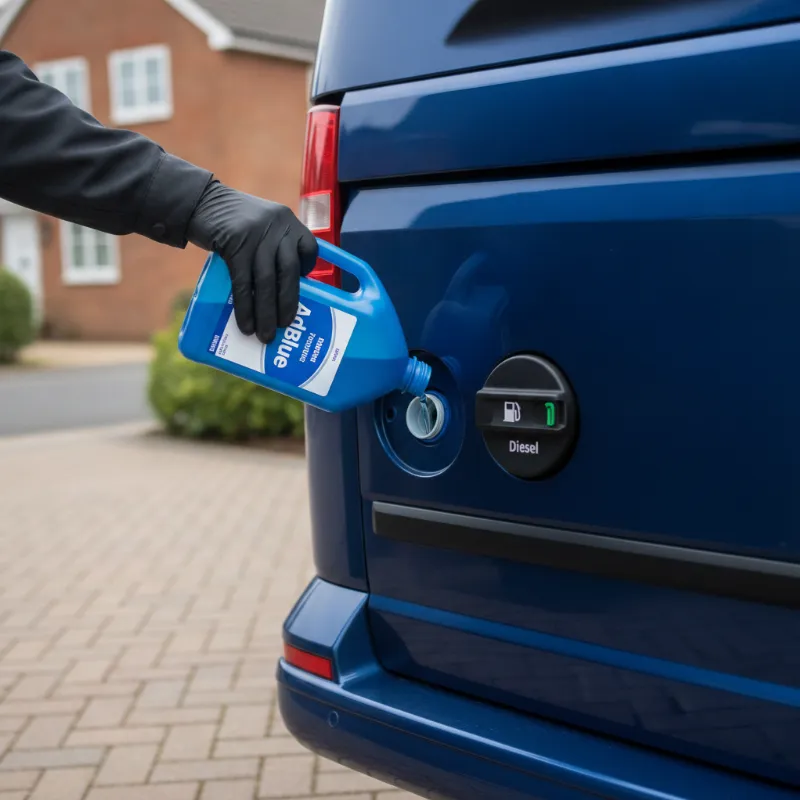
Topping up AdBlue on a Multivan is straightforward and does not require a workshop. Start by parking on level ground and switching the engine off. Open the fuel flap and you will typically find the blue AdBlue cap alongside the diesel filler. Wipe around the cap before removing it to prevent contamination, then insert either a bottle with the manufacturer's screw-fit nozzle or a forecourt AdBlue pump. Bottles are generally the tidier option for home top-ups because their non-drip nozzles reduce the risk of spills — AdBlue is corrosive to paint and vehicle trim if left uncleaned.
Pour steadily until the bottle empties or the pump auto-stops. Do not overfill: the tank has an air gap by design. Replace the cap firmly, close the fuel flap, then start the engine and let it idle for around 30 seconds so the system can register the new fluid level. On most Multivans, the warning message will clear after a short drive; if it persists, cycling the ignition or covering a few miles usually prompts the system to update.
Common AdBlue Warning Messages and What They Mean
The Multivan gives plenty of notice before it becomes a problem. The first warning typically appears with around 1,500 miles of AdBlue range remaining and simply informs you that a top-up will be needed soon. As the level drops further, the warnings become more frequent and show a shrinking mileage countdown. Below roughly 600 miles, expect an amber warning at every start; below around 250 miles the message becomes red and the vehicle will state clearly that the engine will not restart once the tank is empty. If you see "No engine start in X miles — refill AdBlue," treat it as urgent — once the countdown reaches zero and you switch off, the engine will not start again until AdBlue has been added. Other messages, such as "AdBlue: fault — see workshop manual," point to a system issue rather than a fluid shortage and usually need diagnostic investigation.
AdBlue Problems and Fixes on the VW Multivan
The most common AdBlue-related complaints on Multivans fall into a few categories. Crystallisation around the injector or filler neck can occur if fluid has been spilled or if the vehicle sits unused for long periods; a careful clean with warm water usually resolves surface deposits. Failed AdBlue level or NOx sensors will trigger warning lights and, in some cases, limp-home mode — these are typically replaced as a straightforward workshop job. AdBlue pump failure is less common but does happen, particularly on higher-mileage examples, and the pump assembly is a specific service item.
Fluid quality matters more than owners often realise. Using non-ISO 22241 compliant AdBlue, or topping up with contaminated fluid from an old container, can damage the SCR catalyst — an expensive component to replace. Stick to sealed, in-date AdBlue from reputable suppliers, and never dilute it with water or add it to the diesel tank by mistake. If the worst happens and AdBlue is put into the diesel tank, do not start the engine — call for recovery and have the fuel system drained.
AdBlue Running Costs and Maintenance Tips
The good news is that AdBlue itself is inexpensive. Bought in 10-litre containers from a motor factor or supermarket, it typically works out at a small fraction of the cost of the diesel it helps to clean. Even for higher-mileage Multivan owners covering 20,000 miles a year, annual AdBlue spend is modest — often less than a single tank of fuel over the course of a year. Forecourt pump AdBlue is more expensive per litre than bottled but is convenient for topping up during a long journey.
To get the best out of the system, top up before warnings become urgent rather than running the tank to the wire, keep the filler area clean, and stick to ISO 22241 compliant fluid. If your Multivan mostly does short urban journeys, an occasional longer run at motorway speeds helps both the DPF and the SCR system reach ideal operating temperatures. Finally, keep an eye on service intervals — SCR components are checked as part of routine servicing and small issues are cheaper to fix early.
Browse Our VW Multivan Stock in the UK
Whether you are after a pre-AdBlue T5 for simplicity or a Euro 6 T6 or T6.1 for low-emission-zone compliance, we regularly stock a range of VW Multivans to suit different budgets and use cases. Each vehicle is inspected, and where applicable we can talk you through the AdBlue system, top-up procedure and service history on the specific van you are considering. If you would like advice on which generation best suits your needs — family transport, self-build camper base or executive shuttle — get in touch with our team and we will be happy to help.
FAQs
How does the AdBlue system work on a VW Multivan, and what do owners need to know about refilling, warnings and costs?
On Euro 6 VW Multivans (T6 and T6.1), a separate tank of AdBlue — a urea and deionised water solution — is metered into the exhaust ahead of an SCR catalyst, where it converts harmful NOx emissions into nitrogen and water. Owners typically use around 1 to 1.5 litres per 1,000 km, and the roughly 13-litre tank usually lasts 5,000 to 8,000 miles between top-ups. The dashboard gives clear warnings well before the tank runs dry, starting around 1,500 miles remaining and escalating to a red 'no-start' warning below about 250 miles. Refilling is a DIY job via the blue filler cap next to the diesel filler, using ISO 22241 compliant fluid. Running costs are modest — often less than one tank of diesel per year for a typical Multivan owner.
Do all VW Multivans use AdBlue?
No. AdBlue was introduced on the Multivan with the T6, which arrived in 2015 to meet Euro 6 emissions rules. Earlier T5 and T5.1 models (up to around 2015) do not have AdBlue and rely on EGR and diesel particulate filters instead. If you are buying used, any Multivan registered from 2016 onwards will almost certainly need AdBlue top-ups.
What happens if my Multivan runs out of AdBlue?
The vehicle will give repeated warnings with a mileage countdown before the tank is empty. Once the countdown reaches zero and you switch the engine off, it will not restart until AdBlue has been added — this is a legal requirement of the emissions regulations. You will not be stranded on the move, as the engine keeps running until it is turned off, but you should always top up before the countdown reaches zero.
Can I put AdBlue in myself, or does it need a garage?
You can absolutely top it up yourself. Bottled AdBlue with a screw-fit nozzle is the cleanest option — pour it into the blue-capped filler next to the diesel filler, then let the engine idle for around 30 seconds so the system registers the new level. Only take the van to a garage if you see an AdBlue system fault message rather than a simple low-fluid warning.
What happens if I accidentally put AdBlue in the diesel tank?
Do not start the engine. AdBlue in the diesel system can damage injectors, the fuel pump and other components, leading to a very expensive repair. Call for recovery and have the fuel system professionally drained and flushed before the vehicle is used again.