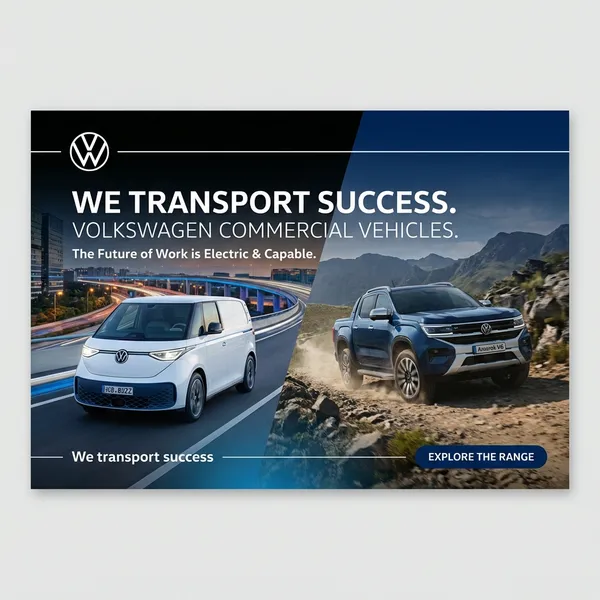
Volkswagen Commercial Vehicles Range
Volkswagen Commercial Vehicles
Volkswagen Commercial Vehicles has been causing a revolution in business transportation for decades, offering a diverse range of vans and trucks tailored to meet the unique needs of various industries. From small enterprises to large corporations, these vehicles have become the backbone of countless businesses, providing reliable and efficient solutions for transporting goods and people. With a reputation for quality and innovation, Volkswagen has established itself as a leader in the commercial vehicle market across the globe. Source
This comprehensive guide delves into the world of Volkswagen Commercial Vehicles, exploring their evolution, model range, and groundbreaking features. It examines the company’s push towards electric mobility, their approach to reducing total cost of ownership, and the innovative technologies that make their vehicles stand out. Whether you’re in the UK, Australia, Dubai, South Africa, or the USA, this article provides valuable insights into how Volkswagen Commercial Vehicles can boost your business’s productivity and effectiveness.
The Evolution of Volkswagen Commercial Vehicles
Built for UK Businesses
Volkswagen Commercial Vehicles has a rich history dating back to 1947 when Dutch importer Ben Pon sketched a van based on Beetle components. This sketch became the foundation for the legendary Type 2 Transporter range. In 1949, Volkswagen General Director Heinrich Nordhoff approved the sketch for production, and by 1950, full production began. The vehicle, initially named Bulli, was renamed Type 2 Transporter due to trademark issues.
The 1950s saw rapid growth for Volkswagen Commercial Vehicles. In 1954, the company celebrated the production of the 100,000th Type 2 Transporter at the Wolfsburg plant. Two years later, the first Type 2 Transporter rolled off the Hanover plant, which became a crucial production site for the company. By 1962, the 1,000,000th Transporter left the production line in Hanover, showcasing the vehicle’s popularity and success.
Technological Advancements
As the decades progressed, Volkswagen Commercial Vehicles continued to innovate and expand its range. In 1967, the second-generation Type 2 Transporter (T2) was released, followed by the third-generation (T3) in 1979. These new generations brought improvements in design, performance, and functionality.
The company made significant strides in engine technology. In 1980, a diesel engine was added to the Type 3 Transporter range, offering more fuel-efficient options. Two years later, water-cooled petrol engines (wasserboxer) were introduced to the German Transporter (T3) range, further enhancing performance and efficiency.
In 1985, VWCV launched the four-wheel drive syncro Transporter T3, expanding the vehicle’s capabilities and versatility. This innovation allowed the Transporter to tackle more challenging terrains and weather conditions, making it even more appealing to a wider range of customers.
Commitment to Sustainability
In recent years, Volkswagen Commercial Vehicles has shown a strong commitment to sustainability and environmental responsibility. The company has aligned itself with the Paris Climate Agreement, aiming to become carbon-neutral by 2050. This commitment has led to significant changes in their product development and manufacturing processes.
One of the key initiatives in this direction has been the focus on electric mobility. The models in the ID. family represent a significant step towards achieving a smaller carbon footprint. These vehicles offer electric, efficient, and zero local emissions mobility solutions. The electric-only MEB platform, which provides the foundation for the new ID. Buzz, has been built with sustainability in mind.
Volkswagen Commercial Vehicles has also been working on sustainable charging solutions. They offer intelligent home charging options and sustainable electricity through partnerships. Additionally, the company has been driving research into increasing the effectiveness of both new and used batteries, contributing to a more circular economy.
The company’s approach to sustainability extends beyond just the vehicles themselves. Volkswagen Group aims to operate climate-neutrally and conscientiously, following the guiding principle of developing sustainable, connected, safe, and tailored mobility solutions for future generations. This strategy, known as NEW AUTO – Mobility for generations to come, encompasses economic, social, and ecological objectives simultaneously.
In conclusion, the evolution of Volkswagen Commercial Vehicles reflects a journey from innovative design and engineering to a comprehensive approach towards sustainable mobility. From the iconic Type 2 Transporter to the cutting-edge electric vehicles of today, the company has consistently adapted to changing market needs and environmental concerns, positioning itself as a leader in the commercial vehicle sector.
Comprehensive Model Range
Volkswagen Commercial Vehicles offers a diverse range of models to cater to various business needs. From compact vans to versatile pickups, each vehicle in the lineup has been designed to provide reliability, efficiency, and practicality.
Transporter Series
The Volkswagen Transporter, now in its T6.1 iteration, continues to be a cornerstone of the commercial vehicle range. This latest version features updated styling with smaller headlights that flow into a revised grille and bumper. The facelift isn’t merely cosmetic; it introduces a new electric power steering system similar to the one found in the larger VW Crafter. This upgrade allows for advanced driver assist features such as lane-keeping assistance and crosswind assistance.
The Transporter T6.1 comes in three trim levels: Startline, Highline, and Sportline. Engine options primarily consist of VW’s reliable 2.0-liter diesel engine, available in single and twin-turbo configurations with various power outputs. For those seeking an eco-friendly alternative, there’s the ABT e-Transporter 6.1, an electric conversion that can be purchased through Volkswagen dealerships with full after-sales support.
For businesses requiring a more specialized vehicle, the VW California camper, based on the Transporter, offers a factory-built campervan solution. This model continues the legacy of the iconic Kombi, which helped popularize the concept of “vanlife” in the 1950s, ’60s, and ’70s. Official Site
Caddy and Crafter Models
The Caddy, now in its fifth generation, has established itself as a leader in the small van class. In Australia, it commands an impressive 74% market share, outperforming competitors like the Peugeot Partner and Renault Kangoo. This latest iteration brings a sleek design and a wealth of innovative features.
The new Caddy boasts a fully digital cockpit and a groundbreaking infotainment system. It offers a 10-inch touchscreen with the “Composition Audio” system, which can be upgraded to the “Discover” navigation system for enhanced functionality. The interior has been designed with practicality and comfort in mind, featuring optional ergoComfort front seats with 4-way lumbar support and power latching for the sliding rear doors and tailgate.
At the larger end of the spectrum, the Crafter provides a solution for businesses needing more cargo space. While specific details weren’t provided in the excerpts, the Crafter typically offers various configurations to suit different commercial needs.
Amarok: The Versatile Pickup Volkswagen Commercial Vehicles
The Volkswagen Amarok, now in its second generation, has quickly become a legend in the pickup truck world. This latest version is the result of a partnership between Volkswagen and Ford, sharing some components with the Ford Ranger but maintaining a distinct VW identity.
Available only in a double-cab bodystyle, the Amarok offers four-wheel drive and a diesel engine as standard. Engine options include a 168bhp 2.0-liter diesel with a six-speed manual gearbox, a more powerful 202bhp version with a 10-speed automatic gearbox, and a top-of-the-range 237bhp 3.0-liter V6 diesel, also with the automatic gearbox.
The new Amarok is 96mm longer than its predecessor, providing increased legroom for rear passengers. It has a maximum payload of 1.13 tons and can accommodate two Euro pallets sideways in its cargo bed. The lineup consists of four specifications: Life, Style, PanAmericana, and Aventura, each offering different levels of equipment and styling.
While the Amarok is positioned as a more premium option in the pickup market, it maintains its practicality and off-road capabilities. It features shorter overhangs, an improved wading depth of 800mm, and an optional rear locking differential, enhancing its performance in challenging terrains.
Revolutionizing Electric Mobility
Volkswagen has made significant strides in revolutionizing electric mobility, positioning itself as a leader in sustainable transportation. See Volkswagen California electric The company’s commitment to decarbonization and e-mobility strategies has become central to its corporate strategy, driving innovation and environmental responsibility across its product line. See more Electric VW Vans
ID. Buzz: The Electric Icon Volkswagen Commercial Vehicles
The Volkswagen ID. Buzz stands as a testament to the company’s dedication to electric mobility. This all-electric MPV recalls the loveable looks of VW’s Type 2 campervans, even reviving the distinctive two-tone paint job. The ID. Buzz has garnered significant attention, winning the 2023 Car of the Year Award partly due to its astonishing practicality.
The ID. Buzz offers a stunning amount of space in the back, surpassing the leg and head room found in similarly priced electric SUVs. The standard-wheelbase model boasts 1,121 liters of storage, while the long-wheelbase version provides even more versatility with up to 1,340 liters of space when the rear-most seats are folded.
Comfort has not been compromised in the pursuit of space. The ID. Buzz features supple suspension, ensuring occupants experience a smoother ride compared to competitors like the Tesla Model Y. The high seating position and expansive glass areas provide excellent visibility, making the vehicle easy to maneuver despite its size.
Charging Infrastructure
Volkswagen has recognized that the success of electric mobility hinges on a robust charging infrastructure. To address this, the company has developed comprehensive charging solutions for its customers.
The We Charge service, integrated into the Volkswagen app, simplifies the charging process when away from home. Users can search for charging stations, check real-time availability, and charge at competitive rates according to their personal We Charge plan. This service provides access to thousands of public charge points across Europe with just one charging card.
For those seeking high-speed charging options, Volkswagen Vans has partnered with Elli to create the Selected Partner Network. This ever-expanding network offers over 600,000 conveniently placed high-speed charge points in 27 European countries. Customers with the We Charge Plus Charging plan can benefit from reduced prices at these locations.
To further enhance the charging experience, Volkswagen has collaborated with BP Pulse. For a monthly fee, this partnership allows users to charge at almost 5,000 charging points for free, with discounted rates at non-included stations.
Environmental Impact Volkswagen Commercial Vehicles
Volkswagen’s commitment to electric mobility extends beyond the vehicles themselves to their overall environmental impact. The company recognizes that while electric cars do not emit greenhouse gasses during operation, their production and energy sources play crucial roles in their carbon footprint.
Studies have shown that electric vehicles have a better carbon footprint than petrol cars when considering their entire lifecycle. An electric vehicle registered as a new car in 2025 is projected to generate 32% fewer CO2 emissions over its lifetime compared to a modern diesel car, and 40% less than a petrol car.
Volkswagen has taken steps to reduce the carbon footprint of its electric vehicles throughout their lifecycle. The company is systematically reducing CO2 emissions in production through energy efficiency measures and the use of green electricity. Any unavoidable emissions in the production and supply process are offset through certified climate protection projects.
The company is also addressing the environmental impact of battery production, which accounts for a significant portion of an electric vehicle’s carbon footprint. Efforts are being made to recycle high-voltage batteries, recovering raw materials such as cobalt, nickel, copper, and lithium for more sustainable production.
Innovative Features for Business Efficiency
Volkswagen Commercial Vehicles has made significant strides in enhancing business efficiency through innovative features. These advancements focus on improving safety, connectivity, and customization options, all of which contribute to a more productive and streamlined business operation.
Advanced Driver Assistance Systems
Volkswagen has integrated a suite of driver assistance systems to ensure smoother and safer drives. The Adaptive Cruise Control system uses radar-controlled technology to maintain a safe distance from the vehicle ahead, making long journeys more comfortable and reducing the risk of accidents. This feature works in tandem with the Front Assist area monitoring system and City Emergency Braking system.
The Driver Alert system is another crucial safety feature. It monitors driver behavior, tracking wheel movements and lane deviations to detect signs of fatigue. If the system senses a loss of concentration, it alerts the driver through visual and audio warnings.
For urban environments, the City Emergency Braking system has proven invaluable. Activated at speeds under 18 mph, it detects critical distances and can trigger emergency braking if a collision is imminent. This feature is particularly beneficial for businesses operating in busy city centers.
Parking in tight spaces has become significantly easier with Active Park Assist. This system uses multiple sensors to automatically steer the vehicle into parking spots, requiring the driver only to control the pedals. For added safety during lane changes, the optional Side Scan feature alerts drivers to vehicles in blind spots through warning signals on the exterior mirrors.
Connectivity Solutions
Volkswagen Connected Services has transformed how businesses interact with their vehicles. Through the Volkswagen App, users can access a wide range of digital services via their smartphones. This integration allows for seamless communication between the vehicle and the user, enhancing overall efficiency.
The ‘Parking Position’ service helps drivers locate their parked vehicles, saving valuable time in large parking areas. The ‘Service Scheduling’ feature automates maintenance planning by transmitting key data to the preferred Volkswagen retailer when a service appointment is due.
For emergency situations, the ‘Emergency Call Service’ provides an added layer of safety. In case of a serious incident, the vehicle can automatically call for help, or the driver can initiate the call manually.
The ‘Lock and Unlock’ feature allows remote control of the vehicle’s central locking system through a smartphone app, providing convenience and security. Additionally, the ‘Online Anti-Theft Alarm’ notifies users via the app or email if there’s an attempted break-in.
Volkswagen’s infotainment systems have also seen significant upgrades. The Composition Color DAB+ radio system, standard across the Caddy Cargo and Transporter 6.1 range, features a 5″ TFT touchscreen, USB port, Bluetooth®, and various other connectivity options. For those requiring more advanced features, the optional Composition Media system offers a larger 6.33″ screen with proximity sensor, while the Discover Media Navigation system includes European map updates through Volkswagen MapCare.
Customization Options Volkswagen Commercial Vehicles
Recognizing that different businesses have unique needs, Volkswagen offers a wide range of customization options for its commercial vehicles. Lights and Styling, a go-to source for Volkswagen Crafter USA accessories, provides an extensive selection of premium add-ons designed to enhance both style and functionality.
These customization options allow businesses to tailor their vehicles to specific requirements, whether it’s adding stylish upgrades or practical additions. From enhanced lighting solutions to specialized storage systems, the range of accessories ensures that each Volkswagen commercial vehicle can be optimized for its intended use.
By offering these innovative features and customization options, Volkswagen Commercial Vehicles has positioned itself as a leader in business transportation solutions. The combination of advanced safety systems, comprehensive connectivity solutions, and flexible customization options enables businesses to maximize efficiency, enhance productivity, and ensure the safety of their drivers and cargo.
Volkswagen’s Approach to Total Cost of Ownership
Volkswagen Commercial Vehicles has developed a comprehensive approach to managing the total cost of ownership for their fleet customers. This strategy encompasses various aspects of vehicle ownership, from fuel efficiency to maintenance programs and resale value.
Fuel Efficiency
Fuel economy has become a crucial consideration for van drivers due to its significant impact on operational costs. Volkswagen recognizes this and has made strides in improving the fuel efficiency of their commercial vehicles. The VW Caddy, for instance, stands out as a well-built and premium economical van. Its 100bhp diesel unit can achieve up to 58mpg, making it one of the most fuel-efficient options in its class.
To help customers maximize fuel efficiency, Volkswagen provides several tips:
- Carry only essential items to reduce weight and improve fuel economy.
- Utilize start/stop features, especially in urban areas, to save fuel when stationary.
- Plan ahead to minimize unnecessary driving and cover fewer miles.
- Maintain regular servicing to ensure the van runs efficiently.
- Practice smooth driving techniques, avoiding sharp acceleration and braking.
Maintenance Programs Volkswagen Commercial Vehicles
Volkswagen offers a range of service plans to suit different fleet sizes and needs. For individual owners or small fleets, fixed cost maintenance and fixed-priced servicing options simplify planning and budgeting for upkeep. Larger fleets with over 100 vehicles can benefit from bespoke services, including favorable terms on labor rates and oil costs.
To streamline fleet management, Volkswagen has developed several tools:
- Centralized billing allows customers to pay for all servicing and repair work through a single account, reducing administrative burden and ensuring consistent pricing.
- The Epyx 1Link platform enables easy booking and authorization of servicing work across the Volkswagen network. It provides transparency on job prices, national fleet labor rates, and parts discounts.
- Regular vehicle maintenance is emphasized to diagnose problems early and prevent costly repairs. Volkswagen recommends weekly checks on tire pressure, oil levels, and coolant levels, as well as annual replacement of wiper blades.
- In partnership with Volkswagen Commercial Vehicle Finance and the RAC, a telematics solution has been developed. This provides in-depth data on fleet productivity, helping businesses track and optimize their operations.
Resale Value
Volkswagen Commercial Vehicles are known for their strong resale value, particularly when well-maintained. The iconic status and durability of VW vans contribute to their ability to hold value over time. For instance, professionally converted Volkswagen campervans often retain their value better than standard vans.
According to CamperKing sales experts, Volkswagen Transporter camper vans typically hold the following values:
- 1-3 years old: 70-80% of the original value on average
- 4-6 years old: 60-70% of the original value on average
- 7-10 years old: 50-60% of the original value on average
This strong resale value is attributed to several factors:
- The VW legacy of producing quality vehicles with lasting performance
- Minimal maintenance needs
- High market demand for VW campervans for sale
- Iconic status in the commercial vehicle market
By focusing on these key areas – fuel efficiency, comprehensive maintenance programs, and strong resale value – Volkswagen Finance demonstrates its commitment to reducing the total cost of ownership for its commercial vehicle customers. This approach not only helps businesses manage their fleet expenses more effectively but also ensures that investing in a Volkswagen commercial vehicle remains a sound financial decision over the long term.
Conclusion Volkswagen Commercial Vehicles
Volkswagen Commercial Vehicles has a profound influence on business transportation, offering a wide range of vehicles that cater to diverse industry needs. From the iconic Transporter to the groundbreaking electric ID. Buzz, the company’s commitment to innovation and sustainability shines through. Their focus on enhancing fuel efficiency, providing comprehensive maintenance programs, and ensuring strong resale value demonstrates a deep understanding of the total cost of ownership, making their vehicles a smart choice for businesses of all sizes.
The company’s push towards electric mobility and its investment in charging infrastructure show its dedication to shaping the future of commercial transportation. With advanced driver assistance systems, cutting-edge connectivity solutions, and flexible customization options, Volkswagen Commercial Vehicles is well-positioned to meet the evolving needs of businesses. As the commercial vehicle landscape continues to change, Volkswagen’s blend of tradition and innovation makes it a reliable partner for businesses looking to boost their productivity and effectiveness in an increasingly competitive market.
FAQs
Q: Is the VW Transporter and Sport Ice considered a commercial vehicle?
A: Yes, the VW Transporter is classified as a commercial vehicle when utilized as a panel van, which features a boxy shape and a spacious rear cargo area, typical of commercial vehicles in the UK.
Q: What type of vehicle is the VW Transporter?
A: The VW Transporter falls under the category of commercial vehicles.
Q: What is the price range for a VW Transporter?
A: The cost of a VW Transporter can vary based on the model, specifications, and additional features.
Q: What are some examples of commercial vehicles used in business?
A: Commercial vehicles encompass a variety of types used in different sectors. Examples include Heavy Goods Vehicles (HGVs) like large trucks, construction vehicles such as cranes, bulldozers, and tippers, transit vans, and busses like school busses and private busses. Official