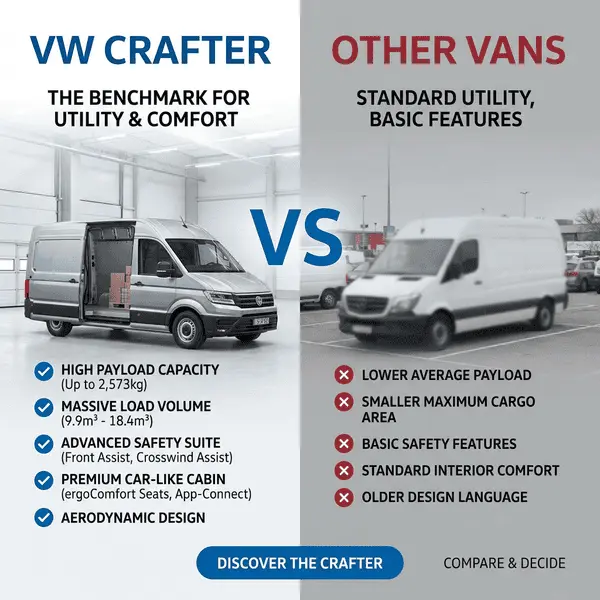
VW Crafter VS Other Vans
VW Crafter vs. Other Van:Does It Compare?
When it comes to choosing the best van for business or personal use, the VW Crafter often stands out as a top contender. However, with a wide range of options available in the market, including popular models like the Mercedes Sprinter and even innovative electric vehicles like the Tesla Model and Mercedes-Benz EQS, making the right choice can be challenging. This comparison aims to shed light on how the VW Crafter measures up against other van brands in key areas. Source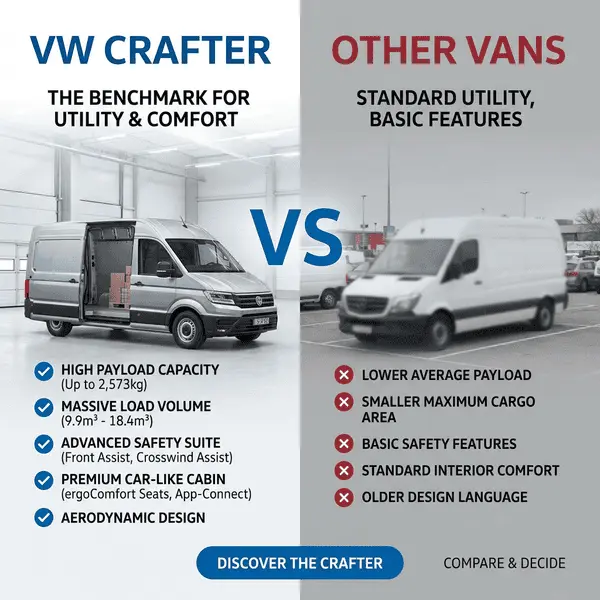
From payload capacity and load space to engine options and fuel efficiency, this article will explore the strengths and weaknesses of the VW Crafter compared to its competitors. We’ll also look at technology and safety features, as well as pricing and value for money. By examining these factors, readers will gain valuable insights to help them make an informed decision when choosing their next van, whether for commercial or personal purposes. See VW Crafter for sale
VW Crafter vs Mercedes Sprinter: Key Differences
The Volkswagen Crafter and Mercedes-Benz Sprinter stand out as two of the most popular large vans in the market. See prices on VW Crafter Lease. Both brands are synonymous with reliability and quality, offering impressive capabilities for various business needs. Let’s explore the key differences between these two heavy-weight champions. See all VW van lease deals
Design and Exterior
From the outside, the Crafter and Sprinter share similar appearances, with smooth lines and confident stances. However, the Crafter boasts a more crisp finish, featuring strong lines that give it a smart, professional look. Both vans offer customization options, allowing buyers to personalize their vehicles. See all our VW Crafter Vans for sale.
The Sprinter comes in two forms: Panel van and Crew van, with four wheelbase lengths available. It offers three different heights and a choice of five solid or five metallic paint options. The Crafter, on the other hand, provides three wheelbase lengths and three height options. It’s available in five solid paint colors, two metallic options, or a pearl effect finish. See VW Crafter Lease
Interior and Comfort
When it comes to the interior, both vans prioritize comfort and functionality, recognizing the importance of cab design for drivers who spend long hours on the road. See VW Crafter 4×4
The VW Crafter’s interior features stylish finishes and innovative technology, such as ergoComfort suspension seats. Its cab design is the result of extensive consultation with working professionals, resulting in a practical layout with ample storage options. The dashboard includes a shelf that runs its entire width, proving surprisingly useful.
The Sprinter’s cab, while sleek and functional, aims for a wow factor. It features the latest MBUX touchscreen infotainment system as standard, with a swooping dashboard design that’s less van-like. Many interior elements, including audio controls and air vents, are shared with Mercedes passenger cars. See VW Crafter accessories
Both vans offer excellent smartphone connectivity and intelligent navigation systems – We Connect in the Crafter and MBUX in the Sprinter. They also provide ample legroom for drivers and passengers, along with convenient storage spaces and cupholders.
Performance Comparison
In terms of performance, both vans offer a range of engine options to suit different business needs. The VW Crafter VS Other Vans comes with a 2.0-liter engine, while the Sprinter features a 2.1-liter motor. Both provide automatic and manual transmission options, as well as front-wheel, rear-wheel, and all-wheel drive configurations. See VW Crafter seat covers
The Sprinter lives up to its name in terms of power, achieving 190bhp and 440Nm of torque, compared to the Crafter’s 177bhp and 410Nm. However, the Crafter has an edge in noise and vibration isolation, providing a quieter ride, especially in its front-wheel-drive variants.
Despite their size, both vans are remarkably easy to handle. The Crafter, in particular, has been praised for its smooth ride and stability, making it highly maneuverable even in tight spaces. Its lighter steering and finessed stability seem to take the rough edges off every journey while maintaining a high level of agility.
In terms of load capacity, the heaviest Sprinter variant (with a gross weight of 5,000kg) can haul an impressive 2,529kg payload, slightly outperforming the Crafter’s maximum payload of 2,454kg at the same gross weight.
While both vans are exceptional in their own right, the choice between the VW Crafter and Mercedes Sprinter often comes down to personal priorities and specific business needs. The Crafter excels in practical design and ease of use, while the Sprinter leads in technological advancements and brand prestige.
Payload Capacity and Load Space
When it comes to choosing the best van for business, payload capacity and load space are crucial factors. The VW Crafter VS Other Vans and its competitors offer various options to meet different needs.
VW Crafter Payload
The VW Crafter boasts impressive payload capabilities across its range and is well suited to VW Crafter racking. The heaviest Crafter variant, with a gross vehicle weight (GVW) of 5,000kg, can support a substantial payload of 2,454kg. This places it among the top performers in its class.
For those operating with a standard car license, which limits the GVW to 3.5 tons, the Crafter still offers competitive options. The front-wheel-drive CR35 model with a 102hp engine and medium length body provides a maximum payload of 1,376kg in basic Startline specification. This can be further increased to 1,531kg by opting for a stripped-out version from Volkswagen.
It’s worth noting that payload capacity varies depending on the drive system. Front-wheel drive Crafters are the lightest and thus offer the highest payload ratings. Rear-wheel drive models weigh about 100kg more, while four-wheel drive versions add approximately 150kg, reducing their payload capacities accordingly.
Competitor Van Payloads
When comparing the VW Crafter VS Other Vans to its rivals, the Mercedes-Benz Sprinter stands out as a close competitor. The heaviest Sprinter, also with a 5,000kg GVW, can haul an impressive 2,529kg payload, slightly edging out the Crafter.
Other competitors in the market offer varying payload capacities. The Maxus Deliver 9, a relatively new entrant, provides competitive payload options, especially in its front-wheel-drive variant with the smallest body. The Ford Transit, while not leading the class, offers respectable payload capacities, with its L2H2 model being the optimal choice for maximum payload.
Interestingly, some older van models in the market tend to have higher payload capacities. This is partly due to their simpler designs and less advanced technology, resulting in lighter overall vehicle weights. For instance, the Fiat Ducato and the Peugeot Boxer/Citroen Relay twins have long been known for their impressive payload capabilities.
Load Space Comparison
Load space is another critical factor in van selection, and the Crafter performs admirably in this area. It offers load volumes ranging from 9.9 to 18.4 cubic meters, depending on the configuration. This maximum volume slightly surpasses the Sprinter’s 17.0 cubic meters.
The VW Crafter VS Other Vans provides a choice of three load lengths and three roof heights, resulting in six combinations. The medium wheelbase model measures 5,986mm in length with a load bed length of 3,450mm. It offers two interior heights: 1,726mm (low roof) and 1,861mm (high roof), corresponding to load volumes of 9.9 and 10.7 cubic meters respectively. See VW Crafter battery location
For those needing more space, the high roof models provide 1,961mm from floor to roof with a load volume of 14.4 cubic meters, while super high roof models measure 2,189mm and offer 16.1 cubic meters of space.
The Crafter’s design is optimized for practical use. It can accommodate Euro pallets and roll containers efficiently. The shorter wheelbase version can take two Euro pallets, while the ‘Maxi’ version increases this to three. Additionally, the Crafter boasts the largest side loading and opening width in its class at 1,311mm via the sliding door.
When comparing dimensions with the Sprinter, the Crafter offers some advantages. While the tallest Sprinter variant provides 2,243mm of load height, the Crafter’s highest load height is 2,196mm. However, in terms of wheelbase length, the longest Crafter van available offers 4,490mm, surpassing the Sprinter’s maximum of 4,325mm. See VW Crafter racking
Engine Options and Fuel Efficiency
The VW Crafter VS Other Vans and its competitors offer a range of engine options and fuel efficiency ratings to cater to various business needs. Let’s explore the engine lineups and compare their fuel economy.
VW Crafter Engine Lineup
The Crafter comes with a choice of four 2.0-liter TDI turbodiesel engines:
- 102hp / 300Nm single-turbo
- 122hp / 300Nm single-turbo
- 140hp / 340Nm single-turbo
- 177hp / 410Nm twin-turbo
It’s important to note that not every engine is available with every body size and drivetrain layout. The 122hp version is only available on rear-wheel drive CR50 (5.0-ton gross vehicle weight) versions with twin rear wheels, while the 102hp engine is limited to front-wheel drive variants.
The Crafter offers both manual and automatic gearbox options. The automatic transmission, while more expensive, improves refinement and should reduce wear and tear costs related to clutches and tires. It’s considered one of the best automatic options available in any large van.
Competitor Engine Options VW Crafter VS Other Vans
When comparing the Crafter to its rivals, we find a variety of engine options across different brands:
- Ford Transit: The Transit offers a 105PS Ecoboost Euro 6.2 diesel engine, which provides the best fuel efficiency results for this model.
- Renault Master: This van comes with a 2.3-liter diesel engine, with the dCi 135 model being the most efficient option.
- Iveco Daily: All 120hp 3.5t manual variants of the Daily are officially rated at 40.3mpg, regardless of body size.
- Fiat Ducato: The Ducato uses a unique 2.0-liter turbodiesel engine that meets Euro 6 emissions standards without requiring AdBlue.
Fuel Economy Comparison VW Crafter VS Other Vans
When it comes to fuel efficiency, the VW Crafter’s performance is somewhat mixed:
- VW Crafter: The most efficient Crafters on paper are the 102hp and 140hp mid-size versions, which claim 38.2mpg at their most efficient according to the older NEDC test. The more powerful 177hp bi-turbo variant isn’t far behind with 37.2mpg.
- Ford Transit: Most fuel-efficient are 2.9t and 3.1t GVW Transits, which achieve 42.2mpg. At 3.5t, this drops to a 40.9mpg best when opting for the 130hp power output.
- Renault Master: The Master claims a maximum of 40.4mpg for several basic front-wheel drive versions fitted with the Energy dCi 145 engine.
- Fiat Ducato: The Ducato stands out as the most fuel-efficient large 3.5t van available, with some variants claiming up to 47.1mpg.
It’s worth noting that while the VW Crafter VS Other Vans claimed fuel economy figures may seem lower than some competitors, real-world performance can differ. In a long-term test, a 140hp Crafter averaged 33mpg over 7,000 miles, which is considered good for such a large van.
Factors affecting fuel economy include driving speed, journey type, and load. Owners’ groups report that traveling much faster than 60-65mph can significantly reduce fuel economy. Additionally, frequent short journeys can lead to higher fuel consumption.
As with all large vans, the Crafter requires AdBlue to meet Euro 6 emissions regulations, which adds to running costs. Users can expect to get around 5,000 miles per tank of AdBlue, depending on driving conditions and style.
In terms of maintenance, VW has extended service intervals from 25,000 miles to 30,000 miles for this generation of Crafter. However, the on-board computer determines variable intervals, often resulting in more frequent servicing. As of 2021, VW recommends an oil service at no later than 12,000 miles, though the 30,000-mile maximum limit remains. See VW Crafter alloy wheels
Technology and Safety Features
The VW Crafter sets new standards in the large van class with its advanced technology and safety features. Its innovative design incorporates state-of-the-art systems that enhance both convenience and safety for drivers and passengers alike.
VW Crafter Tech Offerings
The VW Crafter VS Other Vans technological advancements are evident in its updated electronics architecture, which integrates next-generation infotainment, assist, and convenience systems. The interior boasts a 10.3-inch infotainment display, with an optional 12.9-inch version available. This display features a newly developed graphic interface and intuitive menu navigation, similar to that found in the long-wheelbase ID. Buzz.
The system’s layout includes two permanently visible touch bars and a customizable home screen. A new direct access button allows quick access to the main menu, while the Car Control Center provides immediate control of essential vehicle functions. The bottom touch bar houses air conditioning and seat heating controls, along with illuminated touch sliders for temperature and audio volume adjustment.
Another notable addition is the new online voice control system, which responds to natural voice commands. The Crafter also introduces digital instruments as standard equipment, with the Digital Cockpit offering customizable displays controlled via the new multifunction steering wheel.
Competitor Tech Features
While the Crafter leads in many technological aspects, competitors are beginning to catch up. However, specific details about competitor tech features are not provided in the given information.
Safety System Comparison
The Crafter’s safety features are particularly impressive, with many systems unique to this van in its segment at the time of launch. Standard safety features include:
- Crosswind Assist: Automatically applies steering corrections to counteract crosswinds.
- Driver Alert: Monitors for signs of driver fatigue and displays warnings.
- Front Assist with City Emergency Braking: An autonomous emergency braking system that works up to 18mph.
- Automatic Post-Collision Braking: Locks the brakes after a crash to prevent further movement.
Optional safety systems include:
- Lane Keeping Assist: Adjusts steering to keep the van in lane.
- Park Assist: Controls steering for both perpendicular and parallel parking.
- Trailer Assist: Helps with reversing while towing a trailer.
- Adaptive Cruise Control: Maintains a safe distance from vehicles ahead.
- Rear Traffic Alert: Helps when backing out of parking spaces.
For vehicles over 3.5 tons, additional standard features include a blind spot information system, a moving-off information system, and an oncoming vehicle braking when turning function.
The Crafter also offers up to six airbags, blindspot monitors, and a heated windscreen. With these features, Volkswagen Commercial Vehicles has set a new benchmark for commercial vehicle safety, with the entire van range leaving the factory with autonomous emergency braking as standard since 2017.
These safety innovations have led to industry recognition, with multiple awards for Volkswagen and its vans. The Department for Transport reported that this technology could have prevented 348 deaths or serious injuries and 2,496 accidents if fitted to all commercial vehicles below 3.5 tons in 2016.
By prioritizing safety and incorporating advanced technology, the VW Crafter VS Other Vans not only enhances driver and passenger protection but also contributes to reduced downtime and lower costs for fleets. This comprehensive approach to vehicle safety and technology positions the Crafter as a leader in its class, ready to tackle the toughest jobs while providing a safe and technologically advanced environment for its users.
Pricing and Value for Money VW Crafter VS Other Vans
When considering the VW Crafter and its competitors, pricing and value for money play a crucial role in the decision-making process. This section examines the lease costs, competitor prices, and overall value proposition of these commercial vans.
VW Crafter Lease Costs
The VW Crafter offers a range of leasing options to suit various business needs. Lease prices for the Crafter start from £441.91 per month, excluding VAT, for basic models. However, prices can go up to £610.98 per month, excluding VAT, for more advanced configurations. These prices typically include features such as HBA brakes and an interior entry step in the near-side sliding door.
For businesses looking for additional features, options like a heated windscreen, 270-degree opening rear doors, and a rear-view camera are available at extra cost. It’s important to note that these additions can affect the overall lease price.
Specific models, such as the Crafter CR35 LWB Diesel 4MOTION with a 2.0 TDI 177PS engine and Commerce Plus Extra High Roof, are available for lease at £783.80 per month, excluding VAT. The same model with a High Roof configuration is slightly less expensive at £766.88 per month, excluding VAT.
Competitor Lease Prices
While specific competitor prices aren’t provided in the given information, it’s mentioned that there isn’t a significant price difference between the VW Crafter and its main competitor, the Mercedes Sprinter. Both vans are considered excellent options in their class, with pricing often dependent on specific configurations and features.
When comparing lease prices across different van models, it’s crucial to consider factors beyond the monthly payment. These include:
- Maintenance packages: Some lease deals include maintenance and servicing, which can provide peace of mind and reduce unexpected expenses.
- Warranty coverage: Ensure the lease agreement includes a comprehensive manufacturer’s warranty to protect against mechanical faults and defects.
- Tax considerations: Business van leasing can offer tax benefits, such as claiming a portion of the VAT on lease payments and deducting lease costs as an operating expense.
- Reliability: Choose a van with a strong track record for reliability to minimize downtime and avoid potential loss of income.
- Residual value: Vans with high residual values typically have lower monthly lease payments, as leasing companies expect these vehicles to retain their value over the lease period.
Overall Value Proposition
The overall value proposition of the VW Crafter VS Other Vans extends beyond its lease price. Intelligent Car Leasing, a leasing provider, emphasizes their commitment to delivering value through competitive pricing backed by personalized, first-class service. They work closely with customers to ensure their vehicle requirements are met, from selecting the most suitable vehicle to arranging credit and delivery.
Leasing companies often leverage their size and scale to achieve significant cost savings, which can be passed on to customers in the form of lower leasing fees and more attractive deals. This approach allows businesses to benefit from great value leasing and vehicle contract hire services.
When assessing the value for money, consider the following:
- Monthly payments: Ensure the lease payments fit within your budget, including the required initial deposit and any administration fees.
- Flexibility: Some leasing providers offer various finance options, from van leasing and contract hire to hire purchase, providing great flexibility for businesses.
- Service quality: Look for leasing companies that prioritize customer service and can guide you through the process of selecting the most appropriate model and finance package for your business needs.
In conclusion, while the VW Crafter’s lease costs are competitive, the true value lies in the combination of its features, reliability, and the overall service provided by the leasing company. Businesses should carefully consider their specific needs and evaluate the total package offered by the Crafter and its competitors to make an informed decision.
Conclusion
The VW Crafter proves to be a strong contender in the competitive van market, offering a blend of performance, practicality, and advanced features. Its impressive payload capacity, spacious interior, and cutting-edge safety systems give it an edge over many rivals. The Crafter’s range of engine options and fuel efficiency, while not leading the pack, provide reliable performance for various business needs.
When it comes to value for money, the Crafter holds its own against competitors like the Mercedes Sprinter. Its competitive lease prices, combined with advanced technology and safety features, make it an attractive option for businesses looking to balance cost and quality. In the end, the choice between the Crafter and its rivals often boils down to specific business requirements and personal preferences, with each van bringing its own strengths to the table.
FAQs VW Crafter VS Other Vans
1. What are the main competitors of the VW Crafter?
The primary competitors of the VW Crafter include the MAN TGE and Mercedes Sprinter. Other notable rivals are the Ford Transit, Citroen Relay, Peugeot Boxer, Fiat Ducato, Renault Master, and Vauxhall Movano.
2. Which van shares similarities with the VW Crafter?
The VW Crafter and the Mercedes-Benz Sprinter share a similar background. Previously, both vans were built on the same platform, featured similar interiors, and were manufactured in the same Mercedes factories in Germany.
3. Are the Mercedes Sprinter and VW Crafter essentially the same vehicle?
Yes, historically, the Mercedes Sprinter and VW Crafter were produced in the same factory and were fundamentally the same vehicle. Previously, VW also marketed their large van under the name LT, which in its last generation was a rebadged Sprinter.
4. How does the VW Crafter rate as a van?
The VW Crafter is highly regarded as one of the best vans on the market. Known for its robust workhorse design, the Volkswagen Crafter Cr35 is specifically crafted to meet the demands of heavy-duty use.