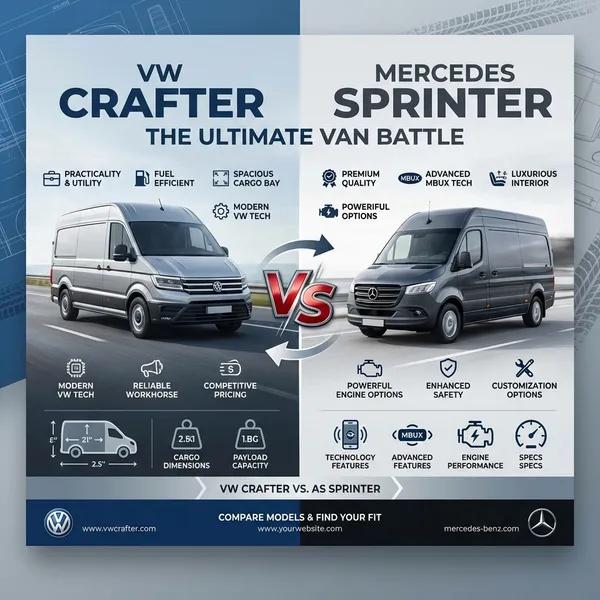
VW Crafter vs Mercedes Sprinter
VW Crafter vs. Competitors: Stack Up?
The commercial van market is fiercely competitive, with manufacturers constantly striving to deliver vehicles that meet the evolving needs of businesses. Among the top contenders in this segment, the VW Crafter and Mercedes Sprinter have long been rivals, each offering unique features and capabilities. This comparison aims to shed light on how the VW Crafter stacks up against its competitors, particularly the Mercedes Sprinter, in terms of performance, design, and functionality For our full verdict, see which is better: Sprinter or Crafter.. Source
In this comprehensive review, we’ll examine the VW Crafter’s exterior styling, interior comfort, engine efficiency, cargo capacity, and technology features. See a VW Crafter interior here. We’ll also look at the latest models, including the new VW Crafter 2024, and compare them to previous versions like the 2020 VW Crafter and 2018 VW Crafter. By analyzing these aspects, we’ll provide a clear picture of where the Volkswagen Crafter stands in the competitive landscape of commercial vans. See all our VW Crafter vans for sale.
Exterior Design and Styling
The exterior design and styling of commercial vans play a crucial role in representing businesses and making a lasting impression. In this competitive market, the VW Crafter lease and its rivals each bring their unique esthetic appeal to the table.
Key Differences Between Crafter and Sprinter
The second-generation Volkswagen Crafter, launched in 2016 and available in the UK from 2017, stands out as a completely new design from the ground up. Unlike its predecessor, which shared similarities with the Mercedes-Benz Sprinter, this Crafter is entirely Volkswagen’s own work. It’s assembled in a brand-new VW Commercial Vehicles factory in Poland, showcasing the company’s commitment to innovation and quality.
The Crafter’s exterior design is characterized by its crisp, professional appearance. It features a neat, razor-like front grille topped with a chrome flourish, giving it a premium look. The van’s overall design philosophy embraces unashamedly square lines, resulting in a smart and professional esthetic. This approach to styling makes the Crafter look like a sharply pressed suit, projecting an image of efficiency and reliability.
Competitor Exteriors
When comparing the Crafter to its main competitor, the Mercedes Sprinter, some notable differences emerge. The new Sprinter model, released after the Crafter’s launch, has taken a different design direction. It features a more rounded and bulbous appearance, adopting a similar design to its predecessor but with modernized elements.
The Sprinter’s exterior is characterized by rounded edges and a face designed to mimic other contemporary Mercedes models, such as the GLE. This design choice gives the Sprinter a softer, more amorphous look. While the large three-pointed star on the grille undoubtedly projects prestige, some might find the overall styling a bit flabby for a large van.
Another competitor worth mentioning is the Ford Transit Trail. It stands out with its aggressive look, featuring a Raptor-style grille that appeals to those seeking an adventure-ready appearance in their commercial van.
Design Comparison
When comparing the VW Crafter and Mercedes Sprinter side by side, the Crafter emerges as the more restrained and professional-looking option. Its sharp lines and squared-off design give it a no-nonsense, business-oriented appearance. On the other hand, the Sprinter’s pronounced nose and rounded edges have drawn comparisons to a Beluga whale, which may not appeal to all tastes.
While the Mercedes brand carries significant prestige, Volkswagen has positioned itself as an up-and-coming, classless alternative. The Crafter’s design reflects this ethos, offering a smart and professional look that can appeal to a wide range of businesses.
In terms of overall esthetic appeal, many observers consider the Crafter to be the better-looking of the two German vans. Its crisp lines and well-defined features create a more cohesive and purposeful appearance. However, it’s worth noting that the Sprinter’s imposing Mercedes corporate face does lend it some added pedigree, which may be important for certain businesses.
Ultimately, the choice between the VW Crafter and its competitors in terms of exterior design will depend on the image a business wants to project. The Crafter offers a clean, professional look that can suit a wide range of industries, while the Sprinter relies more heavily on brand prestige. Other options like the Ford Transit Trail cater to those seeking a more rugged, adventure-ready appearance.
Interior Comfort and Features
VW Crafter Interior VW Crafter vs Mercedes Sprinter Comparison UK
The VW Crafter’s interior has been designed with a clear focus on reducing driver stress and enhancing ergonomics. The cab area stands out as one of the best in its class, featuring first-class build quality and durable materials that maintain a premium feel. The dashboard layout is clean and intuitive, with major controls accessed through chunky dials and large, easy-to-use buttons.
One of the Crafter’s standout features is its abundance of storage options. The interior boasts three open areas above the dashboard, two cupholders, and a horizontally split dashboard with cup-sized storage sections for both driver and passenger. Door compartments are divided into three segments, with the largest central section capable of holding folders or water bottles. Additional storage includes under-seat compartments, overhead shelves, and a decent-sized glovebox.
The driving position offers excellent adjustability, with four seat back positions and ample seat base travel to accommodate drivers of various heights. The steering wheel also provides substantial reach adjustment. For enhanced comfort, Volkswagen offers an optional ergoComfort seat with 14 different position settings and a shock cushioning system, making long journeys more comfortable.
The infotainment system in the Crafter is user-friendly and responsive. The screen is crisp and easily readable, even in bright light conditions. Entry-level Startline trim includes a 5-inch infotainment screen with Bluetooth and USB connectivity, while the Trendline trim upgrades to a 6.5-inch system with Apple CarPlay and Android Auto smartphone mirroring.
Competitor Interiors
In comparison, the Mercedes Sprinter takes a different approach to interior design. The Sprinter’s cabin aims for a wow factor, featuring the latest MBUX touchscreen infotainment system as standard. Its dashboard has a more swooping, less van-like design, with several parts shared directly with Mercedes passenger cars, creating a premium feel.
However, while the Sprinter’s interior looks impressive at first glance, closer inspection reveals that the Crafter offers higher overall build quality and more thoughtful design. The Sprinter’s interior is more customizable, allowing users to add or remove cubbies and cupholders as needed, but it generally provides fewer practical storage spaces compared to the Crafter.
Interior Comparison VW Crafter vs Mercedes Sprinter
When comparing the two interiors, the VW Crafter interior emerges as the more practical and well-thought-out option. Its design is inspired by discussions with working professionals during the development process, resulting in functional clarity and maximum storage. The Crafter’s interior works better as a van, with features like the full-width dashboard shelf becoming surprisingly indispensable.
In terms of seating comfort, both vans offer excellent, highly adjustable driving positions. While the Crafter’s seats are very good, the Sprinter’s seats and Mercedes Sprinter interior are exceptional, offering even more areas of adjustment and comfortable contouring. However, the Sprinter’s seats are unusually figure-hugging for a van, which may not suit all body types.
The Crafter’s interior can be described as simplistic, restrained, and free of distractions, reminiscent of a Dieter Rams creation. Its controls are chunky, sensibly spaced, and easy to operate. In contrast, the Sprinter’s interior is more tech-focused, dominated by the MBUX infotainment system. While this brings the Sprinter up to date with modern automotive technology, it can be fiddly to use while driving.
Ultimately, the choice between the VW Crafter and its competitors in terms of interior comfort and features will depend on individual priorities. The Crafter offers a more practical, storage-rich environment with high build quality, while the Sprinter provides a more premium feel with advanced technology integration.
Engine Performance and Efficiency
VW Crafter Engines
The Volkswagen Crafter engine offers a range of 2.0-liter TDI turbodiesel engines to suit various needs. These engines come in four power outputs:
- 102hp / 300Nm single-turbo
- 122hp / 300Nm single-turbo
- 140hp / 340Nm single-turbo
- 177hp / 410Nm twin-turbo
It’s worth noting that not all engine options are available for every body size and drivetrain layout. The 122hp version is exclusive to rear-wheel drive CR50 (5.0-ton gross vehicle weight) variants with twin rear wheels, while the 102hp engine is limited to front-wheel drive models.
Initial impressions of the Crafter’s engine range were mixed. During testing on mountain roads in Spain, the 140hp versions required significant effort, and even the more powerful 177hp variant sounded reedy and coarse under load. However, with extended use, the 140hp model has shown improvement. After covering about 1,000 miles, engine noise reduces, and smoothness increases.
The Crafter’s fuel efficiency is somewhat disappointing when compared to other large vans. Its maximum claimed fuel economy is 38.2mpg, which puts it near the bottom of the table for large van mpg on paper. This figure applies to both the 102hp and 140hp variants. In real-world conditions, a long-term test of an early-build (2017) 140hp model averaged 33mpg over 7,000 miles, which is considered reasonably good for a van of this size.
Competitor Engines
When looking at competitors, the Mercedes Sprinter stands out with its engine lineup. The Sprinter is equipped with 2.1-liter and 3.0-liter engines, offering a slightly larger displacement compared to the Crafter’s 2.0-liter units. Both vans provide automatic and manual transmission options, as well as front-wheel and rear-wheel drive configurations.
Performance Comparison VW Crafter vs Mercedes Sprinter
To compare the engine performance and efficiency of the Volkswagen Crafter to its competitors, it’s crucial to consider factors such as horsepower, torque, fuel consumption, and emissions. These metrics help determine the best engine option for specific applications, whether it’s heavy-duty hauling, long-distance deliveries, or urban driving.
The Crafter’s engine lineup provides a good balance of power and efficiency. The twin-turbo 177hp variant, producing 410Nm of torque, offers strong performance for heavier loads and towing. However, it’s important to choose the right engine for the van’s workload. The 100hp unit is suitable for light-duty work, while the 138hp option can handle a 500kg payload even on challenging inclines.
One advantage of the Crafter is its energy recuperation system. Although not a hybrid setup, the vehicle’s alternator generates electricity during braking and stores it in the batteries for later use. This feature, combined with the standard stop-start system, helps improve overall efficiency.
In terms of real-world fuel consumption, a test drive of the Crafter, including a mix of winding roads and freeway driving, resulted in an average of 9-10 liters per 100km. With its 75-liter fuel tank, this translates to an estimated range of around 700km. However, it’s important to factor in the cost of AdBlue, which the Crafter’s engine requires.
While the Crafter’s fuel efficiency might not lead the pack on paper, its real-world performance and the balance between power and economy make it a competitive option in the commercial van market. The choice between the Crafter and its competitors will ultimately depend on specific business needs, driving conditions, and the importance placed on factors like fuel efficiency, power, and overall performance.
Cargo Capacity and Payload
VW Crafter Payload Capacity
The Volkswagen Crafter stands out as the largest van in the VW Commercial Vehicle range, offering impressive load volumes ranging from 9.9 to 18.4 cubic meters. This versatility makes it suitable for a wide array of business needs.
The Crafter comes in various configurations:
- Medium Wheelbase (MWB):
- Length: 5,986mm
- Load bed length: 3,450mm
- Low roof height: 1,726mm (9.9 cubic meters)
- High roof height: 1,861mm (10.7 cubic meters)
- Long Wheelbase (LWB):
- Length: 6,836mm
- Load bed length: 4,300mm
- High roof: 1,961mm (14.4 cubic meters)
- Super high roof: 2,189mm (16.1 cubic meters)
- Maxi:
- Length: 7,391mm
- Load bed length: 4,855mm
- High roof: 16.4 cubic meters
- Super high roof: 18.4 cubic meters
From a practical standpoint, the shorter wheelbase can accommodate two Euro pallets, while the ‘Maxi’ version can handle three.
Competitor Capacities VW Crafter vs Mercedes Sprinter
When comparing the VW Crafter to its competitors, it’s essential to consider the broader light commercial vehicle market. This market includes pick-up trucks, commercial 4x4s, and vans of various sizes, all weighing up to 3.5 tons.
Vans in this category often feature:
- Taller roofs
- Reconfigurable seats
- Flat floors
- Sliding doors for rear entry
These features contribute to maximizing internal space, making the vehicles feel more comfortable and spacious. Most vans in this class can comfortably accommodate 15 passengers without luggage.
In the light commercial vehicle market, vans weighing between 2.5 and 3.5 tons continue to dominate, accounting for nearly two-thirds (65.8%) of new registrations. Vans between two and 2.5 tons make up about a quarter (24.9%) of the market.
Capacity Comparison VW Crafter vs Mercedes Sprinter
When comparing the VW Crafter’s cargo capacity and payload to its main competitor, the Mercedes Sprinter, we see some interesting differences:
- VW Crafter:
- Load volumes: 9.9 to 18.4 cubic meters
- Payload capacity: Varies by model
- Mercedes Sprinter:
- Cargo capacity: Up to 319.1 cubic feet (approximately 9 cubic meters)
- Payload capacity: Up to 3,501 pounds (approximately 1,588 kg)
It’s important to note that these figures can vary depending on the specific model and configuration chosen.
The choice between front-wheel drive (FWD), rear-wheel drive (RWD), and four-wheel drive (4Motion) also impacts payload capacity:
- FWD: Lightest configuration, helping with payload and fuel efficiency. The load area floor is 100mm lower than alternatives, making it easier for operators.
- RWD: Good for loaded traction but less efficient and heavier, adding around 100kg to the weight of an equivalent FWD model.
- 4Motion (4WD): Based on FWD models but adds about 150kg, reducing available payload. Suitable for low-grip situations and modest off-road work.
When selecting a van, businesses should consider their specific needs, including required load volume, payload capacity, and driving conditions. The VW Crafter’s range of configurations allows for customization to meet various commercial requirements, from urban deliveries to long-haul transport.
Technology and Safety Features
VW Crafter Tech
The Volkswagen Crafter stands out as a leader in commercial van technology and safety features. It offers a comprehensive suite of advanced systems designed to enhance driver safety, convenience, and overall efficiency. One of the most notable features is the autonomous emergency braking (AEB) system, which VW made standard across its entire van range in 2017. This system works at speeds up to 60km/h, automatically applying the brakes to help avoid or mitigate collisions.
The Crafter also boasts an impressive array of driver assistance technologies. These include Adaptive Cruise Control, which automatically adjusts the vehicle’s speed to maintain a safe distance from the car in front, and Lane Keeping Assist, which uses cameras to detect lane markings and gently steers the vehicle back into the lane if it starts to drift unintentionally. The Blind Spot Monitoring system provides visual warnings to the driver when vehicles are detected in the Crafter’s blind spots, making lane changes and merging safer.
For improved maneuverability, the Crafter offers a Rear View Camera and Park Assist system. The high-resolution camera provides a clear view of the area behind the van, while the Park Assist function can automatically steer the vehicle into both perpendicular and parallel parking spaces. The driver only needs to control the pedals and gear selection.
A standout feature of the Crafter is its Trailer Assist system, which allows drivers to reverse with a trailer using the electric mirror adjustment knob rather than the steering wheel. This innovative technology makes maneuvering with a trailer significantly easier and more precise.
Competitor Tech VW Crafter vs Mercedes Sprinter
When comparing the Crafter to its main competitor, the Mercedes Sprinter, we see some similarities and differences in technology offerings. The Sprinter matches many of the Crafter’s features but lacks the trailer assist and side protection functions. However, it does come standard with 4G internet connectivity and an advanced infotainment system called MBUX (Mercedes-Benz User Experience).
The MBUX system in the Sprinter allows for voice-activated controls, activated by saying “Hey Mercedes.” This feature enables drivers to perform various functions hands-free, such as dictating text messages, setting navigation destinations, and changing radio stations. The system also offers personalization features and connectivity options that the Crafter currently doesn’t match.
Another advantage of the Sprinter is its built-in telematics capability, which works with Mercedes’ own fleet management software, Mercedes Pro Connect. This allows for direct-to-van job instructions and satellite navigation re-routing controlled by the fleet management system.
Tech Comparison VW Crafter vs Mercedes Sprinter
While both vans offer impressive technology suites, they cater to slightly different needs. The Crafter excels in practical safety features and driver assistance systems, with standout offerings like the Trailer Assist and Side Protection systems. Its focus seems to be on enhancing the driving experience and safety in various conditions.
The Sprinter, on the other hand, leans more towards connectivity and fleet management capabilities. Its MBUX system and built-in telematics make it particularly attractive for businesses looking for advanced fleet management tools and driver communication features.
Both vans offer essential safety features such as Electronic Stability Control, Hill Start Assist, and multiple airbags for front passengers. However, it’s worth noting that in camper van conversions like the Crafter-based Kampervan, rear passengers may not have access to side-curtain airbags due to the vehicle’s commercial origins.
Looking to the future, Volkswagen has announced significant upgrades for the Crafter starting from April 2024. These include a new Digital Cockpit instrument display, larger infotainment screens (up to 12.9 inches), and an improved voice control system. New driver assistance systems will also be introduced, such as a blind spot information system for pedestrians and cyclists at low speeds, and a ‘moving-off information system’ for models over 3.5 tons.
In conclusion, both the VW Crafter and its competitors offer a range of advanced technologies, with each having its strengths. The choice between them will largely depend on specific business needs, whether that’s advanced safety features, connectivity, or fleet management capabilities.
Conclusion
The VW Crafter lease has proven to be a strong contender in the commercial van market, offering a blend of practical design, robust performance, and advanced safety features. Its emphasis on driver comfort, ample storage options, and versatile cargo capacity gives it an edge in many areas. The Crafter’s range of engine options and drivetrain configurations allows businesses to tailor the vehicle to their specific needs, while its technology suite enhances safety and ease of use on the road.
When compared to rivals like the Mercedes Sprinter, the Crafter holds its own, often excelling in areas such as exterior design and interior practicality. While each van has its strengths, the Crafter’s focus on functional clarity and thoughtful design makes it a compelling choice for many businesses. As Volkswagen continues to upgrade the Crafter with new features and technologies, it’s likely to maintain its strong position in the competitive commercial van market.
FAQs VW Crafter vs Mercedes Sprinter
What are some of the main competitors to the VW Crafter?
The primary competitors of the VW Crafter include the TGE and Sprinter. Other notable rivals are the Ford Transit, Citroen Relay, Peugeot Boxer, Fiat Ducato, Renault Master, and Vauxhall Movano.
Between the Sprinter and the Crafter, which one is superior?
On the road, the Sprinter generally performs better due to its more powerful engines and greater low-end torque, with maximum torque kicking in 400rpm earlier on mid-level engines. However, the Volkswagen DSG automatic transmission is noted for its superior smoothness and refinement.
How dependable are VW Crafter vans?
VW Crafter vans are generally considered reliable. While there are a few issues to be aware of, they typically maintain a good reputation for reliability, consistent with other Volkswagen vans.
What is the quality of the VW Crafter’s cab area?
The cab area of the VW Crafter is regarded as one of the best among panel vans and the rear racking the most organised. It features high-quality build and durable materials that still manage to convey a sense of luxury. The switchgear used is similar to that found in the T6 Transporter and Volkswagen’s passenger cars, enhancing the overall feel of the cabin.