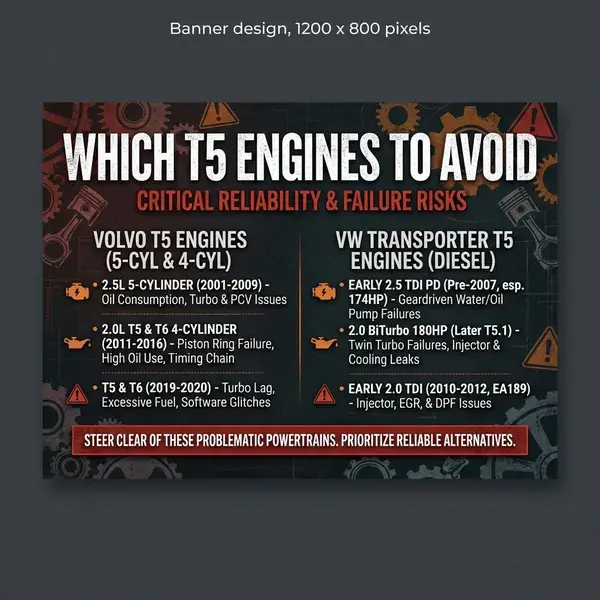
Which T5 Engines To Avoid Buyer Guide
Which T5 Engines To Avoid
Which T5 engines should you avoid? Some VW T5 Transporter engines have a well-documented reliability problem, others don’t. From the notorious 2.5-litre TDI to the more dependable alternatives, knowing which is which affects your van’s performance, running costs and longevity. Our aim is to give you a clear, mechanic’s-eye picture of VW T5 common faults, so you know exactly which engine you’re dealing with before it costs you a repair bill.
The Problematic 2.5-litre TDI Engine
Which T5 Engines To Avoid? The 2.5-litre TDI engine, while popular for its power and flexibility, has gained a reputation for being problematic in the VW T5 Transporter. We’ll delve into the common issues, maintenance challenges, and the balance between performance and reliability. See all VW Van Lease deals
T5 Engine Reliability Issues Explained
One of the most frequent problems with this engine is related to the turbocharger and diesel particulate philtre (DPF). The DPF can become clogged, leading to excessive soot build-up and potential damage. A faulty exhaust gas pressure sensor can trigger false DPF regeneration requests, causing unnecessary concern and expense 1. See all VW vans
Injector problems are another common issue. Due to the high fuel pressure in the 2.5 TDI, injectors can degrade over time, resulting in power hesitancy, flat spots, misfiring, or starting troubles 2. You might even notice increased fuel consumption due to a bad injector. See all VW Vans for sale
The exhaust manifold is prone to cracking, caused by the repeated heating and cooling cycles. This can lead to performance issues and increased emissions .
Maintenance Challenges Which T5 Engines To Avoid
Maintaining the 2.5-litre TDI engine can be challenging due to its complex design. The cam followers and cam lobes are prone to wear, which can degrade engine performance if not addressed promptly . Regular oil changes with the correct specification oil are crucial to mitigate this wear.
The Exhaust Gas Recirculation (EGR) system is another area requiring attention. It can become clogged with soot, particularly if the engine isn’t burning fuel cleanly. A blocked EGR system can trigger the engine management light and increase emissions .
Water pump failures are not uncommon. The seal can degrade, allowing water to mix with oil, which can cause significant engine damage if left unchecked . Regular inspections and timely replacements are essential to prevent this issue.
Performance vs Reliability
The 2.5-litre TDI engine offers impressive performance, with decent power and flexibility well-suited to the T5’s design 5. However, this performance comes at the cost of reliability in some cases.
The dual-mass flywheel, which helps dampen engine vibrations, is a common wear item. It takes a beating, especially with frequent clutch use in stop-start traffic 6. Similarly, the driveshaft can suffer from wear on its metal splines, leading to metallic noises and potential failure 7.
To improve reliability without sacrificing performance, regular maintenance is key. Long journeys that allow the engine to reach operating temperature are beneficial, as short trips can lead to various issues 8. Ensuring the engine is properly warmed up before shutting it off can also help prevent problems.
Despite these challenges, many T5 owners report high mileages with proper care. Some vans have reached 250,000 miles before requiring an engine overhaul, demonstrating that with diligent maintenance, the 2.5-litre TDI can be a long-lasting powerplant .
In conclusion, while the 2.5-litre TDI engine offers strong performance, it requires careful maintenance to ensure reliability. Prospective buyers should weigh the power and torque benefits against the potential for costly repairs. Regular servicing, using the correct oil, and addressing issues promptly can help mitigate many of the common problems associated with this engine.
1.9-litre TDI: A Reliable Alternative Which T5 Engines To Avoid
When it comes to VW T5 engines to avoid, the 1.9-litre TDI stands out as a dependable choice. This powerplant has gained a reputation for being a workhorse, offering a balance of performance and longevity that many T5 owners appreciate. Let’s delve into why this engine is often considered a more reliable alternative to its larger counterpart.
Advantages Over 2.5-litre
The 1.9-litre TDI engine has several advantages over the 2.5-litre variant. Firstly, it’s known for its simplicity and ease of maintenance. This translates to lower repair costs and fewer headaches for owners. Many VW mechanics prefer working on the 1.9 TDI due to its straightforward design and readily available parts 1.
In terms of fuel efficiency, the 1.9 TDI often outperforms its larger sibling. Some owners report achieving impressive fuel economy figures, with one user mentioning 6.5-7 litres per 100km on a tank 2. This makes it an attractive option for those looking to keep running costs down.
While the stock 1.9 TDI might not match the power output of the 2.5-litre engine, it’s worth noting that it’s capable of handling most everyday tasks with ease. Many T5 owners find that the 1.9 TDI provides sufficient power for camping, surfing, and mountain biking trips without the need for towing or carrying heavy loads .
Potential Upgrades Which T5 Engines To Avoid
Which T5 Engines To Avoid? One of the exciting aspects of the 1.9 TDI is its potential for upgrades. Many T5 enthusiasts have successfully increased the engine’s performance through various modifications. A popular upgrade is remapping the ECU, which can significantly boost power output.
For instance, one owner reported having their van remapped from 88 to 136 bhp, noting improved driveability and even better fuel economy . Another user mentioned the possibility of achieving around 130 PS through remapping without any hardware changes .
For those seeking more substantial power gains, turbo upgrades are an option. Some enthusiasts have replaced the stock turbo with units from other VW Group vehicles, such as the Audi A6 1.9 TDI AWX engine. However, it’s important to note that while power increases of up to 170 bhp are possible, they often require additional modifications like upgraded injectors .
Long-term Durability
The 1.9 TDI engine has earned a reputation for long-term durability. Many T5 owners report high mileages with proper care, with some vans reaching well over 200,000 miles 5. This longevity is often attributed to the engine’s robust design and lower stress levels compared to the 2.5-litre variant.
Regular maintenance is key to ensuring the 1.9 TDI’s longevity. Oil changes at prescribed intervals using the correct VW 504 / 507 approved TDI oil are crucial 6. Additionally, the timing belt needs to be changed every 60,000 miles or immediately if there’s no record of when it was last replaced 7.
One potential drawback of the 1.9 TDI compared to the 2.5-litre engine is the presence of a timing belt instead of a timing chain. While this means more frequent replacements, many owners find that the overall lower maintenance costs of the 1.9 TDI offset this factor 8.
In conclusion, the 1.9-litre TDI engine in the VW T5 Transporter offers a compelling alternative to the larger 2.5-litre variant. Its combination of reliability, fuel efficiency, and upgrade potential makes it a favourite among many T5 enthusiasts. While it may not match the raw power of the 2.5-litre engine out of the box, its long-term durability and lower maintenance costs make it an attractive option for those looking to avoid common VW T5 engine problems.
Petrol Engines: The Least Popular Choice
When it comes to VW T5 engines to avoid, petrol engines are often overlooked, as they’re the least popular choice among Transporter owners. However, they deserve consideration, especially given the changing landscape of vehicle regulations and environmental concerns.
Fuel Efficiency Concerns
One of the main reasons petrol engines are less favoured in the T5 is their fuel efficiency. Compared to their diesel counterparts, petrol engines generally consume more fuel, which has an impact on running costs. In our tests, we found that a petrol T5 averaged around 28 mpg over 200 miles of mixed driving 1. This figure is significantly lower than what you’d expect from a diesel variant.
The fuel economy difference becomes even more apparent when we look at the long-term costs. For an operator, a petrol T5 can cost between 5p and 6p per mile more in fuel expenses 1. Over time, this quickly wipes out any initial savings on the purchase price, making petrol engines a less economical choice for many T5 owners.
However, it’s worth noting that there are ways to improve fuel efficiency in petrol T5s. Removing excess weight when not needed, regularly servicing the van, and using the correct tyre size can all help to boost mpg 2. Some owners have reported achieving mid-30s mpg with careful driving and proper maintenance .
Limited Power Output Which T5 Engines To Avoid
Another factor that makes petrol engines less popular in the T5 is their limited power output compared to diesel alternatives. The standard 2.0-litre petrol engine in the T5 produces 116 PS (85 kW; 114 hp) and 170 N⋅m (125 lb⋅ft) of torque . While this might be sufficient for some users, it falls short of the power offered by many diesel options, especially when the van is fully loaded or used for towing.
However, it’s not all bad news for petrol enthusiasts. Volkswagen has introduced turbocharged petrol engines in later models, which offer improved performance. For instance, the 2.0 TSI engine comes in two variants: one producing 149 PS (110 kW; 147 hp) and another offering 204 PS (150 kW; 201 hp) . These turbocharged options provide a more compelling alternative for those who prefer petrol engines but still want decent power.
It’s also worth mentioning that some T5 owners have successfully increased their engine’s performance through remapping and other modifications. While this approach isn’t for everyone, it does show that there’s potential to enhance the power output of petrol T5 engines.
Availability and Parts Which T5 Engines To Avoid
When it comes to availability and parts, petrol T5s can be a bit of a mixed bag. On one hand, Volkswagen was the first manufacturer to introduce a petrol engine to its medium-size panel van, giving operators an affordable alternative to diesel 1. This means that petrol T5s are available, albeit in smaller numbers compared to their diesel counterparts.
However, the lower popularity of petrol T5s can sometimes make finding specific parts more challenging. As these vans age, parts outside of specialist circles may become trickier to source . This is something to consider if you’re looking at a petrol T5 as a long-term investment.
On the flip side, petrol engines are often simpler in design compared to modern diesel engines, which can make maintenance and repairs more straightforward. They don’t have components like diesel particulate philtres or complex turbocharging systems that are common sources of problems in diesel T5s.
It’s also worth noting that as environmental regulations tighten, particularly in urban areas, petrol engines might become more attractive. They generally produce fewer particulate emissions compared to diesel engines, which could be advantageous in the future .
In conclusion, while petrol engines in the VW T5 are the least popular choice, they shouldn’t be dismissed outright. They offer a viable alternative for those concerned about potential diesel restrictions or those who prefer the characteristics of petrol engines. However, prospective buyers should carefully consider the trade-offs in terms of fuel efficiency and power output before making a decision.
Conclusion Which T5 Engines To Avoid
Choosing the right engine for a VW T5 Transporter has a big impact on its performance and longevity. The 2.5-litre TDI, while powerful, comes with its share of issues, including turbocharger problems and DPF troubles. On the flip side, the 1.9-litre TDI stands out as a more reliable option, offering a good balance of efficiency and durability. Petrol engines, though less popular, might be worth a look for those worried about future diesel restrictions.
In the end, each engine type has its pros and cons. The key is to weigh these carefully against your specific needs and driving habits. Regular maintenance is crucial no matter which engine you choose. By understanding these common VW T5 engine problems, you’ll be better equipped to make a smart choice and keep your Transporter running smoothly for years to come.
FAQs Which T5 Engines To Avoid
Which T5 engine should I steer clear of?
180 Bi Turbo
It is widely recommended on specialised forums to avoid the 2.5-litre engines and opt for the 1.9-litre diesel variant instead, as it is considered more reliable.
What are the typical problems with the VW Transporter T5?
Common issues with the VW Transporter T5 include faults with the flywheel, EGR valve, water pump, leaking windows, rust, driveshaft, steering column, and the ABS warning light.
Which VW engines are advised to be avoided according to forums?
It is generally advised to avoid all 2.0 PD VAG engines. The 1.9 PD or 2.0 CR engines are acceptable alternatives. The smaller 1.4-1.6 TDI engines, while economical, tend to lack power, overtaking ability, refinement, and longevity compared to the larger engines.
References
[1] – https://www.breakerlink.com/blog/buying-selling/what-are-the-most-common-problems-with-a-volkswagen-transporter-t5-van/
[2] – https://www.youtube.com/watch?v=4p0-AiSqmNk
[3] – https://www.t6forum.com/threads/has-a-t5-1-got-more-engine-problems-than-any-other-transporter.47577/
[4] – https://haynes.com/en-gb/tips-tutorials/volkswagen-transporter-t5-common-problems
[5] – https://www.volkswagenforum.co.uk/threads/vw-t5-engines-choice-which-is-best-and-which-to-avoid.32114/
[6] – https://www.vwt4forum.co.uk/threads/t5-engine-problems.1158537/
[7] – https://www.veedubtransporters.co.uk/2023/02/15/what-is-the-best-and-most-reliable-vw-t5-t6-transporter-engine/
[8] – https://www.singletrackworld.com/forum/topic/vw-t5-engines-which-one/
Looking to buy rather than diagnose? Browse in-stock, inspected VW Transporters from Swiss Vans.
View VW Transporters for sale →